Jesus consigning the keys to St. Peter, G. Battista Cassignola, 1569
Homily for the Twenty-first Sunday in Ordinary Time (Year A).
It’s hard to imagine a better Gospel reading with which to end an Ignatian retreat. We find this episode at the middle point of Matthew’s Gospel, and the question that Jesus poses to his disciples is the hinge on which everything else turns: “Who do you say that I am?”
We have heard the episode before, so perhaps we don’t register what a strange question Jesus asks. When I test my students at the end of the semester, I ask them about the content of the course, not about my own identity. But Jesus asks about himself, not his message. Were he any other teacher, such a question would be pure arrogance. But Jesus is not like anyone else, and everything depends upon our recognizing the difference.
Public opinion, as the disciples tell it, seeks to put Jesus into a recognizable category; he is one of the prophets, like Elijah or Jeremiah. Perhaps he is the reincarnation of John the Baptist. But Jesus does not let such answers go, and the disciples themselves have been with him long enough that they are not satisfied with such an answer, either. There is a right and a wrong answer to the question Jesus asks. It is not a matter of opinion. Jesus is not administering a Rorschach test to prompt the disciples to look more deeply into themselves. The question is not what is inside, but who is standing here before you.
Homily for the twentieth Sunday of Ordinary Time (Year A).
Christ and the Samaritan Woman at the Well, Annibale Carracci, 1604-5
When I teach my introduction to the sacraments course in Rome, at the end of every sacrament I assign one question and ask my students to write a one-page response. I try come up with unusual questions to keep them on their toes—and to keep myself entertained when I’m grading. This year’s question for the sacrament of marriage was: “Can you marry a chatbot?” Chatbots are essentially AI characters that you can have conversations with; over the past couple of years stories have appeared in the media about people—usually women—becoming emotionally attached to the chatbots they create, to the point where some felt like they had gone through a breakup with a boyfriend when the AI programs they used were discontinued.
There’s not always a right or wrong answer to my questions, but in this case, you will be happy to know that all of my students responded, “No. You cannot marry a chatbot.” And they all passed. There are lots of reasons you can’t marry a chatbot; for one thing, they aren’t actually human, and they don’t have bodies. What a number of my students pointed out, which I found particularly insightful, is that chatbots are designed to give us the answers that we want. An AI program doesn’t have emotions or needs of its own, and it is designed to keep us happy so that we keep using it. This feature is what makes chatbots seem like the perfect boyfriend. The chatbot is programed to always tell you exactly what you want to hear. It never gets impatient. If you wake up at three AM, the chatbot is happy to talk and doesn’t have to go to work in the morning. It feels like the chatbot really understands you because it’s a product of your own design.
My students were right to recognize that conversing with a chatbot is not a real relationship. A relationship means interacting with someone else—someone who is different. Our differences make relationships hard at times, but they are necessary for us to grow. Relationships challenge us to grow because sometimes we don’t get the answer that we want from the other person, and then we have to learn how to respond. This is why marriage is always dynamic, always in progress. In marriage, the fact that men and women are different—physically, emotionally, socially—is what makes the relationship fruitful; the biological difference is necessary for our species to survive.
So why am I bringing up chatbot romance to explain this Sunday’s readings? The reason is because Jesus’ behavior in today’s Gospel story is definitely not what you would expect from a well-programmed chatbot. What Jesus says and does doesn’t quite make sense to anybody. Even for us, reading the Gospel at some distance, his response is jarring because it seems to put a woman seeking help from him in greater difficulty. She comes to him not for anything selfish, but asking for her daughter’s healing. We feel natural sympathy for her, but Jesus, at first, ignores her. An AI boyfriend would never do that.
Homily for the Nineteenth Sunday in Ordinary Time (Year A)
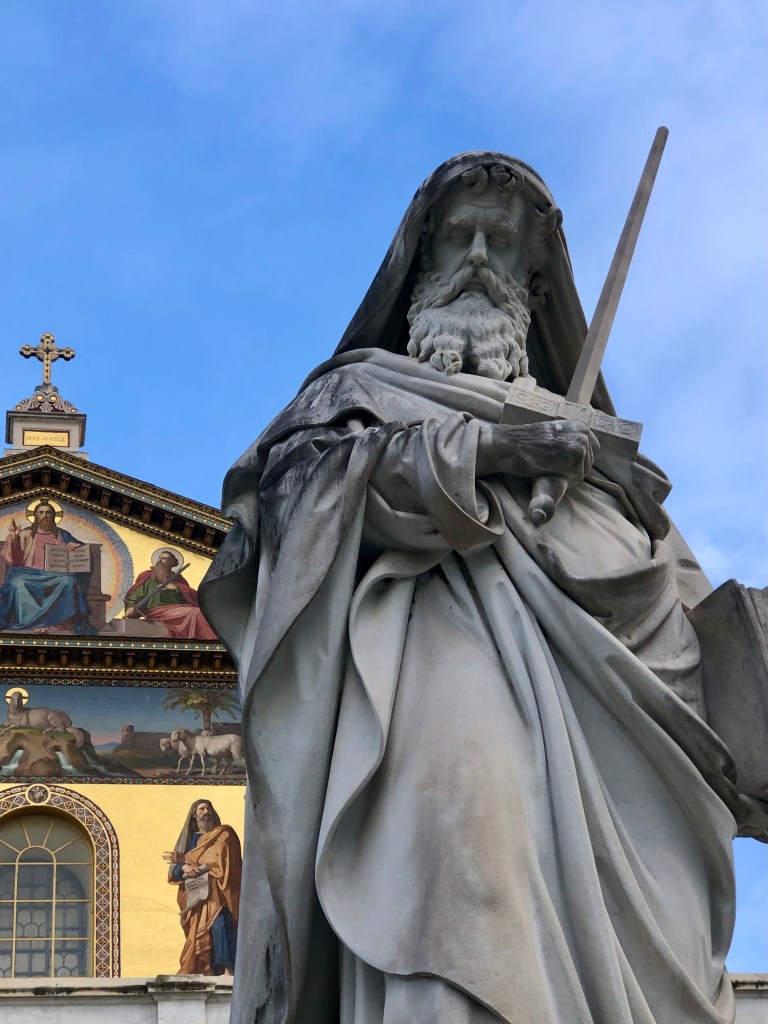
Basilica of St. Paul Outside the Walls, Rome
Today’s marvelous Gospel story of Jesus walking across a stormy sea shows us how faith grows from fear to true understanding. The disciples move from a superstitious worldview, imagining that the Lord is a ghost, to true faith, confessing to Jesus, “Truly, you are the Son of God.” But since the same reading came up at daily Mass earlier this week and some of you already heard what I had to say about it, I thought today I would step out onto a different kind of stormy sea: the second reading, taken from St. Paul’s Letter to the Romans. The reason this particular passage from Romans means walking on turbulent waters is because it deals with St. Paul’s attitude toward his own people, the Jews. It has implications, therefore, for what attitude Christians should take toward the Jewish people today.
I decided to risk stepping out onto such waters this morning because over the past several years we have seen a sharp rise in anti-Semitic rhetoric and an increase in violence directed against Jews. In March, a synagogue in West Bloomfield, Michigan was attacked and, soon after, the FBI thwarted a plot to firebomb synagogues in New York, Los Angeles, and Scottsdale, Arizona. The situation in Europe is worse, and it should disturb anyone of good sense and good will that in the wake of Hamas’s attack on Israel in October 2023—which included murder, rape, and hostage-taking—anti-Semitic rhetoric in the West increased.
Homily for the Eighteenth Sunday in Ordinary Time (Year A).
Sacristy of San Marco, Rome
We don’t know much about how the Gospels were written. Matthew, Mark, Luke, and John didn’t leave dustjacket biographies, like you see on book covers, because the point of writing a Gospel is to put the focus on Jesus and not on oneself. But we can tell a few things about the lives of the earliest Christians indirectly from what they wrote. One thing we know, for example, is that before even a word of the New Testament was written, the earliest Christians were already celebrating the sacraments. When you remember this, you begin to notice that symbols referring to the sacraments are all over the New Testament—especially baptism and the Eucharist, the two pillars of Christian life. Today’s Gospel passage, for example, begins with a reference to John the Baptist and ends with miraculous loaves of bread, an obvious symbol of the Eucharist.
The message of the Gospel writers is clear: when we celebrate the sacraments we are coming into contact with the ministry of Jesus. Today’s Gospel passage begins with news about John the Baptist—the tragic news that John had been killed by King Herod. Herod, if you remember, didn’t like the fact that John had accused him of living in an immoral marriage. Herod’s wife Herodias liked it even less and maneuvered to have John beheaded. Reading between the lines in today’s Gospel, it seems that Jesus felt wounded by the news of his cousin John’s execution and withdrew by boat to “a deserted place” to pray and mourn. Jesus, perhaps, also felt some premonition of his own Passion.



 Tony Lusvardi, S.J.