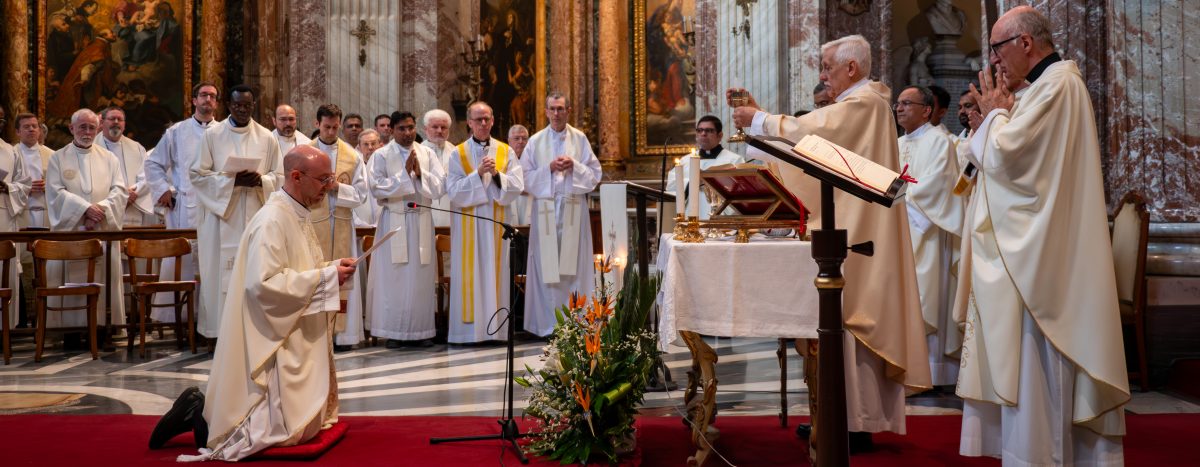
Homily for the twentieth Sunday of Ordinary Time (Year A).

When I teach my introduction to the sacraments course in Rome, at the end of every sacrament I assign one question and ask my students to write a one-page response. I try come up with unusual questions to keep them on their toes—and to keep myself entertained when I’m grading. This year’s question for the sacrament of marriage was: “Can you marry a chatbot?” Chatbots are essentially AI characters that you can have conversations with; over the past couple of years stories have appeared in the media about people—usually women—becoming emotionally attached to the chatbots they create, to the point where some felt like they had gone through a breakup with a boyfriend when the AI programs they used were discontinued.
There’s not always a right or wrong answer to my questions, but in this case, you will be happy to know that all of my students responded, “No. You cannot marry a chatbot.” And they all passed. There are lots of reasons you can’t marry a chatbot; for one thing, they aren’t actually human, and they don’t have bodies. What a number of my students pointed out, which I found particularly insightful, is that chatbots are designed to give us the answers that we want. An AI program doesn’t have emotions or needs of its own, and it is designed to keep us happy so that we keep using it. This feature is what makes chatbots seem like the perfect boyfriend. The chatbot is programed to always tell you exactly what you want to hear. It never gets impatient. If you wake up at three AM, the chatbot is happy to talk and doesn’t have to go to work in the morning. It feels like the chatbot really understands you because it’s a product of your own design.
My students were right to recognize that conversing with a chatbot is not a real relationship. A relationship means interacting with someone else—someone who is different. Our differences make relationships hard at times, but they are necessary for us to grow. Relationships challenge us to grow because sometimes we don’t get the answer that we want from the other person, and then we have to learn how to respond. This is why marriage is always dynamic, always in progress. In marriage, the fact that men and women are different—physically, emotionally, socially—is what makes the relationship fruitful; the biological difference is necessary for our species to survive.
So why am I bringing up chatbot romance to explain this Sunday’s readings? The reason is because Jesus’ behavior in today’s Gospel story is definitely not what you would expect from a well-programmed chatbot. What Jesus says and does doesn’t quite make sense to anybody. Even for us, reading the Gospel at some distance, his response is jarring because it seems to put a woman seeking help from him in greater difficulty. She comes to him not for anything selfish, but asking for her daughter’s healing. We feel natural sympathy for her, but Jesus, at first, ignores her. An AI boyfriend would never do that.
Jesus’ silence provokes the disciples to imagine that they know what he wants, so they say, “Send the woman away.” Jesus then gives a response that seems to explains his behavior, “I was sent only to the lost sheep of Israel.” In other words, the woman is a Canaanite, and Jesus’ mission is only to Israelites. She persists, however, even after Jesus has doubled down on his refusal, this time in shockingly harsh language: “It is not right to take the food of the children and throw it to the dogs.” Not only does the woman not back down; she flips the Lord’s harsh metaphor to serve her argument: “Even the dogs eat the scraps that fall from their masters’ table.” And at that, Jesus is impressed: “O woman, great is your faith!” Of course, he heals the woman’s daughter.
This passage is important for us because often God does not answer our prayers in the way that we want, on our terms and according to our timeline. Prayer is not a conversation with a very powerful chatbot. It is a conversation with a living being, who has his own will, his own plans, his own desire. Because prayer is a relationship with the living God, it can challenge us, change us, and provoke us to grow in ways that wouldn’t happen if God were just an all-powerful computer program designed to give us what we want. In Scripture, God often does to those he loves what Jesus does to the Canaanite woman in today’s passage: he puts her to the test. Abraham is called to leave his home and then to sacrifice Isaac; Jacob wrestles with an angel; Job endures suffering he cannot understand; Jesus himself is led by the Spirit into the desert to be tempted.
In all of these cases, the temptation reveals the true quality of the person being tested. In today’s reading, Jesus knows what he is doing. The woman is challenged in ways that she—and even we—find difficult to understand, but she rises to that challenge. She is forced to grow in faith and in courage; verbal jousting with the Son of God takes guts. It doesn’t take much faith to ask for favors, but to persist in the face of rejection, to trust in Jesus’ power and goodness even when outward appearances suggest otherwise—that is truly impressive. So impressive, in fact, that we are still praising the Canaanite woman two thousand years later.
Jesus doesn’t act like a chatbot in his conversation with the Canaanite woman because he has his own plan. The incident foreshadows a time when Jesus’ name will be preached to all peoples, Jews and Gentiles. This has been God’s plan all along, as we see in the first reading from Isaiah, which predicts that God’s house will be a “house of prayer for all peoples.” After the resurrection, St. Paul calls himself the Apostle to the Gentiles. The Canaanite woman’s interaction with Jesus shows the first steps of this process.
On this time of retreat, perhaps you have found yourselves challenged or surprised. If so, good! Prayer is not a conversation with a chatbot. If not, then just wait—because God will surprise you eventually, as he did the Canaanite woman. The living God may work at a surprising pace—fast or slow—and in ways that we do not expect, but he never leaves us exactly as we are.
Readings: Is 56:1, 6-7; Rm 11:13-15, 29-32; Matt 15:21-28
August 16, 2026
Cloisters on the Platte
Gretna, Nebraska


