The question that changes who we are: homily for the 21st Sunday in Ordinary Time

Jesus consigning the keys to St. Peter, G. Battista Cassignola, 1569

Homily for the Twenty-first Sunday in Ordinary Time (Year A).

It’s hard to imagine a better Gospel reading with which to end an Ignatian retreat.  We find this episode at the middle point of Matthew’s Gospel, and the question that Jesus poses to his disciples is the hinge on which everything else turns: “Who do you say that I am?”

We have heard the episode before, so perhaps we don’t register what a strange question Jesus asks.  When I test my students at the end of the semester, I ask them about the content of the course, not about my own identity.  But Jesus asks about himself, not his message.  Were he any other teacher, such a question would be pure arrogance.  But Jesus is not like anyone else, and everything depends upon our recognizing the difference.  

Public opinion, as the disciples tell it, seeks to put Jesus into a recognizable category; he is one of the prophets, like Elijah or Jeremiah.  Perhaps he is the reincarnation of John the Baptist.  But Jesus does not let such answers go, and the disciples themselves have been with him long enough that they are not satisfied with such an answer, either.  There is a right and a wrong answer to the question Jesus asks.  It is not a matter of opinion.  Jesus is not administering a Rorschach test to prompt the disciples to look more deeply into themselves.  The question is not what is inside, but who is standing here before you.

Continue reading “The question that changes who we are: homily for the 21st Sunday in Ordinary Time”
Cooperating in the mission of Jesus: homily for the 18th Sunday in Ordinary Time

Homily for the Eighteenth Sunday in Ordinary Time (Year A).

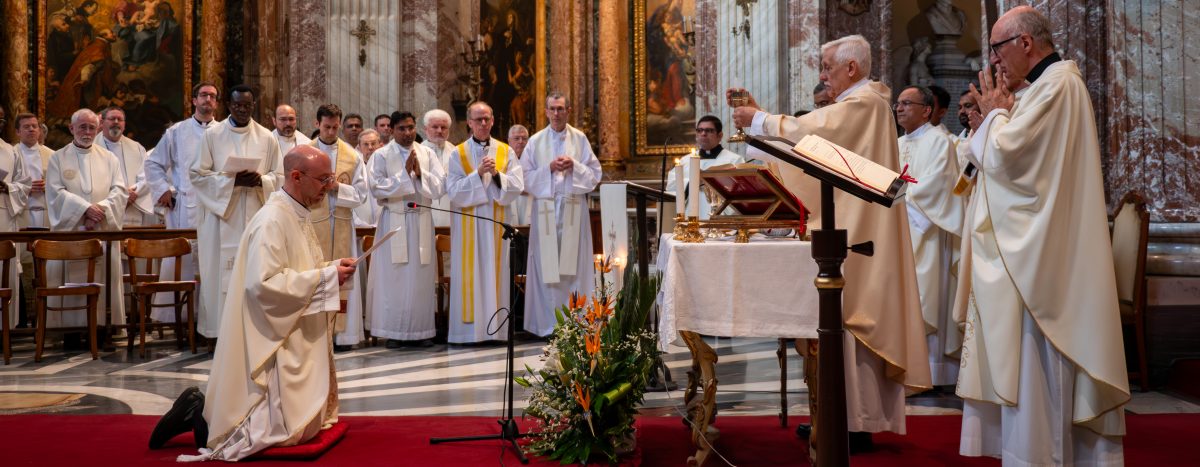
Sacristy of San Marco, Rome

We don’t know much about how the Gospels were written.  Matthew, Mark, Luke, and John didn’t leave dustjacket biographies, like you see on book covers, because the point of writing a Gospel is to put the focus on Jesus and not on oneself.  But we can tell a few things about the lives of the earliest Christians indirectly from what they wrote.  One thing we know, for example, is that before even a word of the New Testament was written, the earliest Christians were already celebrating the sacraments.  When you remember this, you begin to notice that symbols referring to the sacraments are all over the New Testament—especially baptism and the Eucharist, the two pillars of Christian life.  Today’s Gospel passage, for example, begins with a reference to John the Baptist and ends with miraculous loaves of bread, an obvious symbol of the Eucharist.

The message of the Gospel writers is clear: when we celebrate the sacraments we are coming into contact with the ministry of Jesus.  Today’s Gospel passage begins with news about John the Baptist—the tragic news that John had been killed by King Herod.  Herod, if you remember, didn’t like the fact that John had accused him of living in an immoral marriage.  Herod’s wife Herodias liked it even less and maneuvered to have John beheaded.  Reading between the lines in today’s Gospel, it seems that Jesus felt wounded by the news of his cousin John’s execution and withdrew by boat to “a deserted place” to pray and mourn.  Jesus, perhaps, also felt some premonition of his own Passion.  

Continue reading “Cooperating in the mission of Jesus: homily for the 18th Sunday in Ordinary Time”

Pope Leo on the liturgy

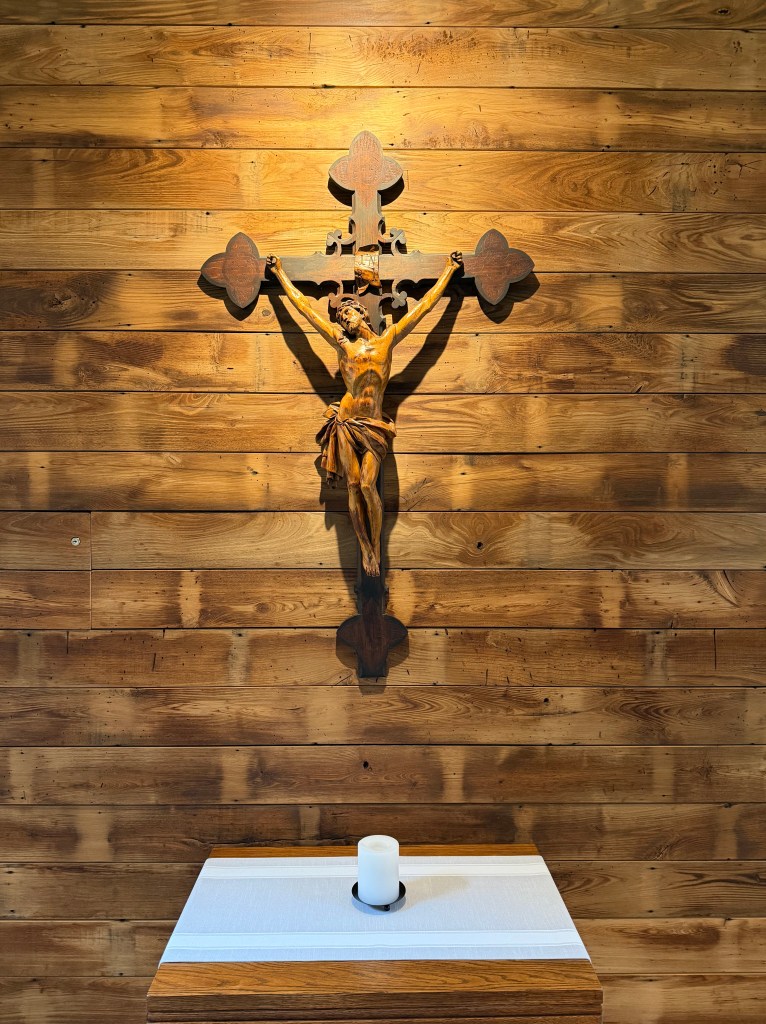
Prayer Chapel, Jesuit Retreat Center, Parma, OH

Yesterday I wrapped up a retreat for Jesuits about praying with the liturgy in Parma, Ohio. It was the second time I offered the retreat, and I was blessed to have another wonderful group of participants. As I’ve worked with young Jesuits in studies in Rome and encountered others around the world, I’ve sensed a renewed interest in celebrating liturgy well. (I made some brief remarks on the topic at the Jungmann Society Congress a few years ago.)

While working on my retreat conferences this year, I read several of the talks that Pope Leo XIV gave on the subject of liturgy at his Wednesday morning catechesis earlier this summer. The Holy Father has been reflecting on Sacrosanctum Concilium, the document from Vatican II dedicated to the liturgy. As to be expected, the Pope’s reflections are solid, touching on the document’s key strengths. In his first talk, for example, he points out that merely changing the rites was not the Council’s goal; instead, the Council wanted us to appreciate just what liturgy is — an encounter with Jesus.

In drafting this Constitution, the Council Fathers sought not only to undertake a reform of the rites, but to lead the Church to contemplate and deepen that living bond which constitutes and unites her: the mystery of Christ. Indeed, the liturgy touches the very heart of this mystery: it is at once the space, the time and the context in which the Church receives her very life from Christ. For in the liturgy, “the work of our redemption is accomplished” (SC, 2)

Continue reading “Pope Leo on the liturgy”

Epiphany homily: recapturing the logic of the gift

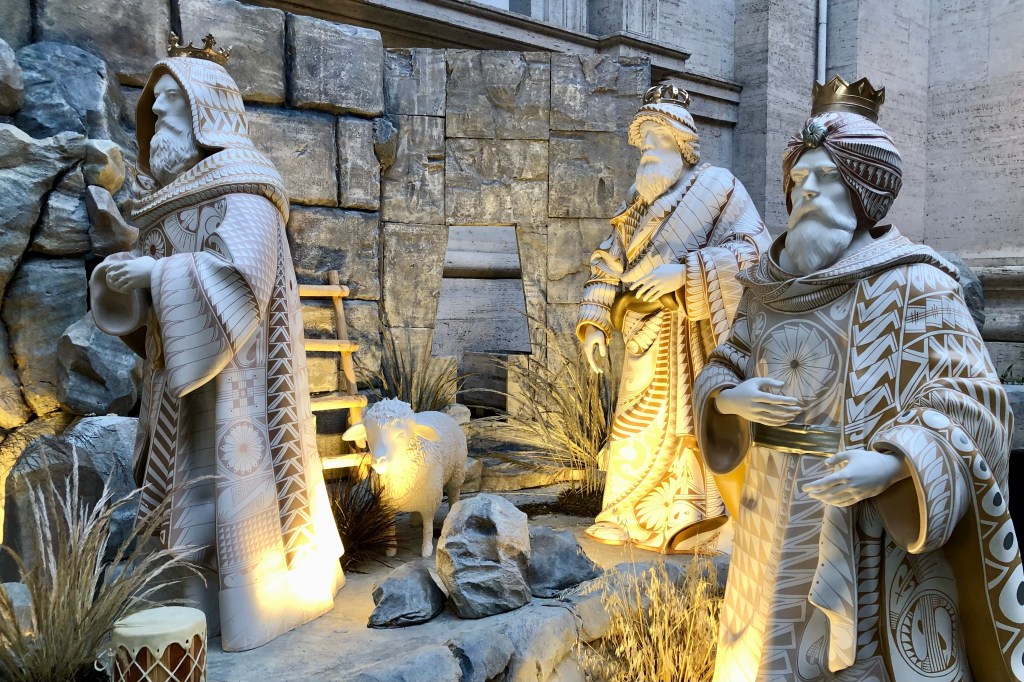
The Three Kings, from a Mexican Nativity displayed inside the Vatican, 2025

Homily for the Solemnity of the Epiphany.

Today’s feast, the Epiphany, traditionally was the day for gift-giving in Italy, though that tradition has been somewhat superseded by the arrival of a more aggressive salesman, Santa Claus.  Santa accepts both Visa and Mastercard—and, in some places, American Express—whereas the Magi bartered or traded in old-fashioned gold.

The Magi are still, however, known for their gifts.  Matthew’s Gospel does not give a precise number of Magi, but since it lists three gifts, the Christian artistic tradition has always depicted three Magi—or kings or wise men, depending on how you translate the word for these learned, wealthy, and adventuresome visitors.  Their gifts—gold, frankincense, and myrrh—struck a chord in the Christian imagination, even if most of us would have trouble explaining what exactly you do with myrrh.

Ancient spiritual writers attributed symbolic meaning to their gifts: gold symbolized Christ’s kingship; frankincense—a type of incense used in worship—symbolized his divinity; and myrrh—myrrh again, gave them a little trouble.  Some associated myrrh with virtue or with prayer.  Myrrh is actually very similar to frankincense; both come from the resin—the sap—of desert trees, which makes them rare and valuable.  Both give off distinct smells when burnt.  Frankincense is sweeter, while myrrh gives off bitter notes sometimes described as earthy or somber.  In the ancient near east, myrrh was used to prepare bodies for burial, so the presence of myrrh at Christ’s birth is sometimes interpreted as foreshadowing his passion and death.  Perhaps that explains why myrrh is no longer popular as a Christmas gift today.

But more than the specific gifts of the Magi, this morning I would like to reflect on what a gift is to begin with.  Today our idea of gift-giving is so shaped by Santa Claus—and by Amazon and Black Friday—that we sometimes lose the sense of what a gift meant in the time of Jesus.  And when we lose our grasp of the logic of gift-giving and gift-receiving, we start to have trouble understanding not only today’s feast of the Epiphany, but other parts of our faith as well, like marriage and the Eucharist.  Even our own existence in this world, which we did not create ourselves and did nothing to earn, becomes difficult to understand.

Continue reading “Epiphany homily: recapturing the logic of the gift”

Remember to say “Thank you”: Homily for the 28th Sunday of Ordinary Time

Homily for the twenty-eighth Sunday of Ordinary Time (C).

One of the lessons I remember being drilled into me as a child was the importance of saying “thank you.”  As with so many of the lessons we learn in childhood, I may not have appreciated its importance at the time, but now I’m grateful for it.  The next time I see my mom and dad, I’ll have to remember to thank them.

Today’s readings are all about remembering—and forgetting—to give thanks.  The attention that Sacred Scripture dedicates to the theme suggests that we are dealing with something much deeper than polite social convention.  Gratitude does make for more pleasant social interactions, but it is also necessary for us to see the world truthfully.  And it is something we easily forget.

Certosa di San Martino, Naples

Today’s Gospel passage, in fact, hints that perhaps we are more inclined to forget to give thanks than to remember.  Ten lepers were cleansed, Jesus points out, but only one returned to thank him.  Busyness can distract us from gratitude—we need to move on to the next thing, we don’t have time.  When we get what we want, often our tendency, instead of saying thank you, is to try to get more.  This is part of what theologians call “concupiscence,” the habit of selfishness burned into human nature by original sin.  Today we can add a sense of entitlement to concupiscence.  We like to speak of our rights—and politicians like to promise more rights—but while the rights we claim for ourselves multiply exponentially, our sense of responsibility never quite seems to keep pace.  We forget that we would have no rights whatsoever if these hadn’t been granted to us by our Creator.  To this forgetfulness we can add advertising that pushes us to buy more, to watch more, to scroll more, to consume more, and not to waste time remembering where we came from.  My parents did well to drill saying “thank you” into me because there are so many other voices saying, “Don’t worry—just give me your credit card.”

The loss of a sense of gratitude makes a truly Christian life impossible.  It’s no accident that the word that describes the central action in the life of the Church—“Eucharist”—comes from the Greek word for thanksgiving.  In some ways, this might seem surprising because in the celebration of the Eucharist, God’s action, and not ours, is central.  It is Jesus who gives himself to us; it is his power that transforms bread and wine into his Body and Blood, his living presence among us.  What we do in this sacrament we do only because he gave us the instructions.  The initiative is always God’s.  The same can be said of all of creation.  Everything that is is an unmerited gift.

Continue reading “Remember to say “Thank you”: Homily for the 28th Sunday of Ordinary Time”

Melchizedek, Jesus, and perfect sacrifice: Homily for Corpus Christi

This month I’ve been asked to contribute Sunday homilies to the Homiletic and Pastoral Review. You can find the rest of the month’s homilies there as well. Here’s this week’s contribution:


Homily for the Most Holy Body and Blood of Christ (C)

I thought I’d begin today by saying a word about Melchizedek. I’d wager most of you don’t know much of anything about Melchizedek. It’s a safe wager because nobody knows much about Melchizedek. His biographical details are limited to what you just heard in the first reading. But Melchizedek turns out to be an important figure. In the first reading, in Genesis, he seems to come out of nowhere. It turns out, when we get to the Letter to the Hebrews in the New Testament, that this mysterious origin is what makes him interesting. The New Testament speaks of Melchizedek as a forerunner of Jesus, the great high priest who has neither beginning nor end. Melchizedek, the Letter to the Hebrews says, represents an eternal priesthood — the priesthood of Jesus Christ.

In fact, perhaps it’s surprising that Genesis would mention Melchizedek at all. Even more surprising is that it mentions the sacrifice that he offers — bread and wine. At the time, bread and wine were not particularly impressive sacrifices. In the ancient world, if you wanted to impress, you offered meat. Birds were OK, lamb was better, a bull best of all. Bread and wine were not the sort of sacrifice a king would brag about.

Continue reading “Melchizedek, Jesus, and perfect sacrifice: Homily for Corpus Christi”

What to do when you don’t have a pope? Preach Jesus Christ

Homily for Wednesday of the Third Week of Easter.

Brothers and sisters, papam non habemus. We do not have a pope. Not yet.

We live in uncertain and, often, disturbing times. I’m not talking only about the sede vacante in the Church of Rome. The last few years–the last few decades, really–have been a difficult time for the Catholic Church. The Church sometimes seems confused and divided from within, and opposed by powerful forces from without. And today we also live with all the uncertainty of a papal election.

In this uncertain moment, today’s first reading reminds us of a simple but profound lesson: things have been worse. Much worse. Here we see the Church at its very beginning, tiny and persecuted. Stephen, one of the first deacons, has just been killed. The faithful are scattered. Those who persecute the Church are full of zeal, backed by the age’s political powers in all their strength. It seems like a catastrophic moment for the nascent Church, but it becomes a moment of triumph, a moment of growth. The dispersion of the faithful–even if caused by persecution–becomes the condition for the spread of the Word. Soon, we know, even the great persecutor, Saul, will convert and become the greatest missionary in the history of the Church.

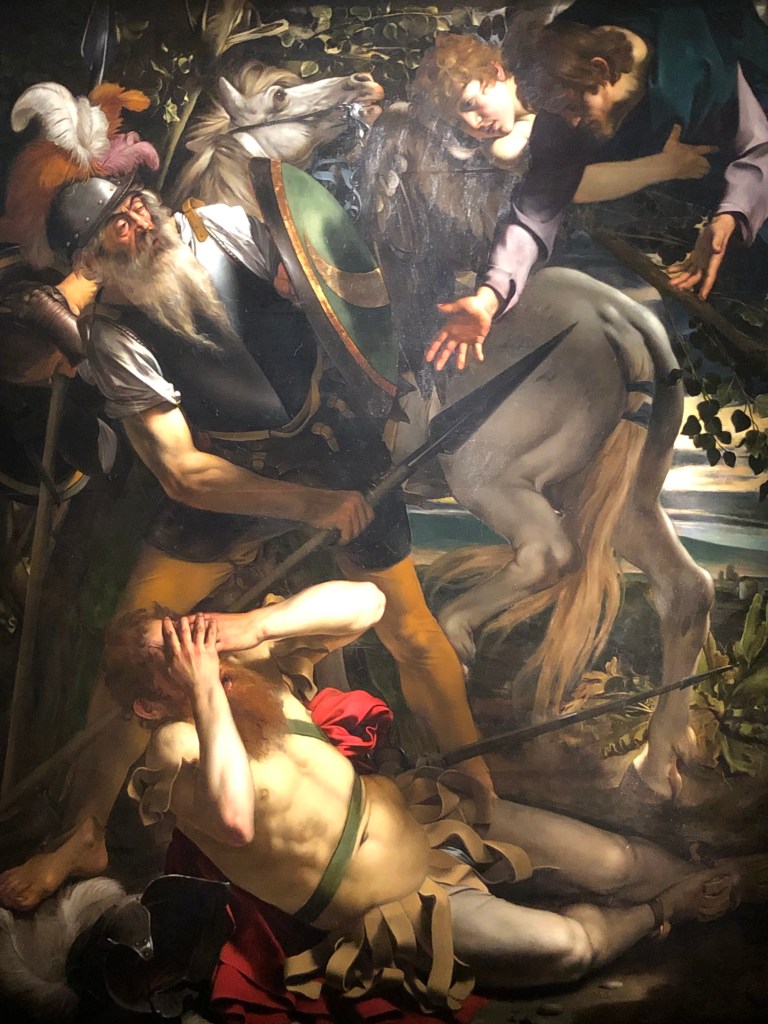
Caravaggio, The Conversion of St. Paul, 1600-1

What I most want to emphasize today is the response of the disciples, who transformed this apparent catastrophe into a moment of growth: They continued to preach Jesus. Without panic, without discouragement. They returned and remained steadfast in the most fundamental mission of the Christian: to bear witness to the life, death and resurrection of Jesus Christ.

Today’s Gospel reading also calls us back to the heart of our Catholic faith: “I am the bread of life,” says Jesus. There is no action more important for the Catholic than to encounter the Lord in the Eucharist, in his true body and in his true blood.

Brothers and sisters, despite our anxieties and our doubts, despite the moments of uncertainty that alternate with moments of glory in the life of the Church, this message remains our rock. If we continue to proclaim it, we cannot go wrong. In a few days we will have a new pope, but our mission will not change. Times change. Popes change. Jesus Christ does not change.

Jesus Christ is the bread of life. Jesus Christ is Lord.

Readings: Acts 8:1b-8; John 6:35-40

(Original: Italian)

May 7, 2025

Gregorian University Chapel, Rome


Those interested can see my interview on the CBS Evening News with Maurice Dubois here.

Sacraments of loyalty, marriage and Eucharist: homily for the twenty-first Sunday in Ordinary Time

Homily for the 21st Sunday in Ordinary Time (B)

Are there any Bears fans here?  I have a question for you: if I reached into my wallet, how much money would I have to offer to get you to root for the Vikings?  I know what you’re thinking: “You keep your wallet where it is, Father, because there ain’t enough money in the world to make me a Vikings fan.” Fair enough.  I am a Notre Dame fan, and you could fill up the collection plate with hundred dollar bills, but you’d never get me to root for USC or Michigan. 

Triumph of Faith over Idolatry, Jean-Baptistre Théodon, Church of the Gesù, Rome

In both cases, the reason why is loyalty.  Each of today’s readings is about loyalty, though much more important types of loyalty than what we show our sports teams.  When the first reading takes place, Joshua and the Israelites have spent their lifetime conquering the Promised Land after the death of Moses; here Joshua is an old man and he is putting a choice to the people.  They’ve arrived, the land is theirs, and he tells them: Now you have to decide whom to serve.  The God of our fathers Abraham and Moses got us here, and he has given us his law.  Other nations have other gods, maybe with laws that aren’t so demanding.  You are free to make a choice.  You can serve whichever god you wish, Joshua says, but “as for me and my house, we will serve the Lord.”  

And the people agree to serve the Lord.  But if you continuing reading in the book of Joshua, you’ll see that Joshua asks the people a second time.  Are you sure?  Because if you agree to serve the Lord, then God will hold you to his law.  You are free, but your choice is binding.  

Continue reading “Sacraments of loyalty, marriage and Eucharist: homily for the twenty-first Sunday in Ordinary Time”

Bread of life or never-ending breadsticks? Homily for the eighteenth Sunday in Ordinary Time

Homily for the 18th Sunday in Ordinary Time (B)

If there were an Olympic event for complaining, the ancient Israelites just might take the gold medal. Today, after being liberated from slavery, they ask to go back, forgetting the oppression they suffered in Egypt and remembering the country as an ancient Olive Garden with fleshpots and never-ending bread sticks.  Hearing their complaint, God sends them manna and quail to eat, but we know that soon enough they’ll start complaining again—“Manna again?  We want leaks and onions, not these leftovers!”  And they’ll attack Moses: “Why’d you have to lead us out here?  Weren’t there enough graves in Egypt?”

The preaching of St. Paul, Rabat, Malta

But, if complaining were an Olympic event, the competition would be fierce.  I suspect there’s something deep in our human nature—some survival mechanism from caveman days that made our ancestors less likely to be eaten by sabretooth tigers or stomped on by wooly mammoths if they were quicker to see the negative than the positive, more inclined to fear than to gratitude.  The problem is if you’re not being stalked by a sabretooth tiger, this instinct for the negative sometimes results in clubbing our friends or retreating into the darkness of our own self-constructed caves.  

Continue reading “Bread of life or never-ending breadsticks? Homily for the eighteenth Sunday in Ordinary Time”

Leftovers transformed: homily for the seventeenth Sunday in Ordinary Time

Homily for the 17th Sunday in Ordinary Time (B)

Miracle of the Loaves from the Triptych of the Miracles of Christ, Master of the Legend of St. Catherine, Flanders 1491-5, National Gallery of Victoria, Melbourne

Today’s readings give a prominent place to leftovers.  In the hands of the prophet Elisha, twenty barley loaves manage to fill a hundred people, with some left over.  When Jesus feeds the five thousand, the leftovers—twelve baskets—exceed the amount of bread there was to begin with—just five loaves.

It’s worth noting that the disciples go to the trouble of collecting the leftovers after the impromptu meal.  Living in an age of abundance, perhaps we are used to throwing leftovers out or letting them molder in the back of the fridge, but letting leftovers go to waste is a luxury most people in history didn’t have.  Certain recipes popular today were originally invented to use stale bread—bread pudding, for example, or the Tuscan bread soup known as ribollita.  The funny thing about ribollita is that what started out as a peasant dish today is served in pricey and fashionable restaurants.  What was once leftovers has become high cuisine.

There’s something deeply Christian in this transformation.  Ours is a faith, after all, in which the stone rejected by the builders becomes the cornerstone, the last become first, the meek inherit the earth, the poor are filled with good things while the rich go away empty, the blood of martyrs becomes the seed of faith, and in dying we are born to eternal life.  We believe not just that leftover bread can be transformed into a savory dish, but that utterly ordinary bread and wine are, in the sacrament of the Eucharist, transformed into the body and blood of Jesus. Moreover, if we approach the sacrament in faith, we too are transformed into the body of Christ; our weak and too often sinful flesh becomes the dwelling place of the Holy Spirit.

I have a friend, a Filipino Jesuit who comes from a family of restauranteurs and is an amazing chef.  He has a particular genius for being able to walk into any kitchen, open the refrigerator, glance over whatever leftovers are inside, spend half an hour spicing and mixing and reheating, and produce a feast that was better than the original meal.  Our Christian faith is something like this.  At its heart is belief in the possibility of transformation.

Continue reading “Leftovers transformed: homily for the seventeenth Sunday in Ordinary Time”