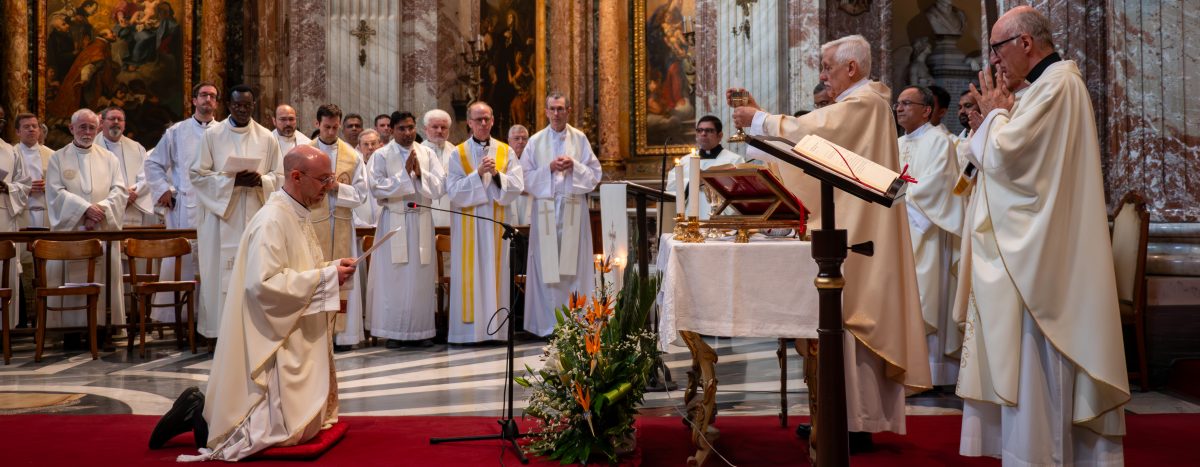
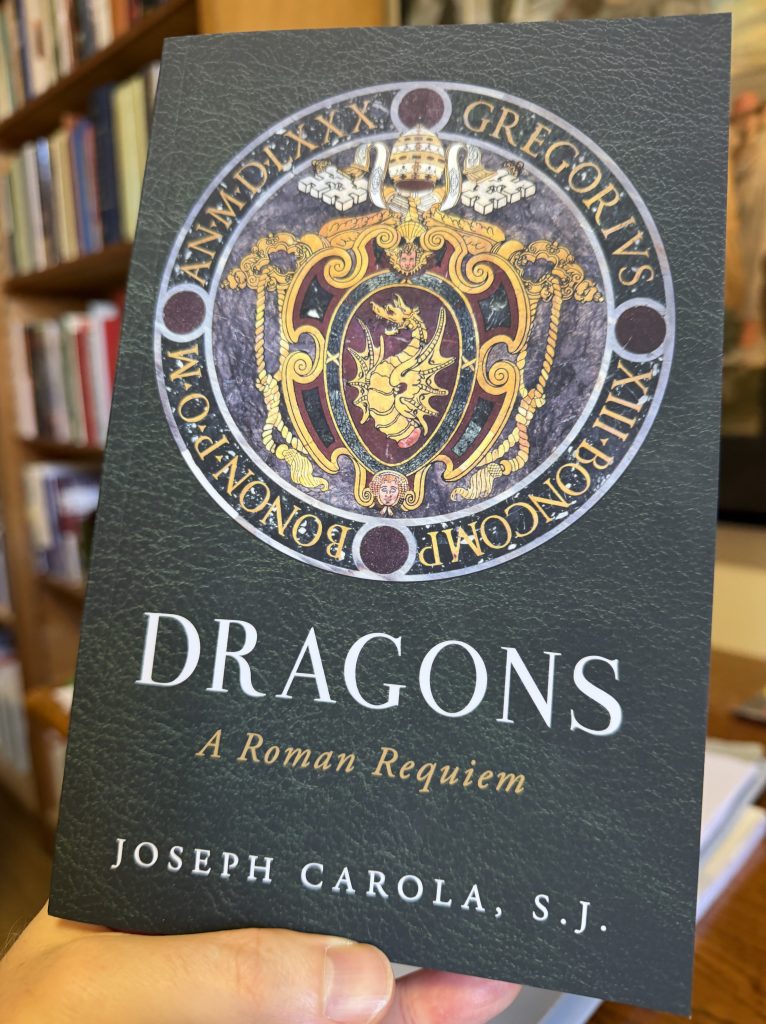
I was delighted earlier this month to be able to speak at the book presentation of a legendary member of the Gregorian faculty, Fr. Joseph Carola, S.J. Fr. Carola recently published his first novel Dragons: A Roman Requiem this summer and invited me to say a few words at the book presentation. The talk gave me the opportunity not only to talk up a great novel, but also to reflect on why we read and write literature to begin with.
Thank you, Fr. Bagasse, for the introduction, and thank you, Fr. Carola, for the invitation to speak today and for involving me in the entire process of the production of Dragons. Outside of Tolkien or Game of Thrones, few people can say that they have witnessed the birth of dragons. But I can now say that I have.
I followed the book’s gestation via energetic reports at the breakfast table in the Gregorian Jesuit community. I heard descriptions of places that would appear in the novel—the aptly named Villa Mondragone in Frascati; the former Jesuit collegio in Orvieto; the famous breach in the wall near the Porta Pia as seen from Villa Bonaparte, the French embassy to the Holy See. I found out that more—many more—exploratory trips went into the production of the novel, including a ferry ride across the English Channel—it’s a good thing, none of the novel’s characters fell overboard or Father Carola might have tried to swim it.
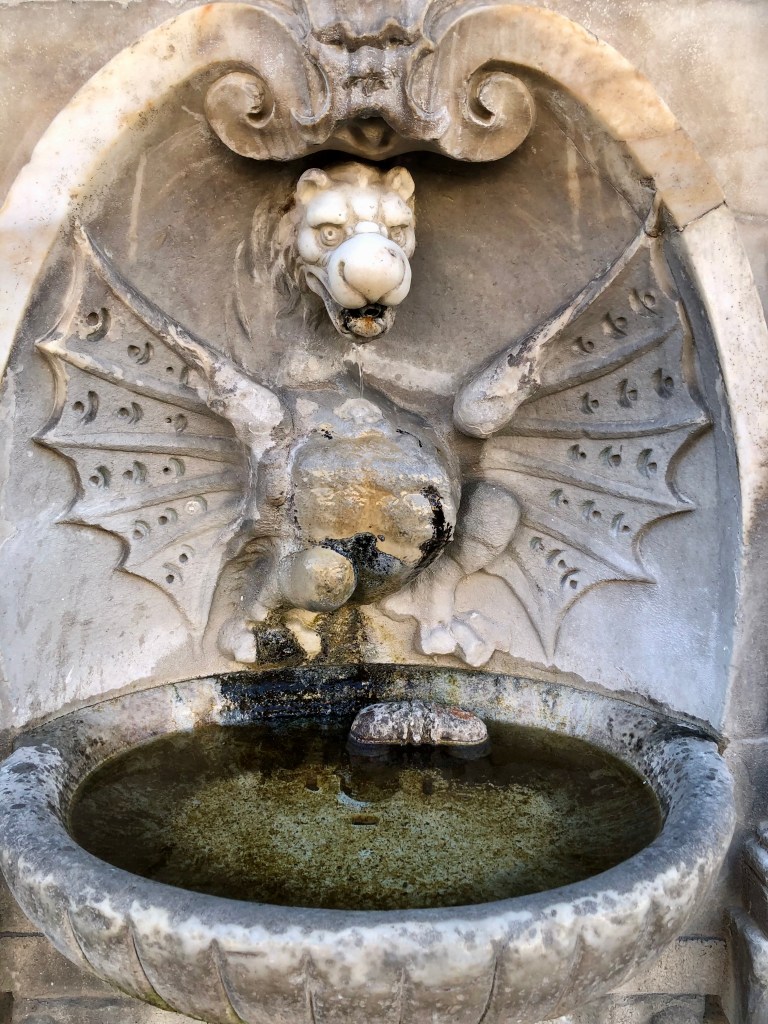
Eventually, I read drafts and witnessed the dragons begin to spread their wings. I saw, as so often happens in that mysterious process by which literature comes into being, the author himself surprised as he realized what his own characters would do. I found myself noticing—Roman readers beware, because this is a side-effect of the novel—I started noticing dragons everywhere—on buildings, in fountains, on floors, in mosaics, looking down from windows, peaking around corners.
For me, seeing the book emerge from the quarry of Father Carola’s imagination was part of the fun of the project. And fun it was, and is. Appropriately so. The Roman poet Horace, after all, wrote that the purpose of literature is both to instruct and to delight. And even though the novel’s subtitle “A Roman Requiem” hints at the somber trajectory of the events it describes, the book is not without its moments of fun: the saucy dialogue of the Jesuit brothers—Brother Paglia, Brother Pampana, and Brother Azzopardi—who provide color commentary on current events, rolling their eyes at the fathers upstairs who remain lost in their theology while making the practical preparations necessary for the community’s survival amid the nineteenth century’s revolutionary violence.
For those of us who do remain lost in our theology, the novel contains little winks and nods, like the cameo of a seminarian named Denzinger, who even at a tender age seems encyclopedic in his disposition. And, of course, the reaction—which I leave to the listener’s imagination—of the Scottish seminarian Malcolm MacIntyre when mistakenly asked about life in the English College.
I myself had an epiphany about the book this summer in Scotland at the first Mass of a real—not fictional—Scottish priest at which Fr. Carola gave the homily. He managed to combine a rich reflection on the priesthood with an engaging narrative of the newly ordained priest’s life. Listening, one felt the adventure of pursuing God’s call.
Perhaps it is an instinct Fr. Carola picked up from St. Augustine, who knew a thing or two about how tell a vocation story and about how to instruct and delight. Or perhaps it is an instinct that developed over time in a teacher and spiritual director who knows not just how to instruct but also how to listen and to mentor and to help others to see their own lives situated in the great drama of salvation, to discern the plotlines sketched by the Author of our lives.
Dragons may be Fr. Carola’s first novel, but it is not his first time telling a story. What struck me listening to that homily in Scotland and reflecting on it in light of the novel I had just read is how important it is for theologians to be able to tell stories. It is well enough for us to analyze, to construct arguments, to compile evidence, but, to quote another MacIntyre—the philosopher Alasdair—“Man is essentially a story-telling animal.” We need narratives to see the meaning in our lives, to understand ourselves, to act with genuine freedom instead of merely drifting on the surface of events.
As you know, Fr. Carola wrote Dragons after spending 18 years researching and writing a book about the 19th century Roman School of theology. What he understood at least implicitly while doing that research, what allowed that experience to be reborn as a novel, is that theology is a human pursuit; that is, it is done by human beings who are trying to make sense of our own lives, of God’s plan for us, of where we fit into the bigger picture, of how to act and react in a world dominated by violence, propaganda, and false gods.
One of the novel’s merits is that it allows names that we might recognize from theological history to come alive as more than just names. Pope Pius IX did not, after all, pass his 85 years on earth as a symbol—or a caricature—of 19th century reaction; he too, as we see him in the novel, tried to figure out what God desired of him and to play his role as faithfully as he could. Today we may tend to think of 19th century theologians as not much more than names attached to particular doctrinal positions regarding the Immaculate Conception or papal infallibility, but the form of a novel allows us to appreciate as human beings figures like Johann Baptist Franzelin or Giovanni Perrone or Clemens Schrader and Carlo Passaglia, whose flawed relationship forms a complex and poignant subplot in the novel.
At the center of Dragons, however, is a character who, though he did not exist in history, does not feel any less real for that omission—Father Luigi Colonna, S.J., the protagonist of Dragons. We meet Luigi as a painfully earnest scholastic and see him evolve into a faithful, if overworked, priest, who does the best he can in confusing circumstances and is generous in situations for which he does not feel adequately prepared. Father Colonna does not have time to recognize the holiness growing steadily within him. As is so often the case, the reader is able to perceive what characters in medias res are unable to see themselves. But the power of narrative, like the power of grace, is also at work in Luigi’s life; as he matures, he is able to look back on his own youthful scrupulosity as a chapter in a much larger story, a happy fault of sorts that makes him who he is—among other things, a knowing and compassionate confessor. For us, too, perceiving the larger, deeper plotlines in our own lives is a characteristic of spiritual depth.
In our own lives, however, we can never fully step out of our first-person perspective into the omniscience of a novel’s reader, and yet, by reading, we do broaden our deposit of experiences. This, it seems to me, is literature’s unique contribution to human life, the special way that literature instructs in addition to delighting. Rarely do novels deliver clean lessons or morals to be memorized; were our purpose in reading literature merely to consolidate a list of morals and commandments, it would be much more efficient just to pick up and memorize Part Three of the Catechism.
What literature does, instead, is to share with us experience, experience molded in a particular way by the author so that, like turning a kaleidoscope, we see the grandeur of human life in a new way, we perceive how the pieces of reality can be arranged into new narratives, into another configuration of meaning. As C.S. Lewis put it, “In reading great literature I become a thousand men and yet remain myself.” Because literature works by sharing experience instead of conclusions, what it says cannot be separated from how it says it; the journey cannot be divorced from the destination; and it retains the capacity to surprise even its creator.
It retains, as well, its ambiguities. Some might, even after reading Dragons, still imagine that these mythic creatures are just that—mere myth—and that their roar or the flapping of their wings is only thunder or wind. The particularly stubborn might even continue to insist that these fierce creatures are evil, taking the side of their fallen cousin in the book of Revelation, without recognizing that some dragons are benevolent.
I will not argue with such people because, though argument and persuasion play their role in the process of conversion, any conversion worthy of the name—whether of Paul or Augustine or a character from Dragons who will go unnamed—any genuine conversion necessarily means seeing the world with new eyes. Literature—and Dragons in particular—allows us to do that, to look into the eyes of another and see reality anew.
If I said more, I would have to start issuing spoiler alerts, so I won’t. The great American Catholic short-story writer and novelist Flannery O’Connor was famous for refusing to answer the question, “What is the story about?” “A story,” she said, “is a way to say something that can’t be said any other way, and it takes every word in the story to say what the meaning is.” The only way to know what a story is about, in other words, is to read it.
We read novels—and some people write novels—to hear what can only be heard, to see what can only be seen, to feel what can only be felt, to say what can only be said by being there. So my advice—which perhaps you have anticipated already, perhaps you have heard somewhere before, perhaps has even been gently foreshadowed and is not entirely original, but is no less valid because of it—my advice is: “Tolle, lege.” Take up and read.
October 5, 2026
Pontifical Gregorian University
Rome
Please support this blog by subscribing:


