Homily for the Nineteenth Sunday in Ordinary Time (Year A)
Today’s marvelous Gospel story of Jesus walking across a stormy sea shows us how faith grows from fear to true understanding. The disciples move from a superstitious worldview, imagining that the Lord is a ghost, to true faith, confessing to Jesus, “Truly, you are the Son of God.” But since the same reading came up at daily Mass earlier this week and some of you already heard what I had to say about it, I thought today I would step out onto a different kind of stormy sea: the second reading, taken from St. Paul’s Letter to the Romans. The reason this particular passage from Romans means walking on turbulent waters is because it deals with St. Paul’s attitude toward his own people, the Jews. It has implications, therefore, for what attitude Christians should take toward the Jewish people today.
I decided to risk stepping out onto such waters this morning because over the past several years we have seen a sharp rise in anti-Semitic rhetoric and an increase in violence directed against Jews. In March, a synagogue in West Bloomfield, Michigan was attacked and, soon after, the FBI thwarted a plot to firebomb synagogues in New York, Los Angeles, and Scottsdale, Arizona. The situation in Europe is worse, and it should disturb anyone of good sense and good will that in the wake of Hamas’s attack on Israel in October 2023—which included murder, rape, and hostage-taking—anti-Semitic rhetoric in the West increased.
I am not criticizing legitimate disagreements with policies of the Israeli government; for example, speaking personally, I am opposed to increased Israeli settlements in the West Bank and think that Israel should be doing more to control violence by its own citizens against both Palestinians and foreign Christians. What is not legitimate, however, is rhetoric that, if taken seriously, would have as its consequence the destruction of Israel and the death of countless of its citizens, such as the slogan, “From the river to the sea.” Such rhetoric justifying violence against Jews is a sin against the fifth commandment.
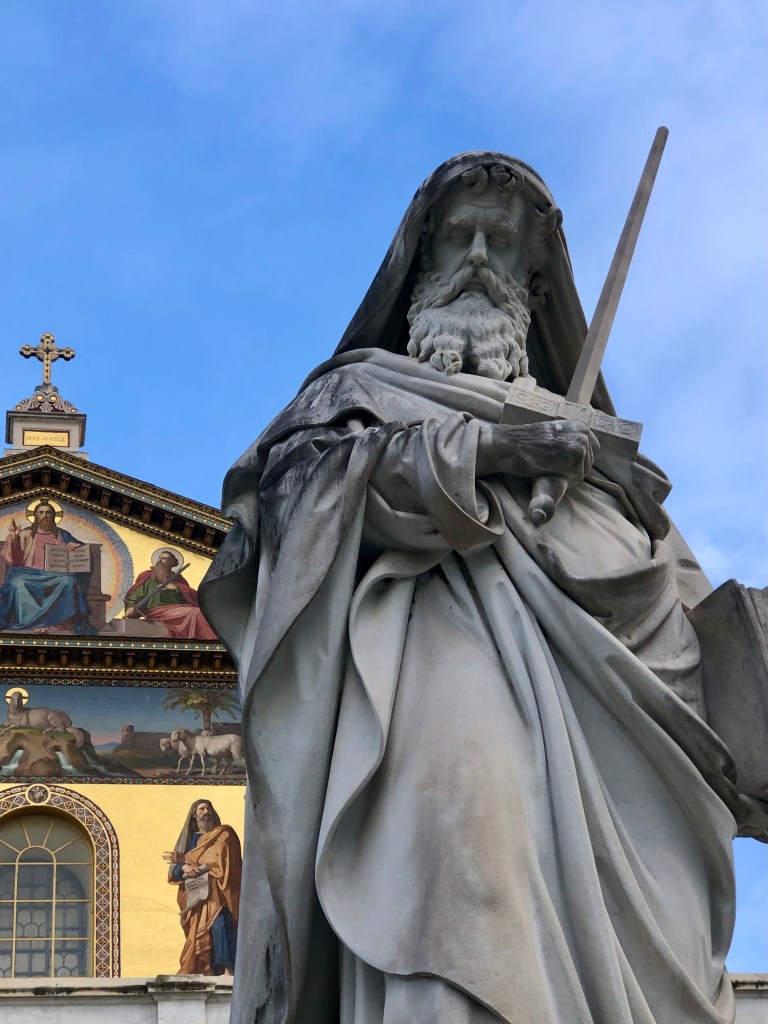
That said, there is room for disagreement between Christians and Jews, both as regards the present conflict in the Middle East and on much deeper religious questions. St. Paul’s Letter to the Romans gets to the heart of our most fundamental disagreement, disagreement over who the Savior is. Paul believes what the disciples profess at the end of today’s Gospel passage: Truly, Jesus is the Son of God. The men who spoke those words to Jesus were Jewish, as was Jesus himself, as was Paul. But in today’s reading, Paul is reflecting on the fact that the majority of his people have not embraced this faith. Paul is devastated by this. “I have great sorrow and constant anguish in my heart,” he writes. We are not dealing with a disagreement about some minor issue, a question of style or preference.
Paul believes as he writes in 1 Timothy that “there is one God and one mediator between God mankind, the man Jesus Christ” (1 Tim 2:5) and as St. Peter says in Acts of the Apostles that “there is no salvation through anyone else” (Acts 4:12). And that, of course, is why he is so upset. He is not torn up because he thinks the Jews are terrible, but because he loves his own people. In fact, he loves them so much that he says he would be willing to give up his own salvation if only it would lead to theirs: “I could wish that I myself were accursed and cut off from Christ for the sake of my own people, my kindred.” There is no hate or disdain in Paul’s attitude. What he feels is the same anguish that we might feel for relatives who do not believe or have left the faith. We hurt because we still love them and they are missing what matters most.
St. Paul would not feel such anguish if he were a relativist, if he believed that there were many different paths to salvation and you could just pick the one that fit you best. He has come to know Jesus Christ, and he has come to believe that knowing Christ is salvation. If he thought otherwise, the emotion he expresses would not make sense. He also knows and believes that the many true elements in the religion of his ancestors, properly understood, point to Jesus Christ. Christ is the fulfillment of the law and the prophets, making these elements of the Jewish religion admirable and good. Paul even seems legitimately proud of the special role his people have played in salvation. “They are Israelites,” he says, “theirs the adoption, the glory, the covenants, the giving of the law, the worship, and the promises; theirs the patriarchs.” But, for St. Paul, the real value of all of these things is that they point to fulfillment in Christ. He says of his people, “from them, according to the flesh, is the Christ.” Of all the admirable things Paul can say about his people, the greatest is that the Son of God was born of them. And it hurts him that very many of his fellow Israelites do not recognize the greatest of God’s gifts.
So what does St. Paul’s attitude toward his people tell us, as Christians, about what our attitude toward the Jews should be like today? St. Paul expresses both disagreement and affection toward his people, and I think that to be true to what God has revealed, we need to maintain both of these elements. We cannot negotiate or compromise on the identity of Jesus or the necessity of faith in him; we must proclaim the truth he has revealed whether that proclamation is welcome or not. But for all the reasons Paul lists in today’s readings—and most of all because Jesus, Mary, and the Apostles were themselves Jewish—we should regard the Jewish people with esteem and warmth. An attack on them is like an attack on our relatives; even if we don’t see eye-to-eye with our relatives, who they are makes us who we are. This is especially true in today’s society, where anti-Semitism is often part of a larger ideological program to undermine all of the sources and foundations of Western civilization, including Christianity. Scapegoating the Jews for our problems or the failures of our own government is self-destructive because it means dodging the real sources of those problems.
Some Jews have recognized Jesus as the Messiah—St. Paul first among them—while others have not. The fact that God’s covenant and his many favors to that people endure—the fact that the Jewish people have endured throughout the centuries—is a reminder of the freedom God gives us to embrace his call or to reject it. God does not coerce religious faith, and neither must we. His truth and his patient love persist even if we ignore him, stray from his commands, or get his message wrong. When it comes to our relations with the Jewish people, we must strive to be God-like in our love. Being faithful to Jesus Christ, the Son of God and Lord of all, requires nothing less.
Readings: 1 Kings 19:9a, 11-13a; Rom 9:1-5; Matt 14:22-33
August 9, 2026
St. Isaac Jogues Parish
Rapid City, South Dakota


