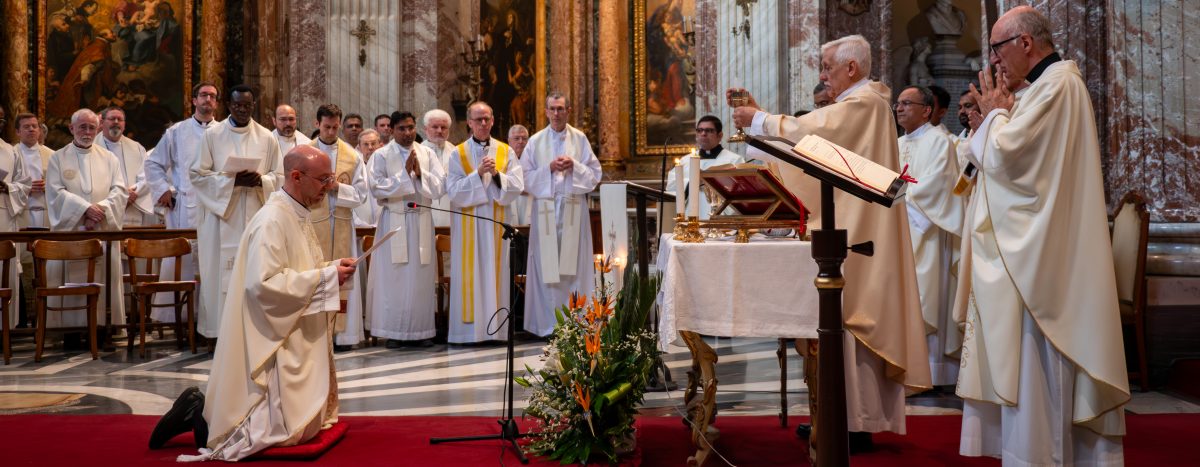
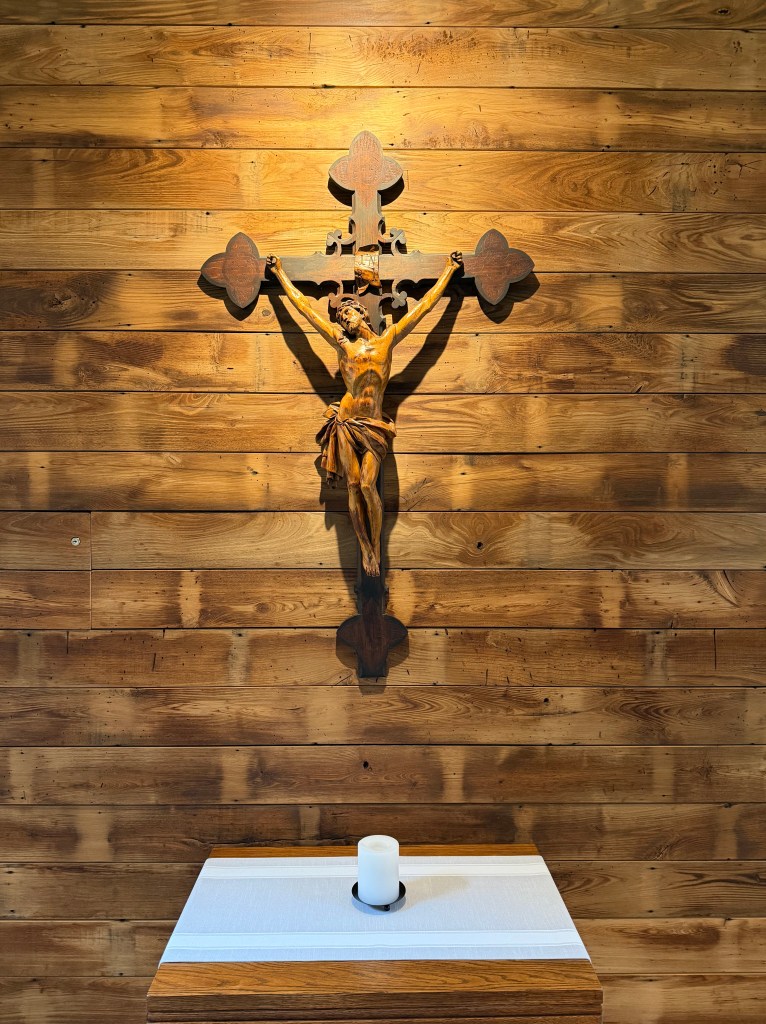
Yesterday I wrapped up a retreat for Jesuits about praying with the liturgy in Parma, Ohio. It was the second time I offered the retreat, and I was blessed to have another wonderful group of participants. As I’ve worked with young Jesuits in studies in Rome and encountered others around the world, I’ve sensed a renewed interest in celebrating liturgy well. (I made some brief remarks on the topic at the Jungmann Society Congress a few years ago.)
While working on my retreat conferences this year, I read several of the talks that Pope Leo XIV gave on the subject of liturgy at his Wednesday morning catechesis earlier this summer. The Holy Father has been reflecting on Sacrosanctum Concilium, the document from Vatican II dedicated to the liturgy. As to be expected, the Pope’s reflections are solid, touching on the document’s key strengths. In his first talk, for example, he points out that merely changing the rites was not the Council’s goal; instead, the Council wanted us to appreciate just what liturgy is — an encounter with Jesus.
In drafting this Constitution, the Council Fathers sought not only to undertake a reform of the rites, but to lead the Church to contemplate and deepen that living bond which constitutes and unites her: the mystery of Christ. Indeed, the liturgy touches the very heart of this mystery: it is at once the space, the time and the context in which the Church receives her very life from Christ. For in the liturgy, “the work of our redemption is accomplished” (SC, 2)
Pope Leo’s second talk defends the necessity of change in the liturgy, but it also points out that not just any kind of change is possible. Any reform of the rites must remain faithful to the tradition that was handed on to us by Christ. The Holy Father highlights the guidelines that are necessary for any reform to work. Vatican II most certainly did not endorse “anything goes.”
It is therefore understandable why the Council Fathers recommended that the revision of the rites, when “the good of the Church genuinely and certainly requires them”, must be carried out taking care that “any new forms adopted should in some way grow organically from forms already existing” (SC, 23). […] The Council Magisterium, in this way, thus calls for the avoidance of confusion amongst the faithful, discouraging anyone from adding, removing or altering anything in liturgical matters on [one’s] own initiative (cf. SC, 22). […] I therefore urge all those called to prepare the celebration of the divine mysteries, in particular priests who exercise the ministry of liturgical presidency, to always uphold that respect for the texts and regulations of the liturgy which springs from an inner attitude of openness and trust in God, manifesting humility before His greatness and sincere fidelity to ecclesial communion.
The Pope’s third talk on the subject highlights a theme that is important to me — the way the liturgy speaks to us through symbols. In fact, more than just speaking to us, the liturgy actually forms us; it makes us Christians and builds us up into a new creation.
The rite involves us in a well-defined sequence of gestures and prayers, which can sometimes be at odds with with our individual tendency towards spontaneity. Its logic, however, is not to constrain freedom within rigid frameworks. On the contrary, with the solemn simplicity of its rhythms, the rite interrupts our frenetic activities, leading us back to what is essential. We thus discover another dimension of action that is not guided by calculations of productivity, and another experience of time and space. In the rite, we experience a logic of gratuitousness, we find a pause that regenerates the heart, we recognize that we are preceded by divine grace and we learn to live in a rhythm inhabited by the Holy Spirit.
[…]
In the Apostolic Letter Desiderio desideravi, Pope Francis, echoing a statement by Romano Guardini, identified “the first task of the work of liturgical formation: man must become once again capable of symbols” (no. 44). We need to allow ourselves to be educated by the rites of the liturgy, caring for the beauty of our celebrations with a delicate touch and without arbitrariness, and committing ourselves to an authentic mystagogy. The experience of a living and devout liturgy, accompanied by appropriate mystagogical catechesis, is the best resource for reawakening in everyone that openness to the encounter with God which, in the logic of the Incarnation, can only take place by involving the whole person: spirit, soul and body (cf. 1 Thess 5:23).
Please consider subscribing to this blog:


