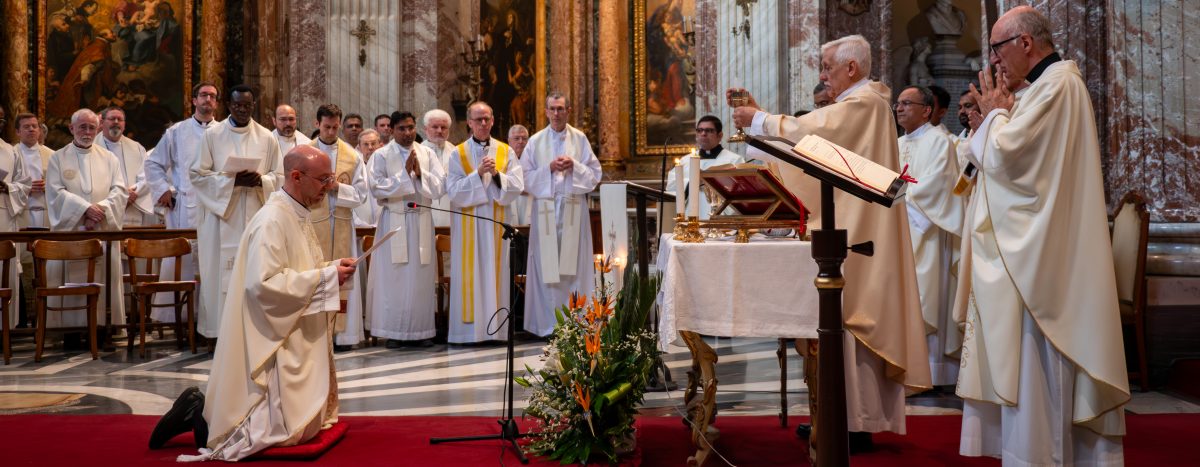
Yesterday I wrapped up a retreat for Jesuits about praying with the liturgy in Parma, Ohio. It was the second time I offered the retreat, and I was blessed to have another wonderful group of participants. As I’ve worked with young Jesuits in studies in Rome and encountered others around the world, I’ve sensed a renewed interest in celebrating liturgy well. (I made some brief remarks on the topic at the Jungmann Society Congress a few years ago.)
While working on my retreat conferences this year, I read several of the talks that Pope Leo XIV gave on the subject of liturgy at his Wednesday morning catechesis earlier this summer. The Holy Father has been reflecting on Sacrosanctum Concilium, the document from Vatican II dedicated to the liturgy. As to be expected, the Pope’s reflections are solid, touching on the document’s key strengths. In his first talk, for example, he points out that merely changing the rites was not the Council’s goal; instead, the Council wanted us to appreciate just what liturgy is — an encounter with Jesus.
Continue reading “Pope Leo on the liturgy”In drafting this Constitution, the Council Fathers sought not only to undertake a reform of the rites, but to lead the Church to contemplate and deepen that living bond which constitutes and unites her: the mystery of Christ. Indeed, the liturgy touches the very heart of this mystery: it is at once the space, the time and the context in which the Church receives her very life from Christ. For in the liturgy, “the work of our redemption is accomplished” (SC, 2)
 Tony Lusvardi, S.J.