Egyptians and the afterlife

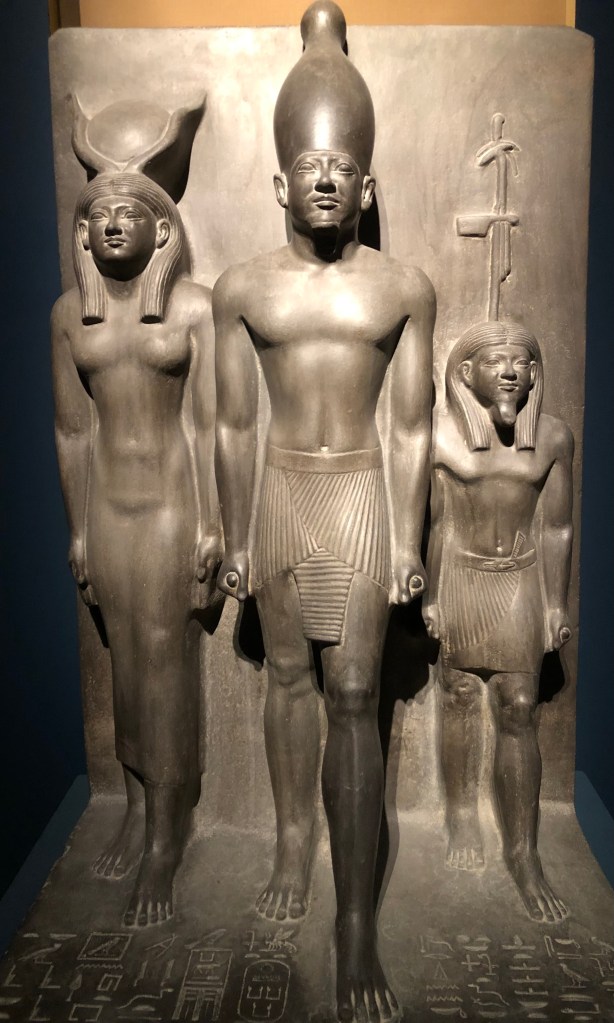
Triad of Menkaure

Romans have been fascinated with Ancient Egypt since before the time of the Caesars. Egypt was for them what Ancient Rome is for us–a powerful, slightly exotic civilization whose influence and fascination extends to the present day. Roman Emperors went to great lengths to bring Egyptian artifacts back to decorate the imperial capital, and today there are more Egyptian obelisks standing in the city of Rome than in Egypt itself.

Part of the fascination of Egypt for the Romans no doubt had to do with the religious intensity of the Egyptians. And that religious intensity, in turn, was concentrated on the life to come. The resources the Ancient Egyptians put into ensuring survival and flourishing in the next life continue to amaze. This aspect of Egyptian civilization is prominently featured in a special exhibit at Rome’s Scuderia del Quirinale (which hosted a fine exhibit on Guercino and the Roman baroque that I wrote about last year). The exhibit sensitively explains important aspects of the Egyptians’ belief system; the gold that covers ancient sarcophagi and death masks, for example, was not ancient bling meant to show off status, but a symbol of incorruptibility, a sign of hope in a new life that would not tarnish.

Continue reading “Egyptians and the afterlife”

Finding hope in Jerusalem, Babylon, and Sweden: homily for the thirtieth Sunday on Ordinary Time

Uppsala domkyrko

Homily for the 30th Sunday in Ordinary Time (B)

Today I’m going to talk about Jerusalem, Babylon, and Sweden—all of them, in different ways, places of hope.

We are probably used to hearing messages of hope in church, so we could easily miss just how remarkable our first reading from the prophet Jeremiah really is.  This particular message of hope, if placed in context, is as startling as stumbling upon a lush citrus grove in the Arabian desert.  To appreciate the passage, it helps to remember a bit about the tragic and cantankerous life of Jeremiah.  This is the prophet, after all, whose name gives us the literary term “jeremiad” to describe a long speech bitterly denuncing something or someone.  In fact, the book of Jeremiah contains plenty of jeremiads.  The prophet denounces the elite of Jerusalem for straying from the law revealed to them by Moses, for their petty idolatry and corruption, for their self-satisfaction and complacency.  Their cowardly refusal to return to the faith of their ancestors has left the Kingdom of Judah weak and vulnerable to its enemies, Jeremiah warns, as had many prophets before him.  What sets Jeremiah apart from these other prophets of gloom is that he tells Jerusalem’s rulers that they have ignored God’s message for too long, and now it’s too late.  A superpower has risen in the East—Babylon—and nothing Judah’s rulers do now will stop it.  It is better, Jeremiah warns, to surrender.

Jeremiah’s message—“you’ve been leading us in the wrong direction for a generation, and you can’t escape the consequences of your actions”—did not win him popularity.  Judah’s rulers hired a more optimistic prophet, Hananiah, who delivered a message more to their liking.  But a few pages before today’s first reading, Hananiah drops dead, a none-too-subtle sign that the Lord does not approve his message.  As the Babylonians close in and a brutal siege begins, Jeremiah tells the people of Jerusalem, you will be defeated, your city destroyed, and then you will be dragged off into exile.

Continue reading “Finding hope in Jerusalem, Babylon, and Sweden: homily for the thirtieth Sunday on Ordinary Time”