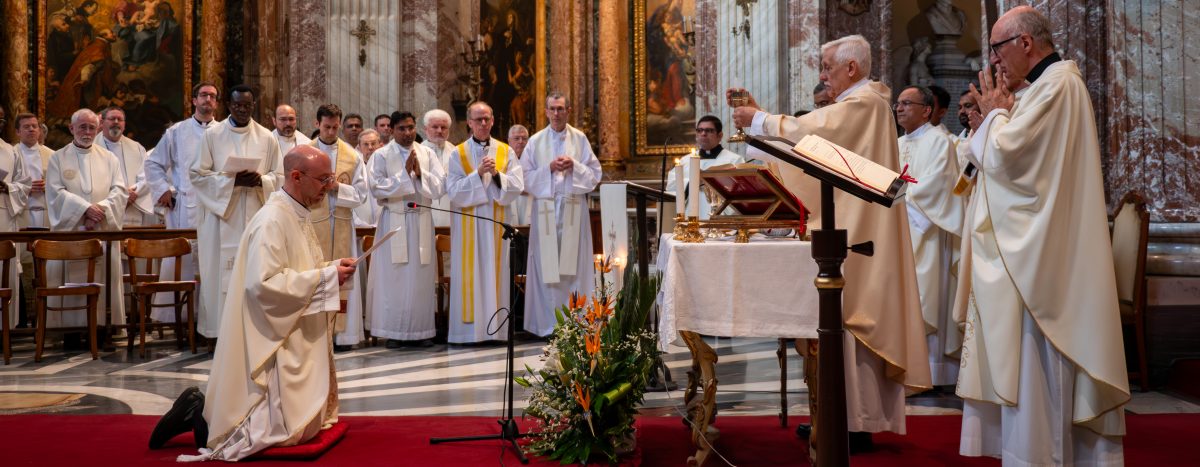
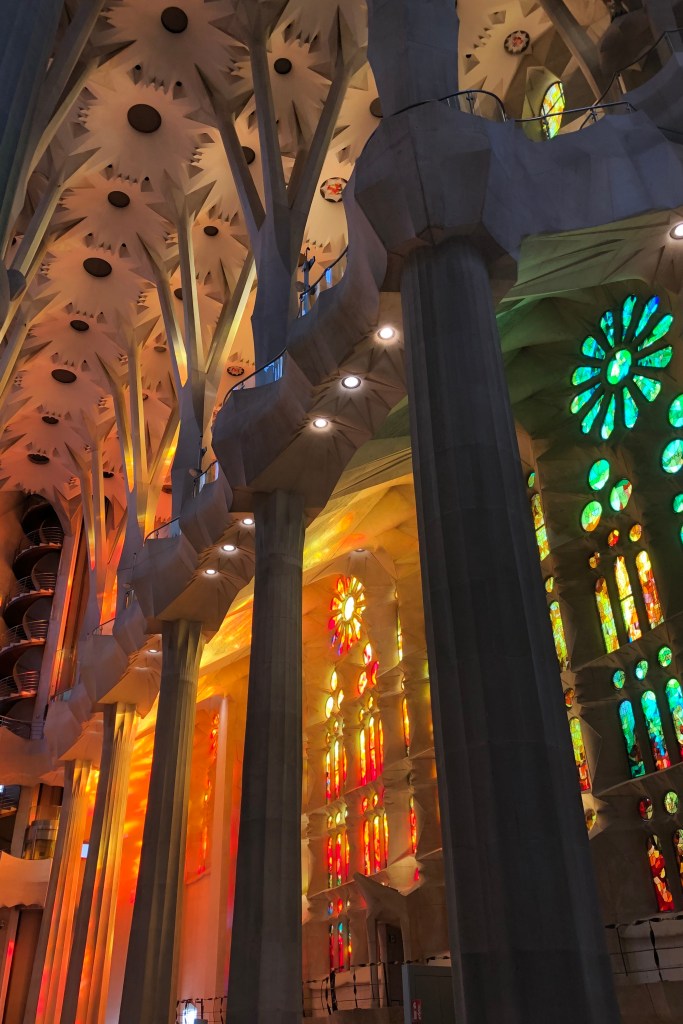
Next week Pope Leo XIV will visit the Basilica of the Sagrada Familia in Barcelona. I have been reflecting on this unique gem of modern architecture a lot since my trip to Barcelona this spring, especially in this essay in America magazine. Pope Leo will dedicate the basilica’s newly completed central tower; his visit got me thinking about the last time a pope visited the Sagrada Familia.
Sixteen years ago, Pope Benedict XVI dedicated the basilica’s central altar and gave a characteristically profound reflection to mark the occasion. I was studying philosophy at Loyola University Chicago at the time, and from the shores of Lake Michigan, I wrote a short reflection on the event, which I thought I’d reproduce here.
Beauty, Basilicas, and Barcelona
Beauty is one of mankind’s greatest needs.
—Benedict XVI
November 9, 2010.
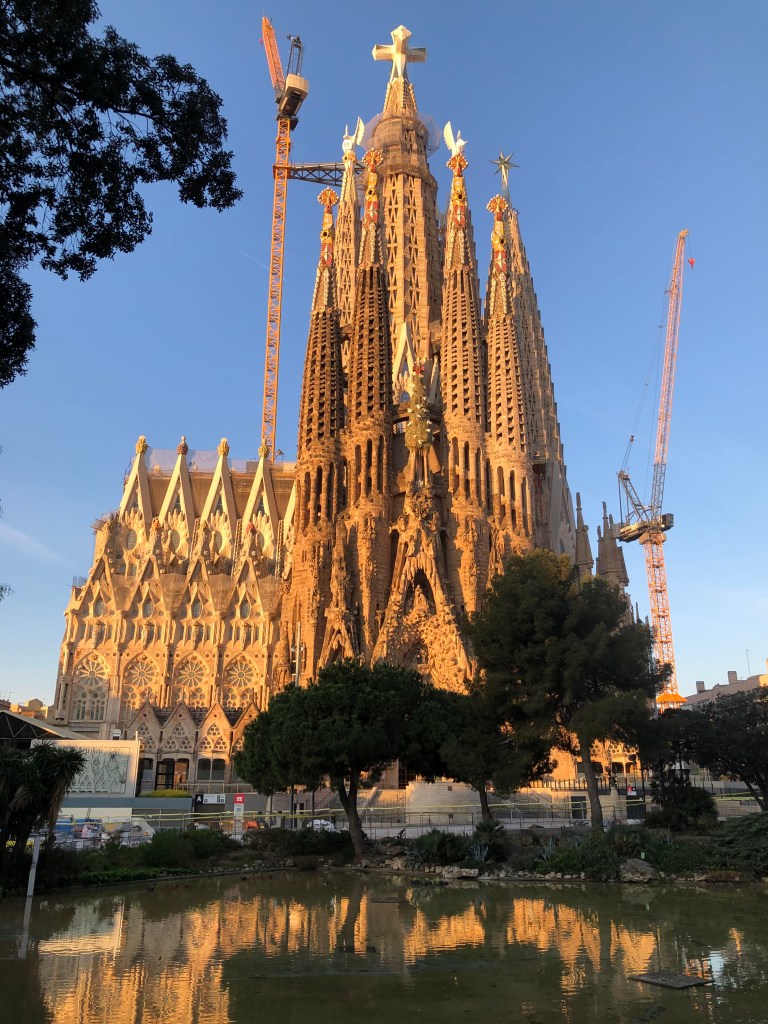
On Sunday Pope Benedict consecrated the Basilica of the Sagrada Familia in Barcelona, Spain, a truly awesome rite. Construction of the basilica, Antoni Gaudí’s masterpiece, began in 1882 and is not expected to be complete for another decade and a half. In that respect, the Sagrada Familia is like many of the other great churches of Europe which took centuries to complete.
Today, the Church celebrates the dedication of another great basilica, St. John Lateran, Rome’s cathedral. To some, this might seem a rather strange feast on the liturgical calendar, commemorating as it does a building rather than an event in the life of Jesus or a saint. Some might even disapprove of lavishing such attention on a structure, a sentiment that finds expression in a line from my least favorite liturgical song, “Gather Us In.” “Gather us in,” the ditty goes, but “[n]ot in the dark of buildings confining.”
The idea of church buildings as “confining,” however, does not do justice to artistic marvels such as the Sagrada Familia or St. John Lateran, wonders as much spiritual as they are architectural. These buildings are, in fact, a true and profound expression of faith.
It takes an act of faith just to start a project such as the Sagrada Familia, especially knowing that one is unlikely to live to see it through. In Pope Benedict’s homily on Sunday he noted the deep faith of the architect Gaudí, who when confronted by setbacks and obstacles would exclaim, “St. Joseph will finish this church.” I’m reminded of Florence’s cathedral, Santa Maria del Fiore, which was designed to be topped by a massive dome—before anyone had developed the technology to make building such a dome possible. Buildings such as the Sagrada Familia and Santa Maria del Fiore represent man’s stretch beyond the limits of his abilities, beyond what seems possible; to start building such a project is always an act of hope.
It’s also an act of great selflessness. I suspect that the thing that makes the Church’s sumptuous basilicas and cathedrals incomprehensible to some and objectionable to others is the difficulty we have seeing beyond the individualism of our era. It’s hard for us to fully appreciate what a profoundly selfless act it is to dedicate one’s life, one’s income, one’s creativity to a project that one will never see complete. Perhaps there is even a social message in the cathedrals of Europe about the nature of the common good and the potential of the human spirit to act without self-interest, to be moved by a motive beyond profit.
Such a spirit of selflessness is exemplified for me in the history of the Basilica of St. Josaphat in Milwaukee, that city’s most beautiful church, financed by working class Polish immigrants. Some of those immigrant families took out second mortgages on their homes in order to see their church completed. They knew they were part of something much greater than themselves. Pope Benedict’s homily suggested that the absolutely gratuitous beauty we see in places like the Sagrada Familia or St. Josaphat can indeed draw us out of our selfishness.
Last year, visiting the Loyola University Museum of Art here in Chicago I was struck by a number of detailed carvings taken from the ceiling of an ancient English church, carvings so high up they would not have been visible to any mortal eye. The spirit embodied in that stone still leaves me a bit in awe. For whatever anonymous stonemason worked that stone, God’s approval was enough; simply making something beautiful was more important than the thing’s utility; and being—the reality of the thing—was more important than perception or recognition.
And how many such anonymous craftsman-saints are represented in the stones of Europe’s great basilicas? Such churches are an almost sacramental sign of the Church itself, of how we in our small, anonymous, and unnoticed ways are part of a beauty infinitely greater than anything we could produce or purchase or even imagine. What is the communion of saints but a long line of grubby peasants shot through with the radiance of the true God, Light from light?
The wonderful thing about the Church’s great cathedrals and basilicas is how they make transcendent beauty accessible to all of us, popes and peasants alike. Perhaps a few of Europe’s palaces and royal gardens might rival its cathedrals in beauty, but they are the domain of the aristocracy alone. And the beauty of St. Peter’s, St. John Lateran, Milan’s Duomo, Santa Maria del Fiore, the Sagrada Familia far outstrips anything the rich might purchase.
I thought I’d close with a word about the Sagrada Familia itself and Gaudí’s strange wonderful style. His buildings ripple and twist, all of them just slightly—and delightfully—off kilter. He owes, it seems to me, quite a bit to the gothic style and something to El Greco as well.
The gothic is wonderful because of all the details—like the unseen ceiling carvings mentioned above—the way it allows for the individual to find a unique and expressive place within an ordered whole, and the way that whole points upward.
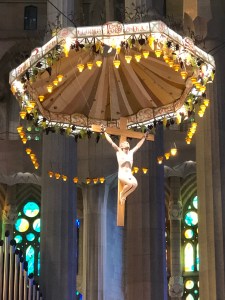
And El Greco’s figures are real, but not quite. They aren’t fragmented and dehumanized as are so many of Picasso’s, but El Greco isn’t striving simply to mimic reality either. He allows an element of fantasy into his realism; he paints a world which is recognizable but different from the everyday. And in this, perhaps, he trains the Catholic mind to think sacramentally, to imagine our resurrected future, a new heaven and a new earth, bodies which are still us but at the same time are in a deeper truer way. One sees in El Greco’s work hints of being intensified.
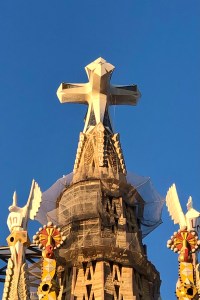
And I think the same goes for Gaudí, architecturally speaking. He has a sacramental sense. His buildings are real, no doubt, stone and concrete and metal and glass, but there’s something in them that says, more. They hint at a beyond. As Pope Benedict put it in his homily on Sunday, the Sagrada Familia stands as “a visible sign of the invisible God” whose spires point “like arrows…toward the absolute light… to the One who is Light, Height and Beauty itself.”
This essay was originally published on the Whosever Desires blog. See my other recent posts on Gaudí and the Sagrada Familia:
- Reflections on Gaudí and the meaning of the Sagrada Familia
- St. George in legend and in architecture
- Easter images from the Sagrada Familia
- The Passion Facade of the Sagrada Familia
Please consider subscribing to this blog:


One thought on “Pope Benedict XVI at the Sagrada Familia sixteen years ago”