Following up on my article in America about the Sagrada Familia and looking forward to Pope Leo XIV’s visit to Spain, I had a chance to sit down at the beginning of the month with Robert Duncan, host of Vatican Access, a new podcast from Catholic News Services.
It was a great conversation, and I was happy to discover this excellent new podcast. You can watch the interview here: “Why Pope Leo Chose Sagrada Família.”
Readers might also be interested to check out the 20th Anniversary Issue of Dappled Things magazine. The fact that this unique contribution to the Catholic literary scene has been going for two decades is indeed worth celebrating, and I was honored that they included one of my stories from 2017 in an anthology of their favorites. The story has dystopian ring, which in retrospect feels almost prophetic….
Here’s a final rundown of recent posts on Gaudí and the Sagrada Familia:
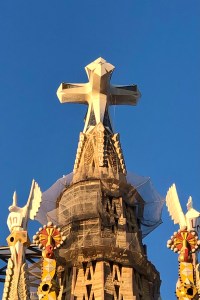
Next week Pope Leo XIV will visit the Basilica of the Sagrada Familia in Barcelona. I have been reflecting on this unique gem of modern architecture a lot since my trip to Barcelona this spring, especially in this essay in America magazine. Pope Leo will dedicate the basilica’s newly completed central tower; his visit got me thinking about the last time a pope visited the Sagrada Familia.
Sixteen years ago, Pope Benedict XVI dedicated the basilica’s central altar and gave a characteristically profound reflection to mark the occasion. I was studying philosophy at Loyola University Chicago at the time, and from the shores of Lake Michigan, I wrote a short reflection on the event, which I thought I’d reproduce here.
Beauty, Basilicas, and Barcelona
Beauty is one of mankind’s greatest needs.
—Benedict XVI
November 9, 2010.
On Sunday Pope Benedict consecrated the Basilica of the Sagrada Familia in Barcelona, Spain, a truly awesome rite. Construction of the basilica, Antoni Gaudí’s masterpiece, began in 1882 and is not expected to be complete for another decade and a half. In that respect, the Sagrada Familia is like many of the other great churches of Europe which took centuries to complete.
Today, the Church celebrates the dedication of another great basilica, St. John Lateran, Rome’s cathedral. To some, this might seem a rather strange feast on the liturgical calendar, commemorating as it does a building rather than an event in the life of Jesus or a saint. Some might even disapprove of lavishing such attention on a structure, a sentiment that finds expression in a line from my least favorite liturgical song, “Gather Us In.” “Gather us in,” the ditty goes, but “[n]ot in the dark of buildings confining.”
The idea of church buildings as “confining,” however, does not do justice to artistic marvels such as the Sagrada Familia or St. John Lateran, wonders as much spiritual as they are architectural. These buildings are, in fact, a true and profound expression of faith.
It takes an act of faith just to start a project such as the Sagrada Familia, especially knowing that one is unlikely to live to see it through. In Pope Benedict’s homily on Sunday he noted the deep faith of the architect Gaudí, who when confronted by setbacks and obstacles would exclaim, “St. Joseph will finish this church.” I’m reminded of Florence’s cathedral, Santa Maria del Fiore, which was designed to be topped by a massive dome—before anyone had developed the technology to make building such a dome possible. Buildings such as the Sagrada Familia and Santa Maria del Fiore represent man’s stretch beyond the limits of his abilities, beyond what seems possible; to start building such a project is always an act of hope.
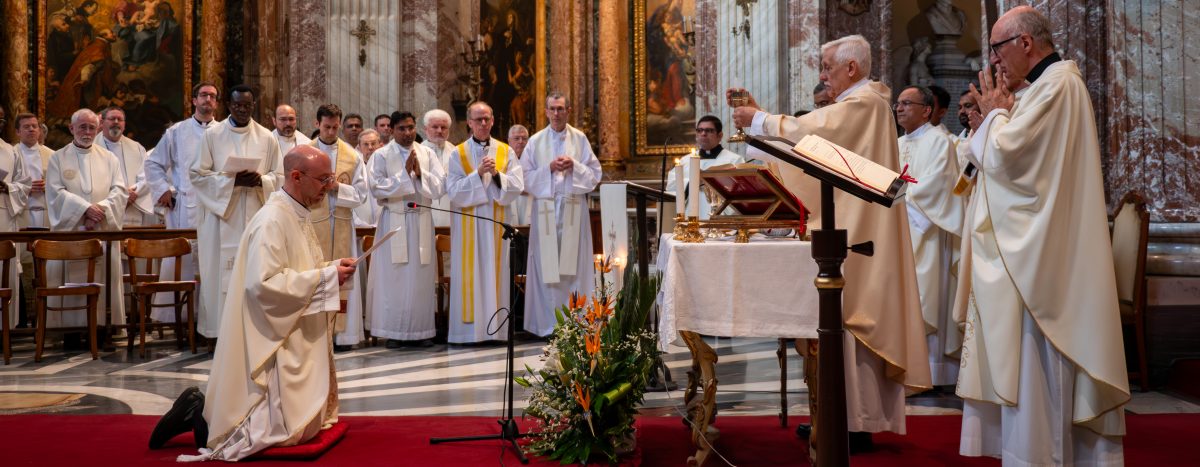
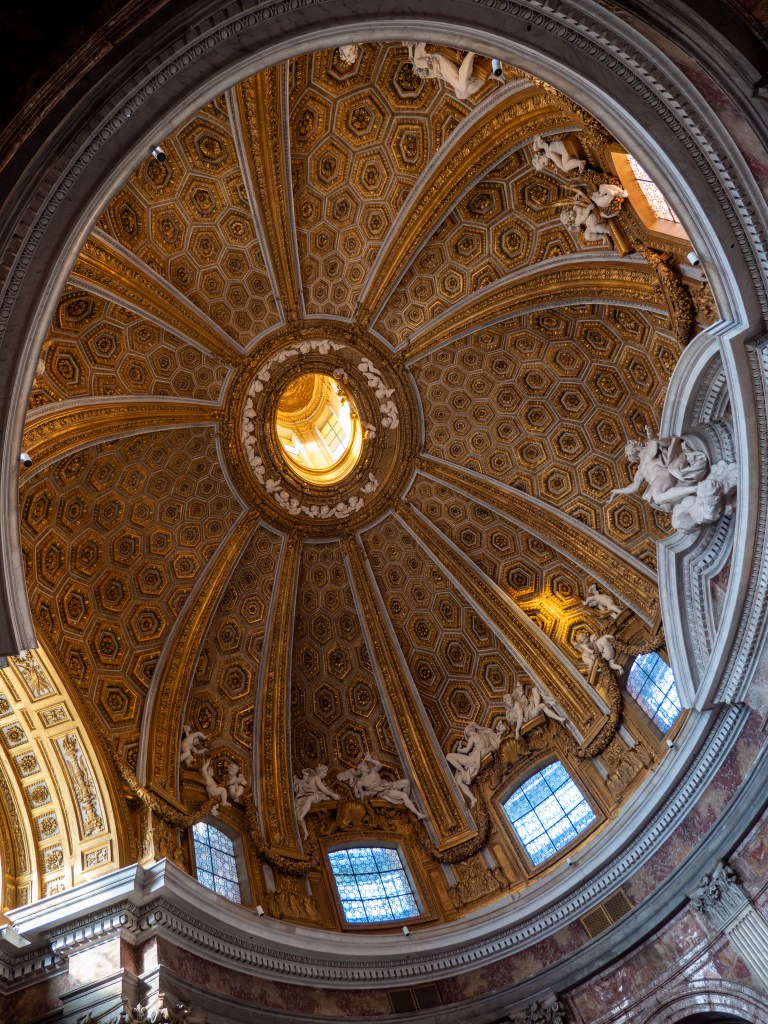
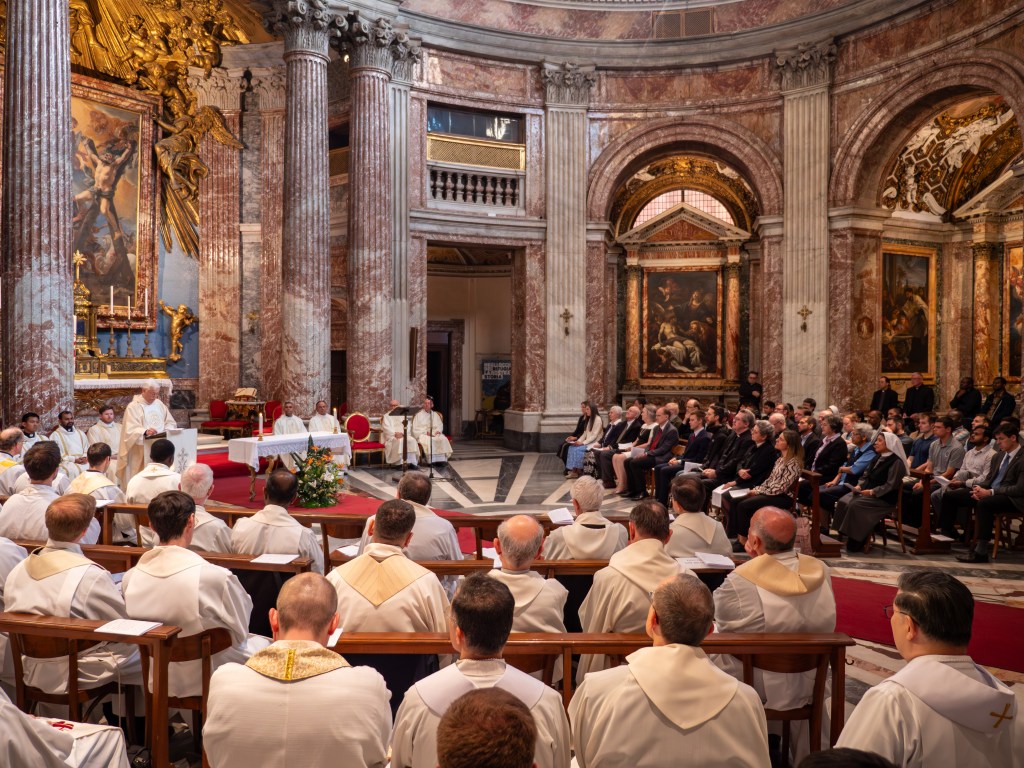
A few weeks ago I shared some reflections on taking my final vows as a Jesuit, a tremendously blessed moment for me. Today I thought I might add a few words and pictures about the place where I took those vows: the Church of Sant’Andrea al Quirinale.
Since Rome is packed with stunningly beautiful churches, sometimes those that would be at the top of the visitor’s itinerary anywhere else in the world end up being overlooked. Sant’Andrea al Quirinale is one of those. It should be numbered among the most important Jesuit churches in the world, but in Rome it has to compete with the Gesù–site of the body of St. Ignatius and the arm of St. Francis Xavier–and Sant’Ignazio–the onetime chapel of the Roman College, as the Gregorian University was first known. Both churches are enormous, paradigmatic examples of the baroque at its most overwhelming.
Sant’Andrea is tiny by comparison, but don’t let size mislead you. It was the chapel of the first Jesuit novitiate; in an adjoining room, one can visit the relics of St. Stanislaus Kostka, patron of Jesuit novices and of students, who died there in 1568 at the age of 17.
Sant’Andrea al Quirinale interior
While it stood on the site of an early church dedicated to Andrew the Apostle, the present Sant’Andrea (built in 1658) was designed by Gian Lorenzo Bernini. Bernini, who was busy at the time decorating the interior of St. Peter’s Basilica and building the colonnade for St. Peter’s Square, refused to take a commission for Sant’Andrea. It was said to be his favorite work, and, as he aged, the great artist was sometimes seen sitting alone inside the church, enjoying its peaceful atmosphere.
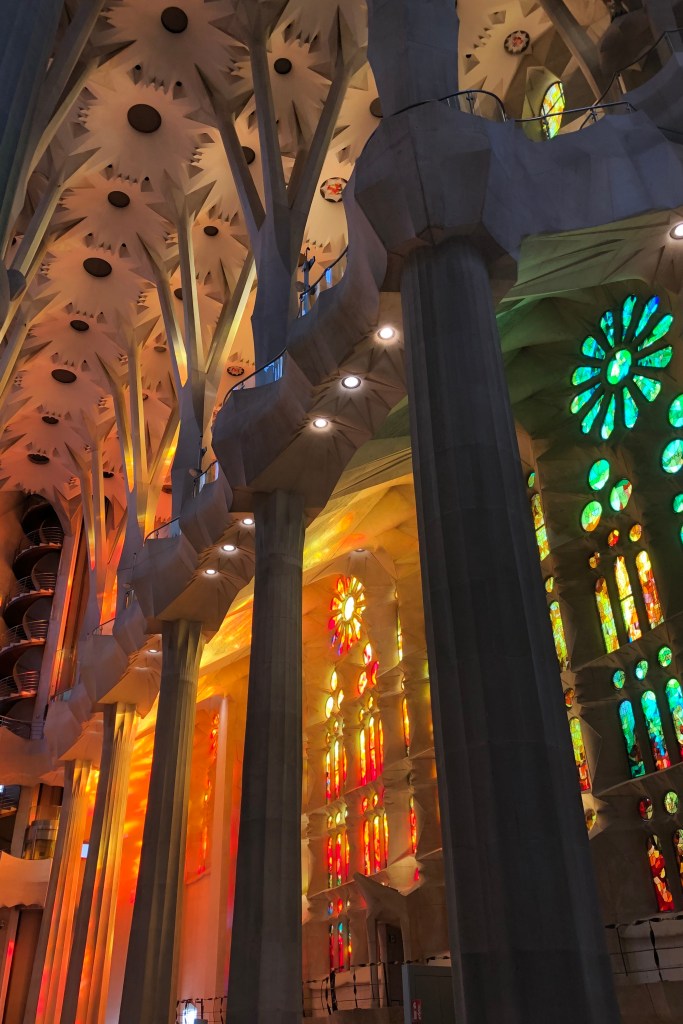
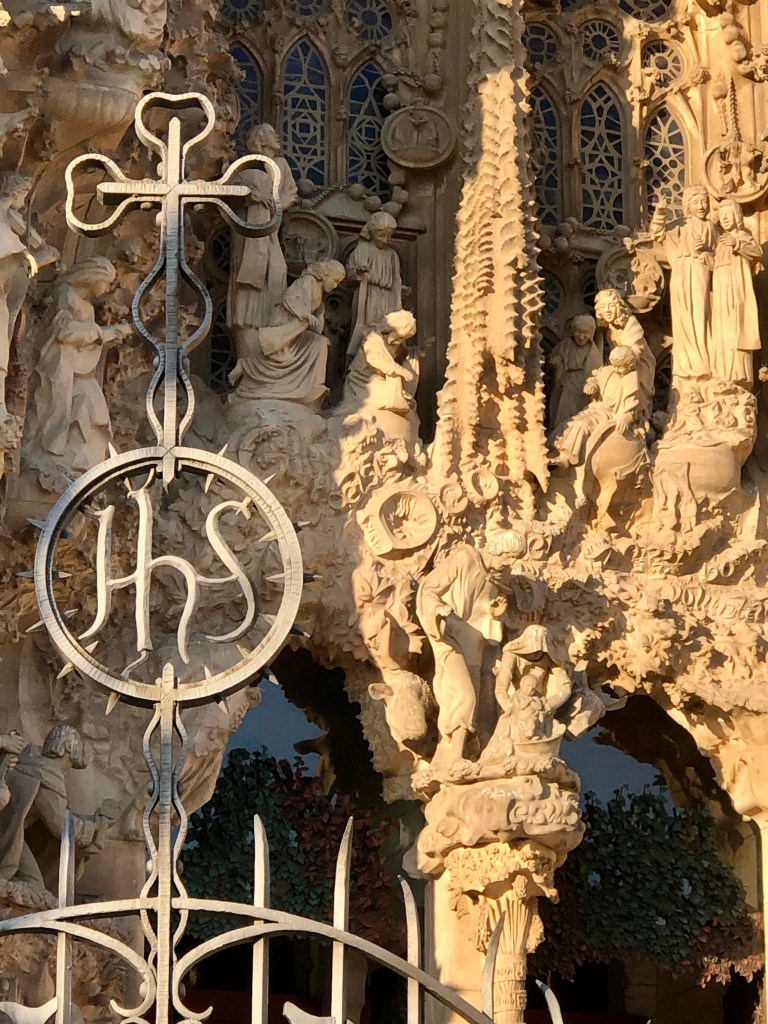
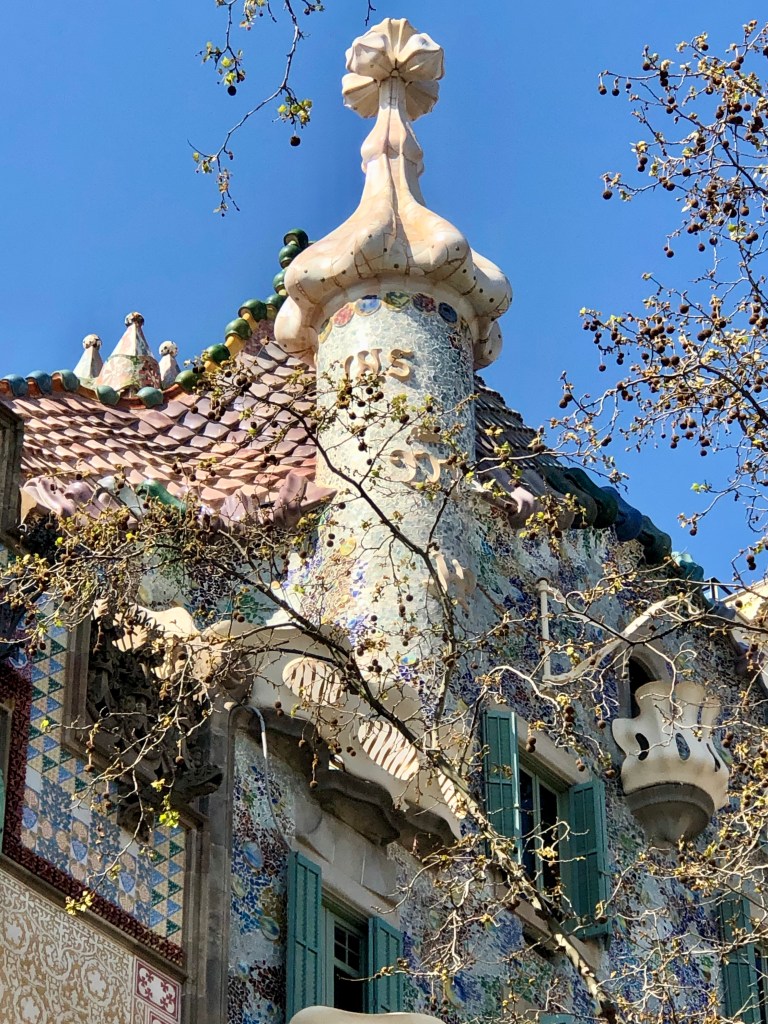
A few weeks ago I alluded to a somewhat unexpected trip I made to Barcelona before Easter and put up a few pictures of the Sagrada Familia (here and here) and Casa Batlló, two of the most iconic works of the architect Antoni Gaudí. This year happens to be the 100th anniversary of Gaudí’s death, which will coincide with the visit of Pope Leo XIV to Spain. The aim of the trip was to write a reflection on the meaning of Gaudí’s great work for America magazine. The article is now out here, and I have to say it is one of my favorite pieces — no doubt because the subject is so beautiful and fascinating.
For good measure, I thought I’d share a few more photos for your reflection and enjoyment:
April 23 is the feast day of St. George, a saint whose popularity — as well as just about everything we know about him — is legendary. The saint hailed from the Christian east — possibly from Cappadocia in present-day Turkey — but seems to have been martyred in the late third century in what is today Israel. George was a soldier who converted to Christianity. He was put to death after refusing to sacrifice to Rome’s pagan gods and undergoing excruciating tortures.
This defiant courage when standing up to a more powerful foe is perhaps what has made the figure of St. George resonate with so many throughout history. Perhaps it also contributed to the legendary stories of St. George slaying a dragon who was oppressing a Christian population. The saint is particularly popular among Arab Christians, who have long lived under the yoke of Muslim rule, and across the eastern Mediterranean — in Greece and Malta, for example, communities menaced for centuries by invasion from various Islamic empires pushing westward.
St. George, in fact, has found popularity wherever an underdog has felt the need for a champion. He is the patron, along with St. Sebastian, of one of Rome’s station churches. This year when I traveled to Barcelona (which I mentioned here and here), I learned that George is the patron of that city as well. The legend of St. George fits, in an unexpected way, into one of the city’s best known architectural monuments, Antoni Gaudí’s Casa Batlló.
Recently, I was fortunate to be able to take a brief trip to Barcelona for a research project (more on that to come). I spent as much time as I could at Antoni Gaudí’s marvel, La Sagrada Família (more on that, as well).
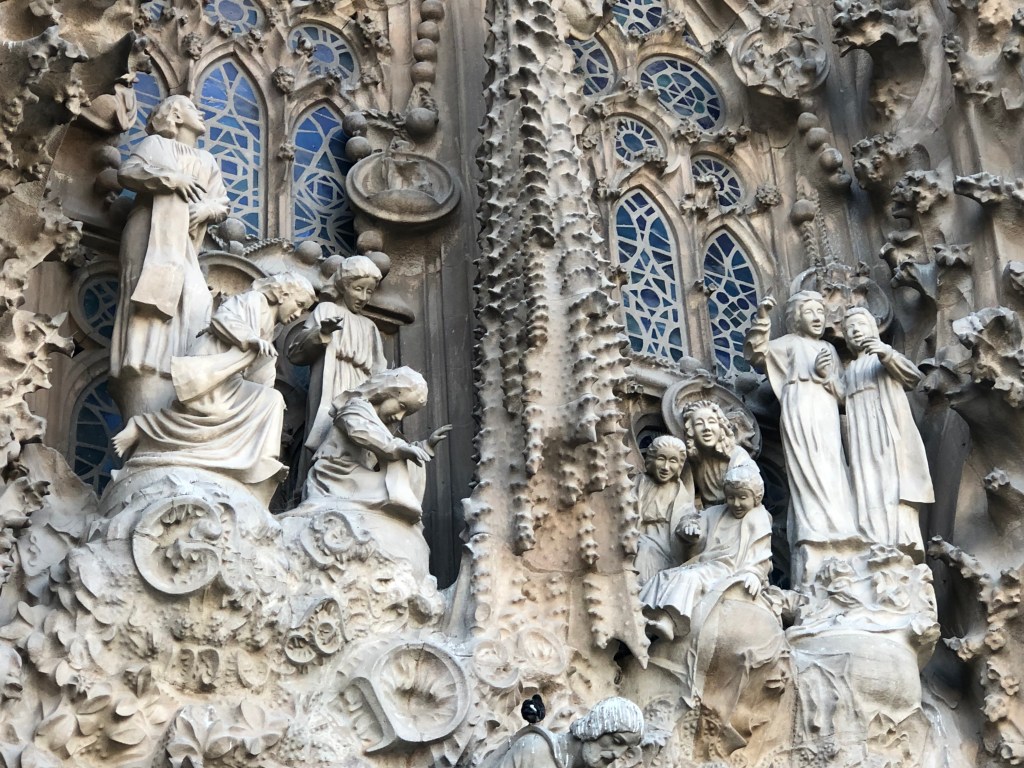
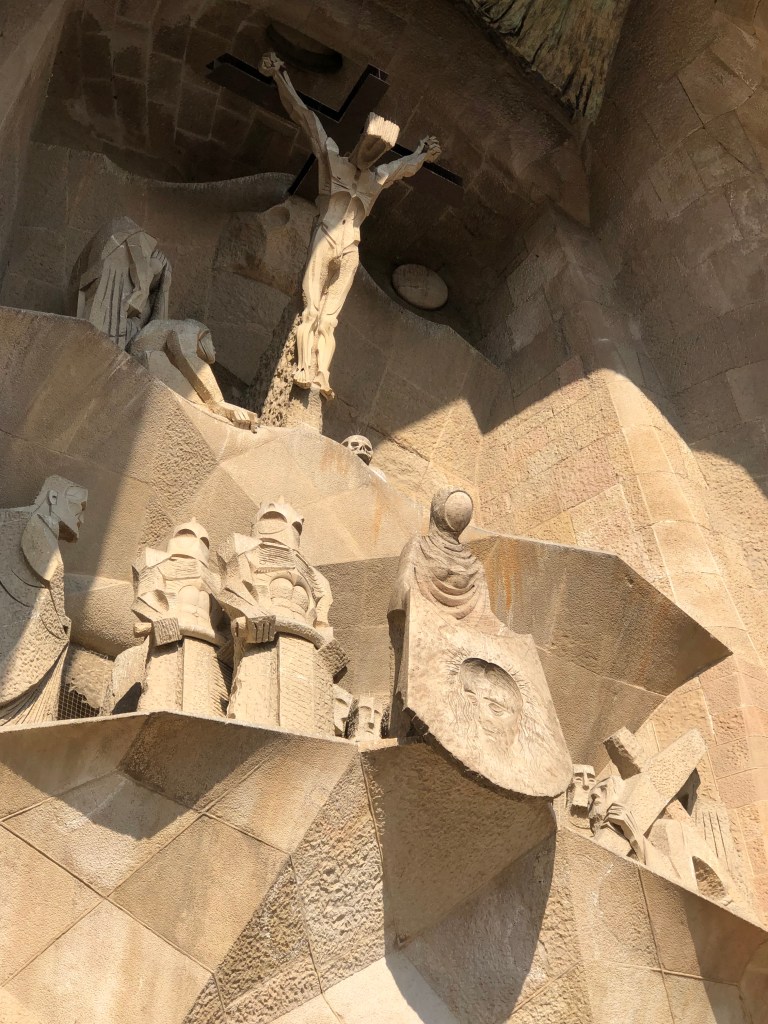
The entire basilica is a marvel, a deeply spiritual and prophetic building. This Holy Week, I thought it would be appropriate to share some photos of the Façana de la Passió, the Passion Facade. The sculptures broadly follow Gaudí’s instructions, though they are the work of Josep Maria Subirachs. If anything, the sculptures are even more harsh and austere than Gaudí’s original sketches. The hardness of the work is actually in keeping with Gaudí’s instructions.
Last week I was pleased to take part in a conference organized by at the Gregorian University’s Faculty of History and Culture and the Institute of Liturgy at the University of Santa Croce entitled L’edificio di culto e gli artisti: A 25 anni dal primo Giubileo degli Artisti (2000-2025). The theme was church architecture and art over the past 25 years. The conference brought together an impressive group of international architects, artists, and theologians.
My own rather modest contribution was to extend the reflection I began in November’s issue of First Things on “Screens and Sacraments.” The talk seemed to produce a good deal of agreement that we need to be more discerning in how we allow technology to intrude on our sacred spaces.
Pulpit, Church of the Gesù, Rome
On a related note, I was also happy to read a quite generous response to my article from Kevin Martin of Raleigh, North Carolina in the January 2025 issue of First Things. He reports being “strong-armed against [his] better judgement into Zooming the liturgy during the first year of the pandemic,” but eventually abandoning the practice because it felt wrong for many of the reasons I discussed in my article. He wonders, however, if I do not concede too much by suggesting that it might be OK to continue to broadcast the Liturgy of the Word, while stopping at the Liturgy of the Eucharist.
It’s a thoughtful question. I’d begin by saying that I am by no means arguing that one must broadcast any form of worship, and I have no quarrel with the decision of Rev. Martin’s church to give up streaming altogether. At the same time, I’m not an absolutist when it comes to technology, and some of the goods that people claim from broadcast Masses are real. Sick parishioners in particular can be helped to pray by seeing images of the liturgy online and comforted by the sight of their home church and familiar faces. These might supplement pastoral outreach to the homebound, without replacing it. I’m a little more skeptical about the evangelical or formative value of e-liturgy, since I think its appeal is mainly to those who have already been sufficiently formed by real liturgy.
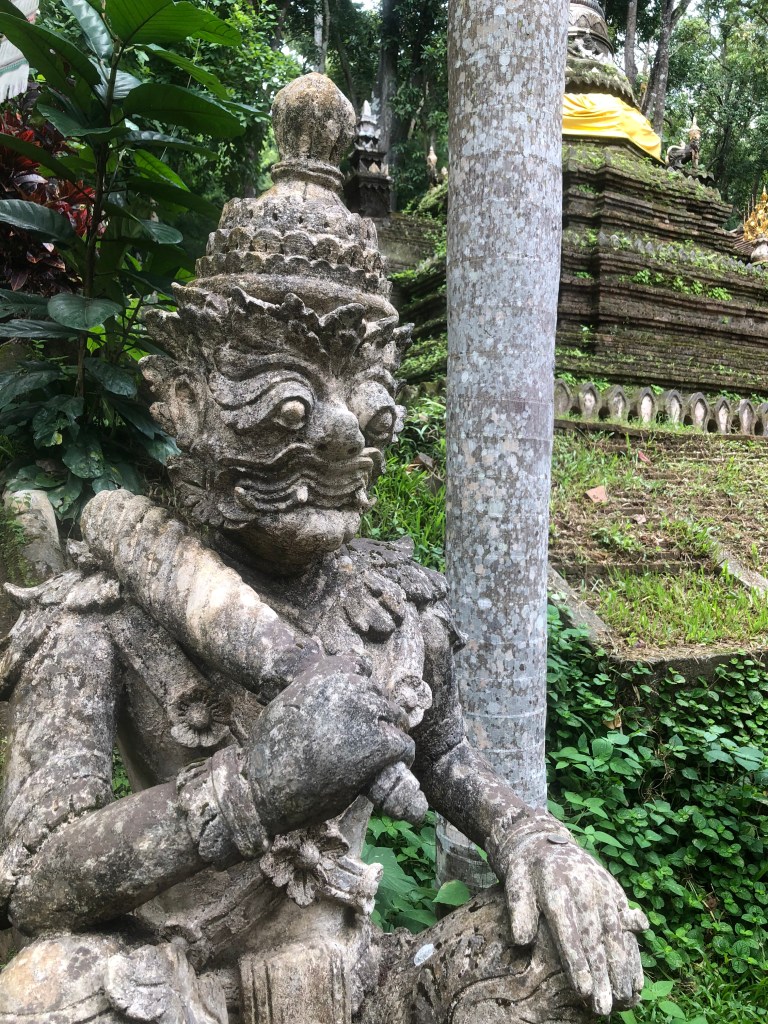
One of the highlights of my recent travels through Asia was visiting a number of quite impressive Buddhist temples and shrines. This was particularly the case in Thailand, though Chinese temples in Singapore, Taiwan, and Hong Kong were also filled with rich carvings, colorful statues, and piles of offerings including fruit, flowers, and burning incense. The warm red–the color of prosperity–of the Chinese temples reminded me of the red color with which the ancient Romans frescoed the inside of their homes. The desire for a warm hearth is written deeply in the human psyche.
Thian Hock Keng Temple, Singapore
A place of worship that makes an absorbing appeal to the senses is of course nothing new to me. I live in Rome, city of the baroque, where tales of religious ecstasy are told and retold in marble, mosaic, and fresco. The impulse of Christianity to express itself in art goes back to the Incarnation itself, to God revealing himself by entering into the world of the flesh, expressing his divinity in the matter of creation. We Catholics believe that he continues to communicate his grace to us through the sacraments. Artistic expressions using color, smell, and sound to amplify this divine work come naturally enough to a sacramental faith.
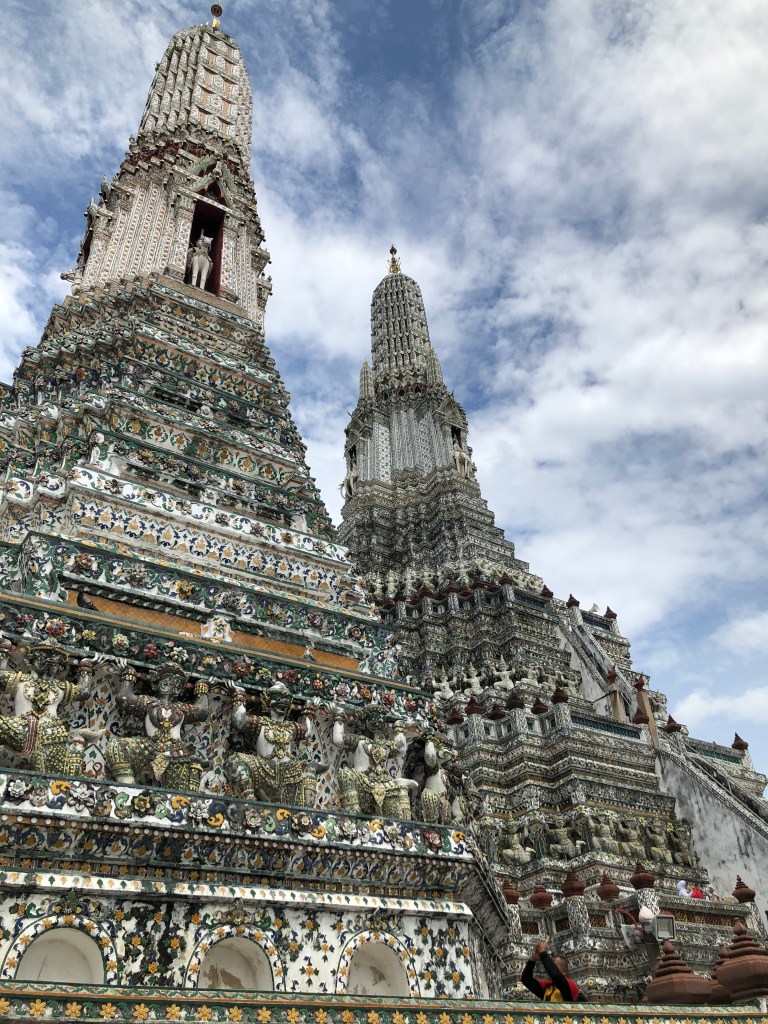
But what about Buddhism? Such expressions would seem to me, an outsider, to fit less naturally within Buddhist philosophy, with its distrust of all desire and negation of the world of pleasure and pain. Incarnation and Nirvana are two radically different beliefs. Yet how else to describe the gilded wats of Thailand, the cascades of angels and demons in glittering ceramic, than Buddhist baroque?
Wat Arun Ratchawaramahawihan, Bangkok
Of course, Thailand’s wats are not the architectural expression of pure Buddhist philosophy but a kind of non-culinary Asian fusion–Buddhism grafted into a still older mix of traditional folk beliefs, legends, and superstitions. How cogent such a mix is, I can’t evaluate. But there’s something human about that folk mix that I find more compelling than Buddhism in its purity, which I’ve always thought a little chilly.