The question that changes who we are: homily for the 21st Sunday in Ordinary Time

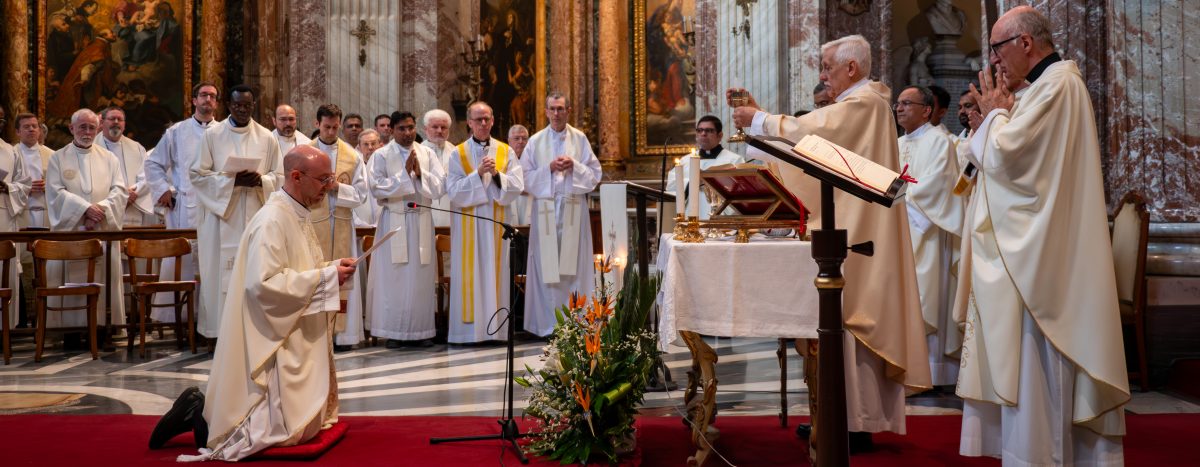
Jesus consigning the keys to St. Peter, G. Battista Cassignola, 1569

Homily for the Twenty-first Sunday in Ordinary Time (Year A).

It’s hard to imagine a better Gospel reading with which to end an Ignatian retreat.  We find this episode at the middle point of Matthew’s Gospel, and the question that Jesus poses to his disciples is the hinge on which everything else turns: “Who do you say that I am?”

We have heard the episode before, so perhaps we don’t register what a strange question Jesus asks.  When I test my students at the end of the semester, I ask them about the content of the course, not about my own identity.  But Jesus asks about himself, not his message.  Were he any other teacher, such a question would be pure arrogance.  But Jesus is not like anyone else, and everything depends upon our recognizing the difference.  

Public opinion, as the disciples tell it, seeks to put Jesus into a recognizable category; he is one of the prophets, like Elijah or Jeremiah.  Perhaps he is the reincarnation of John the Baptist.  But Jesus does not let such answers go, and the disciples themselves have been with him long enough that they are not satisfied with such an answer, either.  There is a right and a wrong answer to the question Jesus asks.  It is not a matter of opinion.  Jesus is not administering a Rorschach test to prompt the disciples to look more deeply into themselves.  The question is not what is inside, but who is standing here before you.

Continue reading “The question that changes who we are: homily for the 21st Sunday in Ordinary Time”
Scholars react to Baptism of Desire and Christian Salvation

A number of reviews and reactions to Baptism of Desire and Christian Salvation have come out in the past few months from scholars who have recognized the book’s importance not only for the field of sacramental theology, but for other areas such as missiology and moral theology as well.

I was especially delighted to read Dom Hugh Somerville Knapman’s appreciative words in The Downside Review. Some very important — but today largely overlooked — debates over limbo, the eternal destiny of unbaptized infants, and baptism were hashed out in the pages of The Downside Review in the mid-twentieth century, and I cite some of them in Baptism of Desire and Christian Salvation. It is gratifying — and humbling — to see my own contribution become a part of this much longer and larger conversation.

Dom Knapman writes

It is to Anthony Lusvardi’s credit that he has revisited such an unfashionable doctrine, and so well… More importantly, even most importantly for this reader, Lusvardi confronts us with the centrality of baptism to the gift of salvation in Christ. Anyone who teaches baptism, especially at secondary and tertiary levels, will benefit enormously from Lusvardi’s work…

Lusvardi explains masterfully and accessibly how authentic doctrinal development plays out, as the Church addressed and overcame these apparent challenges to the fundamental doctrine of the necessity of sacramental baptism. What he reveals is that baptism always remains necessary, but also that in cases of strictly-defined inability, it can be attained by modes other than water, that is by blood or desire. Baptism by water, blood, or desire all achieve the same end: conformity to and participation in the death and resurrection of Christ.

While Dom Knapman appreciated the sacramental dimensions of the work, Dr. Gavin D’Costa, one of the world’s top scholars in the theology of world religions and missiology, notes its importance for those fields. In his review in Angelicum, D’Costa picked up on the parallels between my book’s historical analysis and Servais Pinckaers’s seminal The Sources of Christian Ethics, “where Pinckaers argued a similar thesis about Christian ethics — from Christologically centered praxis and the pursuit of virtue, to emphasizing duty, obligation and juridical categories.” Thinking about baptism or salvation primarily in terms of such categories, I argue, led to a distorted picture which began to come apart in the nineteenth and twentieth centuries.

Continue reading “Scholars react to Baptism of Desire and Christian Salvation”