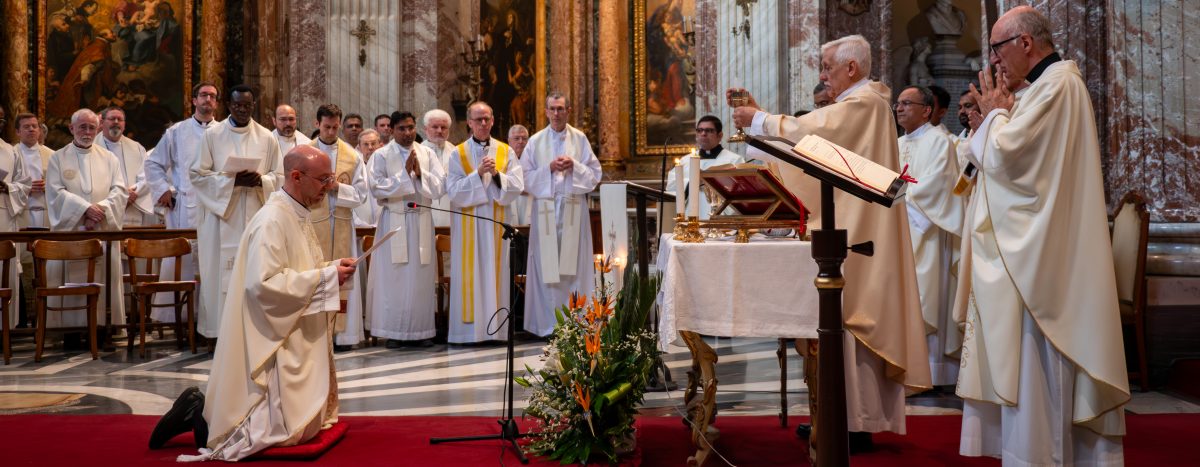
The question that changes who we are: homily for the 21st Sunday in Ordinary Time

Jesus consigning the keys to St. Peter, G. Battista Cassignola, 1569

Homily for the Twenty-first Sunday in Ordinary Time (Year A).

It’s hard to imagine a better Gospel reading with which to end an Ignatian retreat.  We find this episode at the middle point of Matthew’s Gospel, and the question that Jesus poses to his disciples is the hinge on which everything else turns: “Who do you say that I am?”

We have heard the episode before, so perhaps we don’t register what a strange question Jesus asks.  When I test my students at the end of the semester, I ask them about the content of the course, not about my own identity.  But Jesus asks about himself, not his message.  Were he any other teacher, such a question would be pure arrogance.  But Jesus is not like anyone else, and everything depends upon our recognizing the difference.  

Public opinion, as the disciples tell it, seeks to put Jesus into a recognizable category; he is one of the prophets, like Elijah or Jeremiah.  Perhaps he is the reincarnation of John the Baptist.  But Jesus does not let such answers go, and the disciples themselves have been with him long enough that they are not satisfied with such an answer, either.  There is a right and a wrong answer to the question Jesus asks.  It is not a matter of opinion.  Jesus is not administering a Rorschach test to prompt the disciples to look more deeply into themselves.  The question is not what is inside, but who is standing here before you.

Continue reading “The question that changes who we are: homily for the 21st Sunday in Ordinary Time”
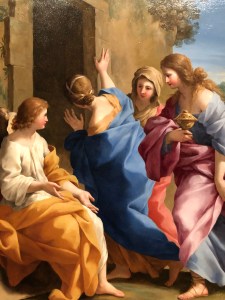
Entering the tomb: a homily for Easter

This Homily for Easter Sunday comes from 2019 and was given just a few days after the fire at Notre Dame Cathedral in Paris — thus the reference to the rose window at the end. Seems appropriate this year when Notre Dame has been reopened…

Occasionally the most erudite theologians overlook the most obvious things. This morning’s gospel contains a curious detail that has provoked a great deal of discussion among theologians: why do Mary of Magdala and John, the other disciple, not enter the tomb? Mary sees the stone removed from the tomb and returns to the apostles. John, running and perhaps a bit younger than Peter, arrives at the tomb first, but remains outside. Why? Biblical exegetes have explained this event symbolically–maybe John represents prophecy and Peter represents the institutional Church–but in my opinion the reason is simpler.

It’s a tomb. They were afraid.

Sometimes the simplest explanations are also the most profound. We know that Jesus is risen–maybe this announcement has become too familiar and gets taken for granted–but at that moment Mary, John and Peter did not have that advantage. We must imagine their psychological state that morning. Two days ago, they had seen the humiliation and killing of their Lord, teacher and friend at the hands of evil men. We must imagine the darkness of those days, when violence, lies and selfishness defeated the truth.

Continue reading “Entering the tomb: a homily for Easter”

Signs of Easter

With winter now banished, one of my favorite signs of Roman spring is here — flowers sprouting from the tile rooftops. Above, my favorite, the corner of St. Ignatius Church seen from the terrace of our building, below a more modest view from my room. I’m not sure what this annual effusion of greenery means for the structural integrity of the tiles — and, I guess, I don’t really care. I find the flowers exuberant and surprising and, yes, just a tad reckless. In other words, a perfect sign of Easter.

I’ve always thought the flowers — life and beauty — breaking through the tiles a nice metaphor for the Resurrection, like the angels dressed in dazzling white among the scattered tombstones. This year they’ve also put me in mind of Peter. Peter is, after all, a slightly reckless figure, the desires of his heart a step ahead of his own moral capacities. His love for Jesus leads him to boast of his fidelity on Holy Thursday — “Lord, I am ready to go with you to prison and to death” — and then to find that his steadfastness has fallen short of his aspirations. It is devastating to read of Peter’s betrayal; one can imagine how much more devastating it was to live it.

Continue reading “Signs of Easter”