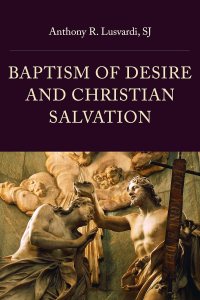
Baptism of Desire and Christian Salvation

My book Baptism of Desire and Christian Salvation is now available to order, though its shipping date will be a little later. Its official publication date was originally last Friday but now seems to have been bumped to March. I’ve been working on the topic of baptism of desire since my STL studies at Sant’Anselmo–a good six years ago–so it has been a long time coming. I think the result says some important things for Catholic theology and the evangelizing mission of the Church. So let me assure you, it’s worth the wait!

I’ll have more on the topic to say, of course, and I’ll share the reactions of others to the book so you don’t have to take my word for it. For now I’ll just share the official description from Catholic University of America Press. The book is available directly from CUA’s website as well as other online booksellers such as Amazon. This spring CUA is offering a 20% discount on new books with the promo code CT10. Make sure that your library gets a copy, too!

Baptism of Desire and Christian Salvation. Belief in the necessity of baptism for salvation is rooted in the New Testament and was forcefully affirmed by the Church Fathers, yet today this belief is treated with unease if not ignored altogether. Over the course of centuries, Catholic theology has wrestled with a doctrine—baptism of desire—that both preserves this fundamental principle and allows for salvation in hard cases, such as catechumens dying unexpectedly. Baptism of Desire and Christian Salvation traces this doctrine’s varied history, from its genesis in a fourth century funeral oration given by Ambrose of Milan to its uneasy position in the Anonymous Christianity of Karl Rahner. 

More than a history, however, this book raises questions about the nature of religious ritual and the sacraments, the mission of the Church, and the essence of salvation. Arguing that theologians of the past two centuries have tended to downplay the role of the sacraments when discussing salvation, Lusvardi suggests that baptism should remain our theological starting point. Engaging with the theological tradition and at times challenging the conventional wisdom, Baptism of Desire and Christian Salvation shows how such a sacramental approach can offer credible—and sometimes surprising—responses to questions related to the salvation of non-Christians, the fate of unbaptized infants, and the relevance of the Church’s mission today.

Pentecost homily

This weekend we celebrate Pentecost, which is sometimes called the birthday of the Church.  You might remember that Jesus told his disciples that he had to go—he had to ascend into heaven—so that he could send the Holy Spirit to them.  On Pentecost the Holy Spirit arrives.  Before that, the disciples could see Jesus because he was a man—both God and man.  So they could see him just as you can see me and I can see you.  The Holy Spirit is God, too, but he’s Spirit, and spirits, by definition, are not physical things.  You can’t see spirits.  

St. Mary’s Cathedral, Perth, Australia

So at Pentecost, the disciples don’t see the Holy Spirit.  Instead, they see his signs.  Those signs are a driving wind and flames shaped like tongues over the heads of the people there.  One sign in particular tells us a lot about the Church.  The people at Pentecost come from different countries, and they speak different languages, so normally they wouldn’t be able to understand each other.  But when the Holy Spirit comes, they do understand each other.  The Holy Spirit changes something inside of them.

Continue reading “Pentecost homily”

A Church of all nations: homily for the twenty-first Sunday of Ordinary Time

Homily for the 21st Sunday in Ordinary Time (C)

Not long ago, at dinner in my community in Rome, which houses Jesuits from maybe 30 different countries, one of my brothers from Columbia was talking with one of my brothers from Poland about the different things people eat around the world, and he mentioned hearing that in parts of Asia people eat dog meat.  And another of my brothers from the Philippines, who is normally very quiet, looked up from his plate and said, “Oh, yes, very good,” and then he went on with his meal.  

Altar of St. Francis Xavier, Gesù Church, Rome

There is no more diverse an organization in the world than the Catholic Church.  Not only do Catholics come from different countries and races and language groups, but the Church includes saints of different historical periods, the great cloud of witnesses mentioned by the letter to the Hebrews last week.  The martyrs of first century Rome, of seventeenth century Japan, of 20th century Spain and Mexico, and, in our still-young century, of Turkey, Pakistan, Kenya, Nigeria, France and elsewhere could not have been more different culturally or socially, yet they all shared a belief in Catholicism so strong they were willing to die for it.  People have indeed come, as the Lord says, from the east and from the west, from the north and from the south to the table in the kingdom of God, around which we gather this morning.

Continue reading “A Church of all nations: homily for the twenty-first Sunday of Ordinary Time”

Not peace, but division: homily for the twentieth Sunday of Ordinary Time

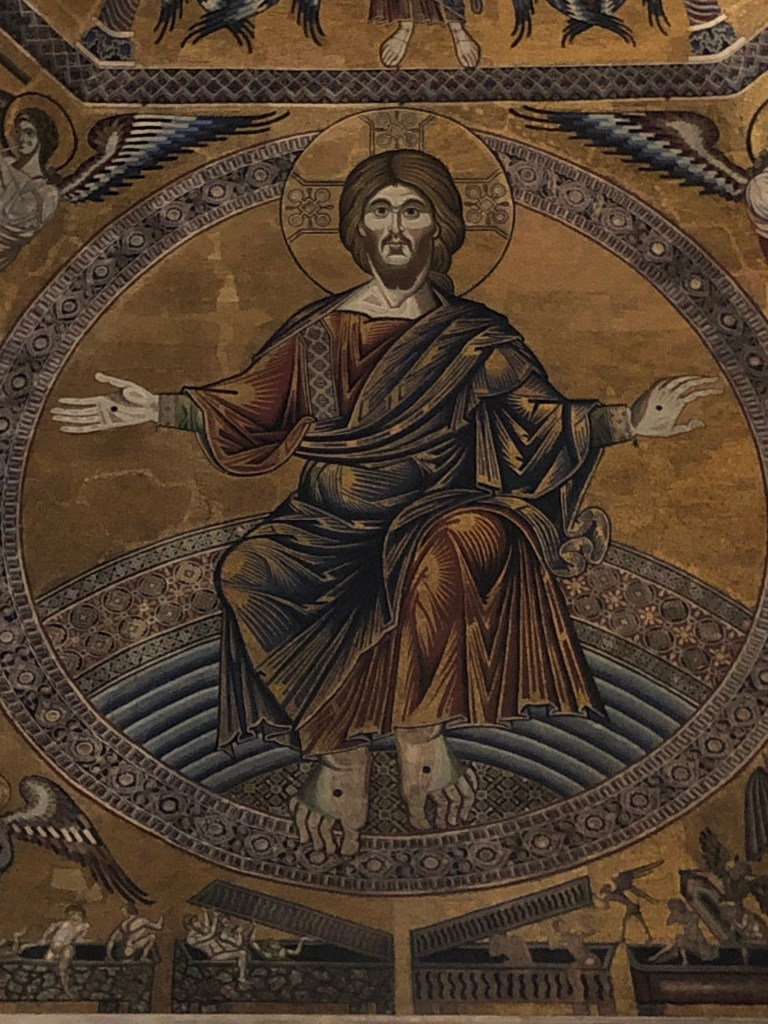
Baptistry, Florence

Homily for the 20th Sunday in Ordinary Time (C)

Politicians frequently claim to be uniters, not dividers.  If you wanted proof, therefore, that Jesus was not a politician, look no further than today’s Gospel: “Do you think that I have come to establish peace on the earth?  No, I tell you, but rather division.”

Political promises of unity, of course, come cheaply; sometimes they simply mean, “If you disagree with me, I’ll accuse you of being a divider.”  In today’s Gospel reading, however, Jesus makes a move never recommended by any political consultant: he preemptively accuses himself of bringing division.  Other than the desire to put centuries of future homilists in a very awkward position, why would Jesus do this?

Continue reading “Not peace, but division: homily for the twentieth Sunday of Ordinary Time”

Bernini’s beads

Can you spot the rosary?

When I reached the end of the station pilgrimage the last time around, I was struck by the details.

For the sacramental theologian such as myself, there’s a deep lesson in the details of the journey. The Son of God’s Incarnation meant entering fully into the reality of human life, with all its diverse moments of suffering and disappointment, of hope and joy, of sometimes just getting by. The Passion narrative is the most vividly detailed part of the Gospels, and the Resurrection stories too, though reflecting the discombobulation of that utterly unprecedented event, also retain the sort of vivid details that stick out in one’s mind even when the world has just gone outside-in. Mary thinks Jesus is the gardener. Jesus eats a bit of fish. The sacraments depend on the details of the Lord’s life, too, on what he ate at his last meal.

Continue reading “Bernini’s beads”

Soldier saints

San Giorgio in Velabro, Rome

I’ve noted before the prevalence of former soldiers among the saints of Rome, a fact especially evident in the first week of Rome’s station liturgy, when day two is celebrated at a church dedicated to St. George and St. Sebastian and day three at the site two other former soldiers, the brothers John and Paul, were martyred in 360.

The prominence of these soldier saints is especially striking while war rages in the Ukraine. Though the signs were all there ahead of time–this was not the first time Vladimir Putin invaded Ukraine–the attack and the resistance to it has seemed to jolt the West from a deep and dangerous torpor. A friend recently showed me a poll asking the people of various nations if they would be willing to fight for their country; less than half of Americans said yes–and that was high for the West. In his inaugural address, John F. Kennedy, pledged to the world, “Let every nation know, whether it wishes us well or ill, that we shall pay any price, bear any burden, meet any hardship, support any friend, oppose any foe, to assure the survival and the success of liberty.” Today, in the face of crisis, presidents compete to issue stimulus checks because, hey, free money. Something seems to have been lost.

Continue reading “Soldier saints”

One Body, many witnesses: Homily for the Third Sunday in Ordinary Time

Homily for the 3rd Sunday of Ordinary Time (C)

In today’s second reading, St. Paul warns us of autoimmune disease.  An autoimmune disease, as you may know, is when the body attacks itself, one of its own parts.  It’s a self-destructive disease.  Last week we heard Paul tell the Corinthians, who had been squabbling over who had the better gifts, that all these different gifts come from one Spirit.  One Spirit, many gifts. 

Today Paul continues the same theme with the analogy of the body.  The Church is like a body, with different parts—eyes and ears and limbs and so on—and if jealousy between these parts enters in and the eye stops seeing because it wants to hear, and the legs stop walking because they want to see, and the lungs stop breathing because they want to walk, then pretty soon instead of a body you have a corpse.  It is one of the most important metaphors in the Bible, and this morning I’d like to focus on two implications of this metaphor.  The first is that bodies share common goods.  And the second is that the Body of Christ is meant to be alive.  

Continue reading “One Body, many witnesses: Homily for the Third Sunday in Ordinary Time”

One Spirit, many gifts: Homily for the Second Sunday in Ordinary Time

Homily for the 2nd Sunday in Ordinary Time (C)

St. Isaac Jogues at sunrise.

This week I stopped at the store to purchase a box of wine.  Just in case there was another quarantine, I wanted to make sure I had enough on hand to celebrate Mass.  Also, like the miracle at Cana, I wanted enough left over for dinner.  Coming out of a box, however, I’m not sure that anyone would say, “You saved the best for last.”

There’s something a little bit lighter in today’s Gospel story.  Usually, Jesus’ miracles involve healing grave ailments—leprosy, paralysis, even death—but the miracle at Cana begins and ends at a party.  At most Jesus’ intervention saves the new bride and groom from a social embarrassment.  The miracle also seems a bit off script, not what Jesus had in mind.  It’s his mother, after all, who intercedes for the couple and then doesn’t take no for an answer.  When Protestants object to Catholics praying for Mary’s intercession, I point out that all we’re doing is repeating what happened at Cana.  Nobody knows what Jesus is capable of better than Mary.

Continue reading “One Spirit, many gifts: Homily for the Second Sunday in Ordinary Time”