When God puts us to the test: homily for the twentieth Sunday of Ordinary Time

Homily for the 20th Sunday in Ordinary Time (A)

Jesus is the Son of God, the savior of the world, the Prince of Peace, King of kings, and Lord of lords. He would also have been a public relations firm’s nightmare.  He is constantly saying things that are unpopular and confusing, offending all the important people, alienating even his own relatives, not taking the advice of his inner circle, and in today’s Gospel he gets caught on the record making ethnically insensitive comments.  No wonder Fr. Ed left town for this Sunday’s readings!

Today’s Gospel raises two difficult issues I’d like to touch on this morning.  The first is the way Jesus gives this woman such a hard time, as if he doesn’t want to help her.  Why?  The second issue is the role ethnicity plays in today’s readings; the woman speaking to Jesus is a Canaanite—a Gentile, not a Jew.  This issue is perhaps especially important given how much talk of racism has been in the news recently.  
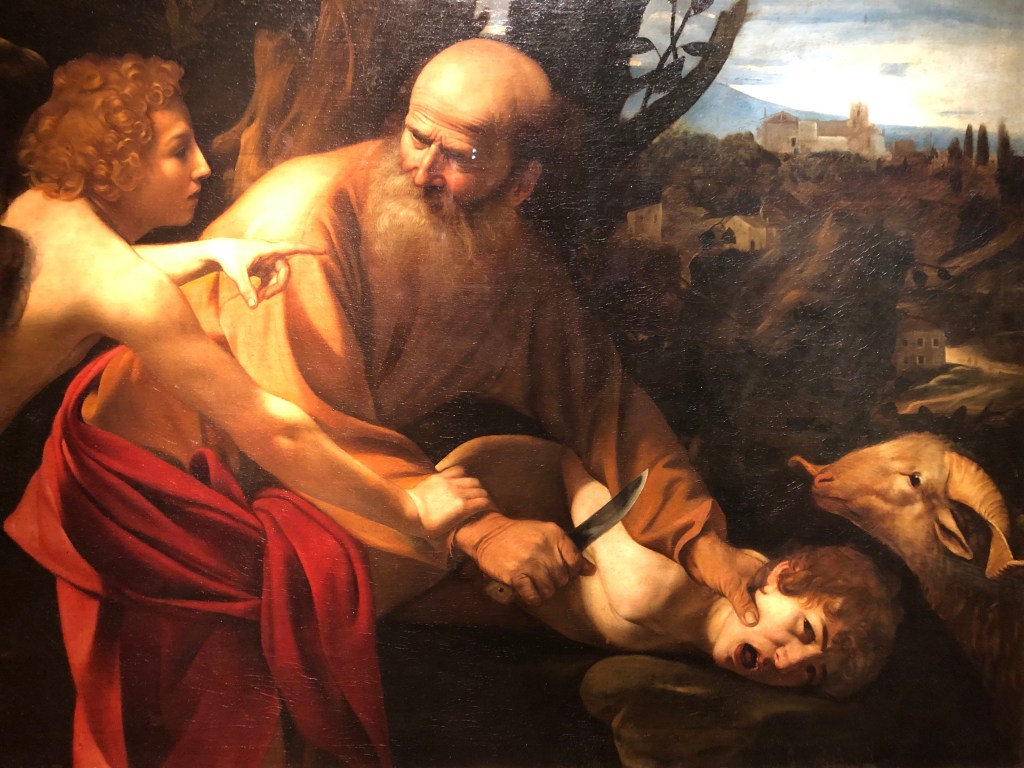
Sacrifice of Isaac, Caravaggio (1603), Uffizi Gallery, Florence

But first, why does Jesus give this woman such a hard time?  She comes to him obviously in distress because of a suffering child, the sort of situation we’ve seen Jesus handle with great compassion before, and first he gives her the silent treatment.  Then it gets worse.  Then he tells her, “We don’t serve your kind here.”  If you cringed a little bit when you heard Jesus’ words this morning, you were hearing them correctly:  “It is not right to take the food of the children and throw it to the dogs.”  Does Jesus have an evil twin?

Continue reading “When God puts us to the test: homily for the twentieth Sunday of Ordinary Time”

Doubt and bearing witness: a homily for the second Sunday of Easter

Explaining St. Paul’s first letter to the Corinthians, St. Thomas Aquinas says that in heaven there will be no faith. We will not need faith when we experience the beatific vision. We need faith now because we live in a world of uncertainties.

Palazzo Venezia, Rome (collection)

We live with doubts. Sometimes these doubts are justified. We doubt our political and church leadership when those in power are not honest, when they use words to hide the truth instead of expressing it. We doubt our abilities when we recognize the same tendency in our own hearts or when, despite our sincerity, our strength is insufficient and we fail. When the world changes unexpectedly, we doubt the future.

Why does Thomas doubt? From one point of view, uncertainty seems justifiable. Believing that a man has come back from the dead is not easy. But it would not have been the first time that Thomas witnessed such an event. He was present at the resurrection of Lazarus. And it seems unlikely that the other disciples had fabricated this story only to deceive him–it is hardly clear what motive they would have had to make up such a lie.

It is true that Thomas speaks of evidence, of what he can see and what he can touch, but his doubt is not really based on a lack of empirical evidence. He does not express the need for more study before coming to a conclusion. He expresses the refusal to believe, the decision not to believe: “I will not believe.”

Continue reading “Doubt and bearing witness: a homily for the second Sunday of Easter”

Abraham’s promises: homily for the sixteenth Sunday in Ordinary Time

Homily for the sixteenth Sunday in Ordinary Time (C)

This morning, I want to talk about Abraham.  For many of us, perhaps, Abraham is like one of those distant relatives your grandmother mentions occasionally but you’re never quite sure how you’re related.  Fortunately, it’s easy to see how Abraham fits into the family tree.  He’s at the top—Abraham is the patriarch, the father of the Jewish people and also, according to the New Testament, the father of us all in faith.

Caravaggio, Sacrifice of Isaac, Uffizi Gallery, Florence

We find Abraham’s story in the book of Genesis.  He lives in that period in history after the fall, when the sin of Adam has left humanity existentially disoriented.  It’s the era of Cain and Abel, the Tower of Babel, Noah and the Flood—man is lost, and every turn he makes only worsens his desolation.  When I was in the Peace Corps, I was once heating a bucket of water with an electric coil, which was, shall we say, not up to OSHA standards.  And without noticing that the plastic safety handle around the coil had melted, I picked it up and gave myself a shock.  And in the moments after the shock, everything was fuzzy, and I couldn’t quite tell what had happened or what I was doing—so I picked it up and shocked myself again.  And that’s kind of what original sin did to mankind.

Continue reading “Abraham’s promises: homily for the sixteenth Sunday in Ordinary Time”

Like a bush in a lava waste…

Craters of the Moon National Monument

Today’s first reading from Jeremiah brought to mind the surreal landscape of Craters of the Moon National Monument in central Idaho, which I visited on a long road trip through the American West several years ago.  It’s a surreal landscape of lava flows, ash, and shards of rock so sharp they’ll slice through your shoes if you wander off the trail.  

Jeremiah’s image of a “barren bush [that] stands in a lava waste” to describe those who trust in men and not in the Lord brought Craters of the Moon to mind.  I remember rounding a cinder cone, descending onto a river of hard rock, and thinking I’d wandered into Mordor.

Continue reading “Like a bush in a lava waste…”