Mercy or Justice? Homily for the twenty-fifth Sunday of Ordinary Time

Homily for the 25th Sunday of Ordinary Time (A)

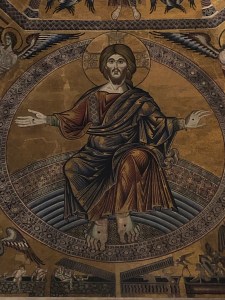
Florence Baptistry

Today’s Gospel raises a host of tricky questions—what is justice?  What is the relationship between divine justice and human justice?  Or between God’s justice and his mercy?  What does the apparently unfair situation described by Jesus in the Gospel—no doubt in violation of several labor laws—tell us about salvation?  Or conversion?  One thing, however, is clear: if I preach for eight hours, or five hours, or three hours, or twelve minutes, I’m going to get paid the same amount anyway.  So I’ll leave some of these questions unanswered.

It’s obvious that Jesus is not giving instruction for how to run a business, but is instead trying to teach us something about salvation.  He is also reinforcing what the prophet Isaiah says: “my thoughts are not your thoughts, nor are your ways my ways, says the Lord.  As high as the heavens are above the earth, so high are my ways above your ways and my thoughts above your thoughts.”  No matter how much advice we give the Lord, he has his own ideas about how to run the universe and he doesn’t always explain them to us.  And sometimes he does explain, but we hear only the parts we want to hear.  

In its original context, the earliest Christians probably understood today’s parable to be about the relationship between Jewish Christians and Gentile Christians, which was the big controversy in the first century.  Even though the Jewish people received divine revelation first, this did not mean that Gentiles who converted to Christianity were in any way less Christian.  Still, even then the passage’s broader meaning would have been apparent to everyone: conversion is possible, even for the worst sinner, even a deathbed conversion.  Thus, Isaiah says, “Let the scoundrel forsake his way, and the wicked his thoughts.”

Now it sounds very nice to say conversion is possible for even the worst sinners.  But Jesus’ parable forces us to confront the difficult question: is that really fair?  Or, to put it another way, what does this mean about the relationship between God’s mercy and his justice?  Do they contradict each other?  We know that God is both merciful and just, but sometimes it’s hard to understand how he can be both.  Is he 50% just, 50% merciful?  Is he just in the obvious cases, but merciful in the ones that are borderline, sort of willing to round up?  In fact, God is 100% merciful and 100% just, and there can be no contradiction between his mercy and his justice.  If we’re thinking about divine justice and divine mercy as contradictory, we’re thinking about them wrong.  

Continue reading “Mercy or Justice? Homily for the twenty-fifth Sunday of Ordinary Time”

Anguish for those who leave: homily for the 19th Sunday of Ordinary Time

Homily for the 19th Sunday in Ordinary Time (A)

In today’s second reading from the letter to the Romans, St. Paul expresses a heartfelt anguish that I am certain many of us here share.  I would wager that there’s not a person in this church who does not have a son or daughter, a brother or sister, perhaps a parent, someone dear to us who has left the Catholic faith.  In Romans, Paul speaks of his people, his Jewish brothers and sisters, the majority of whom have not followed Christ, with painful passion, his heart full of “great sorrow and constant anguish.”  He goes so far as to say, “I could wish that I myself were accursed and separated from Christ for the sake of my brothers.”  So even though it’s not a cheerful topic, the problem of loved ones who have left the faith is one we can’t avoid, one most of us know firsthand.  I do too. 

St. Peter Walking Upon the Water, circle of Giacinto Brandi (1600s), New Norcia, Australia

First, a caution.  Some time ago, I agreed to give a friend a ride to the dentist.  He was having major work done and was going to be given some powerful anesthesia and wasn’t allowed to drive.  I didn’t know where the office was, but I thought, “No problem, he’ll give me directions.”  The problem was he had to take one of the pills the dentist prescribed before the appointment, so when I got there to pick him up he was already floating in blissful never-never land.  We got into the car and I asked him where to go, and he said, “I don’t care.  You can take me wherever you want.  You can take me to a bar.”  Eventually, we got to the dentist.  But the point is he didn’t feel any pain because he’d taken a happy pill.  Now I will be honest:  I’m not going to give you a happy pill.  There are theological happy pills out there and plenty of priests and theologians who will give them to you.  The problem is, they aren’t true.  If they were true, Paul wouldn’t feel anguish and sorrow.

Continue reading “Anguish for those who leave: homily for the 19th Sunday of Ordinary Time”