We’re now smack in the middle of another busy semester at the Gregorian University, which doesn’t leave much time for getting out in Rome. (Seeing the hordes of tourists you might not believe it, but not everyone in Rome is on vacation!)
M.C. Escher, Street in Scanno, Abruzzi
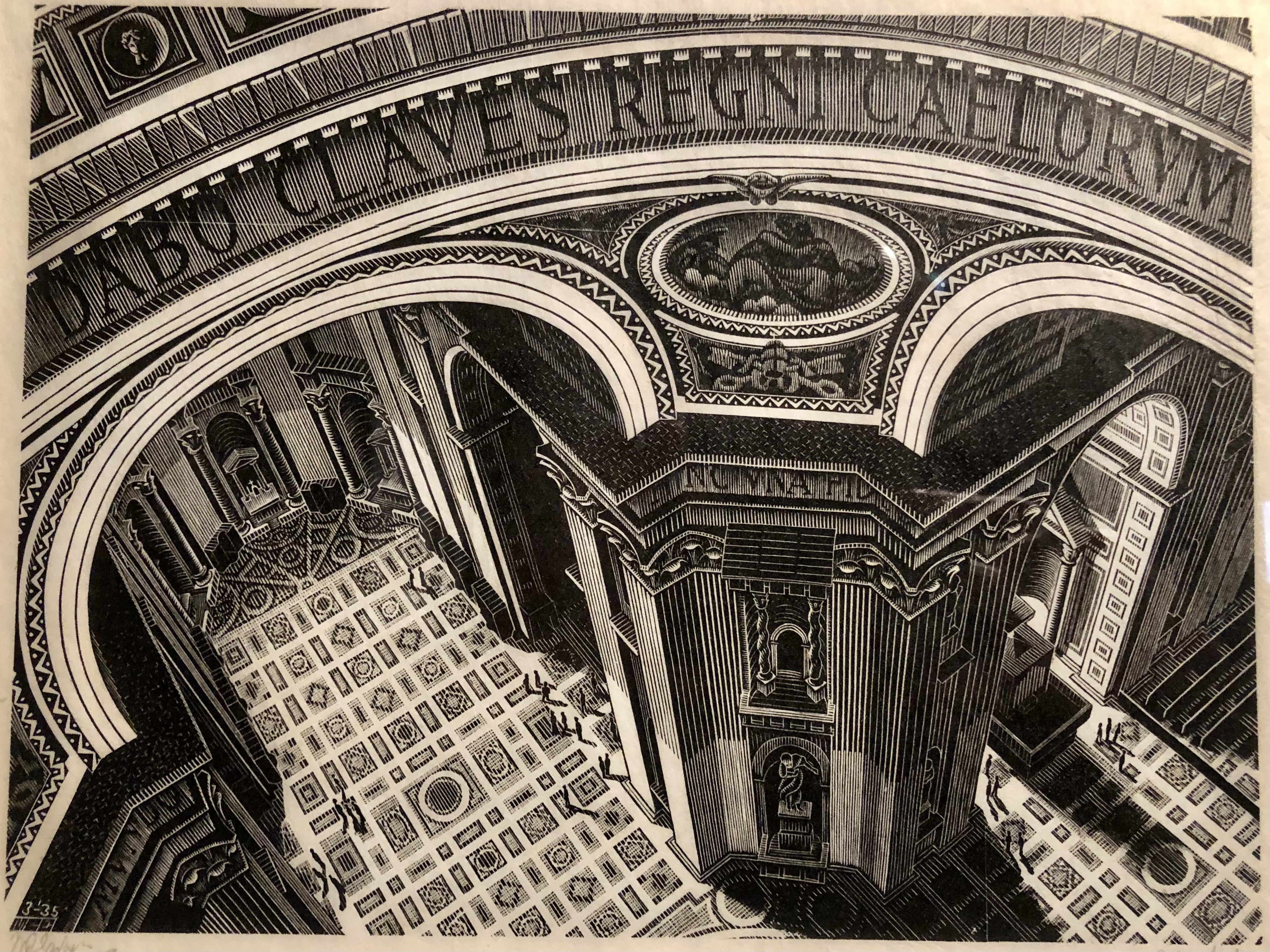
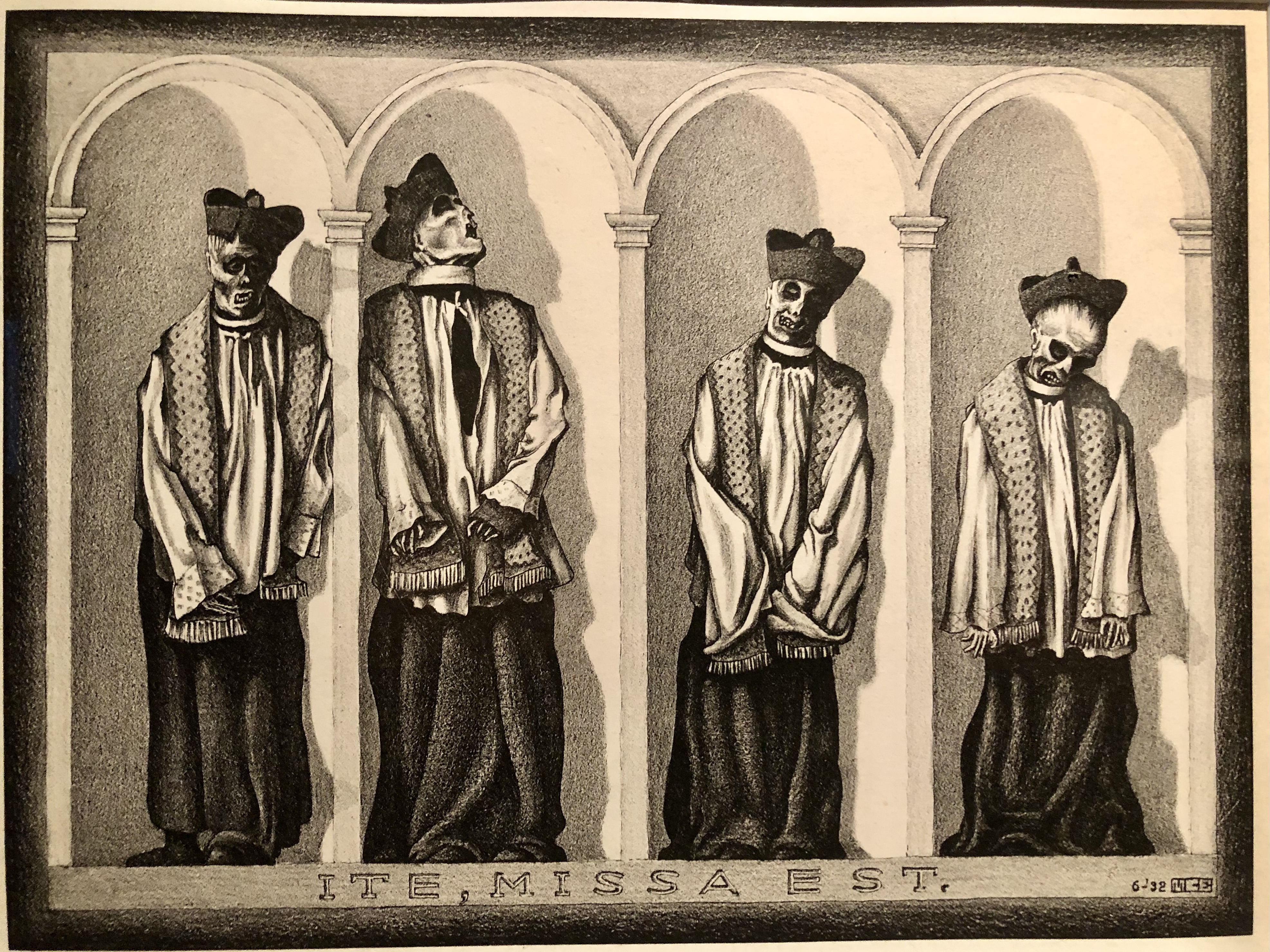
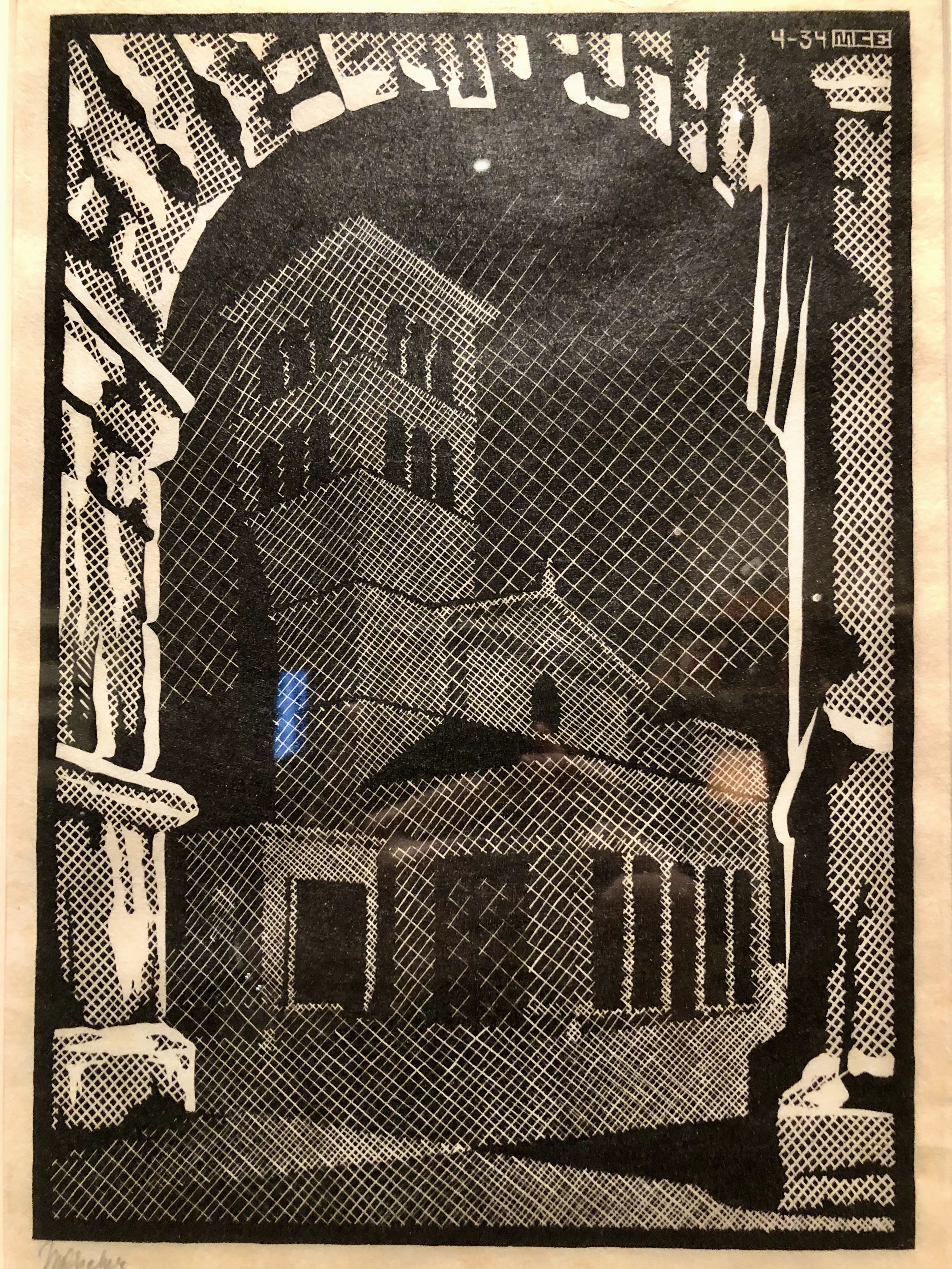
The Eternal City remains eternally fascinating, however, and every once in a while will throw something at you that you weren’t expecting. I thought I’d share a few pictures from a visiting exhibition at Palazzo Bonaparte from last year on M.C. Escher (1898-1972). The Dutchman is perhaps not who you think of when picturing an Italian artist, yet his travels in Italy between 1925-1935, especially in Calabria, were particularly formative for him. When you realize this, you begin to notice that the impossibly fantastical geometric architecture in so many of his works bears a striking resemblance to the look and feel of an Italian hilltop village.
(Below: Inside St. Peter’s [1935]; Mummified Priests in Gangi, Sicily [1932]; San Giorgio in Velabro [1934]; Still Life with Mirror [1934]. Note the holy card of St. Anthony in the corner of the mirror.)
One of the most remarkable places in this remarkable city of art is the Contarelli Chapel in the Church of San Luigi dei Francesi, home to the St. Matthew trilogy of Michelangelo Merisi da Caravaggio. Three paintings–The Conversion, The Inspiration, and The Martyrdom of St. Matthew–tell the story of the life of the saint, from his improbable calling to his death. The paintings are full of artistic drama, reflecting the artist’s own spiritual struggles and his attempt to find his place among Italy’s artistic greats.
Contarelli Chapel, San Luigi dei Francesi, Rome
The paintings date from early in Caravaggio’s career (1599-1600), when he was at the apex of his success in Rome. Only a few years after painting the St. Matthew trilogy, however, Caravaggio’s artistic career was sabotaged by his own unruly passions–he was forced to flee Rome after murdering a man in a brawl. As I’ve argued before, the fact that Caravaggio sinned so spectacularly does not negate a deep thirst for God or his spiritual and sacramental sense. In fact, as so often happens, awareness of his sin may have heightened the need the artist felt for redemption. In one of his later works, which he painted while in exile for his crime, David holds the head of Goliath–who bears Caravaggio’s own anguished face.
David with the Head of Goliath, Caravaggio, Borghese Gallery, Rome
Conversion also drives the “plot” of Caravaggio’s St. Matthew cycle. The first of the paintings, The Call of Matthew, depicts the moment when Jesus walks into Matthew’s customs post where the tax collector sits among cronies, coins spread over the table in front of him. Light shines in from a window just over the Lord’s head and hits Matthew straight on as Jesus raises his hand and points an unrelenting finger, as if to say, “You.” The tax collector’s own finger rises to his chest and his eyes widen, as if to respond, “Who? Me?” Or perhaps he is trying to distract the Lord’s gaze by pointing to the ne’er-do-well next to him, whose eyes are still fixed on the coins. In either case, the painting captures all the passion and confusion of the call to conversion–the unrelenting gaze of God, the instinctual avoidance and doubt of the sinner who is called. Does Matthew think himself unworthy? Shy away from relinquishing the wealth he knows? Hesitate when truth itself dissolves the shadows of ambiguity he has woven around himself? Probably, all of the above.
Earlier this month, after delivering ten copies of Baptism of Desire and Christian Salvation to Sant’Anselmo at Easter time, I walked up the Aventine Hill to pick up my diploma–the last formality involved in earning my doctorate. The last act, I suppose, of my formal education! It’s a walk I made many times before while a student. I haven’t been back to Sant’Anselmo for a while now, but am grateful for the studies in sacramental theology I did there.
When I received my copies of Baptism of Desire and Christian Salvation, I had one more reason to be grateful — the insightful words of endorsement on the back cover from my dissertation director Prof. Andrea Grillo, who read many draft versions of the tome and managed to remain in good humor throughout! Here’s his review:
Lusvardi offers a historical reconstruction of the ‘baptism of desire’ that traverses the entire arc of the Christian tradition, starting from the origins. A straightforward work, expressed in a language endowed with finesse, irony and acumen. Baptism of Desire and Christian Salvation is singularly effective in pointing out the fact that in the modern reception, a series of priorities is imposed on the issue that empty its meaning.
Andrea Grillo, Pontifical Atheneum of Saint Anselm, Rome
Also last week, I was delighted to see Rachel Lu’s review of the book at Word On Fire. Rachel’s review had a particular significance for me since, as she points out, I was there when she was baptized as an adult 19 years ago.
Though I still have a few weeks of grading exams to go, summer is definitely here in Rome. To celebrate the end of classes, I took a morning off last week to visit a special exhibit at Rome’s Capitoline Museum. The Capitoline is one of several museums in the Eternal City that would be the top attraction anywhere else but gets overshadowed by the Vatican Museums and the Borghese Gallery. It contains a number of impressive ancient Roman sculptures and a couple of Caravaggios — antiquity and baroque being the two periods Rome is known best for. When it comes to Renaissance art, Rome takes second place to Florence (though, given the work of Michelangelo and Raphael in the Vatican, the competition is still stiff).
In any case, the Capitoline is hosting an exhibit this summer dedicated to the work of Filippo Lippi (1406-1469) and his son Filippino (1457-1504). I mentioned Filippo before for his wonderful frescoes in Spoleto’s cathedral depicting the life of the Virgin. Filippo grew up an orphan and very poor. He was raised in a Carmelite monastery in Florence and became a monk. His superiors noticed his talent and encouraged his artistic career. He proved, in fact, to be a better artist than a monk. While executing a commission in a monastery in Prato, he ran off with a 17-year old novice, Lucrezia Buti, who became the model for some of his most beautiful female figures. Filippino, you might have guessed, was the fruit of their union.
Santa Maria in Cosmedin, Piazza della Bocca della Verità, Rome
It’s not one of Rome’s station churches, but Santa Maria in Cosmedin was one of my stops as Lent began this year because of the coincidence of Valentine’s Day falling on Ash Wednesday. A college English professor once advised me that in literature love and death are always intertwined, and this year’s liturgical calendar seems to add an exclamation point to the theory. What does all of this have to do with Santa Maria in Cosmedin, a twelfth century Roman church a stone’s throw from the Circus Maximus?
Well, Santa Maria in Cosmedin is home to the relics of St. Valentine. And, given his current appearance, I’d say Valentine drives home Ash Wednesday’s message pretty well. Not much is known about his life; Valentine was third century Roman priest martyred for continuing to minister to his flock in the midst of persecution. A note near his altar says the saint has been turned to not only for love, but as an intercessor in times of plague.
The relics of St. Valentine — romance abounds!
The church itself is rather fascinating. The current building, with its stubby façade and soaring bell tower, dates from the 12th century but was built on the site of an eighth century diaconia. Diaconia were the Catholic Social Services hubs of their day, centers where various forms of charity were distributed to the needy. Today the church is home to Rome’s Melkite community.
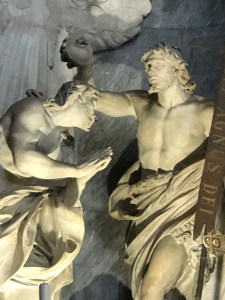
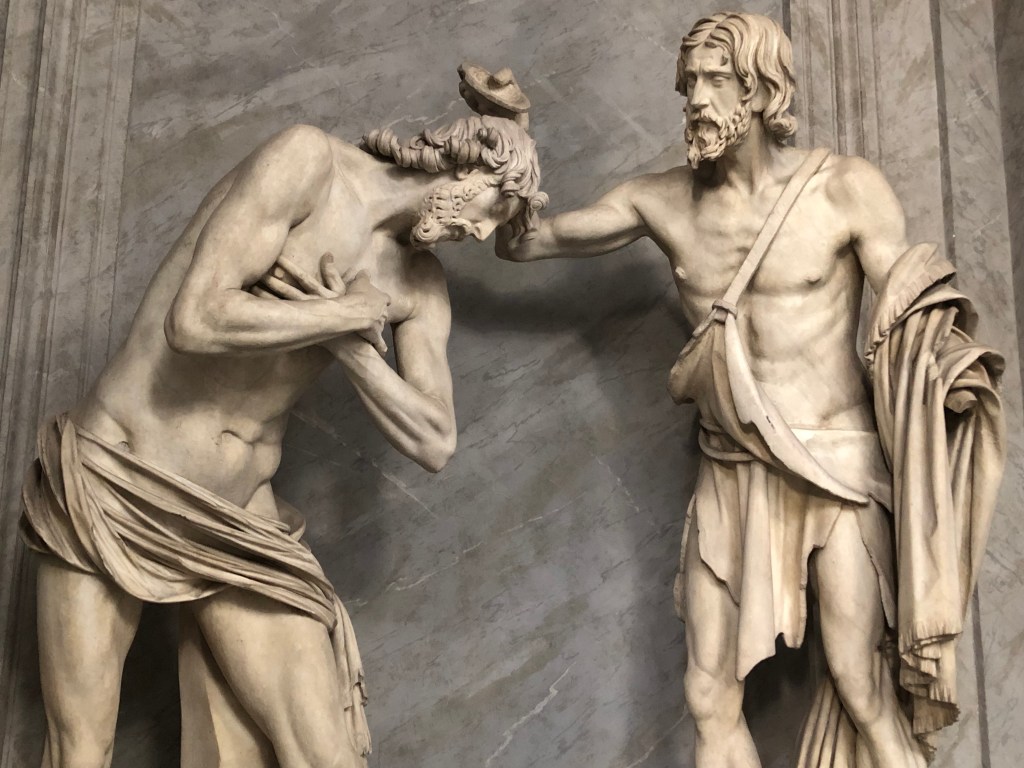
Baptism of Jesus, Antonio Raggi, San Giovanni dei Fiorentini, Rome
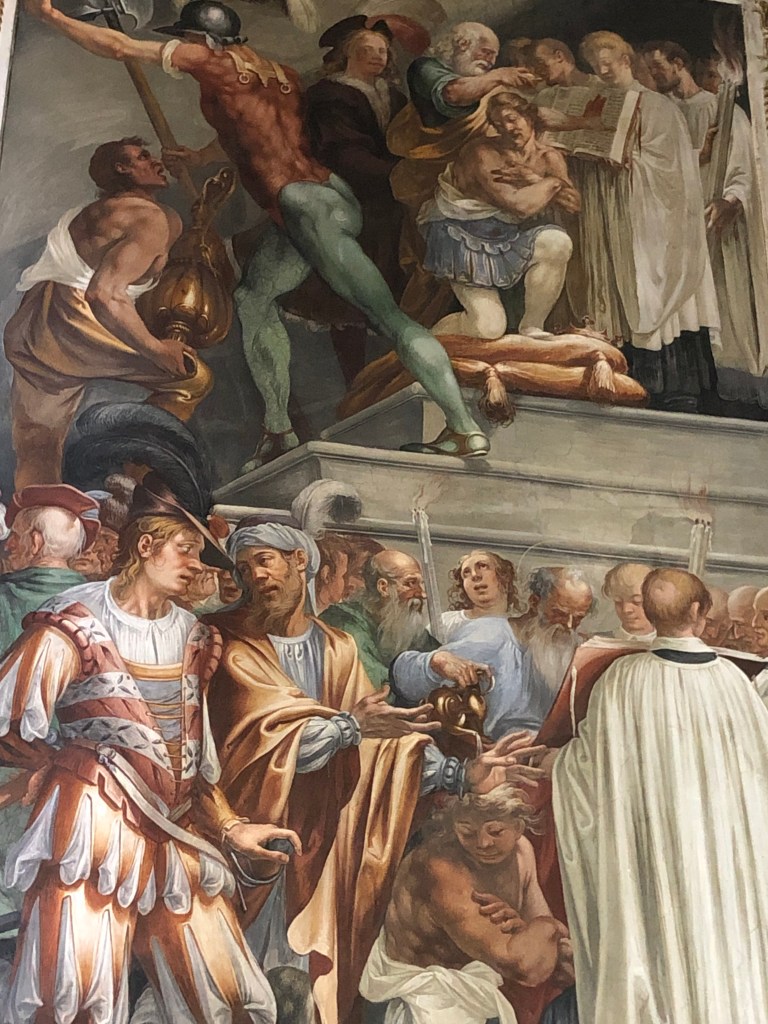
To celebrate the feast of the Baptism of the Lord–which this year falls unusually on a Monday–I thought I’d share a few photos from one of Rome’s lesser known churches, San Giovanni dei Fiorentini. A baroque church, it was built for the Florentine expats in Rome back when Florence was an independent city-state and named for the city’s patron, St. John the Baptist. The church contains a relic of Mary Magdalene (her foot), and is the burial place of the great–but tragically unhappy–baroque architect Francesco Borromini. It also contains a number of interesting artistic works featuring baptism.
I’ve written before about the importance of baptism, but I have a personal reason to be particularly fond of San Giovanni dei Fiorentini. Its 17th century altarpiece, the Baptism of Jesus by Antonio Raggi, features on the beautifully designed cover of my book Baptism of Desire and Christian Salvation. Of course, I’d like to think that what’s inside the cover is pretty interesting as well, and I’m pleased that the book’s release date is coming up later this month–January 26. There’s more information on the website of Catholic University of America Press, and the book is available on other online sellers such as Amazon.
In the meantime enjoy the views of San Giovanni dei Fiorentini.
Baptism of Christ, Francesco Mochi, 1645Simon and Jude baptizing the King of Persia, Orazio GentileschiSan Giovanni dei FiorentiniBaptism of Jesus, Antonio Raggi, San Giovanni dei Fiorentini, Rome
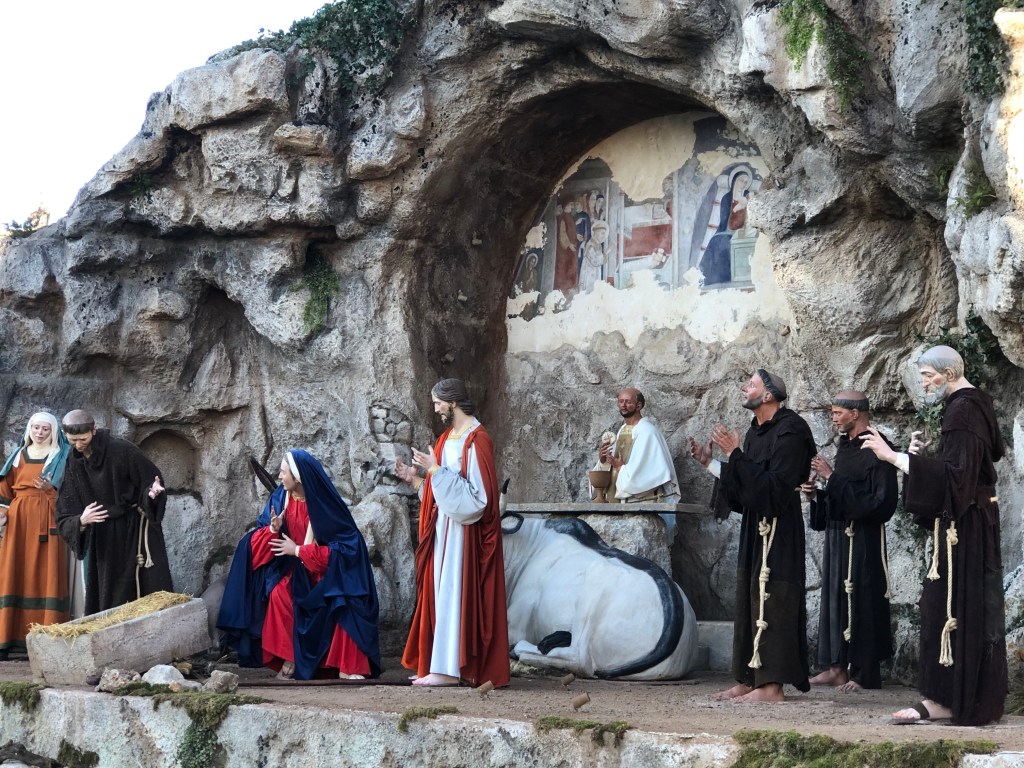
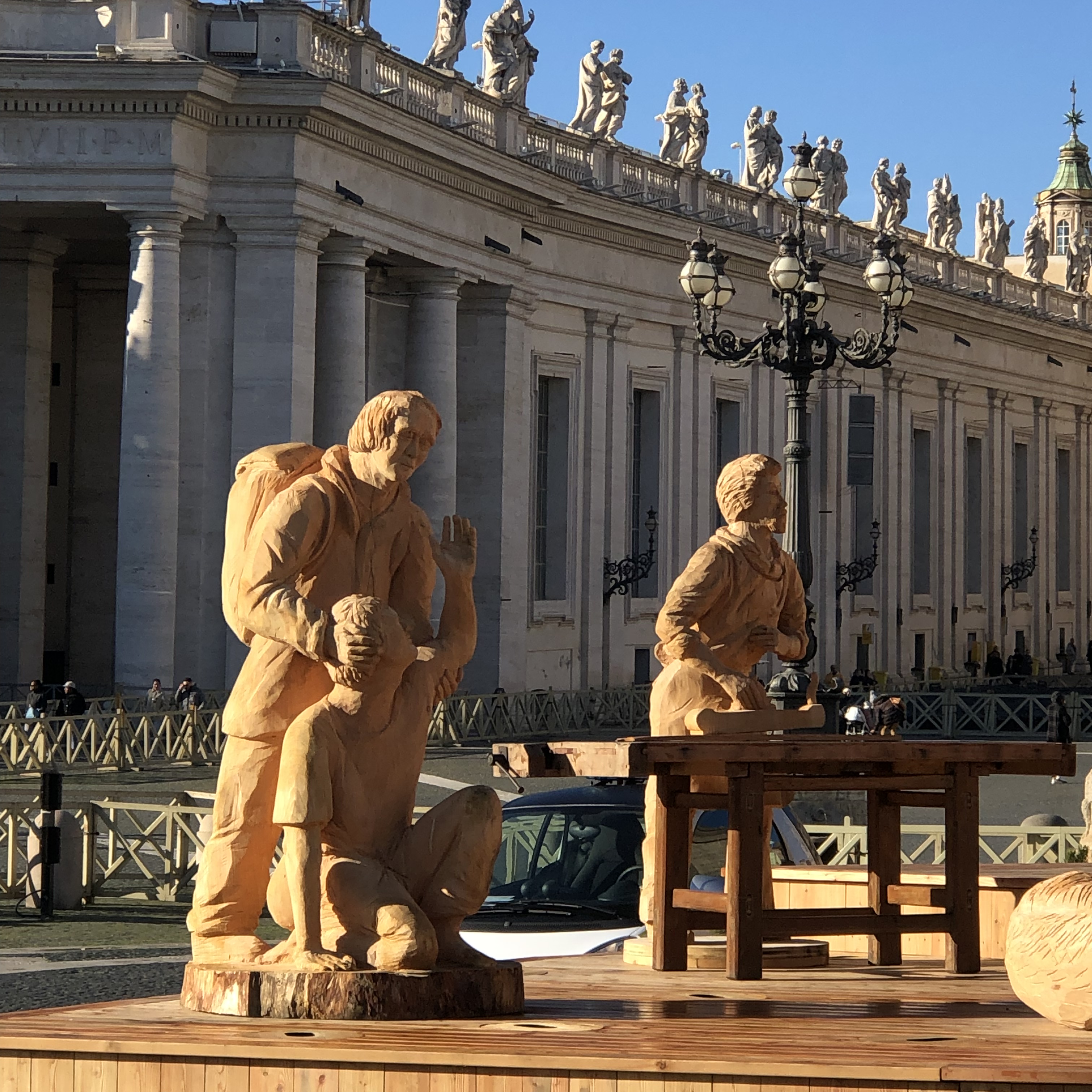
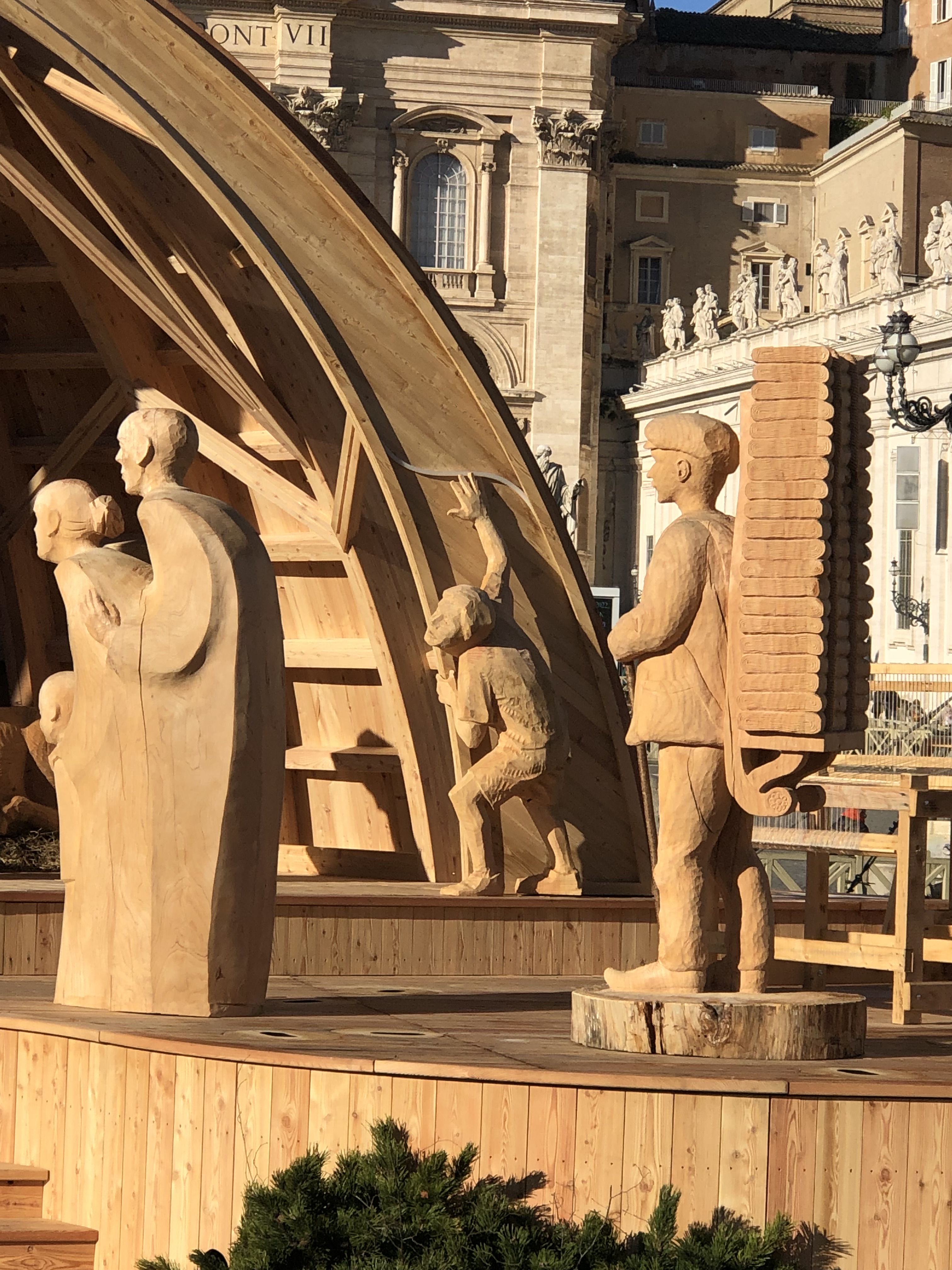
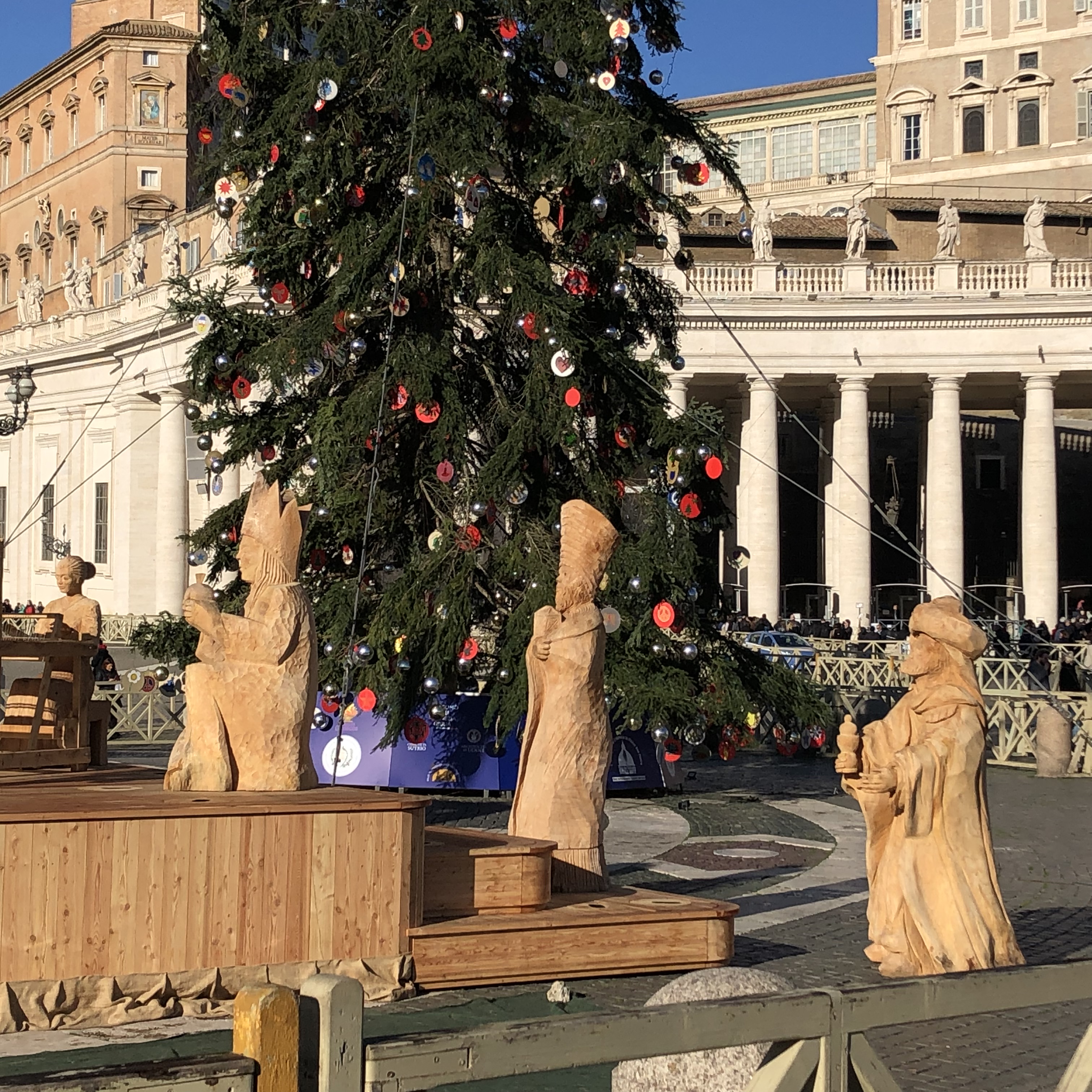
Over the past few weeks, I’ve noted (here and here) that 2023 marks the 800th anniversary of the first Nativity scene set up by St. Francis in the little town of Greccio. The Vatican’s Nativity scene this year also reflects that anniversary.
This year’s scene doesn’t aim for historical accuracy–thus, St. Francis alongside Mary and Joseph and the three friars replacing the three kings. (Oh, and there’s a priest celebrating Mass in the background too.) The fresco on the wall behind them is a replica of the one in the cave in Greccio.
The figures, perhaps, aren’t exquisitely beautiful. (And, come to think of it, the priest in the background seems a tad confused about what he’s supposed to be doing–too much realism?) But at least this year’s Nativity scene isn’t aggressively weird (like the aliens from 2020) or trying too hard to be modern (like… well, there are too many examples).
You’ll notice that the manger itself is empty. As per the tradition, the Baby Jesus doesn’t arrive until Christmas itself. This year he won’t find a perfect Nativity scene, a perfect Church, or a perfect world, but he’ll come nonetheless and we need him all the more because of it.
Advent is one of my favorite times of the year to be in Rome. What they call winter here is nothing to a Minnesotan, and the shortening days are counterbalanced by the city’s delightful display of Christmas lights. These generally don’t start appearing until after the Immaculate Conception (December 8) and they don’t come down until after the Epiphany (January 6).
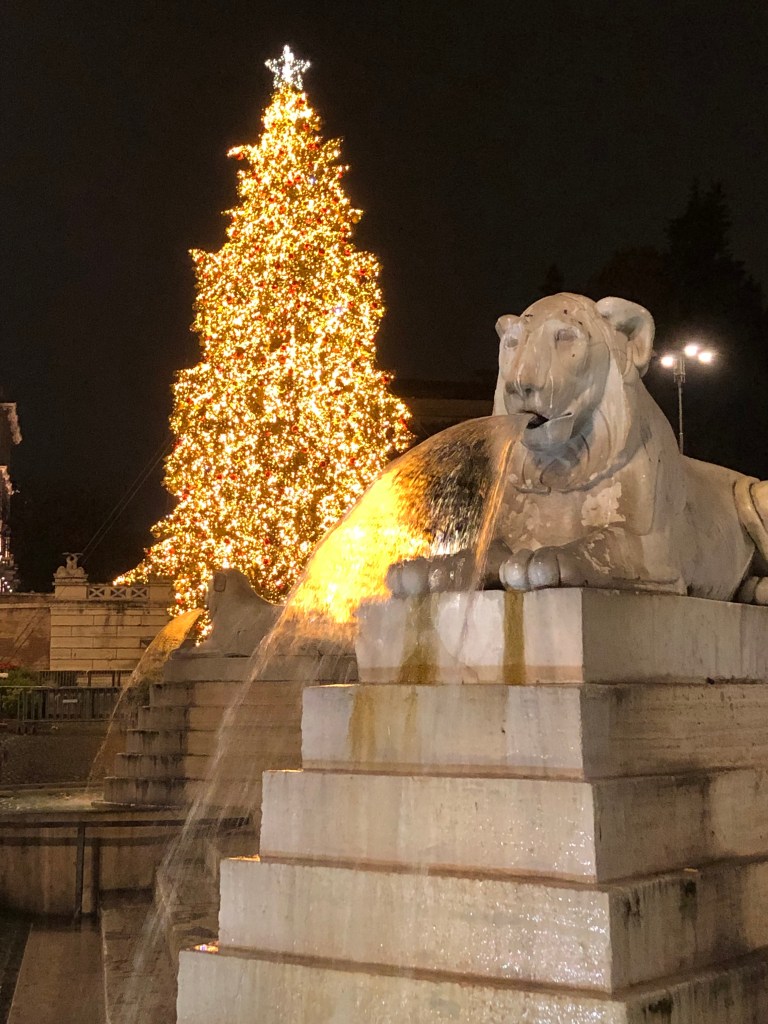
Rome’s Christmas tree, Piazza del Popolo
The city’s official Christmas tree, like the Vatican Nativity scene, is often the subject of local critique and Roman wit. This year, the tree got a new location due to construction work on Rome’s mythical new subway line–scheduled to open a few years after the Second Coming of Christ. The tree’s usual home, Piazza Venezia, is now a construction site, but its new location in Piazza del Popolo is a calmer setting away from the traffic. The official tree also has some competition from a glitzy counterpart at the Spanish Steps, given to the city by the fashion designer Dior.
Dior Christmas tree, Spanish Steps
I’d also be remiss not to mention what a delightful time of year Advent is to be at the Gregorian University, where the university’s international richness is on full display. Student groups from different countries take turns singing in the atrium between classes. It gives them an excuse to duck out of class early (ahem), but you’d have to be Ebenezer Scrooge not to appreciate the festive atmosphere. The Mexican college usually wins the prize for the best show not only because of their charm and energy but because you just can’t top a piñata. It’s a time to be grateful for our young priests, seminarians, religious, and lay students who are such a source of hope for me and for the Church.
Those at daily Mass this week get to enjoy the special treat of hearing the book of Jonah. The book is such a good tale–who doesn’t love a giant sea monster? or a cantankerous prophet?–that I imagine the story originally told dramatically aloud. I think we’re meant to laugh at Jonah, the Mr. Bean of prophets.
Of course, there is a serious message to the book that goes beyond whale innards and the prophet’s pouty attachment to his gourd plant. Jonah reveals the sweeping reach of God’s mercy, extending even to the most wicked of cities–Nineveh, grrr—when those within it seek conversion. Students in my classes are probably sick of hearing it, but one way to get under my skin is to claim that the grumpy “God of the Old Testament” has been replaced by the groovy “God of the New Testament.” There’s only one God. He’s infinitely merciful and revealed in both the Old and New Testaments. And the book of Jonah proves it.
Since St. Francis of Assisi introduced the idea 800 years ago, Italy has been the land of Nativity scenes. And there is no more prominent location for a Nativity scene in the world than St. Peter’s Square. The scene is different every year and–along with the Christmas tree in Piazza Venezia–is usually subject to intense comment and critique from Romans and visitors alike. There’ve been a few doozies in my years here, but this year’s scene from Friuli Venezia Giulia does not seem to have aroused great protests.
Here’s a peak at the scene, still waiting for the child who makes all things complete.
Christmas blessings to one and all!
“In the fullness of time, chosen in the unfathomable depths of God’s wisdom, the Son of God took for himself our common humanity in order to reconcile it with its creator.” (Pope St. Leo the Great)