What to do when you don’t have a pope? Preach Jesus Christ

Homily for Wednesday of the Third Week of Easter.

Brothers and sisters, papam non habemus. We do not have a pope. Not yet.

We live in uncertain and, often, disturbing times. I’m not talking only about the sede vacante in the Church of Rome. The last few years–the last few decades, really–have been a difficult time for the Catholic Church. The Church sometimes seems confused and divided from within, and opposed by powerful forces from without. And today we also live with all the uncertainty of a papal election.

In this uncertain moment, today’s first reading reminds us of a simple but profound lesson: things have been worse. Much worse. Here we see the Church at its very beginning, tiny and persecuted. Stephen, one of the first deacons, has just been killed. The faithful are scattered. Those who persecute the Church are full of zeal, backed by the age’s political powers in all their strength. It seems like a catastrophic moment for the nascent Church, but it becomes a moment of triumph, a moment of growth. The dispersion of the faithful–even if caused by persecution–becomes the condition for the spread of the Word. Soon, we know, even the great persecutor, Saul, will convert and become the greatest missionary in the history of the Church.

Caravaggio, The Conversion of St. Paul, 1600-1

What I most want to emphasize today is the response of the disciples, who transformed this apparent catastrophe into a moment of growth: They continued to preach Jesus. Without panic, without discouragement. They returned and remained steadfast in the most fundamental mission of the Christian: to bear witness to the life, death and resurrection of Jesus Christ.

Today’s Gospel reading also calls us back to the heart of our Catholic faith: “I am the bread of life,” says Jesus. There is no action more important for the Catholic than to encounter the Lord in the Eucharist, in his true body and in his true blood.

Brothers and sisters, despite our anxieties and our doubts, despite the moments of uncertainty that alternate with moments of glory in the life of the Church, this message remains our rock. If we continue to proclaim it, we cannot go wrong. In a few days we will have a new pope, but our mission will not change. Times change. Popes change. Jesus Christ does not change.

Jesus Christ is the bread of life. Jesus Christ is Lord.

Readings: Acts 8:1b-8; John 6:35-40

(Original: Italian)

May 7, 2025

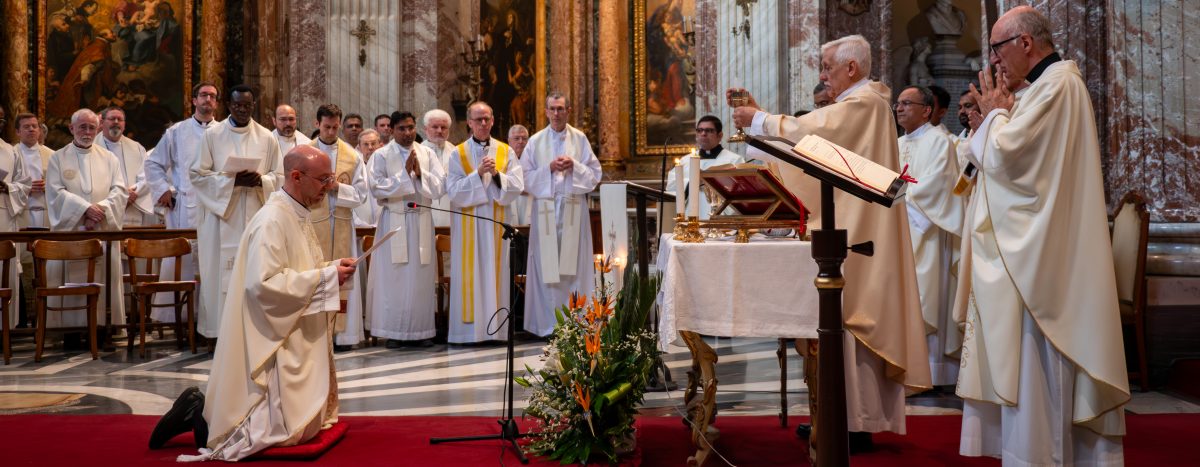
Gregorian University Chapel, Rome


Those interested can see my interview on the CBS Evening News with Maurice Dubois here.

Build back baptistries! A trip to the Baptistry of San Giovanni in Fonte

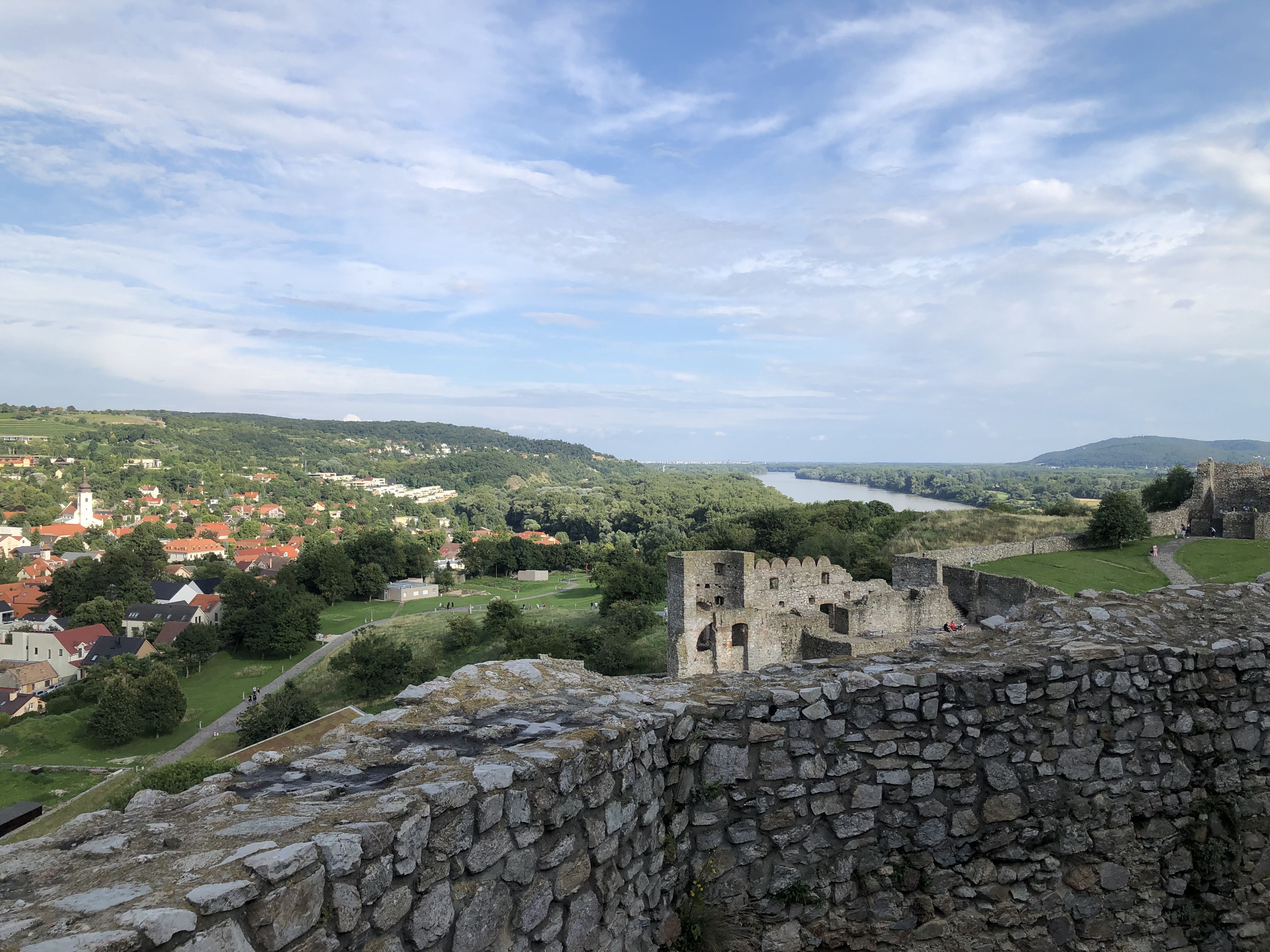
An unexpected discovery on my recent trip to Italy’s Cilento was the Baptistry of San Giovanni in Fonte, just outside of Padula. Also known as the Battistero Marcelliano, after Pope Marcellus, it dates from the fourth century, putting it among the oldest Christian structures in the world. A letter from Cassiodorus in AD 527 mentions a miracle occurring at the baptistry, its water level rising unexpectedly while a priest was pronouncing the prayer over the baptismal waters on the vigil of the feast of St. Cyprian.

Battistero di San Giovanni in Fonte, Paula, Italy

The structure itself sits on the site of a natural spring, so the baptismal font was a pool of “living” water. The baptistry was built on the ruins of an earlier pagan structure and underwent several renovations and expansions throughout history. Hints of a fresco, dating from the 11th century when the structure was converted into a chapel, remain on the wall. The remains of still earlier frescoes from the 6th and 7th centuries were removed and taken to a local museum.

Rising water levels caused the chapel to be abandoned in the 19th century, though the site of the remains and spring, down a winding country road, are quite a pleasant spot today.

This reminder of baptism from Christianity’s earliest days is worth reflecting on during the Easter season. I discuss some of the theological and practical consequences of the shift away from the patristic catechumenate and toward near-universal infant baptism in the Christian cultures of the Middle Ages in Baptism of Desire and Christian Salvation, but the subject is worth more reflection than what I’m able to give it there.

Reflecting on early Christian baptismal practices is important because we are moving into a new phase in Christian history that in some ways will more closely resemble the Church of the Fathers — in which Christianity was a minority — than medieval Christendom. Some of our sacramental practices, I am convinced, will have to shift to respond to this new reality. This may not be entirely a bad thing. When it comes to baptism, for example, too often the sacrament, celebrated in a minimalistic way, has become a mere formality with little connection new life in Christ.

Continue reading “Build back baptistries! A trip to the Baptistry of San Giovanni in Fonte”

Entering the tomb: a homily for Easter

This Homily for Easter Sunday comes from 2019 and was given just a few days after the fire at Notre Dame Cathedral in Paris — thus the reference to the rose window at the end. Seems appropriate this year when Notre Dame has been reopened…

Occasionally the most erudite theologians overlook the most obvious things. This morning’s gospel contains a curious detail that has provoked a great deal of discussion among theologians: why do Mary of Magdala and John, the other disciple, not enter the tomb? Mary sees the stone removed from the tomb and returns to the apostles. John, running and perhaps a bit younger than Peter, arrives at the tomb first, but remains outside. Why? Biblical exegetes have explained this event symbolically–maybe John represents prophecy and Peter represents the institutional Church–but in my opinion the reason is simpler.

It’s a tomb. They were afraid.

Sometimes the simplest explanations are also the most profound. We know that Jesus is risen–maybe this announcement has become too familiar and gets taken for granted–but at that moment Mary, John and Peter did not have that advantage. We must imagine their psychological state that morning. Two days ago, they had seen the humiliation and killing of their Lord, teacher and friend at the hands of evil men. We must imagine the darkness of those days, when violence, lies and selfishness defeated the truth.

Continue reading “Entering the tomb: a homily for Easter”

The Anointing at Bethany and Holy Week’s unsettling beginning

Going through some old files, I came across this homily for the Monday of Holy Week, written, in my younger and more vulnerable years, when I was a novice in St. Paul, Minnesota.

St. Mary Magdalene penitent, Guercino 1622

During the Third Week of the Spiritual Exercises, St. Ignatius asks us to contemplate the suffering and death of Our Lord.  This week, Holy Week, the Church, liturgically, asks us to do the same.  The Third Week is one of the times in the Exercises when we ask for strange graces—shame, sorrow, confusion.  

The Church’s liturgy also evokes these troubling graces, and it does so by, among other things, confronting us with today’s passage from John, the Anointing at Bethany.  The shock this passage should provoke in us is perhaps diminished by its familiarity, but if we really deeply consider what is happening here, then we should be confused.  We should be confused because part of us is tempted to side with Judas.  

Three hundred days wages!  Put in contemporary terms this must amount to something like $30,000, $40,000, $50,000—enough for college scholarships for one or several years, or private high school scholarships for several students; in some Third World countries that much money could build a school.  And instead it is being spent on a jar of ointment.  An expensive perfume.  An ostentatious toiletry.  

Continue reading “The Anointing at Bethany and Holy Week’s unsettling beginning”

Susanna and the wicked judges

Monday of the fifth week of Lent brings one of the Bible’s great courtroom dramas — the story of Susanna and the elders from the Book of Daniel. It’s one of the longest readings in the lectionary, but one that deserves to be read with relish. An innocent woman does what is right even at the cost of her life. Two powerful and corrupt men, overthrown by lust, suppress their consciences, and compound debauchery with vindictiveness. And a lone idealistic voice, indignant at the injustice of the crowd, speaks out — and the old goats are snared in the net they’ve woven.

Susanna and the Elders, Guercino, 1617

There’s something refreshing about the story. It’s not hard to tell the bad guys from the good gal, and for once justice is throughly vindicated. A few weeks ago in my post about Guercino, I mentioned the baroque era’s love of drama (one might be excused for saying “melodrama”). I was happy to see Guercino take up the story of Susanna. Quite a lot could be said about tale — the Lord hears the cry of the innocent even when everyone else seems deaf — but it is, first of all, a great yarn. As we look forward to Holy Week, Susanna’s travail is a reminder that, even if it doesn’t always happen quickly — or even in this life — justice will ultimately prevail.

Susanna and the Elders, Guercino, 1617

The Certosa di San Martino and the Neapolitan baroque

Inside the choir of the Certosa di San Martino (Naples)

A couple of weeks ago, I wrote about the connection between the baroque style, the Jesuits, and the city of Rome. It’s hard to find a city that can outdo Rome in baroqueness, though Naples gives the Eternal City a run for its money. I took a day trip down to Naples in mid-March to meet up with my parents who were vacationing there and was reminded what a treasure trove of marvels that city is.

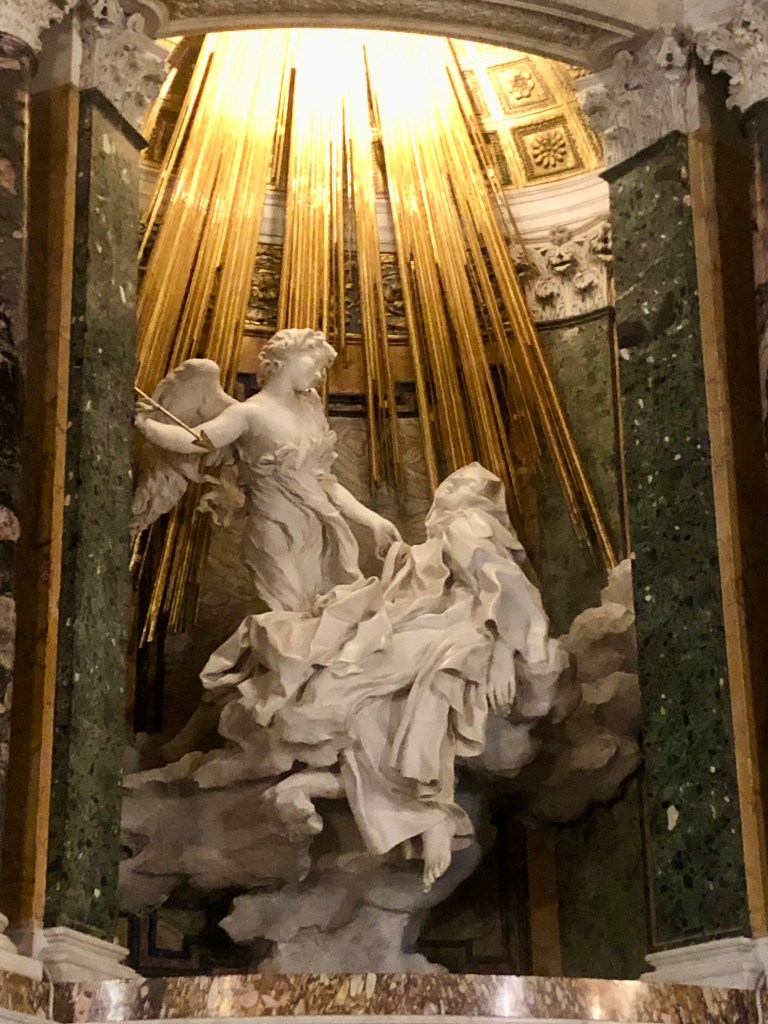
We got in to visit one of the sights I’ve been wanting to see for a long time, Giuseppe Sanmartino’s Veiled Christ (1753). I had seen pictures before of this virtuoso use of marble–carved as if a thin, almost translucent, shroud had been draped over the figure of the dead Christ. What makes the sculpture so moving, however–something I hadn’t appreciated until seeing it in person–is the liquid quality the shroud creates. The way it clings to the flesh below, with the wounds visible through it, and pools around the edge of the body almost makes you feel the life draining from the corpse. The rest of the chapel is chockfull of allegorical figures, though photography is prohibited inside, so you’ll just have to go to Naples to see for yourself!

Chapel, Certosa di San Martino (Naples)

One of the visit’s surprises was to discover the Certosa di San Martino, a Carthusian Monastery, now a museum, tucked under imposing walls of the Castle of Sant’Elmo overlooking the city. We went up for the view from the Vomero hill and just happened into the Certosa, founded in 1368 but redone in extravagant baroque in 1623.

Continue reading “The Certosa di San Martino and the Neapolitan baroque”

A “monumental study… unmatched in what it positively contributes”

With a year approaching since Baptism of Desire and Christian Salvation‘s publication, I’m pleased to see reviews starting to appear. I just read a great one by Joseph Arias of Christendom College in the journal of liturgical theology Antiphon. Arias provides a summary and identifies “controversial” points where I challenge the received wisdom. I’m grateful to have such careful readers and can’t say I mind having the book described as “monumental” and “unmatched”!

Here’s just a sample:

“The author takes the reader on a profoundly illuminating historical and dogmatic theology journey from the apostolic age to our own, acting throughout as an immensely capable and careful guide, making sure we do not miss either major or minor attractions that can enhance the experience of trying to arrive at a deeper understanding of a profoundly significant (though sometimes underappreciated) teaching that is firmly rooted in the Catholic tradition…

… this volume is unmatched in what it positively contributes towards a better understanding of this area of theology.”

And more good news — it looks like the price of the book may have dropped on Amazon as well.

Also, following up on my previous post on the Ukrainian bishops’ statement about the war in their country last week, I have a new piece out on the subject in America. It is equally about what is dysfunctional in our own American political culture right now.

Guercino, Rome, and the Jesuit baroque

Guercino, Moses

One is always discovering new artists in Rome, and earlier this year, thanks to a special exhibit at the Scuderie del Quirinale and the recommendation of a friend, I discovered Guercino (1591-1666). Born Giovanni Francesco Barbieri in Cento (Emilia-Romagna), he worked in Rome when baroque art was at its zenith.

Guercino, Gregory XV, ca. 1621

The exhibit was of particular interest to me because Guercino’s time in Rome corresponded to the period when the Jesuits were also at their zenith. The pope who proved to be Guercino’s great patron, Gregory XV (Alessandro Ludovisi), also favored the Society of Jesus, especially in its mission of spreading Catholicism around the globe.

The Jesuits have often been associated with the baroque because it was the artistic style in vogue around the time of our founding, so our great Roman churches, the Gesù and Sant’Ignazio — and all the other Jesuit churches around the world built to imitate them — are classic examples of baroque architecture.

Guercino, St. Peter Raising Tabitha, 1618
Continue reading “Guercino, Rome, and the Jesuit baroque”

Appeal of the Catholic Bishops of Ukraine

Going through homilies from Lents past, I came upon this post, which happened to date from shortly after the Russian invasion of Ukraine three years ago. The Ukrainian resistance to that invasion, I noted, was something of a jolt to a West that had grown somnolent with self-indulgence, a reminder that some things are worth fighting for.

Just over a week ago, Archbishop Sviatoslav Shevhcuk issued a statement on behalf of Ukraine’s Greek Catholic bishops that should again jolt the conscience of a world gone loopy with self-absorption. “We have not become a people defined by war — we have become a people defined by sacrifice,” the bishops write. For the bishops and for their people, this war is not a card game or great television, not, as the Vice-President of the United States to his great shame recently suggested, a “propaganda tour.”

David, Gian Lorenzo Bernini

Noting the staggering trauma and destruction inflicted on their country, the bishops write: “But we have not come to terms with our losses—each one hurts. Every fallen defender, every innocent life lost remains in the memory of God and people. We remember and pray. We support and uphold. We stand and fight, ever mindful of the God-given dignity that no force on earth can take from us.”

It is obvious enough that the bishops want peace, but they also know that “peace” on Putin’s terms does not mean the end of killing Ukrainians, of kidnappings, or of brutality. The bishops know that Russian occupation will almost certainly include the persecution of Catholics; Archbishop Schevchuk was himself targeted for assassination by Russian invaders attacking Kyiv. No serious Christian should be taken in by Vladimir Putin’s pose as a defender of Christian values. His regime and its ideology are idolatrous.

Continue reading “Appeal of the Catholic Bishops of Ukraine”

Seeing truly, judging clearly: homily for the eighth Sunday of Ordinary Time

Homily for the 8th Sunday of Ordinary Time (C)

St. Luke, 13th century, Old St. Peter’s, Rome

I have to admit that the opening of today’s first reading, “When a sieve is shaken, the husks appear; so do one’s faults when one speaks,” is not the most encouraging thing to read when one has to give a homily.  Both the words of Sirach and Jesus’ sayings in the Gospel of Luke deal with what is inside a person and what becomes visible to others, what we see and what we don’t.  The first reading is a warning about putting too much faith in outward appearances.  Someone might have all the right credentials, but little wisdom; someone might repeat all the fashionable phrases, but say nothing of substance.

The test that Sirach proposes to separate the trustworthy from the slick shyster is tribulation.  “As the test of what the potter molds is in the furnace, so in tribulation is the test of the just.”  It is easy to follow Jesus when he tells us what we want to hear, less so when we might lose friends because of what he says.  Fidelity doesn’t mean much when it comes without a cost.  Imagine marriage vows modified to promise faithfulness “in good times but not bad, in health but not sickness, wherever I find my bliss.”  It’s only when the going gets tough that faith, hope, and love show their worth.

Jesus adds another criterion for distinguishing the enduring truth from the well-dressed lie: you shall know the tree by its fruit.  You may have heard people say, “It’s really what’s inside that counts.”  Jesus pours a bit of cold water on such sentimentalism.  If what’s inside produces thorns, then it can’t really be all that good.  Again and again in different ways Jesus calls for the unity of what is inside with what is outside, opposing any division between interior and exterior religion—challenging us to confess his name with both our words and our deeds.

Jesus again and again challenges us to purity of heart, which means purity all the way through—in our thoughts and in our words, in what we do, and what we chose not to do.  In the Beatitudes, Jesus promises that the pure in heart will see God.  Sight, interestingly, is also at the center of today’s Gospel reading.  The blind lead the blind into a pit, and we notice the splinter in our brother’s eye but not the beam in our own.  But that image showing the absurdity of hypocrisy also comes with an instruction and a promise: “Remove the wooden beam… then you will see clearly.”  

Continue reading “Seeing truly, judging clearly: homily for the eighth Sunday of Ordinary Time”