One of the casualties of the smartphone revolution has been losing our ability to wait. Instead of waiting, we scroll. Losing the ability to wait may not seem a real loss, but I think it is. Scrolling and checking messages and adding new apps has not made me more productive. Instead, I’m more easily distracted and impatient. Inside our electronic cocoons, we miss the things that used to happen while we waited—people watching, striking up conversations, noticing the landscape from the window, wondering at it.
Today’s readings are about the art of waiting. But they warn us not to romanticize it. Times of waiting can be dangerous. Today’s Gospel identifies two dangers of waiting: anxiety and drowsiness.
The anxieties mentioned in the Gospel come from genuinely terrifying world events—“people will die of fright,” the Gospel warns—but also everyday anxieties that seem related to drowsiness. The context of today’s readings, of course, is the Lord’s second coming, when Jesus will return in awesome and awful judgment, remaking all reality. It may be that some of us are anxious about meeting Jesus because we’re afraid of that judgment. Paul warns the Thessalonians to conduct themselves to please God, as they have been taught. Advent is a time when the Church reminds us to examine our consciences, to make use of the sacrament of penance, to align our lives with Jesus’ teaching.
Today I’m going to talk about Jerusalem, Babylon, and Sweden—all of them, in different ways, places of hope.
We are probably used to hearing messages of hope in church, so we could easily miss just how remarkable our first reading from the prophet Jeremiah really is. This particular message of hope, if placed in context, is as startling as stumbling upon a lush citrus grove in the Arabian desert. To appreciate the passage, it helps to remember a bit about the tragic and cantankerous life of Jeremiah. This is the prophet, after all, whose name gives us the literary term “jeremiad” to describe a long speech bitterly denuncing something or someone. In fact, the book of Jeremiah contains plenty of jeremiads. The prophet denounces the elite of Jerusalem for straying from the law revealed to them by Moses, for their petty idolatry and corruption, for their self-satisfaction and complacency. Their cowardly refusal to return to the faith of their ancestors has left the Kingdom of Judah weak and vulnerable to its enemies, Jeremiah warns, as had many prophets before him. What sets Jeremiah apart from these other prophets of gloom is that he tells Jerusalem’s rulers that they have ignored God’s message for too long, and now it’s too late. A superpower has risen in the East—Babylon—and nothing Judah’s rulers do now will stop it. It is better, Jeremiah warns, to surrender.
Jeremiah’s message—“you’ve been leading us in the wrong direction for a generation, and you can’t escape the consequences of your actions”—did not win him popularity. Judah’s rulers hired a more optimistic prophet, Hananiah, who delivered a message more to their liking. But a few pages before today’s first reading, Hananiah drops dead, a none-too-subtle sign that the Lord does not approve his message. As the Babylonians close in and a brutal siege begins, Jeremiah tells the people of Jerusalem, you will be defeated, your city destroyed, and then you will be dragged off into exile.
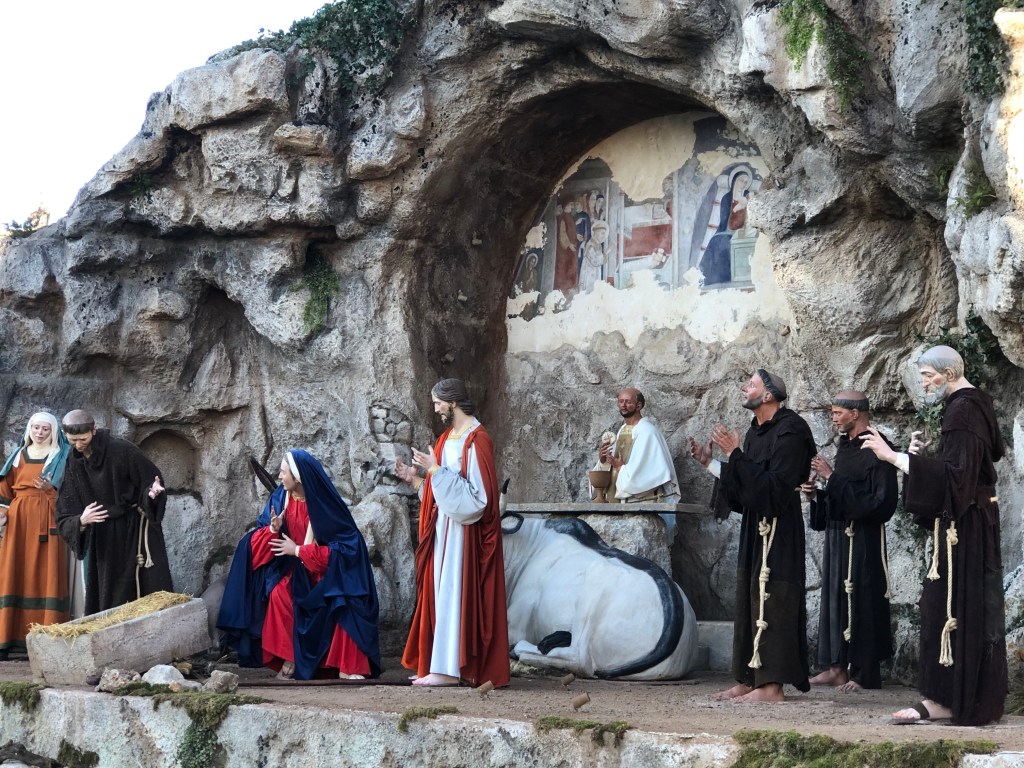
Over the past few weeks, I’ve noted (here and here) that 2023 marks the 800th anniversary of the first Nativity scene set up by St. Francis in the little town of Greccio. The Vatican’s Nativity scene this year also reflects that anniversary.
This year’s scene doesn’t aim for historical accuracy–thus, St. Francis alongside Mary and Joseph and the three friars replacing the three kings. (Oh, and there’s a priest celebrating Mass in the background too.) The fresco on the wall behind them is a replica of the one in the cave in Greccio.
The figures, perhaps, aren’t exquisitely beautiful. (And, come to think of it, the priest in the background seems a tad confused about what he’s supposed to be doing–too much realism?) But at least this year’s Nativity scene isn’t aggressively weird (like the aliens from 2020) or trying too hard to be modern (like… well, there are too many examples).
You’ll notice that the manger itself is empty. As per the tradition, the Baby Jesus doesn’t arrive until Christmas itself. This year he won’t find a perfect Nativity scene, a perfect Church, or a perfect world, but he’ll come nonetheless and we need him all the more because of it.
Advent is one of my favorite times of the year to be in Rome. What they call winter here is nothing to a Minnesotan, and the shortening days are counterbalanced by the city’s delightful display of Christmas lights. These generally don’t start appearing until after the Immaculate Conception (December 8) and they don’t come down until after the Epiphany (January 6).
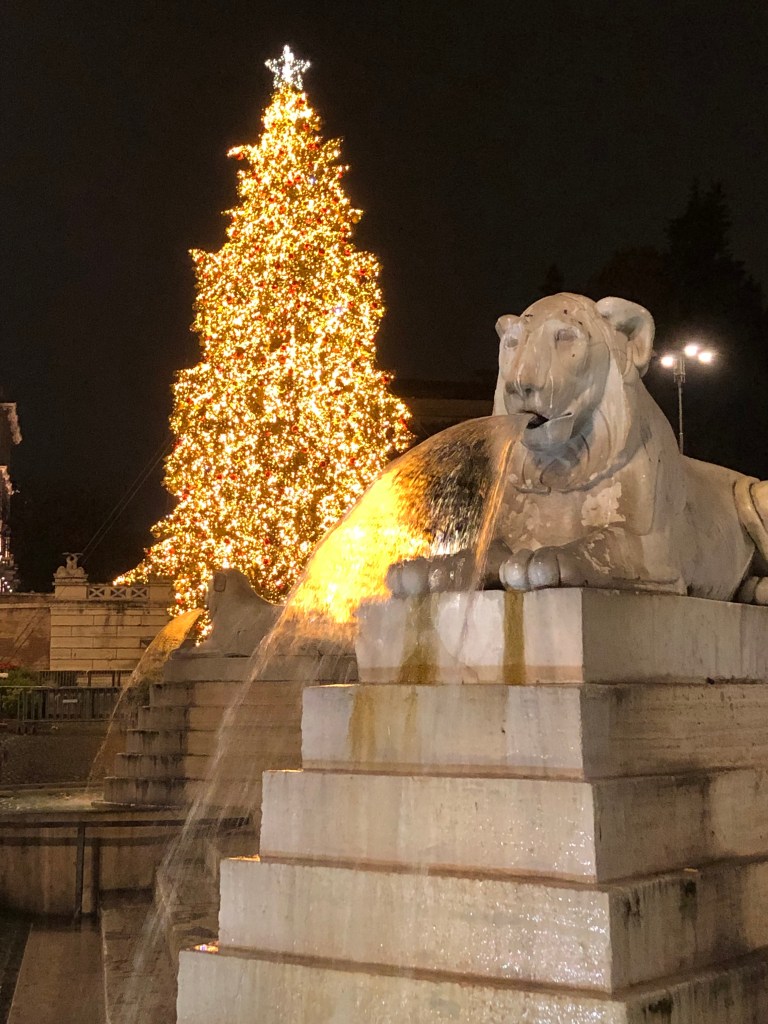
Rome’s Christmas tree, Piazza del Popolo
The city’s official Christmas tree, like the Vatican Nativity scene, is often the subject of local critique and Roman wit. This year, the tree got a new location due to construction work on Rome’s mythical new subway line–scheduled to open a few years after the Second Coming of Christ. The tree’s usual home, Piazza Venezia, is now a construction site, but its new location in Piazza del Popolo is a calmer setting away from the traffic. The official tree also has some competition from a glitzy counterpart at the Spanish Steps, given to the city by the fashion designer Dior.
Dior Christmas tree, Spanish Steps
I’d also be remiss not to mention what a delightful time of year Advent is to be at the Gregorian University, where the university’s international richness is on full display. Student groups from different countries take turns singing in the atrium between classes. It gives them an excuse to duck out of class early (ahem), but you’d have to be Ebenezer Scrooge not to appreciate the festive atmosphere. The Mexican college usually wins the prize for the best show not only because of their charm and energy but because you just can’t top a piñata. It’s a time to be grateful for our young priests, seminarians, religious, and lay students who are such a source of hope for me and for the Church.
When I get near the end of my time in Rapid City every summer—or this year, fall—I feel a little nostalgic. It helps me to imagine how St. Paul would have felt throughout his ministry, founding communities and then having to move on. He invested himself completely into each one; he made friends; he faced opposition, persecution, and disease; sometimes he owed his survival to the care he received from the Christians in each place. And because it was much harder for Paul to travel by foot and ship across the Mediterranean than it is for me to book an airline ticket across the Atlantic, I find the yearning and love expressed in his letters particularly poignant. This is especially the case in his letter to the Philippians.
Not all of Paul’s letters are as warm as the one to the Philippians. (The Philippians, just so we’re clear, were residents of the city of Philippi in northern Greece, not to be confused with Filipinos who come from islands in the Pacific.) In some letters—to the Corinthians, for example—Paul is in battle mode, trying to straighten out bad behavior. He wrote his letter to the Romans before he arrived in Rome, so it’s sort of an introduction and also a fundraising appeal. But Paul knows the Philippians well; he describes them as his partners for the Gospel from the first day. His letter to them was written from prison, probably in Rome. Contemplating the quarantine that awaits me on my own return to Rome, this is also something I can relate to. But despite these circumstances, Paul’s letter to the Philippians overflows with joy and peace. It’s obvious that his affection for the little church in Philippi is a comfort to him even in imprisonment. He writes, “I am confident… that the one who began a good work in you will continue to complete it until the day of Christ Jesus.” Paul knows that we can never just tread water in the life of discipleship. We must always keep striving. So the letter is an exhortation to continue to grow in Christ, but its tone is more that of encouragement than a call to repent.
Now you are probably used to being told not to take certain parts of the Bible literally. Today, however, I’m going to tell you to do the opposite. Read St. Paul’s words to the Philippians, and take them as if they were addressed to you, as if the letter began, “to all the holy ones of Christ Jesus who are in Rapid City.” And take these words literally: “If there is any encouragement in Christ, any solace in love, any participation in the Spirit, any compassion and mercy, complete my joy by being of the same mind, with the same love, united in heart, thinking one thing. Do nothing out of selfishness or out of vainglory; rather, humbly regard others as more important than yourselves, each looking out not for his own interests, but also for those of others. Have in you the same attitude that is also in Christ Jesus.”
Of all the Old Testament prophets, the one whose writings most resemble a hallucination caused by LSD is probably Ezekiel. There’s a psychedelic temple; four-faced creatures that are part man, part lion, part eagle, part ox; apocalyptic battles; a bit of cannibalism; an army of dry bones that rattle back to life; and a few scenes that are definitely rated R. If you’re seeking entertainment, cancel your HBO subscription this month and just read the book of Ezekiel.
Now please don’t go home and tell people, “Father preached this morning about LSD. He was a Jesuit—you know how they are.” In order to appreciate this marvelous book of the Bible, I want to draw a contrast between hallucination, optimism, and the central theme of the book of Ezekiel—hope.
Ezekiel lived through what might be considered the most hopeless moment in the history of the Jewish people. The corruption of the Israelite monarchy had so weakened and divided Israelite society that the nation was easy prey first for the brutal Assyrian empire, which utterly destroyed ten of the twelve tribes of Israel, and then a few decades later for the even more ruthless Babylonians. Ezekiel was a priest, who along with the other educated members of Israelite society was carted off into forced exile in Babylon. It would have appeared to any observer at the time that Israel’s story was over. They had been favored by God; they had been given the Promised Land and a covenant, and they blew it. They broke the covenant, lost their land, and had only slavery and extinction to look forward to.
And at this moment in history, in exile in the heart of enemy territory, in Babylon itself, Ezekiel started receiving visions. Ezekiel’s visions were wild but not hallucinations. They pointed toward a better future but it would be difficult to call Ezekiel—or any of the Hebrew prophets—an optimist. Ezekiel’s vision was something else entirely—it was a vision of hope. What’s the difference, you ask.
In today’s second reading from the letter to the Romans, St. Paul expresses a heartfelt anguish that I am certain many of us here share. I would wager that there’s not a person in this church who does not have a son or daughter, a brother or sister, perhaps a parent, someone dear to us who has left the Catholic faith. In Romans, Paul speaks of his people, his Jewish brothers and sisters, the majority of whom have not followed Christ, with painful passion, his heart full of “great sorrow and constant anguish.” He goes so far as to say, “I could wish that I myself were accursed and separated from Christ for the sake of my brothers.” So even though it’s not a cheerful topic, the problem of loved ones who have left the faith is one we can’t avoid, one most of us know firsthand. I do too.
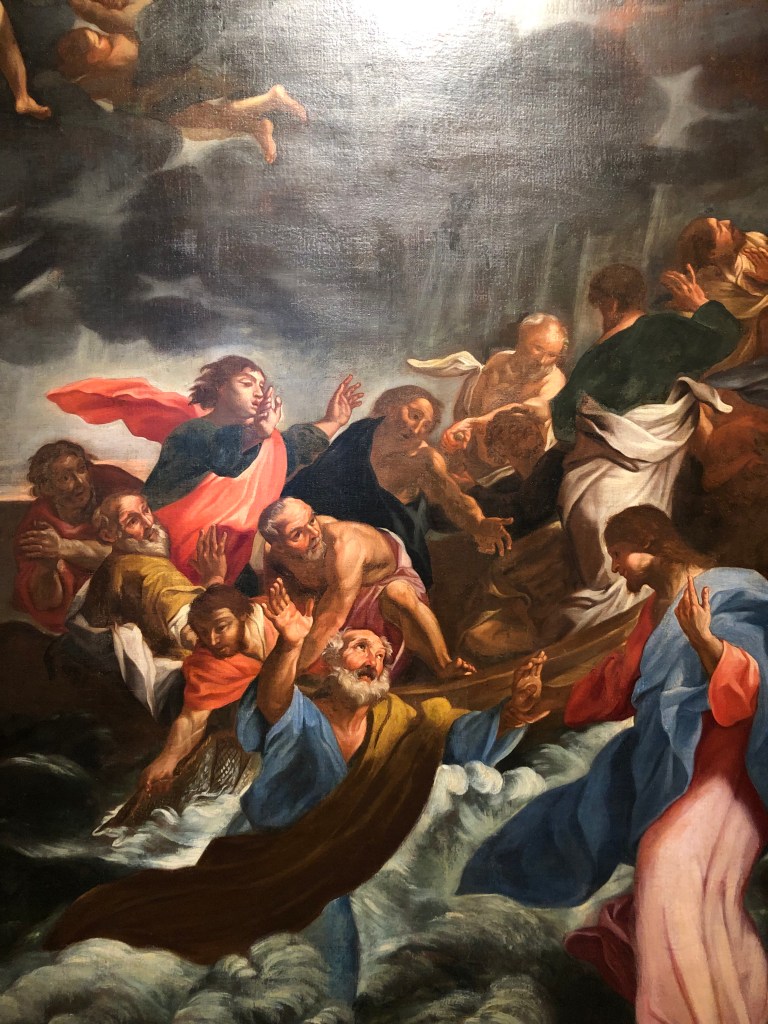
St. Peter Walking Upon the Water, circle of Giacinto Brandi (1600s), New Norcia, Australia
First, a caution. Some time ago, I agreed to give a friend a ride to the dentist. He was having major work done and was going to be given some powerful anesthesia and wasn’t allowed to drive. I didn’t know where the office was, but I thought, “No problem, he’ll give me directions.” The problem was he had to take one of the pills the dentist prescribed before the appointment, so when I got there to pick him up he was already floating in blissful never-never land. We got into the car and I asked him where to go, and he said, “I don’t care. You can take me wherever you want. You can take me to a bar.” Eventually, we got to the dentist. But the point is he didn’t feel any pain because he’d taken a happy pill. Now I will be honest: I’m not going to give you a happy pill. There are theological happy pills out there and plenty of priests and theologians who will give them to you. The problem is, they aren’t true. If they were true, Paul wouldn’t feel anguish and sorrow.
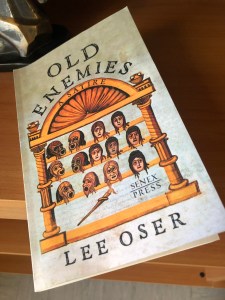
I don’t have much time for leisure reading this semester, but I was pleased to pick up Lee Oser’s witty satire Old Enemies as I settled back into Roman life last month. It’s both funny and thought-provoking. In fact, you can read the thoughts it provoked in my review “Hope in the Ruins” published at Law & Liberty. I also muse about what grounds we have for hope during the West’s current self-destructive cultural moment.
Homily for the sixteenth Sunday in Ordinary Time (C)
This morning, I want to talk about Abraham. For many of us, perhaps, Abraham is like one of those distant relatives your grandmother mentions occasionally but you’re never quite sure how you’re related. Fortunately, it’s easy to see how Abraham fits into the family tree. He’s at the top—Abraham is the patriarch, the father of the Jewish people and also, according to the New Testament, the father of us all in faith.
Caravaggio, Sacrifice of Isaac, Uffizi Gallery, Florence
We find Abraham’s story in the book of Genesis. He lives in that period in history after the fall, when the sin of Adam has left humanity existentially disoriented. It’s the era of Cain and Abel, the Tower of Babel, Noah and the Flood—man is lost, and every turn he makes only worsens his desolation. When I was in the Peace Corps, I was once heating a bucket of water with an electric coil, which was, shall we say, not up to OSHA standards. And without noticing that the plastic safety handle around the coil had melted, I picked it up and gave myself a shock. And in the moments after the shock, everything was fuzzy, and I couldn’t quite tell what had happened or what I was doing—so I picked it up and shocked myself again. And that’s kind of what original sin did to mankind.







 Tony Lusvardi, S.J.