Entering the tomb: a homily for Easter

This Homily for Easter Sunday comes from 2019 and was given just a few days after the fire at Notre Dame Cathedral in Paris — thus the reference to the rose window at the end. Seems appropriate this year when Notre Dame has been reopened…
Occasionally the most erudite theologians overlook the most obvious things. This morning’s gospel contains a curious detail that has provoked a great deal of discussion among theologians: why do Mary of Magdala and John, the other disciple, not enter the tomb? Mary sees the stone removed from the tomb and returns to the apostles. John, running and perhaps a bit younger than Peter, arrives at the tomb first, but remains outside. Why? Biblical exegetes have explained this event symbolically–maybe John represents prophecy and Peter represents the institutional Church–but in my opinion the reason is simpler.

It’s a tomb. They were afraid.

Sometimes the simplest explanations are also the most profound. We know that Jesus is risen–maybe this announcement has become too familiar and gets taken for granted–but at that moment Mary, John and Peter did not have that advantage. We must imagine their psychological state that morning. Two days ago, they had seen the humiliation and killing of their Lord, teacher and friend at the hands of evil men. We must imagine the darkness of those days, when violence, lies and selfishness defeated the truth.

Continue reading “Entering the tomb: a homily for Easter”

Popular piety and tradition in Sardinia

I was fortunate this year to have spent Holy Week and Easter in Maracalagonis, Sardinia, a small town about a 20 minute drive from the center of Cagliari. It was a good break from the classroom and a wonderful taste of parish life.

Chiesa della Santa Vergine degli Angeli, Maracalagonis, Sardinia

The religious atmosphere I experienced was both warm and traditional. Masses were full; I heard confessions all week long; I met deeply committed Catholic families. I was especially impressed by the enthusiasm for traditional popular devotions. Teams of parishioners take responsibility for organizing different devotions throughout the year. Of particular note during Holy Week were the su Scravamentu, in which the nails are removed from the Lord’s hands and feet and he is taken down from the Cross after the Good Friday liturgy, and the many processions through the town streets–Stations of the Cross, Palm Sunday, Holy Thursday, the Sorrows of Mary on Good Friday, and then the S’Incontru on Easter morning.

Continue reading “Popular piety and tradition in Sardinia”

An event unlike any other: homily for Easter Sunday

Homily for Easter Sunday 2024

National Gallery of Victoria, Melbourne

What is a miracle? The word is used often and not always in a very precise way. A quick search on the Internet revealed exercises, mineral solutions, and even a perfume, all described as “miraculous.”

At least the word seems to be useful for advertising. Probably we have also heard stories from the Middle Ages or antiquity that tell of extraordinary events. And probably some are really miracles, others are legends. They are the special effects that storytellers from a time before movies used to make a story more fascinating, moving, or funny.

Speaking more precisely, a miracle is something that happens in this world caused by a power beyond this world. Miracles do not mean that the divine is absent from non-miraculous events, from everyday events. When a doctor uses his intelligence to save life, he is using a divine gift–intelligence–to cooperate with the purpose of God who wants to save life and not destroy it. When a woman gives birth it is not a miracle in the literal sense–it does not require a force beyond human biology–but I would say there is something divine about that event because it is a participation in the Creator’s work.

A miracle, however, requires a power that no creature possesses.

We know with certainty that there has been at least one miracle in the history of the universe, namely, the creation of the universe. No existing thing possesses the power to create everything from nothing. This power is the essence of a miracle. I haven’t smelled the miraculous perfume, but I doubt that it qualifies .

Today we celebrate the miracle of miracles–the resurrection of Jesus Christ from the dead. Since creation there has been no other event like this. It is the most important event in human history, an event so different from all other historical events that, even today, after almost two thousand years, it remains difficult to explain.

Continue reading “An event unlike any other: homily for Easter Sunday”

Homily for Passion Sunday

I recently read something in a book written by an American sociologist that struck me–and disturbed me. This sociologist is a very good scholar and has conducted studies in several different countries and written a number of topics. In one of these studies, as an aside, he mentioned that, in general, people care more about being normal than about being good. For the majority of people it is more important to feel normal than to be good.

Holy Stairs, Rome

This disturbing observation struck me because it seemed hard to deny. And the truth of this observation is evident on no other day more than on this one, Palm Sunday. The celebration begins with Jesus’ triumphal entry into Jerusalem. The people welcome him as a hero, as a king. They throw their cloaks before him and cheer him enthusiastically, “Hosanna!” And in the space of a week, the same crowd will shout with the same enthusiasm, “Crucify him!”

On no other day do we feel so acutely the fickleness of the crowd or the inconstancy of the human heart.

Continue reading “Homily for Passion Sunday”

Maximus of Turin on the Resurrection

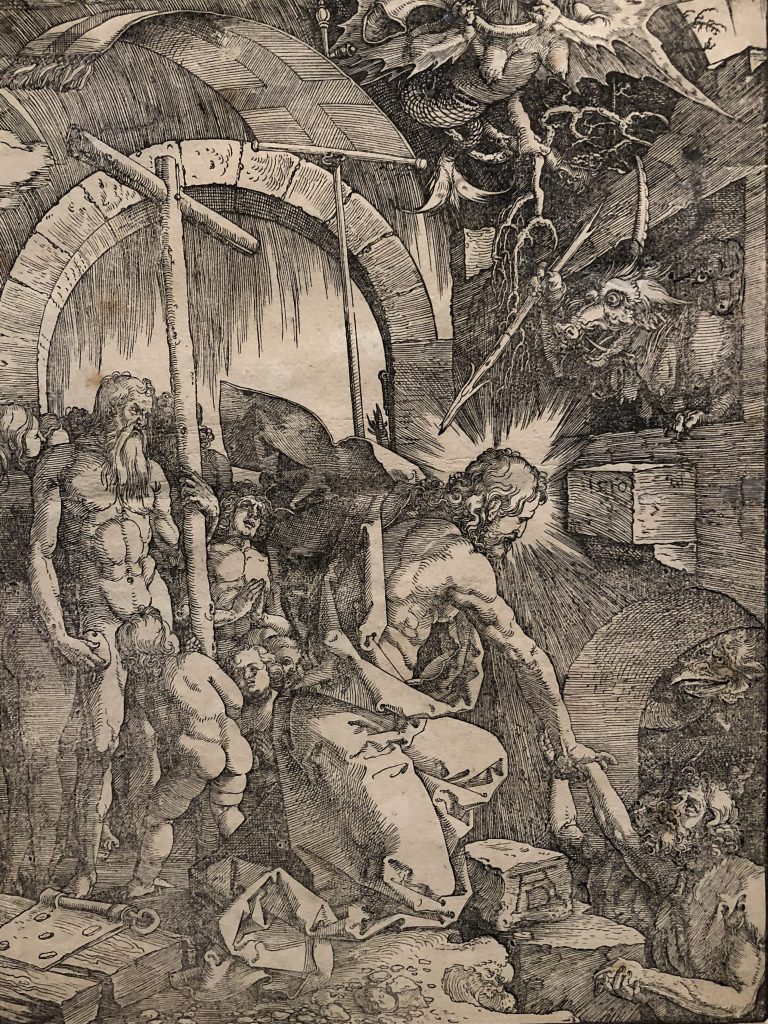
Albrecht Dürer woodcut, cathedral museum, Mdina, Malta

Christ is risen! He has burst open the gates of hell and let the dead go free; he has renewed the earth through the members of his Church now born again in baptism, and has made it blossom afresh with men brought back to life. His Holy Spirit has unlocked the doors of heaven, which stand wide open to receive those who rise from the earth. Because of Christ’s resurrection the thief ascends to paradise, the bodies of the blessed enter the holy city, and the dead are restored to the company of the living. There is an upward movement in the whole of creation, each element raising itself to something higher. We see hell restoring its victims to the upper regions, earth sending its buried dead to heaven, and heaven presenting the new arrivals to the Lord. In one and the same movement, our Savior’s passion raises men from the depths, lifts them up form the earth, and sets them in the heights…

Continue reading “Maximus of Turin on the Resurrection”

Bernini’s beads

Can you spot the rosary?

When I reached the end of the station pilgrimage the last time around, I was struck by the details.

For the sacramental theologian such as myself, there’s a deep lesson in the details of the journey. The Son of God’s Incarnation meant entering fully into the reality of human life, with all its diverse moments of suffering and disappointment, of hope and joy, of sometimes just getting by. The Passion narrative is the most vividly detailed part of the Gospels, and the Resurrection stories too, though reflecting the discombobulation of that utterly unprecedented event, also retain the sort of vivid details that stick out in one’s mind even when the world has just gone outside-in. Mary thinks Jesus is the gardener. Jesus eats a bit of fish. The sacraments depend on the details of the Lord’s life, too, on what he ate at his last meal.

Continue reading “Bernini’s beads”