Homily for the 29th Sunday in Ordinary Time (C). Translation of a homily, originally given in Italian in October 2019.
Why pray? Because the other team’s fans are praying, and we don’t want to give them any advantage? Because God seems a little indecisive, and maybe he needs our good advice? Because to get what we want, it helps to have powerful friends?
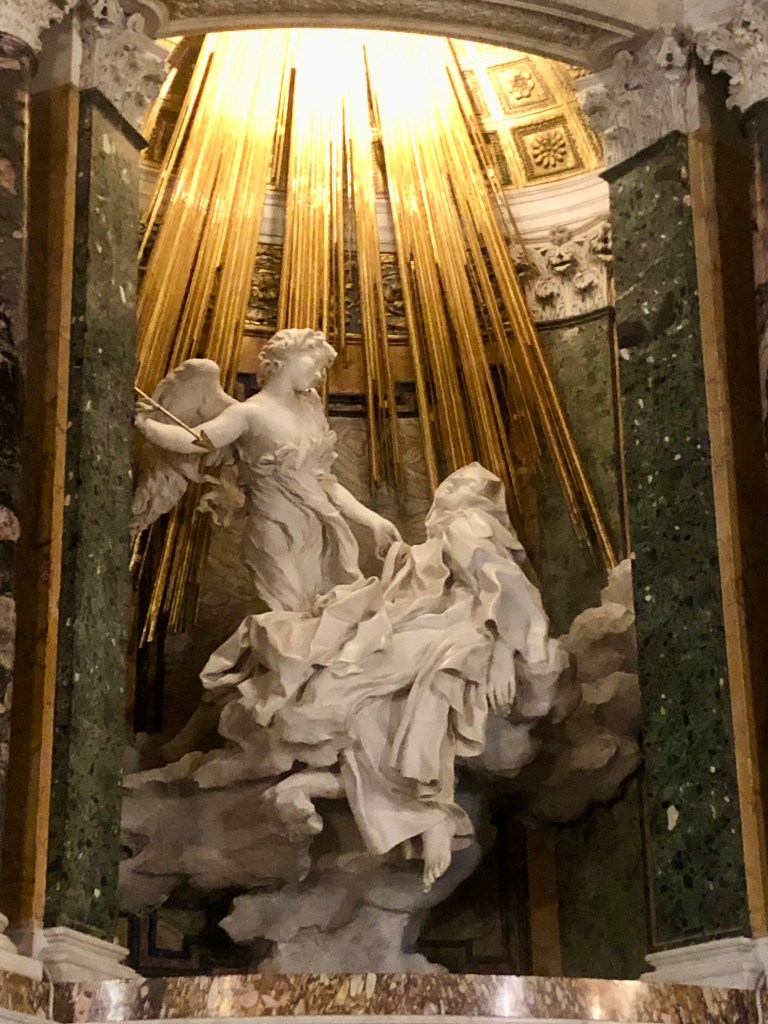
Ecstasy of St. Teresa, Gian Lorenzo Bernini, 1652
Unless we walked into church this morning by mistake, each of us believes that prayer is important in some way. In fact, we may feel that it is necessary. Maybe we can’t explain it, but we need prayer. Maybe we’ve learned from experience, maybe from hard experience, how necessary prayer is.
Brothers and sisters, papam non habemus. We do not have a pope. Not yet.
We live in uncertain and, often, disturbing times. I’m not talking only about the sede vacante in the Church of Rome. The last few years–the last few decades, really–have been a difficult time for the Catholic Church. The Church sometimes seems confused and divided from within, and opposed by powerful forces from without. And today we also live with all the uncertainty of a papal election.
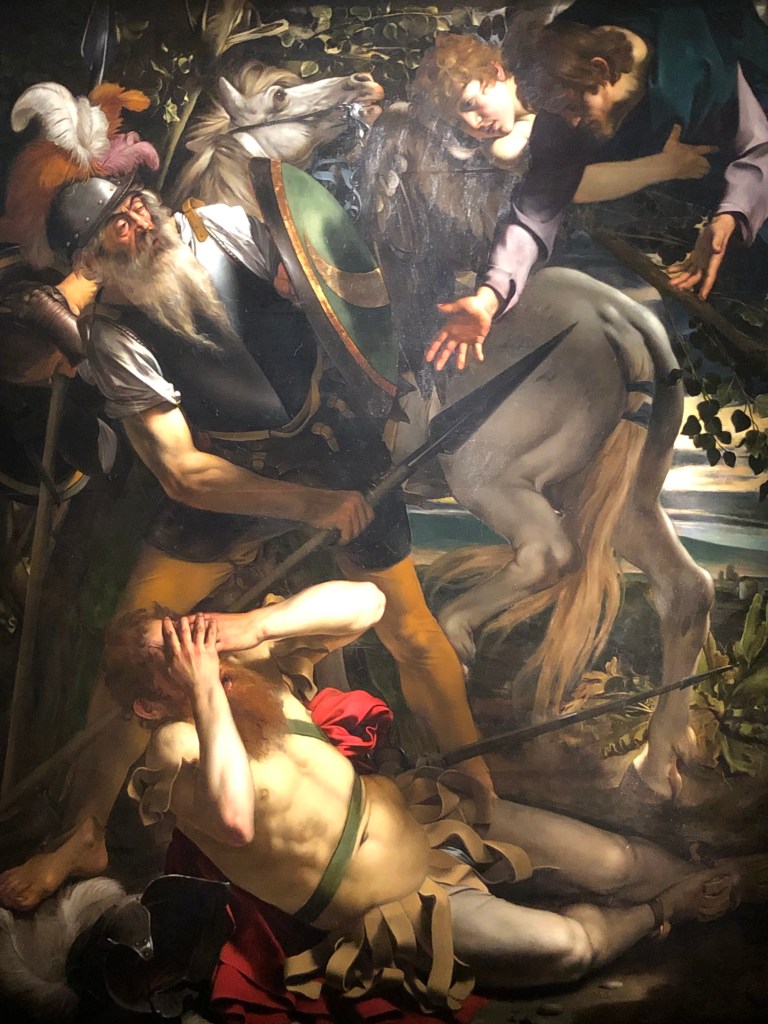
In this uncertain moment, today’s first reading reminds us of a simple but profound lesson: things have been worse. Much worse. Here we see the Church at its very beginning, tiny and persecuted. Stephen, one of the first deacons, has just been killed. The faithful are scattered. Those who persecute the Church are full of zeal, backed by the age’s political powers in all their strength. It seems like a catastrophic moment for the nascent Church, but it becomes a moment of triumph, a moment of growth. The dispersion of the faithful–even if caused by persecution–becomes the condition for the spread of the Word. Soon, we know, even the great persecutor, Saul, will convert and become the greatest missionary in the history of the Church.
Caravaggio, The Conversion of St. Paul, 1600-1
What I most want to emphasize today is the response of the disciples, who transformed this apparent catastrophe into a moment of growth: They continued to preach Jesus. Without panic, without discouragement. They returned and remained steadfast in the most fundamental mission of the Christian: to bear witness to the life, death and resurrection of Jesus Christ.
Today’s Gospel reading also calls us back to the heart of our Catholic faith: “I am the bread of life,” says Jesus. There is no action more important for the Catholic than to encounter the Lord in the Eucharist, in his true body and in his true blood.
Brothers and sisters, despite our anxieties and our doubts, despite the moments of uncertainty that alternate with moments of glory in the life of the Church, this message remains our rock. If we continue to proclaim it, we cannot go wrong. In a few days we will have a new pope, but our mission will not change. Times change. Popes change. Jesus Christ does not change.
Jesus Christ is the bread of life. Jesus Christ is Lord.
Readings: Acts 8:1b-8; John 6:35-40
(Original: Italian)
May 7, 2025
Gregorian University Chapel, Rome
Those interested can see my interview on the CBS Evening News with Maurice Dubois here.
Last week I was pleased to take part in a conference organized by at the Gregorian University’s Faculty of History and Culture and the Institute of Liturgy at the University of Santa Croce entitled L’edificio di culto e gli artisti: A 25 anni dal primo Giubileo degli Artisti (2000-2025). The theme was church architecture and art over the past 25 years. The conference brought together an impressive group of international architects, artists, and theologians.
My own rather modest contribution was to extend the reflection I began in November’s issue of First Things on “Screens and Sacraments.” The talk seemed to produce a good deal of agreement that we need to be more discerning in how we allow technology to intrude on our sacred spaces.
Pulpit, Church of the Gesù, Rome
On a related note, I was also happy to read a quite generous response to my article from Kevin Martin of Raleigh, North Carolina in the January 2025 issue of First Things. He reports being “strong-armed against [his] better judgement into Zooming the liturgy during the first year of the pandemic,” but eventually abandoning the practice because it felt wrong for many of the reasons I discussed in my article. He wonders, however, if I do not concede too much by suggesting that it might be OK to continue to broadcast the Liturgy of the Word, while stopping at the Liturgy of the Eucharist.
It’s a thoughtful question. I’d begin by saying that I am by no means arguing that one must broadcast any form of worship, and I have no quarrel with the decision of Rev. Martin’s church to give up streaming altogether. At the same time, I’m not an absolutist when it comes to technology, and some of the goods that people claim from broadcast Masses are real. Sick parishioners in particular can be helped to pray by seeing images of the liturgy online and comforted by the sight of their home church and familiar faces. These might supplement pastoral outreach to the homebound, without replacing it. I’m a little more skeptical about the evangelical or formative value of e-liturgy, since I think its appeal is mainly to those who have already been sufficiently formed by real liturgy.
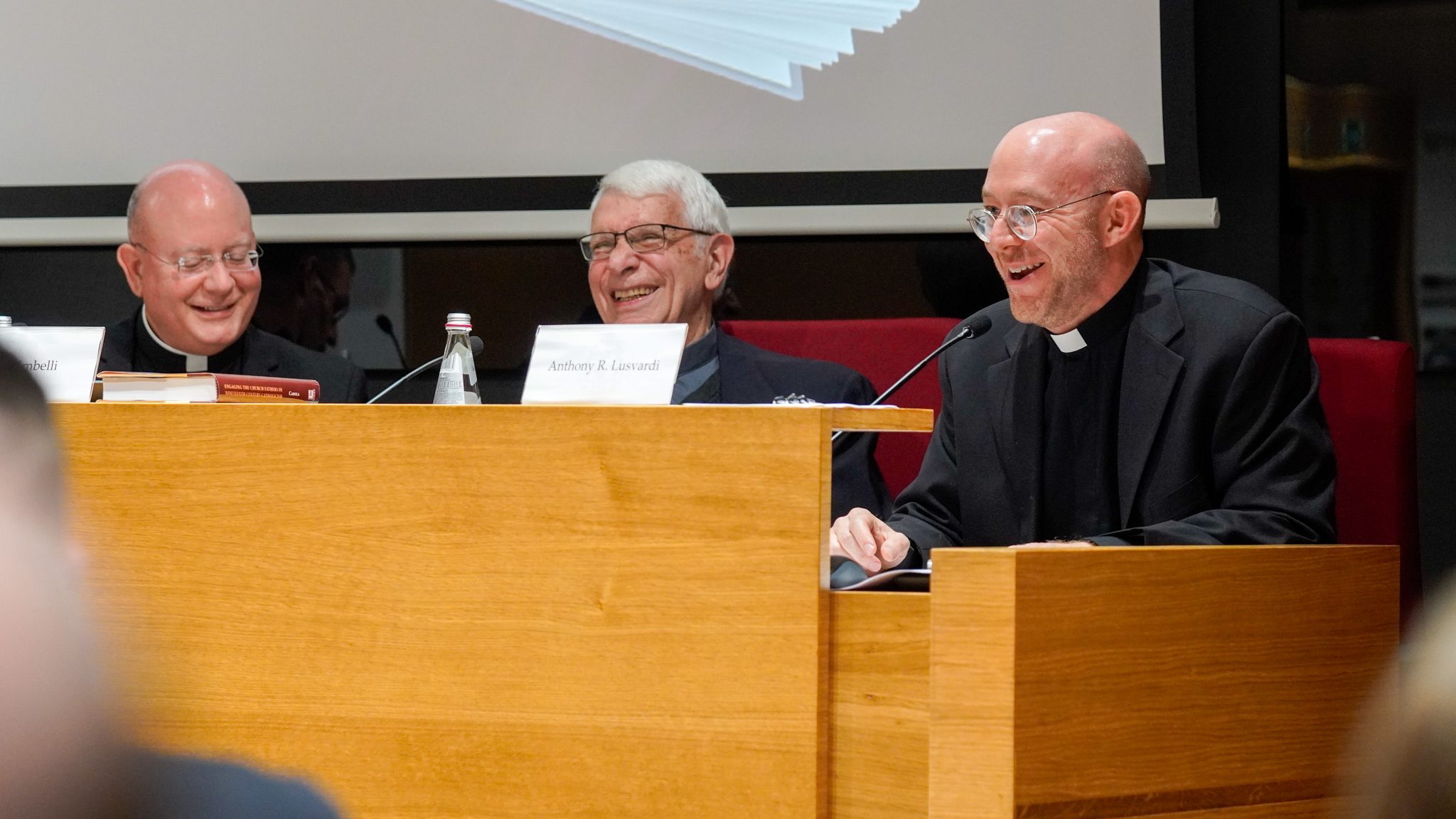
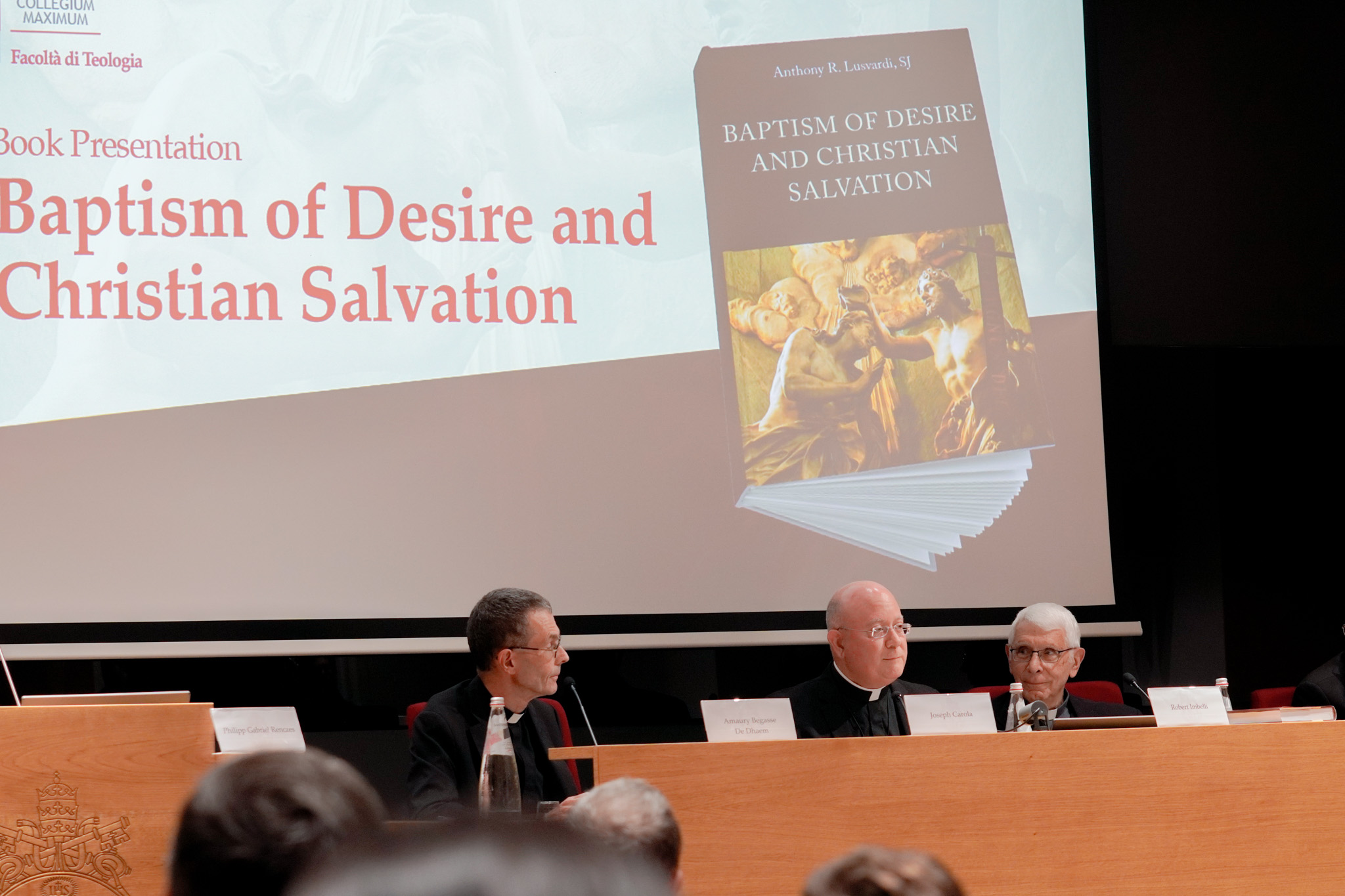
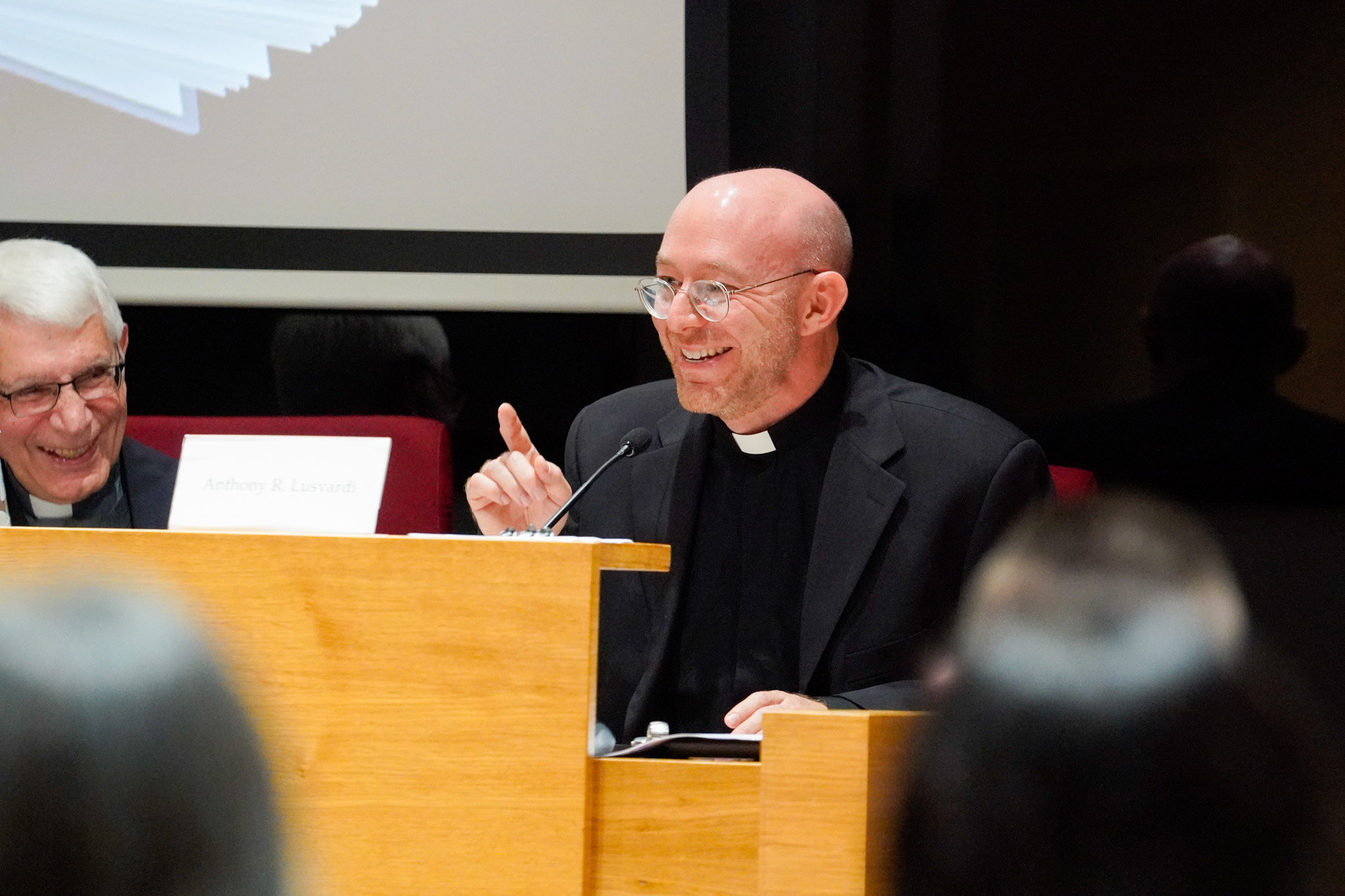
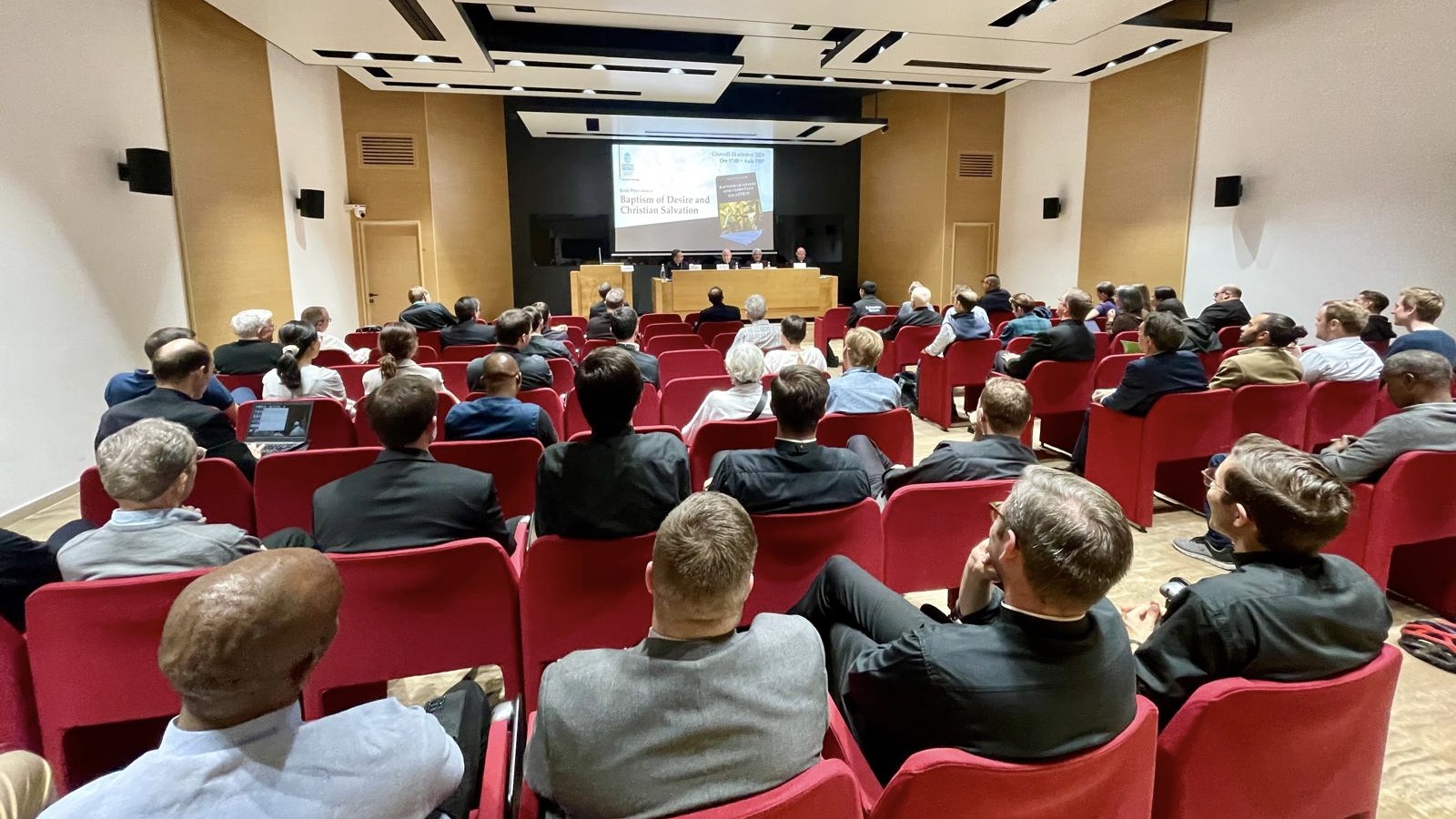
Baptism of Desire and Christian Salvation is now in orbit after an excellent turnout at the official book launch at the Gregorian last Thursday. More good news: the code CT10 still gives you a 20% discount if ordering the book directly from Catholic University of America Press. At the presentation of the book, Fr. Joseph Carola gave an overview of its content and shared some stories from personal experience to illustrate its pastoral relevance. Fr. Bob Imbelli drew on other contemporary thinkers, such as Khaled Anatolios, Charles Taylor, and William Cavanaugh to demonstrate its relevance. I hope to have video of the presentations up on the Baptism of Desire page soon.
Fr. Joseph Carola, S.J., Fr. Robert Imbelli, Fr. Anthony Lusvardi, S.J.
On another note, in this month’s First Things I return to an issue I raised a few years ago in an article in America magazine, the effects of technology on the liturgy. Here’s the new article: “Screens and Sacraments.” The original from 2020 is here.
And, finally, if you’re looking for some pre-election reading that isn’t about either Donald or Kamala, but instead about the way voting functions as a civic ritual, check out my latest at The Catholic Thing: “Rites (and Wrongs) of Democracy.“
The question of invalid baptisms has been in the news recently. In my commentary on the question in La Civiltà Cattolica, I pointed out that the Vatican’s most recent document on the question, Gestis verbisque, gives renewed attention to the minister’s intention. For a sacrament to be valid, a minister must intend to do what the Church does when celebrating that sacrament. And that means that if he changes what the Church prescribes in her official liturgical texts–by inserting his own words or deleting something required to be there–then he manifests an intention to do something else. It’s just as straightforward as it sounds. The proof is not in the pudding, but in the action.
Baptismal font, St. Peter’s Basilica
Last week, however, another question was sent to the Vatican about what sort of intention might invalidate a sacrament, this time an ordination. The question proposed the distasteful case of a bishop who ordained a man with whom he had engaged in an illicit sexual relationship. Could he possibly have the right intention? Wouldn’t such a sinful situation invalidate the ordination?
The article in which this question was raised described it as “potentially explosive.” Fortunately, this grenade was defused by St. Augustine in the fifth century. The great theologian was responding to controversy about the validity of baptisms, whether the sinfulness of a minster invalidated the sacrament. He responded no. Augustine’s principle has remained a bedrock of sacramental theology ever since. It is really Christ who baptizes, Augustine said, and he can do so even through profoundly imperfect human instruments. The same goes for ordinations. Augustine sagely realized that if perfection were required of ministers in order for sacraments to be valid, then we simply wouldn’t have sacraments.
So how does Augustine’s principle fit with the requirement that one has to have the right intention to celebrate a sacrament validly? Here we have to make what might at first seem like a rather technical distinction but is, once you’ve thought the question through, also rather straightforward. The distinction is between intention and motive.
After a few delays, I am pleased to report that my book is now officially in print and copies have arrived for those who preordered. It seems to have been released on Good Friday no less.
If you’re still on the fence about whether it’s worth the read, I thought I’d share the very kind words of endorsement from Fr. Joseph Carola, SJ, my colleague at the Gregorian University and expert in both the Church Fathers and Nineteenth Century theology.
So take it from Fr. Carola:
Jesus instructed Nicodemus that, “unless one is born of water and the Spirit, he cannot enter the kingdom of God” (John 3:5). Faithful to the Lord’s revelation, Christians have insisted for two millennia upon the necessity of baptism for salvation. But already in the ancient Church, salvation’s rough edges, as Father Anthony Lusvardi creatively calls them, have challenged believers. What is the fate of those who lived before Christ and therefore died without Christian baptism? What happens to the catechumen who dies unexpectedly before being baptized? Can unbaptized babies get to heaven? Is there any hope for the salvation of non-Christians? In his thoroughly historical and insightfully theological study of the baptism of desire, Father Lusvardi offers his readers a fresh perspective on this traditional notion often misunderstood and misapplied in contemporary theology and pastoral practice. Providing a convincing response to the challenges that the hard cases present, Father Lusvardi especially appeals to the Catholic Church’s lex orandi in order to establish the Church’s lex credendi that simultaneously upholds the necessity of baptism, the need for evangelization, and the nuances of desire. Historically informative, theologically rich, and occasionally even humorous, Baptism of Desire and Christian Salvation is a book not only for theologians, but perhaps even more so for pastors who labor on the rough edges of salvation.
“True reverence for the Lord’s passion means fixing the eyes of our heart on Jesus crucified and recognizing in him our own humanity.
“The earth–our earthly nature–should tremble at the suffering of its Redeemer…. No one, however weak, is denied a share in the victory of the cross. No one is beyond the help of the prayer of Christ. His prayer brought benefit to the multitude that raged against him. How much more does it bring to those who turn to him in repentance… Everything that he did or suffered was for our salvation: he wanted his body to share the goodness of its head.
“First of all, in taking our human nature while remaining God, so that the Word became man, he left no member of the human race, the unbeliever excepted, without a share in his mercy. Who does not share a common nature with Christ if he has welcomed Christ, who took our nature, and is reborn in the Spirit through whom Christ was conceived?
“Again, who cannot recognize in Christ his own infirmities? Who would not recognize that Christ’s eating and sleeping, his sadness and his shedding of tears of love are marks of the nature of a slave? …
“The body that lay lifeless in the tomb is ours. The body that rose again on the third day is ours. The body that ascended above all the heights of heaven to the right hand of the Father’s glory is ours. If then we walk in the way of his commandments, and are not ashamed to acknowledge the price he paid for our salvation in a lowly body, we too are to rise to share his glory.”




 Tony Lusvardi, S.J.