Apocalypse when? Homily for the 33rd Sunday in Ordinary Time

Homily for the 33rd Sunday in Ordinary Time (C). November 2019.

Reflecting on this Sunday’s readings, I turned to that great source of theological wisdom, Amazon Video. In November, at the end of the liturgical year, the liturgy speaks of the Apocalypse. Well, I discovered that there are also many films on this theme. I found earthquakes, hurricanes, volcanoes–even alien invasions. And lots and lots of zombies.

The name of one film–at a discounted price–was “Apocalypse 2012.” This film provoked the question: has the Apocalypse already happened? Was I distracted and didn’t notice? As I thought about it, I remember hearing in 1999, “The end is near. At midnight, our computers will no longer work, there will be a total collapse of civilization. Buy canned food.”

From the Church of Santa Maria dell’Orazione e Morte, Rome

Then in 2012, I did an interview for an American Catholic radio program, and they asked me about the Mayan calendar. It was about to end on December 21, 2012, they said, and asked, “Is it true that the world will end? Should we buy canned food?”

Even today, when we talk about the environment—an important issue—there is often an apocalyptic element. And this element, in my opinion, probably does not help us deal with this complex problem in a sober manner.

Perhaps you are now thinking, “But, Father, are you saying that there will be no Apocalypse?” Absolutely not. The Apocalypse is a recurring theme in Jesus’ preaching, and since time of the apostles, the Church has never ceased to proclaim the urgency of being prepared for this event. There have been many false prophets who have proclaimed “the time is near,” but that does not mean we should not be prepared. Even if the Mayan astrologers were wrong about the date, our life is short.

However, with these recent examples of false prophecies, I would like to point out that in today’s culture, the idea of the Apocalypse continues to exist but has become secularized. Earthquakes, hurricanes, aliens, computers, astrologers, pollution, zombies—in all this apocalyptic talk, the one thing missing is the most important thing: Jesus Christ.

Continue reading “Apocalypse when? Homily for the 33rd Sunday in Ordinary Time”

Buildings that speak to us: Homily for the dedication of the Lateran Basilica

Homily for the Feast of the Dedication of the Lateran Basilica (2023).

From the cloister of St. John Lateran, Rome

The feast we celebrate today is particularly special for us in Rome. We celebrate the dedication of our cathedral. It is a magnificent building, and probably all of us have been there to appreciate the beauty of this splendid and ancient church.

The anniversaries of church dedications are important in the Church calendar because churches are the places where we gather to celebrate the Christian liturgy, the holy mysteries of salvation. Here in Rome, however, we live in an unusual situation because there are many beautiful and ancient churches–but when we enter them, often we find few of the faithful.

We should not be discouraged; instead we should remember the faithful who still speak to us through these monuments of their faith. The churches they built and left us are not mere buildings; they are their testimony. There is a message in these buildings that the saints of past times wanted to convey to us.

But more than a message, there is still a presence. When we celebrate the liturgy, we are not alone; we enter into the presence of the saints. They are with us. On November 1, we entered the season in which we remember the saints. Churches–from St. John Lateran to this little chapel–are more than museums where we learn from the past; they are places where we encounter the saints, where eternity becomes the present.

(Original: Italian)

Readings: Ez 47:1-2, 8-9, 12; 1 Cor 3:9c-11, 16-17; John 2:13-22

Gregorian University Chapel

November 9, 2023

From the cloister of St. John Lateran, Rome

Do we still desire holiness? Homily for the Feast of All Saints and Blesseds of the Society of Jesus

November 5 is a special feast day on the Jesuit liturgical calendar–the Feast of All Saints and Blesseds of the Society of Jesus, a kind of All Saints Day for Jesuits. Five years ago, in 2020, at the height of the pandemic, I celebrated Mass in our formation community in Rome on that day. The homily, translated into English, is below.

We need saints.

Today more than ever, I feel this need. In these days of isolation, loneliness, anxiety, and disillusionment, we need companions. We need to know that we are not alone—even in the dark nights when we cannot sleep. And when we are confused, afraid, full of doubts, we need companions who have experienced confusion, opposition, doubt, sin and penance, and yet have come to peace.

Today we celebrate the great consolation that we have such companions. As Jesuits, we celebrate the fact that among all the saints recognized by the Church, there are many who made the same choice we have made, who prayed as we pray–who have, we might say, eaten with us in the refectory. As Moses says of the word of God, these companions are not across the sea but are near to us. In the long winter we are experiencing, we need only open our mouths in prayer, and these companions will be present at our side.

Church of St. Ignatius (ceiling), Rome

Today we remember not only the great names—Robert Bellarmine, who cheers us on in our studies, and Francis Xavier, who reminds us that our studies are only a means to spread the Gospel. Among these heavenly friends, there are many less famous ones, perhaps even some companions we have known in this life who are now in the Father’s house.

Every year when we reach the second half of Ordinary Time and volume four of the breviary, I find the holy card of Bob Araujo, a Jesuit who taught me in Chicago and greatly encouraged me in my studies and advised me during some doubtful moments of my formation. Bob suffered quite a bit in his life, first, from opposition in his career and, then, from a slow and painful cancer. He died in October 2015. When he died, the words of St. Paul came to mind: “I have fought the good fight; I have finished the race; I have kept the faith.” When he died, another companion said to me, “He’ll get right in.” Now I talk to Bob from time to time, and I ask him, “What do you think? How am I doing? Do you have any advice for me?” I imagine you also have such companions.

But when we talk about saints and Jesuit saints, I must admit that there is also something that disturbs me, just as there is something that disturbs us in the Gospel passage chosen for this feast: “Whoever loves his life loses it, and whoever hates his life in this world will preserve it for eternal life.”

Continue reading “Do we still desire holiness? Homily for the Feast of All Saints and Blesseds of the Society of Jesus”

Infants and baptism of desire: one theologian’s perspective

Spisska Kapitula, Slovakia

As I mentioned earlier, over the summer God’s providence brought me into contact with a group of people dedicated to sharing the story of Baby Brian Gallagher. The circumstances of Baby Brian’s short life raise the question of babies who die before baptism and baptism of desire, and the group asked me to write up a one page summary of the argument I present in my book Baptism of Desire and Christian Salvation. Of course, for the full story–and much else besides–buy the book! What I wrote is not intended as a full pastoral response to those who have lost a child too soon, but a very brief sketch of the theological issues involved.

Theologians have a precise mission within the Church. Our task is not to “create” the truth, but to use the tools of reason and study to understand better what God has revealed to us. When it comes to salvation, theologians don’t “decide” what the Church believes; we merely try to express with greater clarity what we find in Christian revelation. 

Good theologians, then, must be humble and cautious in what they claim. Historically, theologians have found the question of what happens to babies who die before baptism particularly difficult. We know that baptism is necessary for salvation (John 3:5) because baptism is the unique way Jesus has revealed for us to participate in his death and resurrection (Romans 6:3-5). At the same time, the doctrine of baptism of desire has found strong support among theologians and in the Church’s official teaching. Baptism of desire does not deny the necessity of baptism or create an alternative to the sacrament. Instead, the doctrine means that those who desire the sacrament but are prevented by circumstances beyond their control from receiving it can still obtain baptism’s effect—rebirth to eternal life. 

Historically, most—but not all—theologians have had trouble seeing how baptism of desire could apply in the case of infants who are too young to formulate a desire of their own. After a decade studying baptism of desire, however, I believe that these theologians have tended to leave out a decisive piece of evidence: our practice of the sacrament of baptism. The key theological principle that has been neglected up until now is known as lex orandi—lex credendi, which means “the law of prayer is the law of belief.” In other words, the way we celebrate the sacraments is itself a guide to what is true. In this case, the Church’s firmly-established practice invites us to look more deeply into how to understand the desire for baptism in regard to infants.

Continue reading “Infants and baptism of desire: one theologian’s perspective”

Why pray? Homily for the 29th Sunday in Ordinary Time

Homily for the 29th Sunday in Ordinary Time (C). Translation of a homily, originally given in Italian in October 2019.

Why pray? Because the other team’s fans are praying, and we don’t want to give them any advantage? Because God seems a little indecisive, and maybe he needs our good advice? Because to get what we want, it helps to have powerful friends?

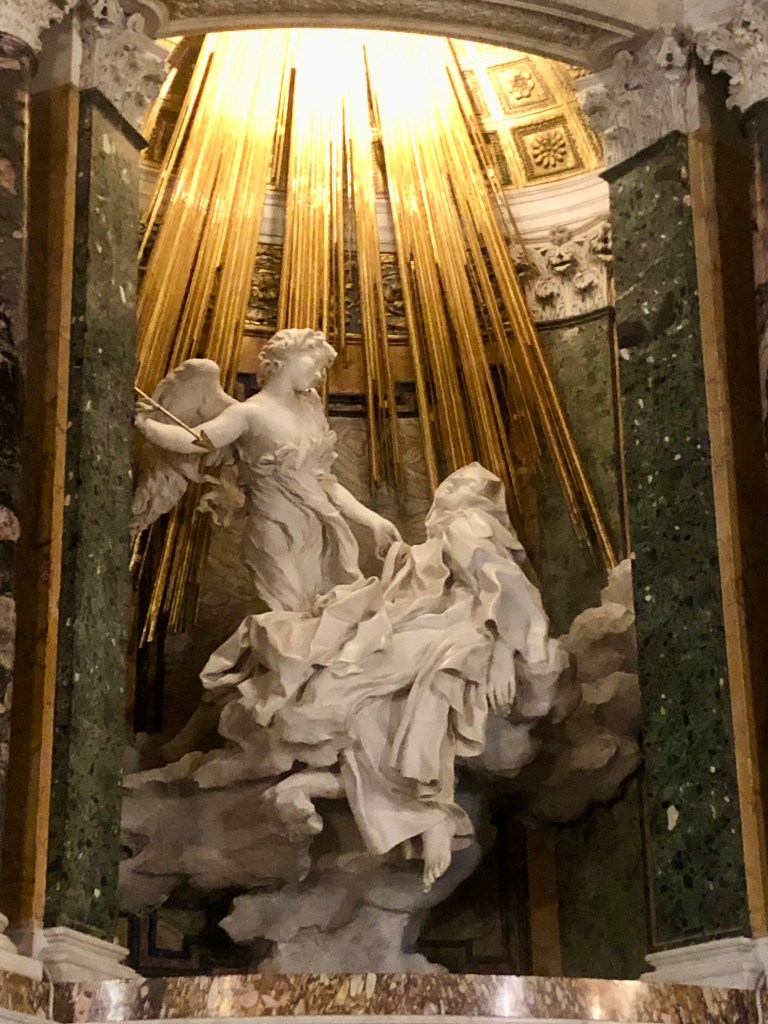
Ecstasy of St. Teresa, Gian Lorenzo Bernini, 1652

Unless we walked into church this morning by mistake, each of us believes that prayer is important in some way. In fact, we may feel that it is necessary. Maybe we can’t explain it, but we need prayer. Maybe we’ve learned from experience, maybe from hard experience, how necessary prayer is.

Continue reading “Why pray? Homily for the 29th Sunday in Ordinary Time”

Remember to say “Thank you”: Homily for the 28th Sunday of Ordinary Time

Homily for the twenty-eighth Sunday of Ordinary Time (C).

One of the lessons I remember being drilled into me as a child was the importance of saying “thank you.”  As with so many of the lessons we learn in childhood, I may not have appreciated its importance at the time, but now I’m grateful for it.  The next time I see my mom and dad, I’ll have to remember to thank them.

Today’s readings are all about remembering—and forgetting—to give thanks.  The attention that Sacred Scripture dedicates to the theme suggests that we are dealing with something much deeper than polite social convention.  Gratitude does make for more pleasant social interactions, but it is also necessary for us to see the world truthfully.  And it is something we easily forget.

Certosa di San Martino, Naples

Today’s Gospel passage, in fact, hints that perhaps we are more inclined to forget to give thanks than to remember.  Ten lepers were cleansed, Jesus points out, but only one returned to thank him.  Busyness can distract us from gratitude—we need to move on to the next thing, we don’t have time.  When we get what we want, often our tendency, instead of saying thank you, is to try to get more.  This is part of what theologians call “concupiscence,” the habit of selfishness burned into human nature by original sin.  Today we can add a sense of entitlement to concupiscence.  We like to speak of our rights—and politicians like to promise more rights—but while the rights we claim for ourselves multiply exponentially, our sense of responsibility never quite seems to keep pace.  We forget that we would have no rights whatsoever if these hadn’t been granted to us by our Creator.  To this forgetfulness we can add advertising that pushes us to buy more, to watch more, to scroll more, to consume more, and not to waste time remembering where we came from.  My parents did well to drill saying “thank you” into me because there are so many other voices saying, “Don’t worry—just give me your credit card.”

The loss of a sense of gratitude makes a truly Christian life impossible.  It’s no accident that the word that describes the central action in the life of the Church—“Eucharist”—comes from the Greek word for thanksgiving.  In some ways, this might seem surprising because in the celebration of the Eucharist, God’s action, and not ours, is central.  It is Jesus who gives himself to us; it is his power that transforms bread and wine into his Body and Blood, his living presence among us.  What we do in this sacrament we do only because he gave us the instructions.  The initiative is always God’s.  The same can be said of all of creation.  Everything that is is an unmerited gift.

Continue reading “Remember to say “Thank you”: Homily for the 28th Sunday of Ordinary Time”

Lessons from Slovakia

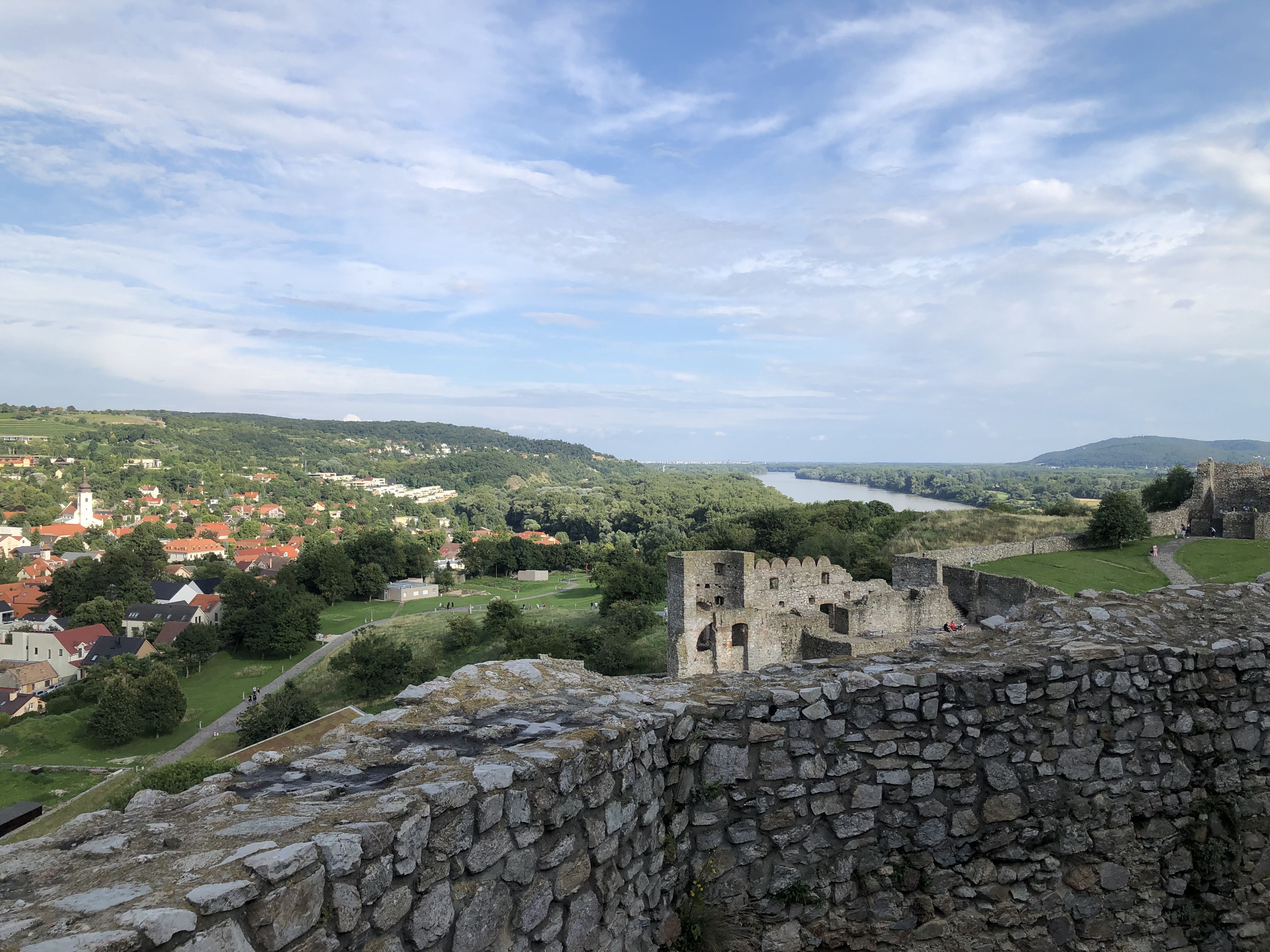
Spiš Castle, Slovakia

With classes starting up again this week at the Greg, I’ve been looking back with gratitude on a full summer. Among the highlights was a unexpected trip to Slovakia to accompany the Free Society Seminar organized by the Faith & Reason Institute and the Kolégium Antona Neuwirtha. It was a delight to meet a diverse group of curious and insightful young people from Slovakia, Poland, and the States, all of them committed in one way or another to serving their societies and the common good. The faculty was equally a joy to be with.

In addition to chaplain duties, I was able to lead a seminar on the theme of “civil religion,” taking an article I wrote for The Catholic Thing last year “Rites (and Wrongs) of Democracy” and Robert Bellah’s 1967 article “Civil Religion in America” as jumping off points. Another article I wrote about public apologies and how we deal with historical wrongs, “Confessing Other People’s Sins,” produced an even livelier discussion, enriched by the diverse eastern European perspectives.

Slovakia is a country of castles, idyllic landscapes, and beautiful churches, but one of the trips’s most haunting memories has to do with the legacy of communism. We visited the Victims of Communism Museum in Košice, which seeks to keep the history of that dark time alive. The geography of Slovakia also provided a vivid reminder of the desperation that system produced. The ancient and strategically placed Devín Castle overlooks the Danube, with Austria–and during the Cold War, freedom–just on the other side. Displays detail the brutal lengths to which the border guards went to prevent Czechoslovak citizens from escaping. Some tried to swim the Danube at the narrow point by Devín. Thousands were imprisoned for illegally trying to cross the Czechoslovak-Austria frontier, and 42 people lost their lives.

Continue reading “Lessons from Slovakia”

Caveat emptor! Investing in the Kingdom of Heaven: Homily for the 25th Sunday of Ordinary Time

Homily for the twenty-fifth Sunday of Ordinary Time (C).

Detail of the statue of St. Matthew (St. John Lateran)

In 1920, Charles Ponzi devised a scheme to buy international postal coupons in Europe and sell them for a profit in the United States.  So many people invested in Ponzi’s plan that he couldn’t keep up with demand, so he used the money from new investors to pay off old investors, which worked as long as there were more new investors.  And, then, when there weren’t, the whole scheme went kaput.  For a while, Mr. Ponzi made a lot of money using a financial trick without actually producing anything real.  Today similar scams are known as “Ponzi schemes.”  

The parable of the dishonest steward, which Jesus tells in the Gospel, is rather like a first century Ponzi scheme.  The steward, learning that he is about to be fired, retires debts to his master at a steep discount.  Doing so doesn’t cost him anything but comes at his master’s expense.  His master’s debtors will now owe him for their savings, so he’ll have many grateful new friends when he becomes unemployed.  What is surprising about the parable is that the master does not condemn his conniving steward but seems to think his trick is rather clever.  

The explanation Jesus gives of the parable also surprises us because you’d expect the Lord to condemn obvious fraudulent behavior.  But, instead, Jesus uses the story to make a different—very ironic—point.  Jesus’ point is that people—like the steward—put so much cleverness and effort into making money that when it comes to what really matters—their relationship with God—they’re rather careless.  So, he says, “Go ahead, make friends with dishonest wealth.  Invest in the Ponzi scheme.  Then, when it fails, and you see how clever you really were, maybe, then, you’ll start thinking about your eternal dwelling.”  After all, if the steward had worked half as hard for his master as he did to save his own skin, he wouldn’t have been fired to begin with.

Continue reading “Caveat emptor! Investing in the Kingdom of Heaven: Homily for the 25th Sunday of Ordinary Time”

Summer articles

The October start of the Roman academic year means that I am wrapping up my time in the States before heading home (and back to work!) next week. Nonetheless, I haven’t been idle over the course of the summer. In addition to seminars and retreats, I published a couple of articles which might be of interest.

First Things asked me to weigh in on the questions surrounding transsexuals and the sacrament of baptism: Can Transsexuals Be Baptized?

America magazine also published a long-planned article on baptism of desire, in which I distinguish the implications for evangelization of my position from those of two other people I admire but (partially) disagree with: Is there salvation outside baptism? A better way of looking at a difficult question.

The relationship between salvation and evangelization, however, is only one of the difficult questions my book addresses. I also suggest a new approach to the question of unbaptized infants and children dying in utero. This summer, I was contacted by some folks involved in ministry to Catholic parents who have lost children either through miscarriage or in early infancy. I found a quite enthusiastic reception for my work among those who are involved in this kind of grief ministry, and, a week ago, a group of the faithful put up a statement online in support of the position that I advance in my book: that baptism of desire can, in some cases, apply to the children of Christian parents. You can find this statement in support of the development of doctrine I outline here and sign if you wish: A Statement of Hope regarding Salvation through Baptism of Desire for Infants.

The statement also mentions the case of baby Brian Gallagher, whose grave I visited at Black Hills National Cemetery. On the outskirts of the cemetery I snapped a photo of a quintessentially American scene: a giant flag waving from a piece of heavy machinery with the Western landscape in the background. What else is there to say but, God bless the USA!

On the road with St. Augustine

It seems like I’ve been on the road–or more precisely in the air–a lot this summer. Some of the journeys have been planned, others unexpected; some have involved meeting old friends, others making new ones. One was to bury my grandfather (that was tough); others involved planting new seeds (both spiritually and literally). My retreat for Jesuits on praying the liturgy got off the ground; I was able to return to St. Isaac Jogues and Rapid City and to Cloisters on the Platte to give a retreat; and for the first time I participated in the marvelous Free Society Seminar in Slovakia. St. Augustine’s words from the Feast of Martha, Mary, and Lazarus a few weeks ago struck me in a particular way this year, a reminder of the journey we all are on…

“Our Lord’s words teach us that though we labor among many distractions of this world, we should have but one goal. For we are but travelers on a journey without as yet a fixed abode; we are on our way, not yet in our native land; we are in a state of longing, not yet of enjoyment. But let us continue on our way, and continue without sloth or respite, so that we may ultimately arrive at our destination.”

St. Augustine, Sermo 103