Book launch, podcasts, and other news

I am pleased to see Baptism of Desire and Christian Salvation in the news. Ralph Martin mentioned the book in his recent video Are All Religions a Path to God? As Dr. Martin points out, the research and arguments the book offers are highly relevant to some of the most difficult theological questions the Church faces today. As I’ve said before, perhaps the most urgent question the book raises has to do with whether we should still understand salvation to be at the heart of the Church’s mission. (Spoiler alert: Yes.)

With Dr. George Ceremuga at St. Isaac Jogues this summer.

I was also delighted to have a thoroughly enjoyable conversation a few weeks ago with Dr. George Ceremuga, friend and parishioner at St. Isaac Jogues parish in South Dakota, for the inaugural episode of his new Lead With Love podcast. We talked about Baptism of Desire and Christian Salvation as well as Dr. George’s new book My 50 Day Pentecost in the Holy Land, in which he recounts some of the encounters and insights he had on an amazing journey through the Holy Land last year. UPDATE: the podcast is now out here. I’m collecting info and reviews about baptism of desire here.

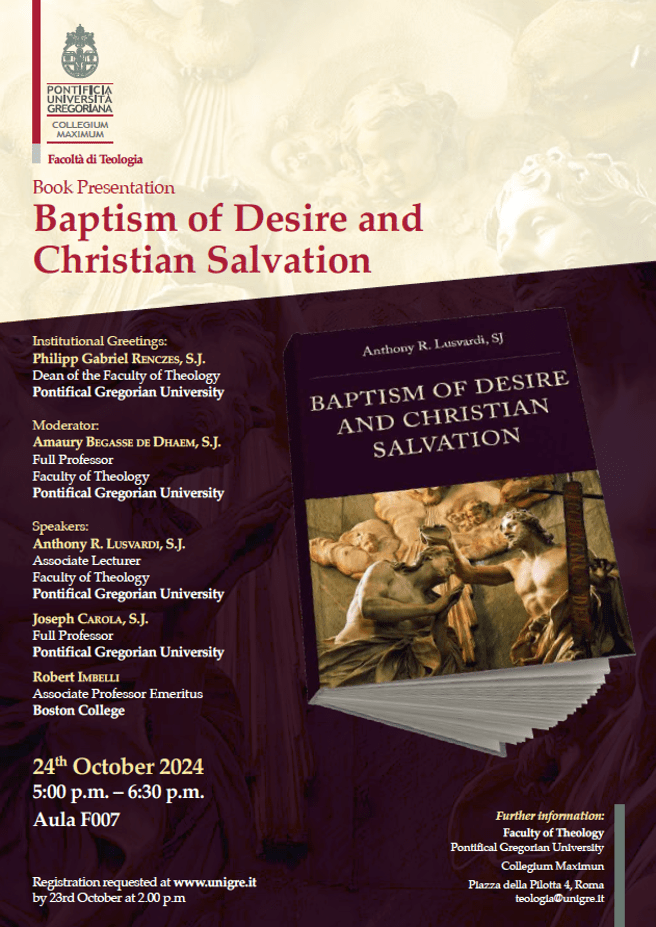
And finally, as you can see from the flyer at the top of this post, I’m pleased to announce that we will have a book launch for Baptism of Desire and Christian Salvation later this month at the Gregorian University. If you are in Rome, please come on Thursday October 24 to hear Fr. Robert Imbelli (coming all the way from New York!) and Fr. Joseph Carola discuss the book’s significance. The event will take place at 5:00 PM in room F007 of the Frascara Building at the Gregorian University. I’ll try to get the talks posted here, too, since it promises to be an interesting discussion.

And for something just a little bit different, you might want to check out the November issue of First Things. Just saying.

Ascension

Transfiguration, pulpit (Pisan 1160), Cattedrale, Cagliari

“Today our Lord Jesus Christ ascended into heaven; let our hearts ascend with him. Listen to the words of the Apostle: ‘If you have risen with Christ, set your hearts on the things that are above, where Christ is, seated at the right hand of God; seek the things that are above, not the things that are on earth’ (Col. 3:1-2). For just as he remained with us even after his ascension, so we too are already in heaven with him, even though what is promised us has not yet been fulfilled in our bodies.”

St. Augustine, homily on the Lord’s Ascension, quoted in Robert Imbelli’s
Christ Brings All Newness (Word on Fire Academic, 2023), p. 144.

The bodily resurrection of Jesus

Galleria degli Arazzi (Gallery of Tapestries), Vatican Museum: The Resurrection, Raphael, 1519

As we near the end of the Easter season, I’ve been reading the latest book of Fr. Robert Imbelli, Christ Brings All Newness (Word On Fire Academic, 2023). It is a fine collection of essays on everything from Vatican II to Dante, all held together by the wonder and uniqueness of the Son of God’s entry into the world. The title comes from St. Irenaeus of Lyons: “Christ brought all newness in bringing himself.”

To give a taste of the book–and as we approach the Ascension–I thought I’d share some of Fr. Imbelli’s words on the Resurrection from the essay “Resurrection and Real Presence.” Insisting on the bodily resurrection of Jesus–and not some watered-down academic knock-off–Imbelli again demonstrates a truly sacramental sense of the body’s importance, which I mentioned in another post a few weeks ago.

“Resurrection faith stretches heart and mind to the breaking point, as they stagger under the unbearable lightness of being. Is it any wonder that we frequently retreat before the mystery, reducing it to more manageable perspectives? And so, certain scholars contend, ‘He is risen into the kerygma’–betraying thereby their inordinate appetite for ideas. No resurrection there, only a ghostly apparition. Or, some ecclesiastical functionaries insist, ‘He is risen into the institutional church”–displaying, by the very contention, a rather petrified imagination. That would merely exchange one tomb for another. Or, others of more liberationist bent cry, ‘He is risen as the people’–manifesting their often havoc-wreaking innocence. A provocative resuscitation, perhaps, but no true resurrection. But against all infringement of the mystery, the angel stands adamant: ‘He is risen; he is not here!'” (pp. 158-9)

Sacraments, incarnation, and the body

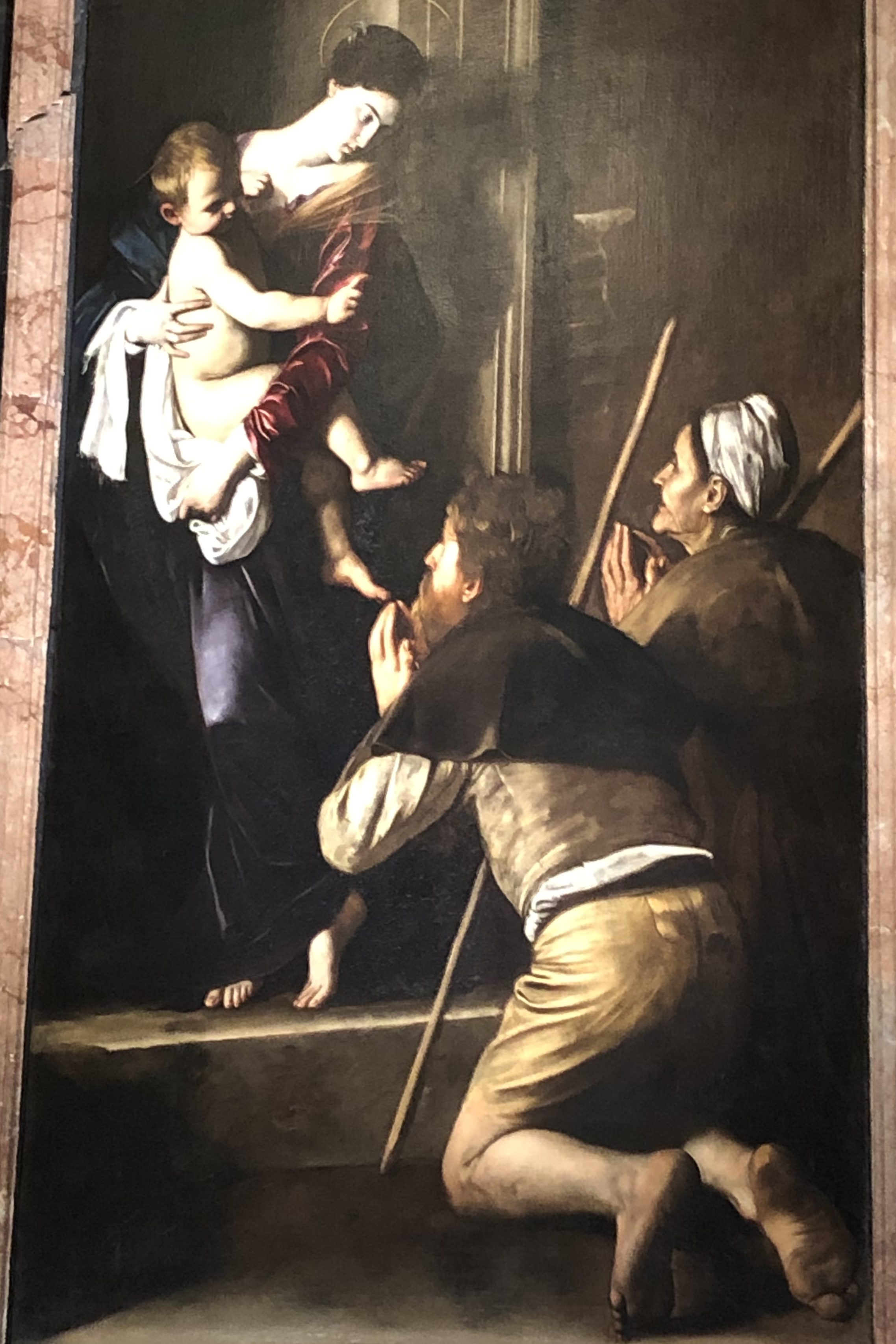
Madonna of the Pilgrims, (1604-6) Caravaggio, Church of Sant’Agostino, Rome

I’ve shared the work of theologian Fr. Robert Imbelli before. Here is another piece from him about a theme near to my heart, the “sacramental sense,” a phrase he takes from St. John Henry Newman.

Imbelli makes a point that has struck me before as well, that our society’s neglect of the transcendent is oddly connected to an unease with the body. We see this unease with our own bodies in everything from the explosion in the popularity of piercings and tattoos to the growth of eating disorders. Sex-changes are perhaps the most dramatic example of turning against one’s own flesh.

One of the sad marks of our secular age is a paradoxical double loss. Not only do we struggle to find access to the other dimension, that is, the spiritual, but we also seem impervious to the true sense of the material. Our sacramental sense has atrophied. Indeed, these two losses may be intricately connected.

Imbelli quotes philosopher Charles Taylor to argue that secular people today live lives of “excarnation,” disconnected from the communities and traditions that bore them. We live increasingly rootless lives. In contrast to this “excarnation,” Imbelli quotes Jesuit poet Gerard Manley Hopkins and points toward our Eucharistic faith. He hints at the way that this sacrament directs us toward a relationship with creation–and our own embodied part in it– that is rooted, first of all, in gratitude.

Read the rest of Imbelli’s piece at the Catholic Thing.

On the Annunciation

Detail from Botticelli’s Annunciation.

A beautiful piece for today’s feast from Fr. Robert Imbelli, a fine theologian and teacher, “Annunciations are Frequent, Incarnations are Rare.”

Here’s an excerpt:

You may understandably object that I project too much into a scant fifteen-minute encounter passed almost entirely in silence. I concede the complaint. Yet the Spirit radiates where he wills. And the new Eve leads a multitude of daughters (and sons) to compassionate being, which manifests itself in courteous demeanor and directness of gaze. Mary continues both to enchant and to challenge.

Indeed, let me insist: bodily demeanor and gaze. For in an incarnational spirituality the body assumes a dignity and importance that is unique. It is no rarefied “spiritual” assent that we celebrate on Mary’s feast: but a fully embodied “yes” to God’s call.

Read the whole article at The Catholic Thing.