Capernaum’s centurion: a man of faith and hope

Homily for Monday of the first week of Advent (2019).

The figure we encounter today in the Gospel, the centurion of Capernaum, helps us to prepare. We use his adapted words to prepare for communion: “Lord, I am not worthy that you should enter under my roof, but only say the word and my soul shall be healed.” And today, at the beginning of Advent, the season when we prepare for the coming of the Lord, the centurion appears in the readings.

A season of preparation is a season of faith and hope—and I think the centurion of Capernaum appears today because he is a figure of faith and hope.

Both of these virtues exist in imperfect situations. We need hope because of something we lack in the present; we need faith because there is something doubtful about the situation in which we find ourselves.
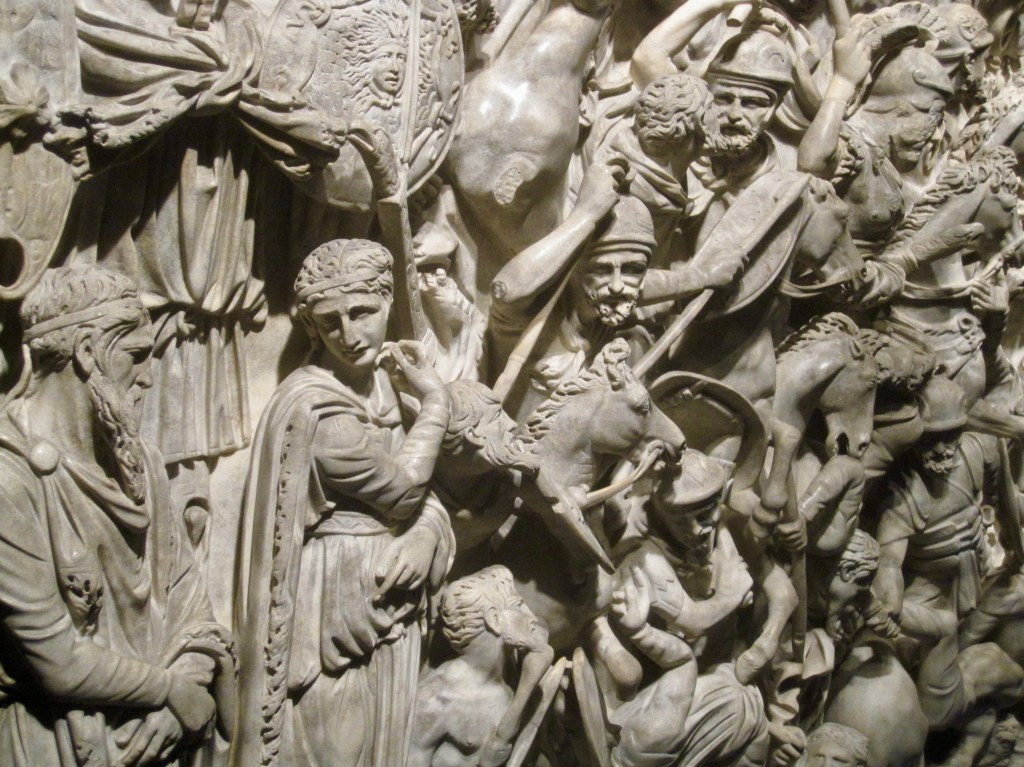
Roman Sarcophagus, Palazzo Massimo, Rome

The centurion comes to Jesus asking for help. And his words—“I am not worthy that you should enter under my roof”—are poignant because in them we hear the unvarnished truth. We can easily imagine that the centurion, an officer in the imperial army, has seen terrible things and perhaps–even if only out of duty–has had to do terrible things as well. His sense of unworthiness, however, does not prevent him from turning to the Lord.

Continue reading “Capernaum’s centurion: a man of faith and hope”
Why pray? Homily for the 29th Sunday in Ordinary Time

Homily for the 29th Sunday in Ordinary Time (C). Translation of a homily, originally given in Italian in October 2019.

Why pray? Because the other team’s fans are praying, and we don’t want to give them any advantage? Because God seems a little indecisive, and maybe he needs our good advice? Because to get what we want, it helps to have powerful friends?

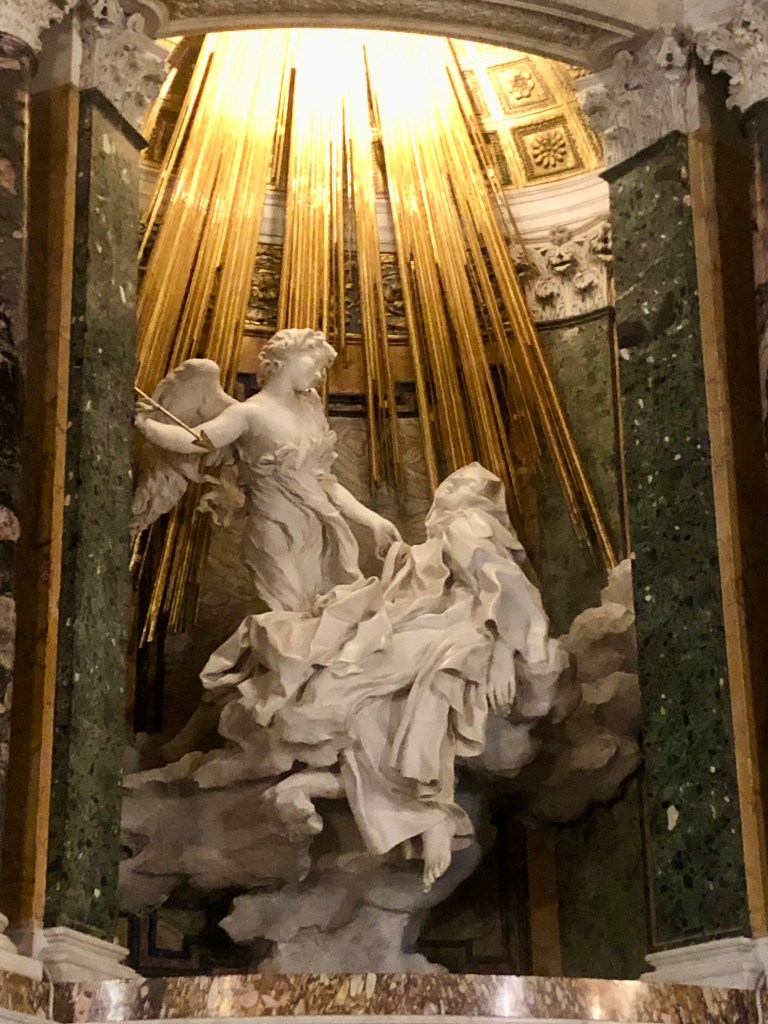
Ecstasy of St. Teresa, Gian Lorenzo Bernini, 1652

Unless we walked into church this morning by mistake, each of us believes that prayer is important in some way. In fact, we may feel that it is necessary. Maybe we can’t explain it, but we need prayer. Maybe we’ve learned from experience, maybe from hard experience, how necessary prayer is.

Continue reading “Why pray? Homily for the 29th Sunday in Ordinary Time”

Bargaining with God? Homily for the 17th Sunday of Ordinary Time

Homily for the seventeenth Sunday in Ordinary Time (C)

Guido Reni, Trinity of the Pilgrims (1625-6)

Readings: Gn 18:20-32; Col 2:12-14; Lk 11:1-13

A few weeks ago, some friends were talking about watching a movie.  They knew that it took a dark twist at the end, so they hit the stop button early to avoid the tragic finish.  That’s exactly what happens in today’s first reading.  The wickedness of Sodom and Gomorrah becomes too great for God to ignore, and he decides to destroy the cities.  Abraham questions him, as if bargaining him down.  If just ten innocent people remain, God will spare the cities.  But, as you probably know, if you read on, God does destroy the cities.  They did not contain even ten good men.  They were corrupt from top to bottom. 

Still, it’s not an accident that today’s reading stops where it does.  The premature ending focuses our attention on God’s reaction to human corruption.  He is not eager for destruction or motived by vindictiveness.  To use the terms of later Christian theology, we could say that the destruction of Sodom and Gomorrah is one of the many stories in the Book of Genesis that express the reality of Original Sin.  The Biblical message is clear: None of us is innocent.  Mankind is corrupt from top to bottom.  God’s reaction to Abraham—his desire to spare the innocent—shows that the destruction wrought by Original Sin is not what God wants.  Our sinfulness is self-destructive. 

If self-destruction were the end of the movie, we could understand turning it off early.  But God’s full response to human sinfulness, which unfolds in the New Testament, is not to strike a deal, to plea bargain, or to negotiate.  Nor is it to ignore our sinfulness or to excuse it.  It is not to declare a new paradigm in which there are no longer any moral absolutes and what was once sinful is now OK, if circumstances are right or you get your pastor’s permission.  No, God’s reaction is something else entirely.  As St. Paul tells the Colossians, God has removed sinfulness from our midst by “nailing it to the cross.”

Continue reading “Bargaining with God? Homily for the 17th Sunday of Ordinary Time”

Look East! Homily for the Second Sunday of Advent

Homily for the Second Sunday of Advent (C)

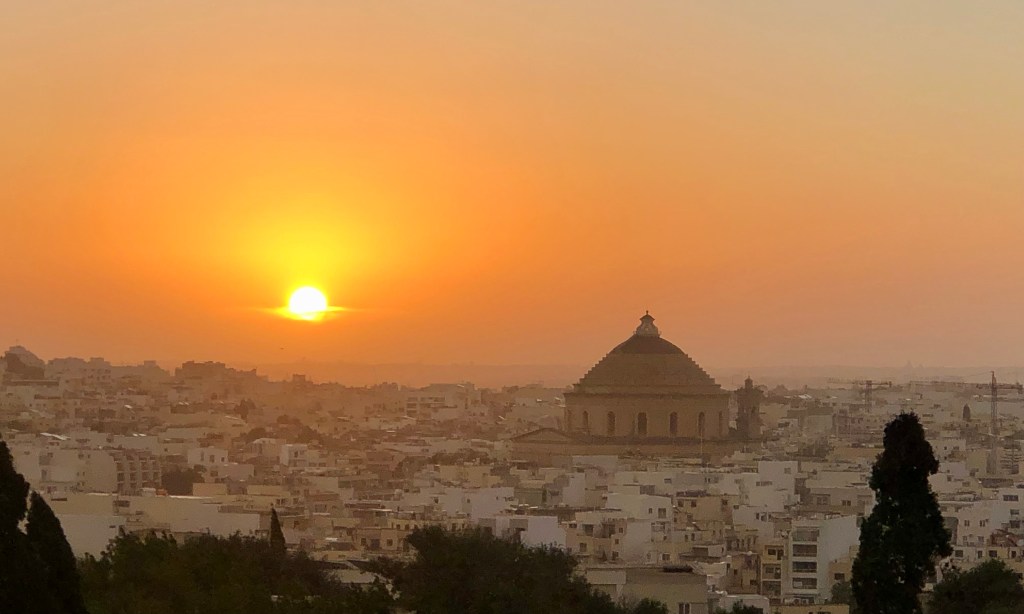
Dawn, Mosta, Malta

“Look to my coming,” Gandolf tells Aragorn in the second installment of the Lord of the Ringstrilogy, The Two Towers.  “At dawn on the fifth day, look east.”  Those familiar with the story, know that Gandolf’s words come at a particularly dramatic moment in the epic, when the last holdouts of Rohan—one of the two remaining kingdoms of men not to succumb to the forces of evil—have retreated to their mountain stronghold, Helms Deep, and the walls of the fortress have begun to crumble, its gates to give way, and its doors to crack under the onslaught of a massive army sent by the turncoat wizard Saruman, who, seduced by power, has joined the forces of darkness.  And as Aragorn, the king in exile, prepares for one final charge with what knights remain, he remembers the words of the faithful wizard Gandolf, who had left five days before to seek aid.  “At dawn on the fifth day, look east.”

We read a similar instruction in the Book of Baruch, directed to the holy city, “Up, Jerusalem! Stand upon the heights; look to the east.”  These words are echoed in the Advent hymn familiar to many of us, “People, Look East.”  There is something primordial in this call, in the instinct to look in hope to the east.  When I worked among the Lakota Sioux in South Dakota, I learned that in their traditional religion, east was the direction of prayer.  I found some Lakota Christians very insistent on a Christian tradition—which I did not know about—of burying the dead facing east.  The Christian tradition of prayer facing east goes back to the first centuries.  St. Ambrose talks about catechumens, after their baptism, turning from the west to the east as a sign of the new orientation of their lives.

Continue reading “Look East! Homily for the Second Sunday of Advent”

Bread of life or never-ending breadsticks? Homily for the eighteenth Sunday in Ordinary Time

Homily for the 18th Sunday in Ordinary Time (B)

If there were an Olympic event for complaining, the ancient Israelites just might take the gold medal. Today, after being liberated from slavery, they ask to go back, forgetting the oppression they suffered in Egypt and remembering the country as an ancient Olive Garden with fleshpots and never-ending bread sticks.  Hearing their complaint, God sends them manna and quail to eat, but we know that soon enough they’ll start complaining again—“Manna again?  We want leaks and onions, not these leftovers!”  And they’ll attack Moses: “Why’d you have to lead us out here?  Weren’t there enough graves in Egypt?”

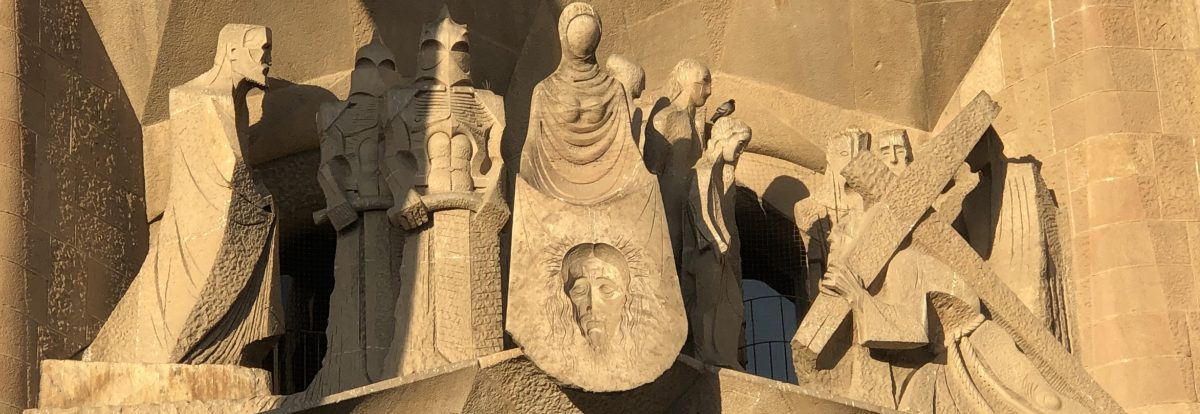
The preaching of St. Paul, Rabat, Malta

But, if complaining were an Olympic event, the competition would be fierce.  I suspect there’s something deep in our human nature—some survival mechanism from caveman days that made our ancestors less likely to be eaten by sabretooth tigers or stomped on by wooly mammoths if they were quicker to see the negative than the positive, more inclined to fear than to gratitude.  The problem is if you’re not being stalked by a sabretooth tiger, this instinct for the negative sometimes results in clubbing our friends or retreating into the darkness of our own self-constructed caves.  

Continue reading “Bread of life or never-ending breadsticks? Homily for the eighteenth Sunday in Ordinary Time”

Theology of Carla Tortelli

I was blessed to spend last week as one of the spiritual directors for the Pontifical North American College’s pre-ordination retreat. I was humbled and deeply impressed by the sincerity and generosity of the young men preparing for ordination to the diaconate next week. I thought I’d share the homily I gave on one of the weekdays during the retreat. The Gospel for the day was:

The mother of Jesus and his brothers came to him
but were unable to join him because of the crowd.
He was told, “Your mother and your brothers are standing outside
and they wish to see you.”
He said to them in reply, “My mother and my brothers 
are those who hear the word of God and act on it.”

Luke 8:19-21

Many years ago, in the previous century, before streaming, when you could watch TV on one of three different channels–then four with Fox and maybe Channel 9 if you adjusted the antenna just right–there existed a neighborhood bar in Boston where everybody knew your name, and they were always glad you came because, well, troubles were all the same.

At that bar, Cheers, there worked a waitress, Carla Tortelli. Carla was a hardboiled Sicilian who didn’t take guff or prisoners. Carla was a Catholic, but she was not, let us say, in the running to be the mascot for the year of mercy.

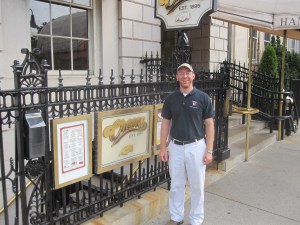
Boston, 2014

On one episode of Cheers, Carla’s son decided to become a priest. Carla was thrilled because according to her belief, a priest’s mother automatically went to heaven. The rest of the episode, Carla behaves like a monster–spilling beer on the mailman Cliff Claven, being even more crass toward her customers than usual–because she can. She has a get-into-heaven-free card.

Continue reading “Theology of Carla Tortelli”