With a year approaching since Baptism of Desire and Christian Salvation‘s publication, I’m pleased to see reviews starting to appear. I just read a great one by Joseph Arias of Christendom College in the journal of liturgical theology Antiphon. Arias provides a summary and identifies “controversial” points where I challenge the received wisdom. I’m grateful to have such careful readers and can’t say I mind having the book described as “monumental” and “unmatched”!
Here’s just a sample:
“The author takes the reader on a profoundly illuminating historical and dogmatic theology journey from the apostolic age to our own, acting throughout as an immensely capable and careful guide, making sure we do not miss either major or minor attractions that can enhance the experience of trying to arrive at a deeper understanding of a profoundly significant (though sometimes underappreciated) teaching that is firmly rooted in the Catholic tradition…
… this volume is unmatched in what it positively contributes towards a better understanding of this area of theology.”
And more good news — it looks like the price of the book may have dropped on Amazon as well.
Also, following up on my previous post on the Ukrainian bishops’ statement about the war in their country last week, I have a new piece out on the subject in America. It is equally about what is dysfunctional in our own American political culture right now.
A friend sent me this picture, which looks like a recipe for beating the midwinter blues if ever there was one. I’m pleased that a number of reviews of Baptism of Desire and Christian Salvation have started to appear. And, though I haven’t seen them all–sometimes it takes a while for parcels and periodicals to arrive in Rome–it is humbling to see some really topnotch scholars engaging with my work. As far as I know, reviews have recently appeared in Antiphon, the Nouvelle Revue Théologique (in French), Hekima Review, Ephemerides Liturgicae (in Italian), and on João Vila-Chã’s page (in Portuguese). More news is collected here.
And in case you missed it in November, consider checking out my discussion of the book with Dr. Larry Chapp on his podcast Gaudiumetspes22.com. It was really an enjoyable interview, also available on YouTube:
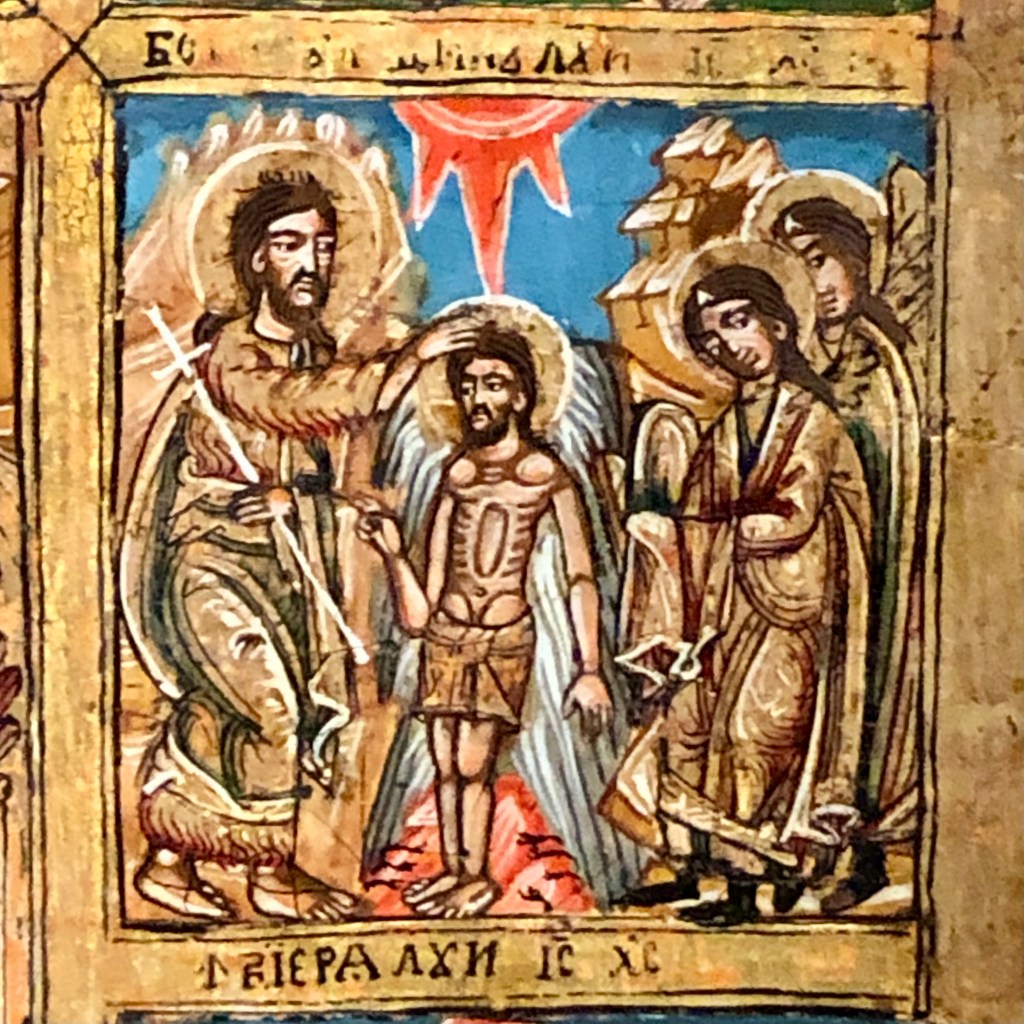
Baptism of the Lord from “Praznicar,” Romanian, 19th century
Today’s readings use some artful cinematography. Today we celebrate the Baptism of the Lord. Our readings give us scenes before baptism and immediately after baptism, but they cut away so that we don’t see the baptisms. This montage of before and after shots nonetheless serves to highlight the uniqueness of Christian baptism. Luke cuts from John the Baptist’s preaching to Jesus praying after his baptism. The Holy Spirit descends like a dove and a voice from heaven speaks to the Lord. The scene is obviously meant to show approval for Jesus’ baptism at the hands of John.
The scene chosen today from Acts of the Apostles is also meant to put the stamp of divine approval on baptism. To understand Peter’s words in the house of Cornelius, we need to remember the whole context of the chapter in which they occur, Acts 10. The scene unfolds in the earliest days of the Church when there was still doubt about who could belong to the Church: was the message of Jesus directed only to Jews or were all people called to Christianity? In Acts 10, the centurion Cornelius—a Roman, not a Jew—receives a vision that prompts him to call Peter to his house. At the same time, Peter receives a vision in which he’s told to eat all of the animals that Jewish dietary laws consider forbidden. The vision was not a marketing ploy for the pork and shellfish industry, but instead it ensured that Peter didn’t hesitate to go to a Gentile’s house when Cornelius’s servants came to find him. At Cornelius’s house Peter preached the message that we hear today. The word was sent to the Israelites, he says, but it was intended, as Isaiah prophesied in the first reading, “to bring forth justice to the nations,” in other words, to extend beyond Israel itself.
What we unfortunately don’t read today is what happens next. As if anyone missed the first several hints, the Holy Spirit descends on the people in Cornelius’s house, who begin to speak in tongues, and Peter says, “Can anyone forbid water for baptizing these people?” (Acts 10:47). God’s will is that baptism should be conferred on Gentiles as well as Jews and that all nations should enter the Church, even Roman centurions.
Now if you were a medieval theologian, who spent your days raising difficulties about sacramental theology, the story of Cornelius’s baptism might provoke another question: if the Holy Spirit had already descended on everyone in Cornelius’s household, why did they even need to be baptized? Isn’t getting the Holy Spirit the whole point of baptism? And once you’ve got the Holy Spirit, doesn’t the ceremony become redundant? If you remember from Matthew’s account of the baptism of Jesus, John the Baptist himself poses a similar question about the baptism of Jesus. “I need to be baptized by you,” he says. “Why do you come to me?” (Matt 3:4).
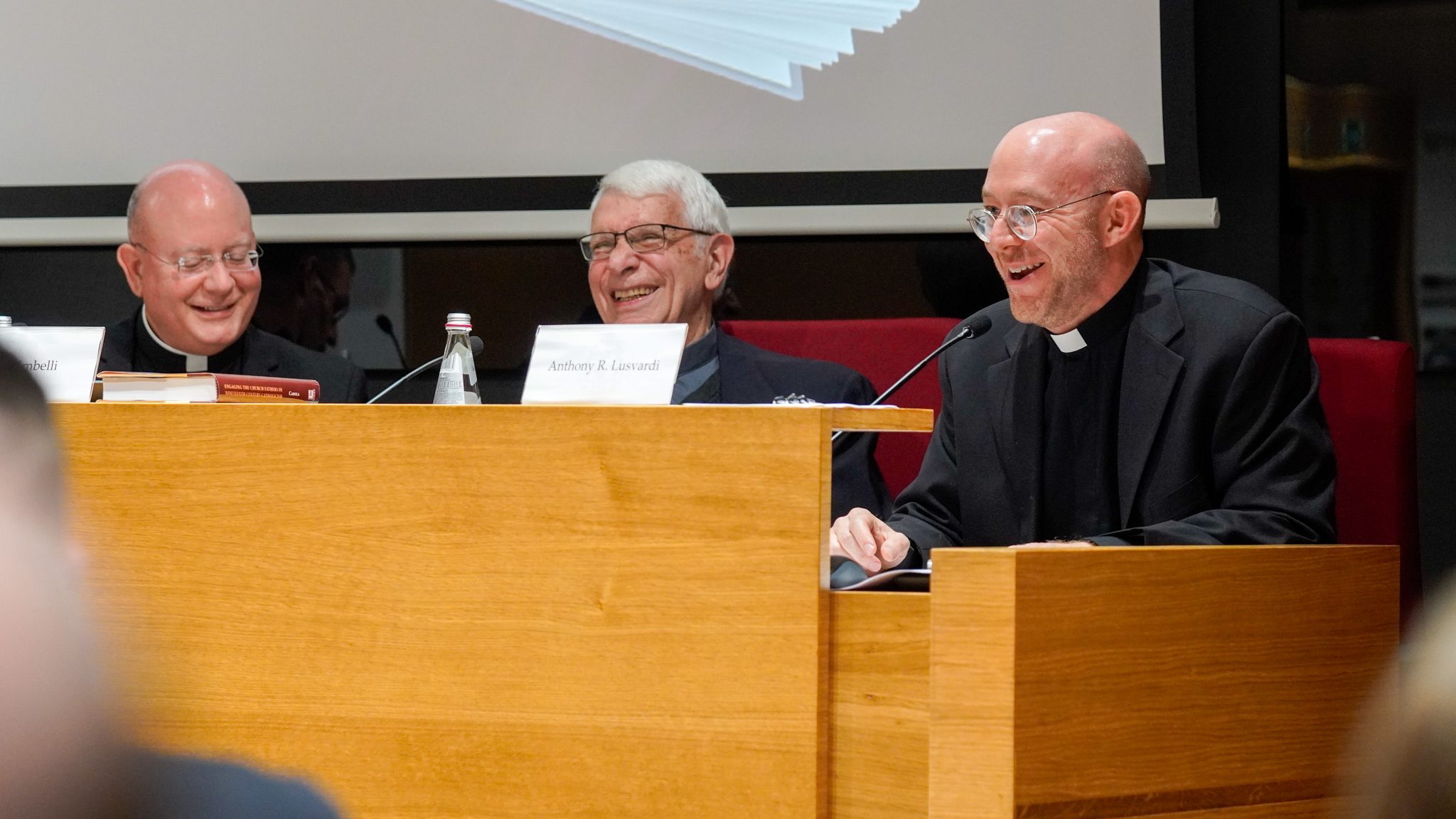
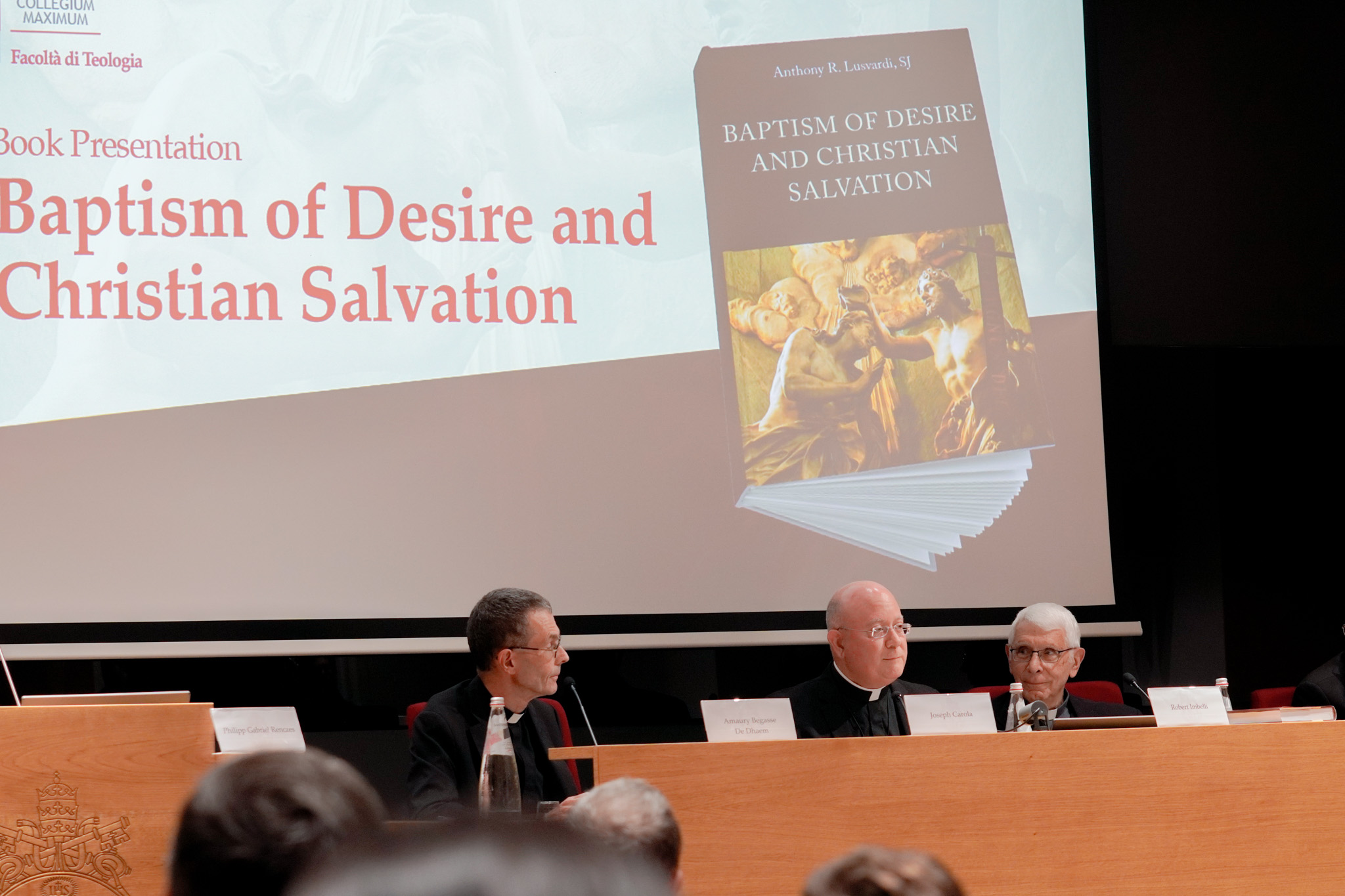
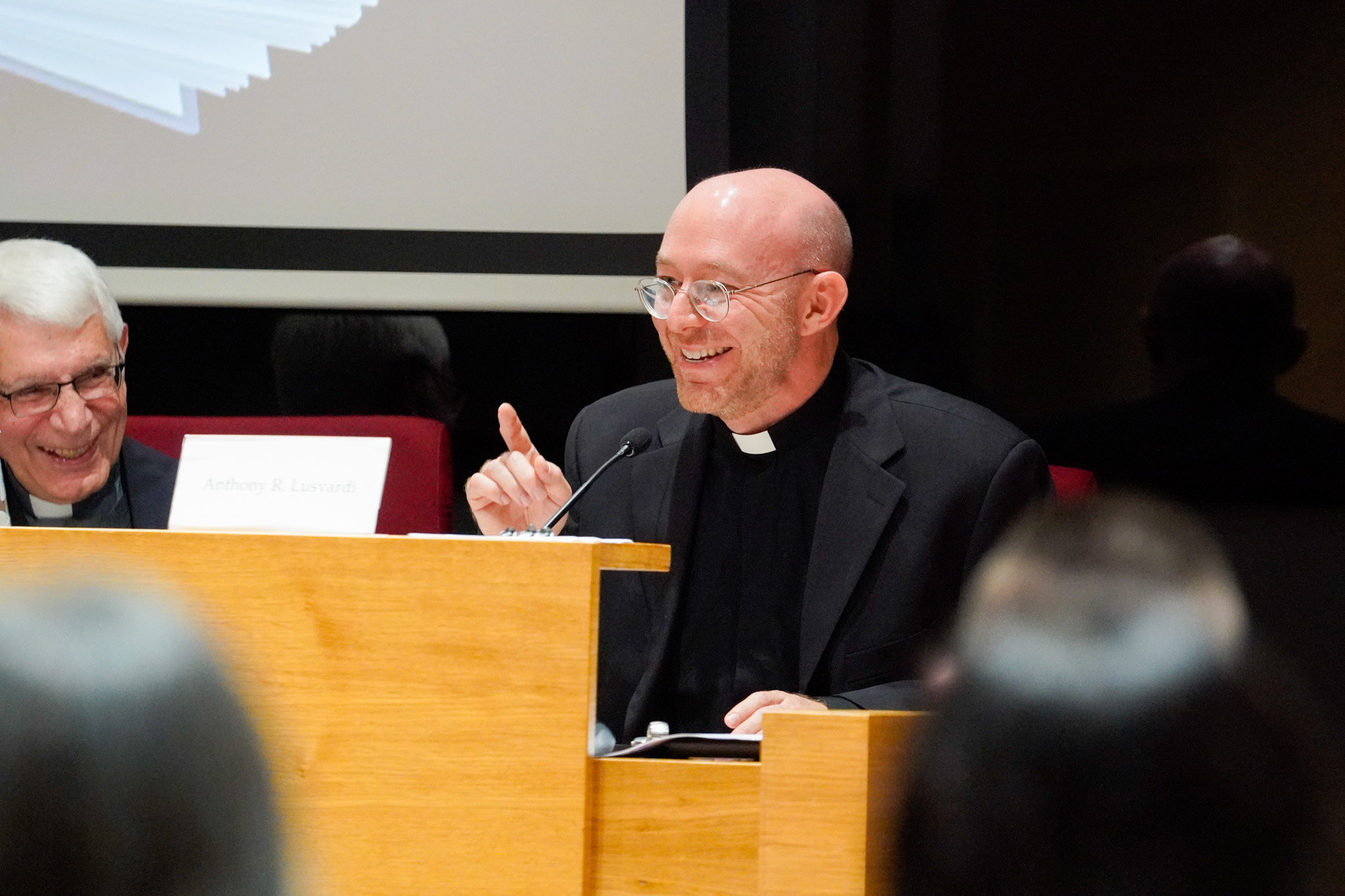
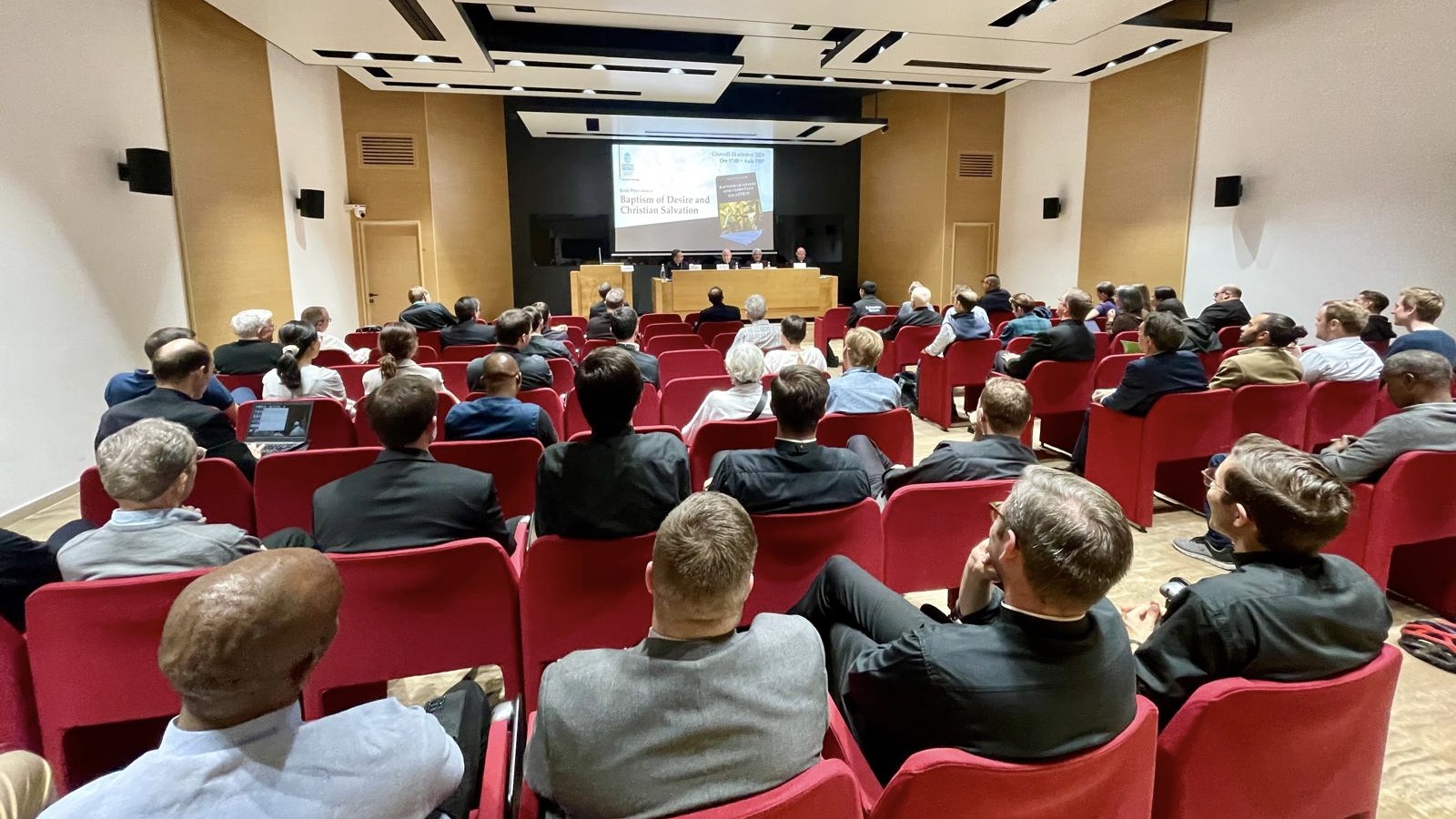
Baptism of Desire and Christian Salvation is now in orbit after an excellent turnout at the official book launch at the Gregorian last Thursday. More good news: the code CT10 still gives you a 20% discount if ordering the book directly from Catholic University of America Press. At the presentation of the book, Fr. Joseph Carola gave an overview of its content and shared some stories from personal experience to illustrate its pastoral relevance. Fr. Bob Imbelli drew on other contemporary thinkers, such as Khaled Anatolios, Charles Taylor, and William Cavanaugh to demonstrate its relevance. I hope to have video of the presentations up on the Baptism of Desire page soon.
Fr. Joseph Carola, S.J., Fr. Robert Imbelli, Fr. Anthony Lusvardi, S.J.
On another note, in this month’s First Things I return to an issue I raised a few years ago in an article in America magazine, the effects of technology on the liturgy. Here’s the new article: “Screens and Sacraments.” The original from 2020 is here.
And, finally, if you’re looking for some pre-election reading that isn’t about either Donald or Kamala, but instead about the way voting functions as a civic ritual, check out my latest at The Catholic Thing: “Rites (and Wrongs) of Democracy.“
The question of invalid baptisms has been in the news recently. In my commentary on the question in La Civiltà Cattolica, I pointed out that the Vatican’s most recent document on the question, Gestis verbisque, gives renewed attention to the minister’s intention. For a sacrament to be valid, a minister must intend to do what the Church does when celebrating that sacrament. And that means that if he changes what the Church prescribes in her official liturgical texts–by inserting his own words or deleting something required to be there–then he manifests an intention to do something else. It’s just as straightforward as it sounds. The proof is not in the pudding, but in the action.
Baptismal font, St. Peter’s Basilica
Last week, however, another question was sent to the Vatican about what sort of intention might invalidate a sacrament, this time an ordination. The question proposed the distasteful case of a bishop who ordained a man with whom he had engaged in an illicit sexual relationship. Could he possibly have the right intention? Wouldn’t such a sinful situation invalidate the ordination?
The article in which this question was raised described it as “potentially explosive.” Fortunately, this grenade was defused by St. Augustine in the fifth century. The great theologian was responding to controversy about the validity of baptisms, whether the sinfulness of a minster invalidated the sacrament. He responded no. Augustine’s principle has remained a bedrock of sacramental theology ever since. It is really Christ who baptizes, Augustine said, and he can do so even through profoundly imperfect human instruments. The same goes for ordinations. Augustine sagely realized that if perfection were required of ministers in order for sacraments to be valid, then we simply wouldn’t have sacraments.
So how does Augustine’s principle fit with the requirement that one has to have the right intention to celebrate a sacrament validly? Here we have to make what might at first seem like a rather technical distinction but is, once you’ve thought the question through, also rather straightforward. The distinction is between intention and motive.
I’m honored to have a couple of recent works appear in print in the past few weeks, the first an article in La Civiltà Cattolica, a publication founded by Italian Jesuits in 1850, which has since gone international. The article “Gestis Verbisque: The Words and Actions of the Sacraments” (the Italian is here) analyzes a recent Vatican document dealing with sacramental theology — specifically the question of invalid baptisms. The document Gestis verbisque was available only in Italian at the time I wrote the article, but has since come out in English (and other languages) here. It’s an important document because it reminds priests and deacons of the need to faithfully celebrate the sacraments according to the Church’s tradition and liturgical books. We probably all have had unfortunate experiences of goofy things happening in liturgy because Father thought that he could improve upon a centuries-old ritual with regrettable results. Gestis verbisque reminds us that “The Church is the ‘minister’ of the Sacraments, but she does not own them.” My own article fleshes out some of the background behind the document and points out where I think it adds something theologically (its treatment of the minister’s intention). It was interesting to see some of the strange cases in history that I found while researching Baptism of Desire and Christian Salvation come up again in modern settings. You’d think we’d learn!
The other publication is the first short story I’ve published in a while–too busy with academic work–in a magazine that will be familiar to readers of these pages, Dappled Things. Dappled Things is the only literary magazine I know of dedicated exclusively to Catholic literature. I’ve been honored to have a number of short stories and essays appear in their pages over the years, some of which can be found on their site. My most recent story, “Pious Tchotchkes,” is in their Easter 2024 issue, which is only available in print. Their print issues are always beautifully crafted.
The story is set in Portugal, and here are a couple of places alluded to — baroque exuberance in Coimbra and Cabo da Roca, the westernmost point in continental Europe.
After a few delays, I am pleased to report that my book is now officially in print and copies have arrived for those who preordered. It seems to have been released on Good Friday no less.
If you’re still on the fence about whether it’s worth the read, I thought I’d share the very kind words of endorsement from Fr. Joseph Carola, SJ, my colleague at the Gregorian University and expert in both the Church Fathers and Nineteenth Century theology.
So take it from Fr. Carola:
Jesus instructed Nicodemus that, “unless one is born of water and the Spirit, he cannot enter the kingdom of God” (John 3:5). Faithful to the Lord’s revelation, Christians have insisted for two millennia upon the necessity of baptism for salvation. But already in the ancient Church, salvation’s rough edges, as Father Anthony Lusvardi creatively calls them, have challenged believers. What is the fate of those who lived before Christ and therefore died without Christian baptism? What happens to the catechumen who dies unexpectedly before being baptized? Can unbaptized babies get to heaven? Is there any hope for the salvation of non-Christians? In his thoroughly historical and insightfully theological study of the baptism of desire, Father Lusvardi offers his readers a fresh perspective on this traditional notion often misunderstood and misapplied in contemporary theology and pastoral practice. Providing a convincing response to the challenges that the hard cases present, Father Lusvardi especially appeals to the Catholic Church’s lex orandi in order to establish the Church’s lex credendi that simultaneously upholds the necessity of baptism, the need for evangelization, and the nuances of desire. Historically informative, theologically rich, and occasionally even humorous, Baptism of Desire and Christian Salvation is a book not only for theologians, but perhaps even more so for pastors who labor on the rough edges of salvation.
My book Baptism of Desire and Christian Salvation is now available to order, though its shipping date will be a little later. Its official publication date was originally last Friday but now seems to have been bumped to March. I’ve been working on the topic of baptism of desire since my STL studies at Sant’Anselmo–a good six years ago–so it has been a long time coming. I think the result says some important things for Catholic theology and the evangelizing mission of the Church. So let me assure you, it’s worth the wait!
I’ll have more on the topic to say, of course, and I’ll share the reactions of others to the book so you don’t have to take my word for it. For now I’ll just share the official description from Catholic University of America Press. The book is available directly from CUA’s website as well as other online booksellers such as Amazon. This spring CUA is offering a 20% discount on new books with the promo code CT10. Make sure that your library gets a copy, too!
Baptism of Desire and Christian Salvation. Belief in the necessity of baptism for salvation is rooted in the New Testament and was forcefully affirmed by the Church Fathers, yet today this belief is treated with unease if not ignored altogether. Over the course of centuries, Catholic theology has wrestled with a doctrine—baptism of desire—that both preserves this fundamental principle and allows for salvation in hard cases, such as catechumens dying unexpectedly. Baptism of Desire and Christian Salvation traces this doctrine’s varied history, from its genesis in a fourth century funeral oration given by Ambrose of Milan to its uneasy position in the Anonymous Christianity of Karl Rahner.
More than a history, however, this book raises questions about the nature of religious ritual and the sacraments, the mission of the Church, and the essence of salvation. Arguing that theologians of the past two centuries have tended to downplay the role of the sacraments when discussing salvation, Lusvardi suggests that baptism should remain our theological starting point. Engaging with the theological tradition and at times challenging the conventional wisdom, Baptism of Desire and Christian Salvation shows how such a sacramental approach can offer credible—and sometimes surprising—responses to questions related to the salvation of non-Christians, the fate of unbaptized infants, and the relevance of the Church’s mission today.
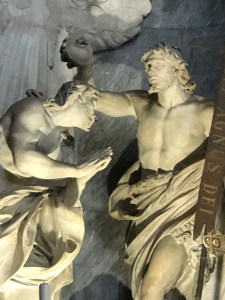
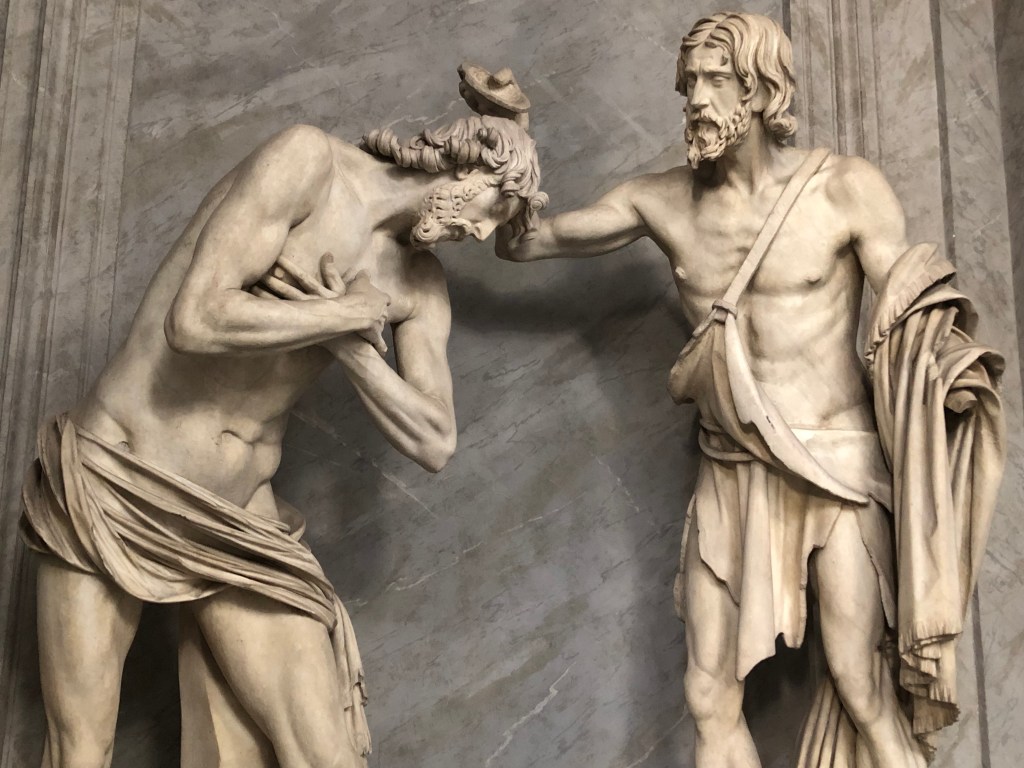
Baptism of Jesus, Antonio Raggi, San Giovanni dei Fiorentini, Rome
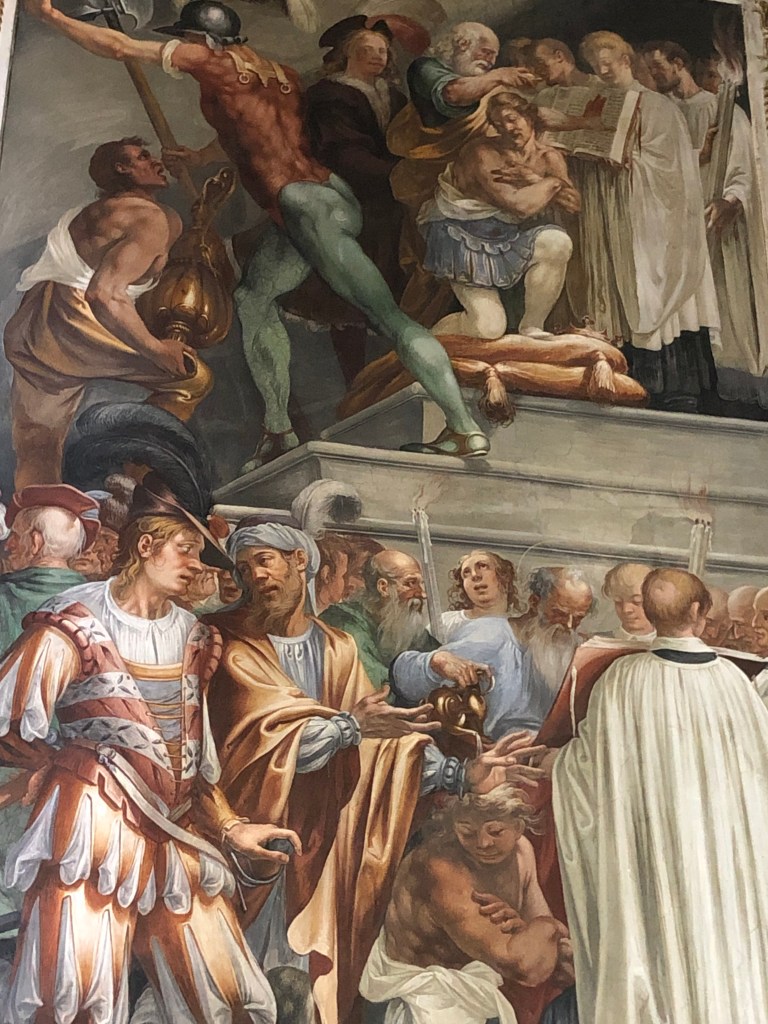
To celebrate the feast of the Baptism of the Lord–which this year falls unusually on a Monday–I thought I’d share a few photos from one of Rome’s lesser known churches, San Giovanni dei Fiorentini. A baroque church, it was built for the Florentine expats in Rome back when Florence was an independent city-state and named for the city’s patron, St. John the Baptist. The church contains a relic of Mary Magdalene (her foot), and is the burial place of the great–but tragically unhappy–baroque architect Francesco Borromini. It also contains a number of interesting artistic works featuring baptism.
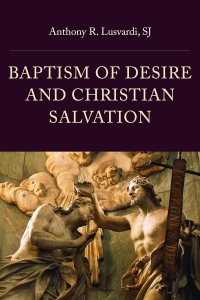
I’ve written before about the importance of baptism, but I have a personal reason to be particularly fond of San Giovanni dei Fiorentini. Its 17th century altarpiece, the Baptism of Jesus by Antonio Raggi, features on the beautifully designed cover of my book Baptism of Desire and Christian Salvation. Of course, I’d like to think that what’s inside the cover is pretty interesting as well, and I’m pleased that the book’s release date is coming up later this month–January 26. There’s more information on the website of Catholic University of America Press, and the book is available on other online sellers such as Amazon.
In the meantime enjoy the views of San Giovanni dei Fiorentini.
Baptism of Christ, Francesco Mochi, 1645Simon and Jude baptizing the King of Persia, Orazio GentileschiSan Giovanni dei FiorentiniBaptism of Jesus, Antonio Raggi, San Giovanni dei Fiorentini, Rome
Sant’Agnese in Agone, the church in the center of Piazza Navona, is more beautiful than usual these days because it is hosting a special exhibit of three El Greco paintings. The largest and most impressive of these is the “Baptism of Christ,” a favorite theme of mine and something I think the Church would do well to reflect on more deeply–especially in these days of deep division and various lobbies jockeying for influence.
Sant’Agnese in Agone, Piazza Navona, Rome
At his baptism, the identity of Jesus is revealed by the Father: “This is my beloved Son, with whom I am well pleased.” As John the Baptist well knew, Jesus had no need of baptism; the event was for our benefit. The Lord’s baptism reveals what happens in our baptism: we become the children of God by adoption; we come to share in the Sonship of Jesus. The Father’s words come to apply to us. We become the beloved sons and daughters of God.
The reason I think this event is so important is because, for Christians, our status as God’s sons and daughters must become and remain our most fundamental identity. When some other form of identity becomes primary–our national identity, our identification with a particular political party or ideology, even our natural family–we go badly astray. This, it seems to me, is the most serious problem with contemporary LGBT ideology. The problem is certainly not with the people themselves, nor even so much with any particular sexual desires per se–living our sexuality with integrity has always been challenging, in different ways, for all Christians. The problem is when those sexual desires become ideology and ideology becomes identity, when one particular aspect of one’s personal make-up–one’s sexuality–becomes the dominant characteristic in one’s self-definition, the one ring to rule them all.









 Tony Lusvardi, S.J.