What was the father thinking? Homily for the twenty-fourth Sunday of Ordinary Time

Homily for the 24th Sunday in Ordinary Time (C).

Here’s another homily from my year as a deacon, this one given at St. Bridget’s and St. Charles Parishes on the Rosebud Reservation in South Dakota, places from which I have many warm memories.

I have looked forward to this morning for a very long time.  As many of you know, last weekend I was ordained a deacon in Boston.  I learned to be a minister of the Gospel here on Rosebud and all of you were my teachers, so I wanted my first weekend as a deacon to be here with you.  And God has answered that prayer.  As you can imagine, Paul’s letter to Timothy speaks to me.  Paul is writing to his friend and assistant Timothy and he’s marveling that God has trusted him to be a minister of the Gospel even though he himself was a sinner.  And after all his years of experience, Paul expresses the Gospel message with a single powerful sentence:  “Jesus Christ came into the world to save sinners.”  

Lakota crucifix, Sioux Spiritual Center, Howes, SD

So if there’s anyone here who’s not a sinner, I’m sorry, you’re in the wrong place.  Go have brunch.  I don’t have anything to offer you.  The Catholic Church is like a big AA meeting for recovering sinners.  We even begin each Mass by acknowledging that we are sinners: “I confess to Almighty God and to you my brothers and sisters, that I have sinned…”  As in AA, we’re here because we know we can’t overcome sin on our own; we need a higher power.  

Continue reading “What was the father thinking? Homily for the twenty-fourth Sunday of Ordinary Time”

What is wisdom? Homily for the twenty-third Sunday of Ordinary Time

Homily for the 23rd Sunday in Ordinary Time (C).

I’m back to my day job in Rome, so this week I’m posting a homily from 2016, given the day after my ordination to the diaconate.

Ordination to the diaconate 2016, St. Ignatius Church, Boston, MA

Today’s Gospel reading is perhaps the single most unfortunate passage in Scripture to have to preach about to a congregation consisting mostly of family members, so we’re going to work our way up to it by starting with the Old Testament.

The Old Testament reading is from the Book of Wisdom.  You’ll be happy to know that I took an entire course on the Biblical wisdom tradition and have prepared a brief 45-minute summary as an introduction to the homily.  We can skip all that, however, if you will consider for a moment the question of what it means to be wise.  

To understand what wisdom is, it can be helpful, first, to think about what it is not.  Wisdom is not the same thing as being clever; we probably know people who are clever manipulators, for example, but not really wise.  Wisdom is not the same as knowledge, as knowing lots of facts.  Teachers know that there’s a difference between a student who memorizes what he hears and then regurgitates it, and a student who actually thinks about what she’s learning.  Wisdom is not the same thing as being educated.  If you’ve been in school as long as I have, you realize that there are some very foolish people with PhDs.  And we all probably know people who didn’t receive much education who nonetheless we’d consider wise because they had a sense for people, a sense for what was right and wrong, a sense for what really matters in life. 

Continue reading “What is wisdom? Homily for the twenty-third Sunday of Ordinary Time”

Go Irish!

I know it’s not an official day on the Church’s liturgical calendar, but today is Notre Dame’s opening football game. And it’s a big one, not least because ND’s new coach Marcus Freeman is squaring off against his former team, the #2 Ohio State Buckeyes. Unfortunately, I’ll be somewhere over the Atlantic during the game–oh, the sacrifices of religious life!

For your game day spiritual reading, I’d recommend this article and interview in the National Catholic Register: Coach Marcus Freeman Talks Faith, Fatherhood and Notre Dame Football. He has wise words on all of those subjects, and I was particularly struck by his unabashed embrace of ND’s Christian identity: “I want our guys to wonder about what it means to embrace Jesus Christ.” Maybe he could take over “Mission and Identity” at our Jesuit universities too.

There is a lot to like about Coach Freeman.

Etiquette for heaven: homily for the twenty-second Sunday of Ordinary Time

Homily for the 22nd Sunday of Ordinary Time (C)

Years ago, one of my college friends—who remains among the best judges of character I know—gave me as a gift a book by Judith Martin, otherwise known as Miss Manners.  I said, “Miss Manners, huh?  Is this a hint?”  And she said, “Yes.”  

My friend has assured me that my social skills have improved over the past 20 years, but, more than that, the value of the book is that Judith Martin—who is an elegant, witty writer—explains the reason why we should care about manners.  We might think that manners are about things like what to do with all the extra forks at a fancy restaurant, but Miss Manners reminds her readers that the fundamental purpose behind all manners is to facilitate harmonious relationships with other people.  It doesn’t matter how fancy you are; if you make your guests or your hosts or your friends or your acquaintances feel uncomfortable, then you’re being rude.  

The best definition of justice is “right relationship.”  Manners are not the only thing that goes into right relationships, but they are one way of making interpersonal justice a little smoother. Fundamentally, having good manners means being considerate of other people.

Continue reading “Etiquette for heaven: homily for the twenty-second Sunday of Ordinary Time”

A Church of all nations: homily for the twenty-first Sunday of Ordinary Time

Homily for the 21st Sunday in Ordinary Time (C)

Not long ago, at dinner in my community in Rome, which houses Jesuits from maybe 30 different countries, one of my brothers from Columbia was talking with one of my brothers from Poland about the different things people eat around the world, and he mentioned hearing that in parts of Asia people eat dog meat.  And another of my brothers from the Philippines, who is normally very quiet, looked up from his plate and said, “Oh, yes, very good,” and then he went on with his meal.  

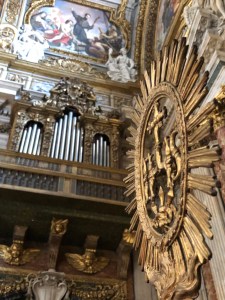
Altar of St. Francis Xavier, Gesù Church, Rome

There is no more diverse an organization in the world than the Catholic Church.  Not only do Catholics come from different countries and races and language groups, but the Church includes saints of different historical periods, the great cloud of witnesses mentioned by the letter to the Hebrews last week.  The martyrs of first century Rome, of seventeenth century Japan, of 20th century Spain and Mexico, and, in our still-young century, of Turkey, Pakistan, Kenya, Nigeria, France and elsewhere could not have been more different culturally or socially, yet they all shared a belief in Catholicism so strong they were willing to die for it.  People have indeed come, as the Lord says, from the east and from the west, from the north and from the south to the table in the kingdom of God, around which we gather this morning.

Continue reading “A Church of all nations: homily for the twenty-first Sunday of Ordinary Time”

Weight-lifting for the Assumption: homily for Mary’s Assumption

Homily for the Solemnity of the Assumption of the Blessed Virgin Mary

Santa Maria in Trastevere, Rome

If you are looking for an appropriate way to observe today’s Solemnity of the Assumption of the Blessed Virgin Mary, may I suggest weight-lifting.

Today’s feast is a celebration of strength.  The strength we celebrate today is more than that shown by Olympic weightlifters—though it includes a little of that—more than the moral strength of a figure like Rosa Parks—though it includes that too—more than the geo-political strength projected by a squadron of B-21 bombers—though that’s not absent either.  Add to all of these the strength of a cosmic force—like the gravity of the sun or the moon tugging at the tides—and you get an idea of the strength we’re dealing with. 

Continue reading “Weight-lifting for the Assumption: homily for Mary’s Assumption”

Not peace, but division: homily for the twentieth Sunday of Ordinary Time

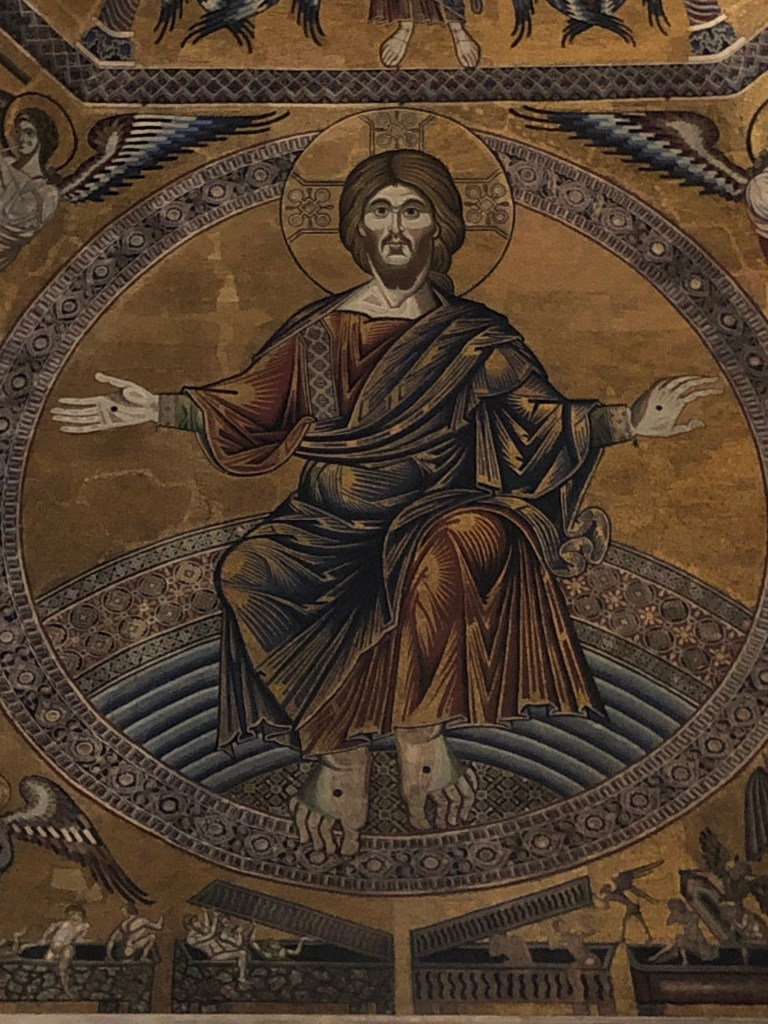
Baptistry, Florence

Homily for the 20th Sunday in Ordinary Time (C)

Politicians frequently claim to be uniters, not dividers.  If you wanted proof, therefore, that Jesus was not a politician, look no further than today’s Gospel: “Do you think that I have come to establish peace on the earth?  No, I tell you, but rather division.”

Political promises of unity, of course, come cheaply; sometimes they simply mean, “If you disagree with me, I’ll accuse you of being a divider.”  In today’s Gospel reading, however, Jesus makes a move never recommended by any political consultant: he preemptively accuses himself of bringing division.  Other than the desire to put centuries of future homilists in a very awkward position, why would Jesus do this?

Continue reading “Not peace, but division: homily for the twentieth Sunday of Ordinary Time”

Catholic self-help

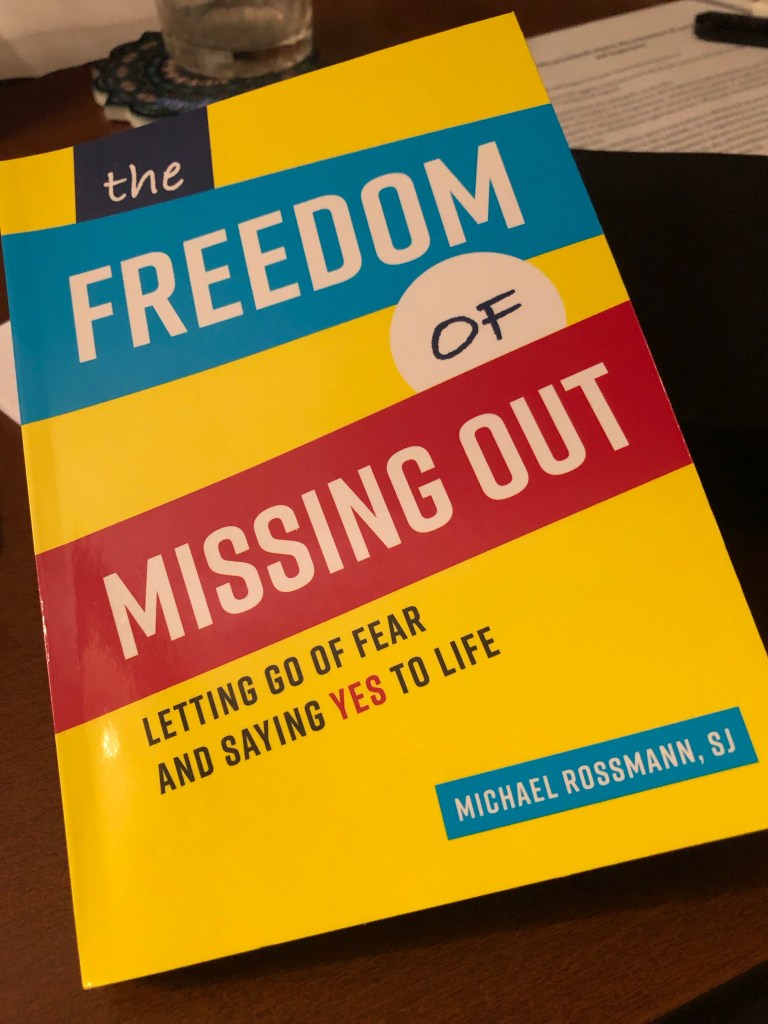
My friend and Jesuit classmate Fr. Michael Rossmann has just published a book, which upon its release held the status of Amazon’s #1 book in “self-help for Catholics”. Actually, I didn’t know there was such a category (and neither did Fr. Rossmann).

Inside the snappy cover, Fr. Rossmann makes a point I think is very important today — really saying yes to something or someone means saying no to other things. Never committing in order to keep one’s options open means refusing to choose the things that matter most.

The book is called The Freedom of Missing Out and continues the long Jesuit tradition of practical help for good decision-making that goes back to St. Ignatius’s rules for discernment. In fact, the influence of Ignatius is not far below the surface, though the book is illustrated with examples from all walks of life and lots of contemporary research. While Rossmann draws on the best of the Catholic tradition, his words about commitment and freedom will ring true to people of any religion.

Interview on Sacramental Theology

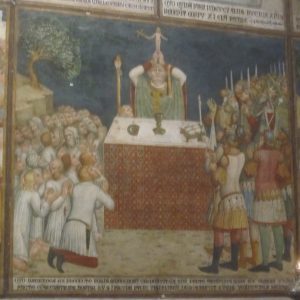
Chapel of the Corporal, Orvieto

Last month I had an interesting discussion with Jesuit scholastic David Inczauskis about the sacraments–what they are, why we have them, how they and the theology surrounding them developed through time, what are the challenges for sacramental theology today. David produces an in-depth podcast on liberation theology, so my general introduction to sacramental theology was the lead-in to some of his reflections on liberation theology and the sacraments, which are also included in the podcast. Here’s the Apple version of the episode:

Episode 22: Liturgy and Sacraments, the Liberation Theology Podcast. I’m told it can be found on other podcast venues as well.

Saints Joachim and Anne, grandparents of Jesus

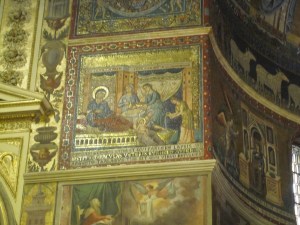
Santa Maria in Trastevere

It’s been one of the great blessings of my life to have gotten to know all four of my grandparents and to have them with me well into adulthood. Particularly in times that change so quickly and so dramatically, grandparents give us access not just to another generation but, really, to other worlds.

On this memorial of St. Joachim and St. Anne, I came across this quotation from one of the 20th century’s literary giants:

I feel that all my writing has been about the experiences of the time I spent with my grandparents.

Gabriel García Márquez