Anguish for those who leave: homily for the 19th Sunday of Ordinary Time

Homily for the 19th Sunday in Ordinary Time (A)

In today’s second reading from the letter to the Romans, St. Paul expresses a heartfelt anguish that I am certain many of us here share.  I would wager that there’s not a person in this church who does not have a son or daughter, a brother or sister, perhaps a parent, someone dear to us who has left the Catholic faith.  In Romans, Paul speaks of his people, his Jewish brothers and sisters, the majority of whom have not followed Christ, with painful passion, his heart full of “great sorrow and constant anguish.”  He goes so far as to say, “I could wish that I myself were accursed and separated from Christ for the sake of my brothers.”  So even though it’s not a cheerful topic, the problem of loved ones who have left the faith is one we can’t avoid, one most of us know firsthand.  I do too. 

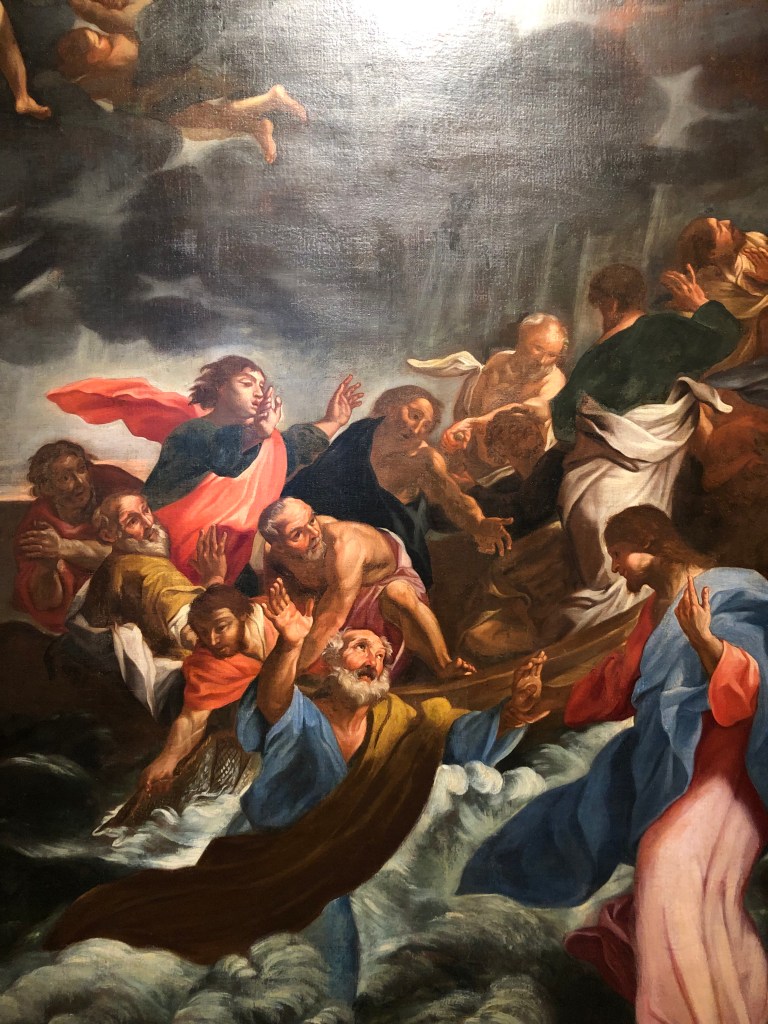
St. Peter Walking Upon the Water, circle of Giacinto Brandi (1600s), New Norcia, Australia

First, a caution.  Some time ago, I agreed to give a friend a ride to the dentist.  He was having major work done and was going to be given some powerful anesthesia and wasn’t allowed to drive.  I didn’t know where the office was, but I thought, “No problem, he’ll give me directions.”  The problem was he had to take one of the pills the dentist prescribed before the appointment, so when I got there to pick him up he was already floating in blissful never-never land.  We got into the car and I asked him where to go, and he said, “I don’t care.  You can take me wherever you want.  You can take me to a bar.”  Eventually, we got to the dentist.  But the point is he didn’t feel any pain because he’d taken a happy pill.  Now I will be honest:  I’m not going to give you a happy pill.  There are theological happy pills out there and plenty of priests and theologians who will give them to you.  The problem is, they aren’t true.  If they were true, Paul wouldn’t feel anguish and sorrow.

Continue reading “Anguish for those who leave: homily for the 19th Sunday of Ordinary Time”

The Transfiguration and previews for the main event: homily for the Feast of the Transfiguration

Homily for the Transfiguration of the Lord (A)

At the end of today’s Gospel reading, Jesus tells Peter, James, and John to keep a secret.  A Jesuit friend once wisely observed, “Most people can keep secrets.  It’s the people they tell who can’t.”

This is just one of a number of times throughout his public ministry when Jesus asks his disciples not to tell people about the miracles they’ve seen.  Since Jesus is constantly urging us to spread the Good News, this seems strange.  Why would Jesus not want stories of his miracles to spread?  

I suspect that Jesus does not want these miracles to distract from his mission.  The miracles that we read about in the Gospels that stick with us and we love so much—the healing of the paralytic, the wedding at Cana, the healing of the man born blind, the raising of Lazarus—show Jesus’ compassion and his power, but they are nothing compared to the transformation that Jesus works through the cross.  When, for example, Jesus raises Lazarus from the dead, Lazarus will die again.  But when Jesus rises after being crucified, he opens for us a new life, a new way of being, that will never end.  

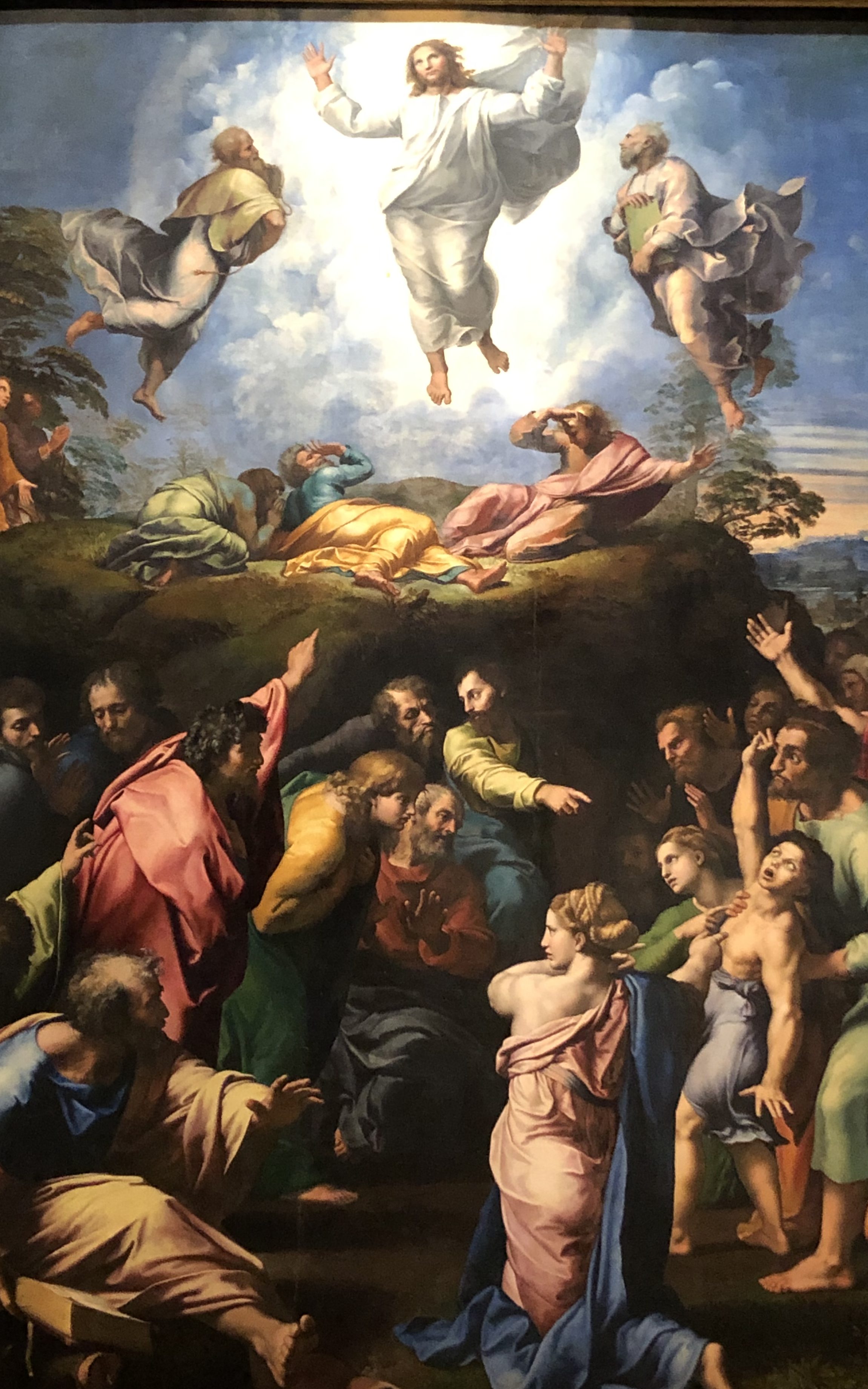
The Transfiguration, Raphael (1520), Vatican Museums

The miracles that Jesus performs before his death and resurrection—and I’d include today’s feast, the Transfiguration as one—are like the previews they show in movie theaters before the feature film.  Jesus doesn’t want us to get so excited by the pictures of popcorn and soft drinks that we run out to the concession stand and forget about the movie.  This is not to say that we should fast forward through first part of the Gospel.  But we can’t stop halfway through; we can never be followers of Christ if we stop before the cross.  

Continue reading “The Transfiguration and previews for the main event: homily for the Feast of the Transfiguration”

Fools for love: homily for the seventeenth Sunday of Ordinary Time

National Gallery of Victoria, Melbourne, Australia

Homily for the 17th Sunday of Ordinary Time (A)

When he was a young priest St. Philip Neri shaved off half his beard in order to counteract vanity.  St. Simeon the Stylite lived on a small platform on top of a 50-foot tall pillar in Syria for over 30 years. Another St. Simeon (of Emesa), known as the Holy Fool, walked through town with a dead dog tied around his waist.  St. Catherine of Siena lived for weeks on nothing more than the hosts she received at communion.  Shortly after his conversion, St. Francis stripped naked in front of the bishop of Assisi.  St. Francis Xavier, a Jesuit, tending plague victims in a hospital found himself holding back out of fear of contracting the disease.  (This one’s a little gross.)  So he scraped the back of one of the sick men he was tending, gathered up a handful of puss, and put it in his mouth.  And St. Maximiliam Kolbe, a Polish Franciscan priest imprisoned in Auschwitz, asked his Nazi guards if he could take the place of a man condemned to die in order to save that man’s life and give up his own instead.

I am not recommending that you try any of these things at home.  Instead I want to ask you a question:  are these saints foolish or wise?  And if they are wise, then what does wisdom really mean? 

In our first reading, the young King Solomon is praised by God for asking for the gift of wisdom.  But what makes someone wise?  Wisdom is not the same as memorizing lots of facts or accumulating knowledge.  You could go home and memorize the phonebook, but I’d consider someone who just looked up phone numbers as needed actually to be wiser.  We probably know people—perhaps grandparents—who received relatively little formal education but we’d consider wise.  And I’ve known a plenty of people with PhDs who were not nearly as smart as they told you they were.

Continue reading “Fools for love: homily for the seventeenth Sunday of Ordinary Time”

Judgments and Judgmentalism: homily for the sixteenth Sunday of Ordinary Time

Orvieto Cathedral

Homily for the 16th Sunday of Ordinary Time (A)

At the end of one of the great 20th century Catholic novels Brideshead Revisited there’s a dramatic deathbed scene.  The novel is about a British Catholic aristocratic family. Early on in the story the patriarch of the family, Lord Marchmain, abandons his wife and goes off to live with an Italian mistress who is younger than his children.  Needless to say, he becomes very hostile toward the Church and its teachings.  At the end of the novel, sick and dying, he comes back to the family estate in England, and all of his children—and even his Italian mistress—beg him to see a priest and be reconciled before he dies.  He refuses.  They call the local priest to visit the house several times, and each time Lord Marchmain angrily chases him away.  

The story is narrated by a friend of the family, Charles, who is an atheist.  Charles, the narrator, gets angry at the family for continuing to call the priest even though Lord Marchmain has chased him away again and again.  Finally, when Lord Marchmain really is dying, when he’s still conscious but no longer able to speak, the priest comes again and begins the last rites.  And Charles, the narrator, is indignant.  The dying man starts to move his hand, and Charles thinks, “Look, he’s trying to swat the priest away one last time.”  And the shaking old hand moves up to his forehead, and then down to his stomach and then across his chest.  The Sign of the Cross.

Now deathbed conversions are probably more common in literature than in real life, though they happen in real life too.  But there’s a reason deathbed conversions, though small in number, are important in our Catholic worldview.  This is because the fact that deathbed conversions are even possible tells us something important about God:  that his mercy is infinite, that his mercy is patient, that his mercy is more powerful than a lifetime of sin, that his mercy directs us toward a life that only begins in this world.  

The parables that Jesus tells today about the wheat and the weeds, about the mustard seed and the yeast, reflect this understanding of God.  God’s power is capable of bringing forth a good harvest even from a field that seems choked with weeds, of bringing forth a flowering tree from a tiny mustard seed, of bringing forth nourishing bread from what looks like a handful of dust.  

Continue reading “Judgments and Judgmentalism: homily for the sixteenth Sunday of Ordinary Time”

Van Gogh and the Sower

Last year, Rome’s Palazzo Bonaparte hosted a special exhibition of the work of Vincent Van Gogh (1853-1890). It highlighted, among other things, the deep religiosity of this son of a Protestant minister. Van Gogh’s life was marked by inner turmoil, culminating in a horrendously painful suicide. The exhibition made me appreciate the ways in which faith, failure, sin, turmoil, and hope intersected in Van Gogh’s work. The artist’s tragic struggle gave his work its unique power.

Vincent Van Gogh, The Sower, pencil, chalk, and watercolor

One of the themes to which Van Gogh repeatedly returned was the parable of the sower. Something about the the way the parable combines both failure and fecundity with the life cycle of the seed–being buried in order to give life–seemed to fascinate Van Gogh.

Continue reading “Van Gogh and the Sower”

The waters of Australia

Peaceful Bay, Western Australia

After a couple of months in Western Australia and half a year Down Under, I am still amazed by the diversity of this island continent’s landscapes. This includes unparalleled bio-diversity–all the birds and marsupials and one-of-a-kind wonders, like the platypus, that look like something out of a Dr. Seuss book–as well as the geological curiosities.

The Twelve Apostles, Victoria, Australia

On this, the driest of Earth’s continents, I’ve been especially fascinated by water. Most of Australia’s population (almost 90%) live within 30 miles of the coast, and some of the country’s greatest wonders–the Great Barrier Reef, for example–lie underwater. My own fascination with water comes in part from its sacramental usage. Water is the one physical element necessary for baptism and, thus, entry into Christianity.

Continue reading “The waters of Australia”

St. Aloysius Gonzaga and giving God your all: homily for St. Aloysius

St. Mary’s Cathedral, Perth

The readings for our celebration of the life of St. Aloysius Gonzaga tell us to show our love for God by keeping his commandments.  Sometimes people talk about love and the commandments as if there were a contradiction between the two, but Jesus teaches us otherwise.  

For Jesus, love isn’t a feeling.  Don’t confuse love with romance, which can be produced with mood lighting and champagne.  For Jesus, love is life-giving.  God, the creator, first shows his love for us by giving us life.  And Jesus, the Son of God, shows the power and depth of his love by giving up his own life so that we might have eternal life.

But life is a delicate thing.  If you plant a garden, you have to know the right amount of water to give the seeds—too much and they’ll rot, too little and they’ll dry up.  I’ve killed a few houseplants learning this lesson.  If you just leave your garden alone to do whatever it wants, it will soon choke with weeds and die.  Keeping plants alive sometimes requires trimming them.  Nurturing life requires rules.

Continue reading “St. Aloysius Gonzaga and giving God your all: homily for St. Aloysius”

The hunger and the harvest are abundant: homily for the eleventh Sunday of Ordinary Time

Homily for the 11th Sunday in Ordinary Time (A)

A couple of weeks ago I visited the Art Gallery of Western Australia, not very far from here, and I was moved by an exhibition of works by young artists, Year 12 Visual Arts graduates, from here in WA.  In addition to the talent of these young people, I was moved—even disturbed—by the pain that I saw expressed in their work.  Not youthful idealism, but pain.

Western Australia Pulse 2023 Exhibition, Perth

The pain that I saw expressed so honestly in art was not from material deprivation.  These young artists enjoyed all the advantages and opportunities of a state-of-the-art education system.  No generation has ever had the material advantages we enjoy today in the West.  Yet as I have traveled in America, in Australia, in Europe I have felt what I think many people today perceive, an ache, an emptiness—sometimes a sense of rootlessness, sometimes a vague, unspecified guilt, often a lack of purpose and meaning.  We claim to be free, yet fear of giving offense suffocates us.  We are hyperconnected through media and gadgets, yet no generation has ever been so lonely.  We boast of the diversity of our societies, yet we barely speak to those with whom we disagree.  Something is wrong, something is missing—something at the root of the hurt expressed in those young artists’ work.

In the popular culture of the West, the spiritual void is inescapable.  We have uncountable comforts.  In fact, I don’t think that our most characteristic compulsion is to acquire more stuff.  Instead, today, we are addicted to being entertained.  But our entertainment does not lift the soul—it is not like the art of Michelangelo.  It just keeps us occupied and keeps us paying.  How could we, beings created in the image of God, find this satisfying?  

Continue reading “The hunger and the harvest are abundant: homily for the eleventh Sunday of Ordinary Time”

Sacred Heart of Jesus homily

Sometimes certain people get on my nerves, and it’s hard to love them.  Sometimes people behave badly toward others, and it’s hard to love them, too.  Sometimes people have hurt me; it’s hard enough to forgive them and even harder to love them.  

The first letter of John tells us that God is love, and remaining in his love means loving others as he does.  In the Sermon on the Mount, Jesus commands us to love our enemies, just as our heavenly Father loves them.  From the cross, he even prays for the forgiveness of those who crucified him.  

Jerónimos Monastery, Belén, Portugal

But it’s hard to love those who irritate me or who’ve hurt me or who behave obnoxiously or cruelly.  With effort, I succeed in being kind and fair to them maybe 75% of the time, though that percentage falls quickly if I’m tired or hungry or disappointed.  Sometimes I want to say to Jesus, “This yoke doesn’t seem easy to me.” 

Continue reading “Sacred Heart of Jesus homily”

Corpus Christi homily

Chapel of the Corporal, Orvieto Cathedral

“Unless you eat the flesh of the Son of Man and drink his blood, you do not have life within you.”  A few years ago, in Boston, I was talking to a group of kids preparing for their first communion, and one of them asked me, “If we eat the body of Jesus, does that mean we’re cannibals?”  

I thought it was a good question.  What Jesus teaches us about the Eucharist is not easy to understand.  In the Gospel, Jesus’ teaching provokes arguments and even causes some of his disciples to leave him.  But he doesn’t back down.  The Catholic Church, I’m happy to say, has also never backed down from the faith that the Eucharist is the Body and Blood of Jesus.  It’s not a prop in a play. It is not a mere symbolic reminder.  It’s not a visual aid from before the days of PowerPoint.  It may not look or taste like flesh and blood, but Jesus forces us to make a choice—do we believe our own senses or do we believe him?  It’s the same choice required to believe in eternal life, which we have never seen.  Do we trust his words?  And if we do, does that make us cannibals?

Continue reading “Corpus Christi homily”