Granados endorsement

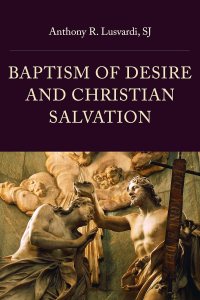
Just a friendly reminder that if you haven’t yet ordered your copy of Baptism of Desire and Christian Salvation, at a mere 20 cents/page, it remains a bargain. And each page is jam-packed with non-stop theological action.

You might think I’m biased, but you don’t have to take my word for it. When the book came out, I was thrilled to see that CUA Press had arranged a review and endorsement from Fr. José Granados. Attentive readers will recall that I mentioned Fr. Granados’s superb Introduction to Sacramental Theology here before. (It’s now available in Italian under the title Teologia dei sacramenti: Segni di Cristo nella carne.)

Here’s his verdict:

Offers a very accurate historical analysis of the doctrine of baptism of desire, starting with St. Ambrose and St. Augustine up to Vatican II. Lusvardi does not only give information about the different Fathers and theologians but delineates a clear leading thread that allows us to follow the development of the idea. The analyses are precise, the bibliography is abundant and well chosen, the documentation is excellent, the theological approach very sound.

José Granados, author of Introduction to Sacramental Theology: Signs of Christ in the Flesh

Some recent publications…

Lisbon, Portugal

I’m honored to have a couple of recent works appear in print in the past few weeks, the first an article in La Civiltà Cattolica, a publication founded by Italian Jesuits in 1850, which has since gone international. The article “Gestis Verbisque: The Words and Actions of the Sacraments” (the Italian is here) analyzes a recent Vatican document dealing with sacramental theology — specifically the question of invalid baptisms. The document Gestis verbisque was available only in Italian at the time I wrote the article, but has since come out in English (and other languages) here. It’s an important document because it reminds priests and deacons of the need to faithfully celebrate the sacraments according to the Church’s tradition and liturgical books. We probably all have had unfortunate experiences of goofy things happening in liturgy because Father thought that he could improve upon a centuries-old ritual with regrettable results. Gestis verbisque reminds us that “The Church is the ‘minister’ of the Sacraments, but she does not own them.” My own article fleshes out some of the background behind the document and points out where I think it adds something theologically (its treatment of the minister’s intention). It was interesting to see some of the strange cases in history that I found while researching Baptism of Desire and Christian Salvation come up again in modern settings. You’d think we’d learn!

The other publication is the first short story I’ve published in a while–too busy with academic work–in a magazine that will be familiar to readers of these pages, Dappled Things. Dappled Things is the only literary magazine I know of dedicated exclusively to Catholic literature. I’ve been honored to have a number of short stories and essays appear in their pages over the years, some of which can be found on their site. My most recent story, “Pious Tchotchkes,” is in their Easter 2024 issue, which is only available in print. Their print issues are always beautifully crafted.

The story is set in Portugal, and here are a couple of places alluded to — baroque exuberance in Coimbra and Cabo da Roca, the westernmost point in continental Europe.

Ascension

Transfiguration, pulpit (Pisan 1160), Cattedrale, Cagliari

“Today our Lord Jesus Christ ascended into heaven; let our hearts ascend with him. Listen to the words of the Apostle: ‘If you have risen with Christ, set your hearts on the things that are above, where Christ is, seated at the right hand of God; seek the things that are above, not the things that are on earth’ (Col. 3:1-2). For just as he remained with us even after his ascension, so we too are already in heaven with him, even though what is promised us has not yet been fulfilled in our bodies.”

St. Augustine, homily on the Lord’s Ascension, quoted in Robert Imbelli’s
Christ Brings All Newness (Word on Fire Academic, 2023), p. 144.

The bodily resurrection of Jesus

Galleria degli Arazzi (Gallery of Tapestries), Vatican Museum: The Resurrection, Raphael, 1519

As we near the end of the Easter season, I’ve been reading the latest book of Fr. Robert Imbelli, Christ Brings All Newness (Word On Fire Academic, 2023). It is a fine collection of essays on everything from Vatican II to Dante, all held together by the wonder and uniqueness of the Son of God’s entry into the world. The title comes from St. Irenaeus of Lyons: “Christ brought all newness in bringing himself.”

To give a taste of the book–and as we approach the Ascension–I thought I’d share some of Fr. Imbelli’s words on the Resurrection from the essay “Resurrection and Real Presence.” Insisting on the bodily resurrection of Jesus–and not some watered-down academic knock-off–Imbelli again demonstrates a truly sacramental sense of the body’s importance, which I mentioned in another post a few weeks ago.

“Resurrection faith stretches heart and mind to the breaking point, as they stagger under the unbearable lightness of being. Is it any wonder that we frequently retreat before the mystery, reducing it to more manageable perspectives? And so, certain scholars contend, ‘He is risen into the kerygma’–betraying thereby their inordinate appetite for ideas. No resurrection there, only a ghostly apparition. Or, some ecclesiastical functionaries insist, ‘He is risen into the institutional church”–displaying, by the very contention, a rather petrified imagination. That would merely exchange one tomb for another. Or, others of more liberationist bent cry, ‘He is risen as the people’–manifesting their often havoc-wreaking innocence. A provocative resuscitation, perhaps, but no true resurrection. But against all infringement of the mystery, the angel stands adamant: ‘He is risen; he is not here!'” (pp. 158-9)

Popular piety and tradition in Sardinia

I was fortunate this year to have spent Holy Week and Easter in Maracalagonis, Sardinia, a small town about a 20 minute drive from the center of Cagliari. It was a good break from the classroom and a wonderful taste of parish life.

Chiesa della Santa Vergine degli Angeli, Maracalagonis, Sardinia

The religious atmosphere I experienced was both warm and traditional. Masses were full; I heard confessions all week long; I met deeply committed Catholic families. I was especially impressed by the enthusiasm for traditional popular devotions. Teams of parishioners take responsibility for organizing different devotions throughout the year. Of particular note during Holy Week were the su Scravamentu, in which the nails are removed from the Lord’s hands and feet and he is taken down from the Cross after the Good Friday liturgy, and the many processions through the town streets–Stations of the Cross, Palm Sunday, Holy Thursday, the Sorrows of Mary on Good Friday, and then the S’Incontru on Easter morning.

Continue reading “Popular piety and tradition in Sardinia”

Sacraments, incarnation, and the body

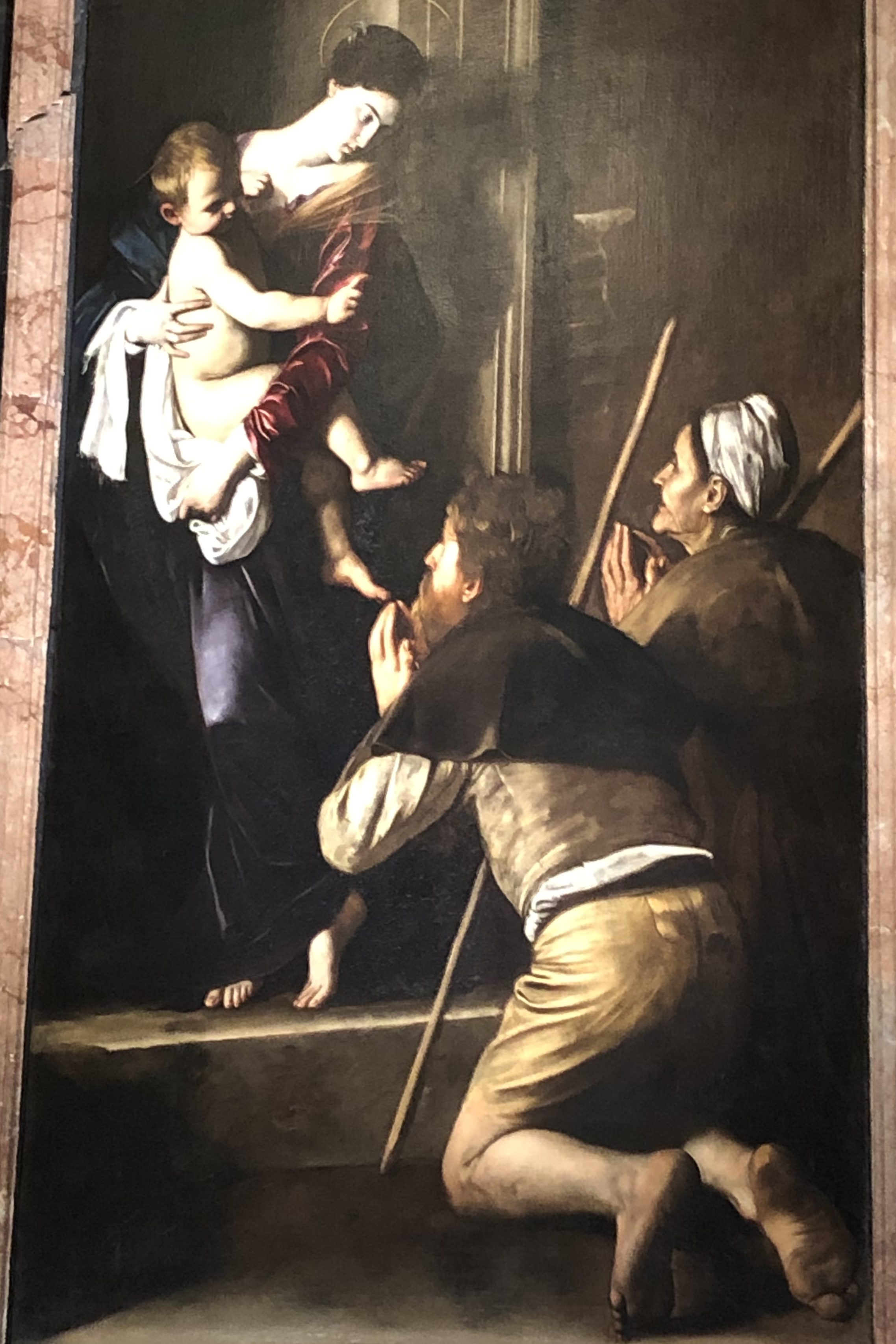
Madonna of the Pilgrims, (1604-6) Caravaggio, Church of Sant’Agostino, Rome

I’ve shared the work of theologian Fr. Robert Imbelli before. Here is another piece from him about a theme near to my heart, the “sacramental sense,” a phrase he takes from St. John Henry Newman.

Imbelli makes a point that has struck me before as well, that our society’s neglect of the transcendent is oddly connected to an unease with the body. We see this unease with our own bodies in everything from the explosion in the popularity of piercings and tattoos to the growth of eating disorders. Sex-changes are perhaps the most dramatic example of turning against one’s own flesh.

One of the sad marks of our secular age is a paradoxical double loss. Not only do we struggle to find access to the other dimension, that is, the spiritual, but we also seem impervious to the true sense of the material. Our sacramental sense has atrophied. Indeed, these two losses may be intricately connected.

Imbelli quotes philosopher Charles Taylor to argue that secular people today live lives of “excarnation,” disconnected from the communities and traditions that bore them. We live increasingly rootless lives. In contrast to this “excarnation,” Imbelli quotes Jesuit poet Gerard Manley Hopkins and points toward our Eucharistic faith. He hints at the way that this sacrament directs us toward a relationship with creation–and our own embodied part in it– that is rooted, first of all, in gratitude.

Read the rest of Imbelli’s piece at the Catholic Thing.

Romano Guardini on the liturgy

In preparation for I talk I gave last week to a group of seminary rectors from Africa and Asia, I read Romano Guardini’s short but profound book Liturgy and Liturgical Formation.

Guardini was one of the twentieth century’s sharpest and most balanced theological minds, and his writings on the liturgy are particularly valuable. He understands the irreducibility of liturgy and liturgical symbols and has absorbed the way the Fathers experienced liturgy, best exemplified by the line from Pope St. Leo the Great’s Ascension homily: “What was visible in the Lord has passed over into the mysteries.”

Chapel of San Basilio, Maracalagonis, Sardinia

Here are a few gems from Liturgy and Liturgical Formation:

“Liturgy does not deal with knowledge but with reality. There is knowledge of the liturgical action, which precedes it and could be called liturgical knowledge. And there is knowledge within it; the liturgical event allows an insight into itself. To speak of this today is not easy because it has escaped our religious consciousness at large. The liturgy itself is not merely knowledge but a full reality, which embraces much more than knowledge alone: a doing, an order, and the being of itself.” (13)

Continue reading “Romano Guardini on the liturgy”

Baptism of Desire and Christian Salvation — now in print!

After a few delays, I am pleased to report that my book is now officially in print and copies have arrived for those who preordered. It seems to have been released on Good Friday no less.

If you’re still on the fence about whether it’s worth the read, I thought I’d share the very kind words of endorsement from Fr. Joseph Carola, SJ, my colleague at the Gregorian University and expert in both the Church Fathers and Nineteenth Century theology.

So take it from Fr. Carola:

Jesus instructed Nicodemus that, “unless one is born of water and the Spirit, he cannot enter the kingdom of God” (John 3:5).  Faithful to the Lord’s revelation, Christians have insisted for two millennia upon the necessity of baptism for salvation.  But already in the ancient Church, salvation’s rough edges, as Father Anthony Lusvardi creatively calls them, have challenged believers.  What is the fate of those who lived before Christ and therefore died without Christian baptism?  What happens to the catechumen who dies unexpectedly before being baptized?  Can unbaptized babies get to heaven?  Is there any hope for the salvation of non-Christians?  In his thoroughly historical and insightfully theological study of the baptism of desire, Father Lusvardi offers his readers a fresh perspective on this traditional notion often misunderstood and misapplied in contemporary theology and pastoral practice.  Providing a convincing response to the challenges that the hard cases present, Father Lusvardi especially appeals to the Catholic Church’s lex orandi in order to establish the Church’s lex credendi that simultaneously upholds the necessity of baptism, the need for evangelization, and the nuances of desire.  Historically informative, theologically rich, and occasionally even humorous, Baptism of Desire and Christian Salvation is a book not only for theologians, but perhaps even more so for pastors who labor on the rough edges of salvation.

Joseph Carola, S.J., S.T.D.

November 2, 2023

All Souls

The Pontifical Gregorian University, Rome

An event unlike any other: homily for Easter Sunday

Homily for Easter Sunday 2024

National Gallery of Victoria, Melbourne

What is a miracle? The word is used often and not always in a very precise way. A quick search on the Internet revealed exercises, mineral solutions, and even a perfume, all described as “miraculous.”

At least the word seems to be useful for advertising. Probably we have also heard stories from the Middle Ages or antiquity that tell of extraordinary events. And probably some are really miracles, others are legends. They are the special effects that storytellers from a time before movies used to make a story more fascinating, moving, or funny.

Speaking more precisely, a miracle is something that happens in this world caused by a power beyond this world. Miracles do not mean that the divine is absent from non-miraculous events, from everyday events. When a doctor uses his intelligence to save life, he is using a divine gift–intelligence–to cooperate with the purpose of God who wants to save life and not destroy it. When a woman gives birth it is not a miracle in the literal sense–it does not require a force beyond human biology–but I would say there is something divine about that event because it is a participation in the Creator’s work.

A miracle, however, requires a power that no creature possesses.

We know with certainty that there has been at least one miracle in the history of the universe, namely, the creation of the universe. No existing thing possesses the power to create everything from nothing. This power is the essence of a miracle. I haven’t smelled the miraculous perfume, but I doubt that it qualifies .

Today we celebrate the miracle of miracles–the resurrection of Jesus Christ from the dead. Since creation there has been no other event like this. It is the most important event in human history, an event so different from all other historical events that, even today, after almost two thousand years, it remains difficult to explain.

Continue reading “An event unlike any other: homily for Easter Sunday”