Popular piety and tradition in Sardinia

I was fortunate this year to have spent Holy Week and Easter in Maracalagonis, Sardinia, a small town about a 20 minute drive from the center of Cagliari. It was a good break from the classroom and a wonderful taste of parish life.

Chiesa della Santa Vergine degli Angeli, Maracalagonis, Sardinia

The religious atmosphere I experienced was both warm and traditional. Masses were full; I heard confessions all week long; I met deeply committed Catholic families. I was especially impressed by the enthusiasm for traditional popular devotions. Teams of parishioners take responsibility for organizing different devotions throughout the year. Of particular note during Holy Week were the su Scravamentu, in which the nails are removed from the Lord’s hands and feet and he is taken down from the Cross after the Good Friday liturgy, and the many processions through the town streets–Stations of the Cross, Palm Sunday, Holy Thursday, the Sorrows of Mary on Good Friday, and then the S’Incontru on Easter morning.

Continue reading “Popular piety and tradition in Sardinia”

Santa Maria in Cosmedin – home to St. Valentine

Santa Maria in Cosmedin, Piazza della Bocca della Verità, Rome

It’s not one of Rome’s station churches, but Santa Maria in Cosmedin was one of my stops as Lent began this year because of the coincidence of Valentine’s Day falling on Ash Wednesday. A college English professor once advised me that in literature love and death are always intertwined, and this year’s liturgical calendar seems to add an exclamation point to the theory. What does all of this have to do with Santa Maria in Cosmedin, a twelfth century Roman church a stone’s throw from the Circus Maximus?

Well, Santa Maria in Cosmedin is home to the relics of St. Valentine. And, given his current appearance, I’d say Valentine drives home Ash Wednesday’s message pretty well. Not much is known about his life; Valentine was third century Roman priest martyred for continuing to minister to his flock in the midst of persecution. A note near his altar says the saint has been turned to not only for love, but as an intercessor in times of plague.

The relics of St. Valentine — romance abounds!

The church itself is rather fascinating. The current building, with its stubby façade and soaring bell tower, dates from the 12th century but was built on the site of an eighth century diaconia. Diaconia were the Catholic Social Services hubs of their day, centers where various forms of charity were distributed to the needy. Today the church is home to Rome’s Melkite community.

Continue reading “Santa Maria in Cosmedin – home to St. Valentine”

Saint Emilianus of Trevi

St. Emilianus of Trevi is perhaps destined to be overshadowed by St. Thomas Aquinas with whom he shares a feast day, January 28. He was one of the many bishops martyred during Roman persecution who provided inspiration and strength to their local communities but today are little know, the details of their biographies mingled with legend.

From the Martyrdom of St. Emilianus of Trevi, 12th century, Spoleto

I came across a striking set of 12th century carvings depicting the martyrdom of the saint in Spoleto last year and was taken by their vividness. St. Emilianus hailed originally from Armenia and came to Italy in the third century, where he was made the first bishop of Trevi. He was martyred during the persecution under Emperor Diocletian in 304, and his relics are preserved in Spoleto Cathedral.

He was condemned to die by a Roman proconsul for his refusal to sacrifice to the gods, but–as the panels from Spoleto recount–the first attempts to put him to death failed. The wild beasts sent to kill him instead bowed before him, and when he was tied up to be burnt the torches of his would be executioners fizzled out as they approached him. Finally, he was beheaded. The last panel of the work depicts Christ enthroned in heaven welcoming the martyr.

San Giovanni dei Fiorentini

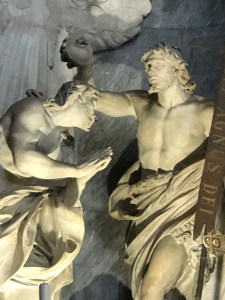
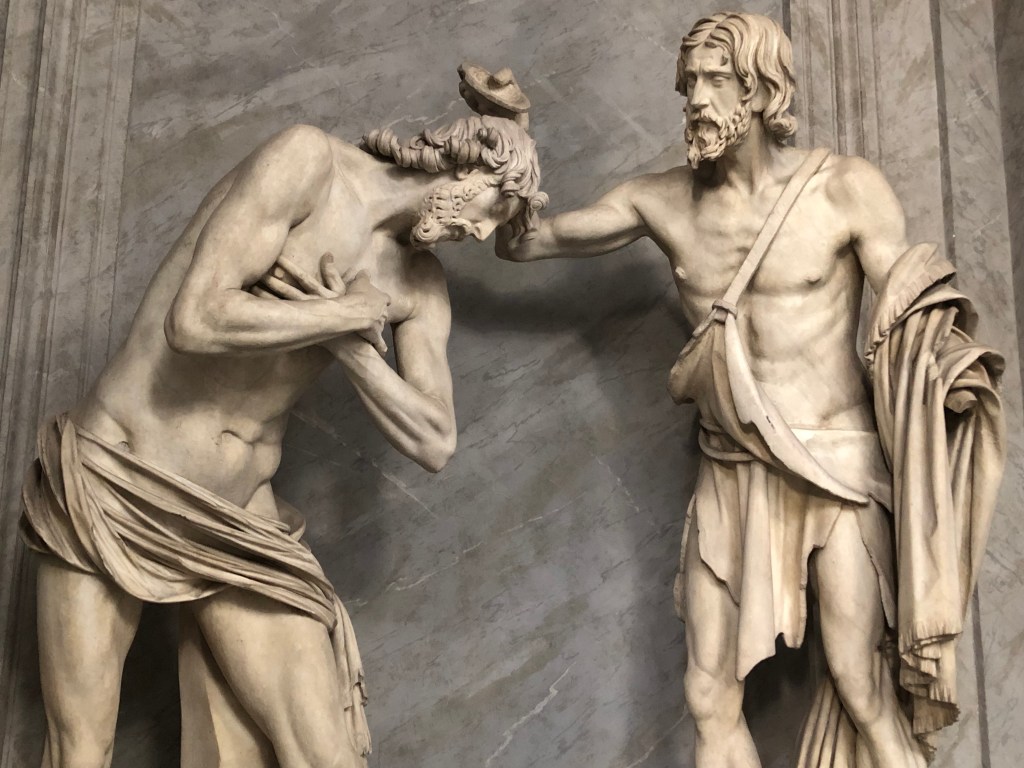
Baptism of Jesus, Antonio Raggi, San Giovanni dei Fiorentini, Rome

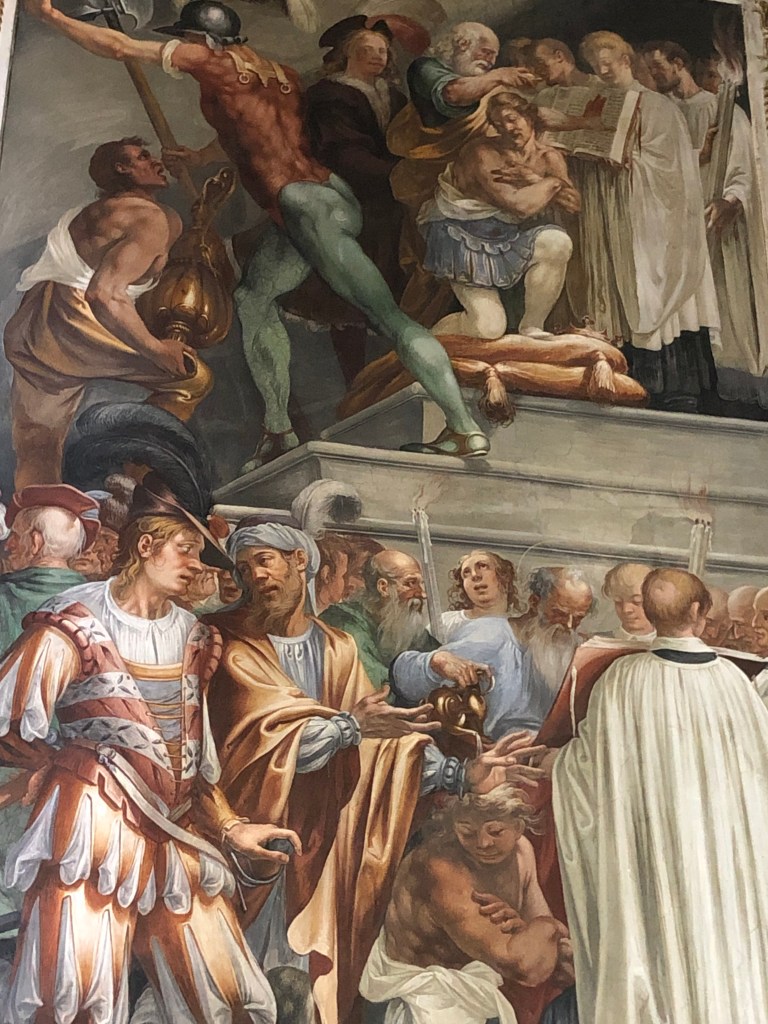
To celebrate the feast of the Baptism of the Lord–which this year falls unusually on a Monday–I thought I’d share a few photos from one of Rome’s lesser known churches, San Giovanni dei Fiorentini. A baroque church, it was built for the Florentine expats in Rome back when Florence was an independent city-state and named for the city’s patron, St. John the Baptist. The church contains a relic of Mary Magdalene (her foot), and is the burial place of the great–but tragically unhappy–baroque architect Francesco Borromini. It also contains a number of interesting artistic works featuring baptism. 

I’ve written before about the importance of baptism, but I have a personal reason to be particularly fond of San Giovanni dei Fiorentini. Its 17th century altarpiece, the Baptism of Jesus by Antonio Raggi, features on the beautifully designed cover of my book Baptism of Desire and Christian Salvation. Of course, I’d like to think that what’s inside the cover is pretty interesting as well, and I’m pleased that the book’s release date is coming up later this month–January 26. There’s more information on the website of Catholic University of America Press, and the book is available on other online sellers such as Amazon.

In the meantime enjoy the views of San Giovanni dei Fiorentini.

A jaunt to Spoleto

The Coronation of the Virgin, Filippo Lippi, Spoleto Cathedral

Compared to the first half of 2023, the past few months back at my day job have kept me mostly at my desk or in the classroom. I can’t complain. My students at the Gregorian University are a source of real encouragement and hope, and, even though preparing new classes is a daunting task, I always learn things in the process. This year’s new courses included penance–the sacrament and the virtue–and a seminar on marriage. The history of penance probably contains more twists and turns than that of any other sacrament, and I’ve particularly enjoyed the discussion in my marriage seminar provoked by Mark Regnerus’s excellent study The Future of Christian Marriage. 

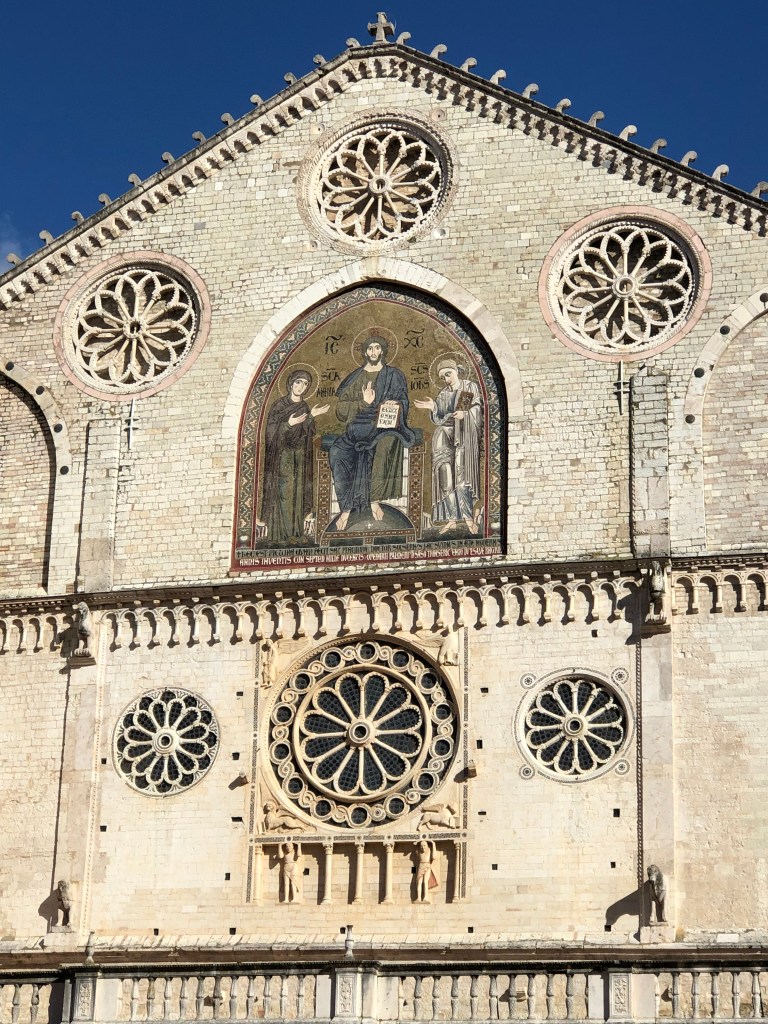
Duomo, Spoleto
Filippo Lippi (self-portrait in the Dormition, Spoleto Cathedral)

Every semester the Jesuits in the Gregorian community also get away for a day trip, which involves a bit of relaxation together and a very big meal. This year’s trip was to the Umbrian hill town of Spoleto, the sort of place where one finds Italy at its most picturesque. Highlights include a fortress that became a papal and then state prison and a 12th century cathedral. The cathedral’s highlight is an apse fresco of the Life of the Virgin Mary (started in 1467) by the Renaissance master Fra Filippo Lippi. I’ve shared some of the frescoes on my Facebook page at Christmas time, but the colorful Coronation seems an apt scene for the Solemnity of Mary Mother of God (January 1). The work also contains a hint of scandal–Lippi, a Carmelite friar, painted himself into the scene along with Lucrezia Buti, a novice in a Florentine convent who became the artist’s model and then his, ahem, mistress. Perhaps they got a pastoral, but not a liturgical, blessing.

The Vatican Nativity scene, 2023

Nativity scene, St. Peter’s Square, 2023

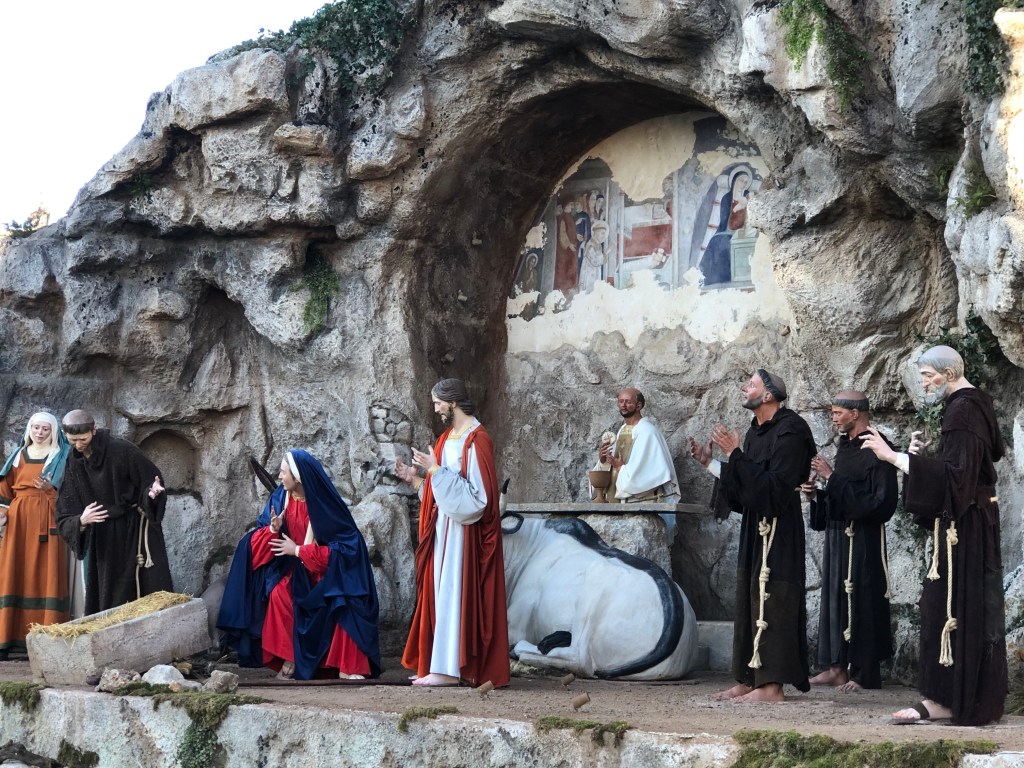
Over the past few weeks, I’ve noted (here and here) that 2023 marks the 800th anniversary of the first Nativity scene set up by St. Francis in the little town of Greccio. The Vatican’s Nativity scene this year also reflects that anniversary. 

This year’s scene doesn’t aim for historical accuracy–thus, St. Francis alongside Mary and Joseph and the three friars replacing the three kings. (Oh, and there’s a priest celebrating Mass in the background too.) The fresco on the wall behind them is a replica of the one in the cave in Greccio.

The figures, perhaps, aren’t exquisitely beautiful. (And, come to think of it, the priest in the background seems a tad confused about what he’s supposed to be doing–too much realism?) But at least this year’s Nativity scene isn’t aggressively weird (like the aliens from 2020) or trying too hard to be modern (like… well, there are too many examples).

You’ll notice that the manger itself is empty. As per the tradition, the Baby Jesus doesn’t arrive until Christmas itself. This year he won’t find a perfect Nativity scene, a perfect Church, or a perfect world, but he’ll come nonetheless and we need him all the more because of it.

Nativity scene, St. Peter’s Square, 2023

Rome for the holidays

Advent is one of my favorite times of the year to be in Rome. What they call winter here is nothing to a Minnesotan, and the shortening days are counterbalanced by the city’s delightful display of Christmas lights. These generally don’t start appearing until after the Immaculate Conception (December 8) and they don’t come down until after the Epiphany (January 6).

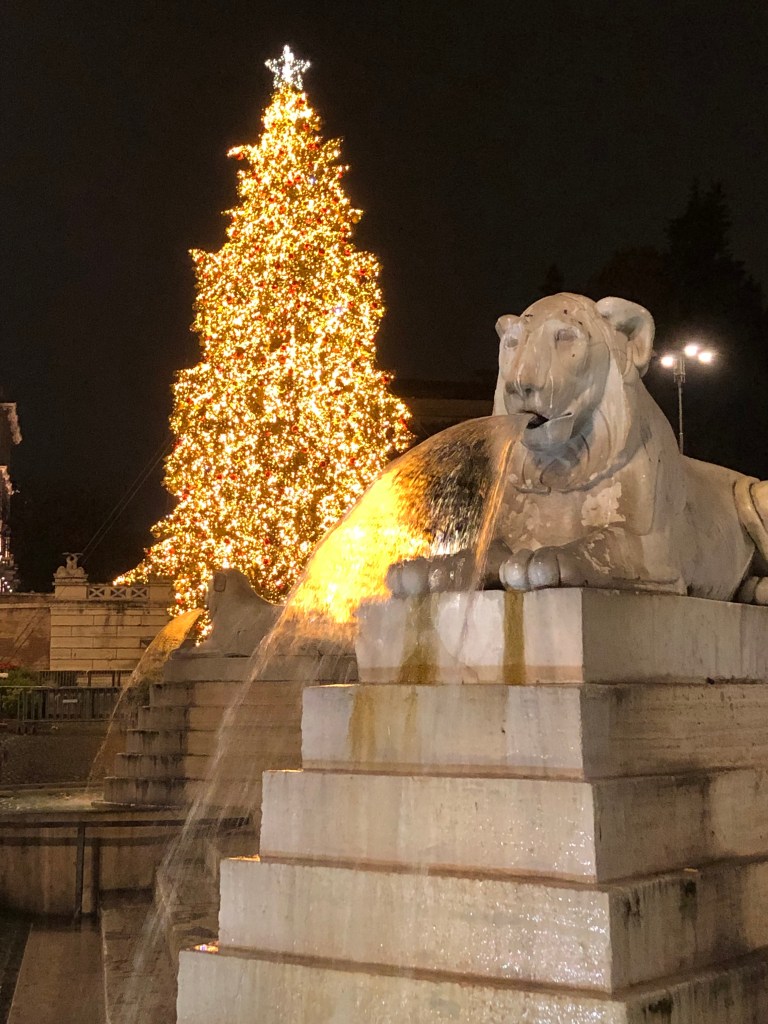
Rome’s Christmas tree, Piazza del Popolo

The city’s official Christmas tree, like the Vatican Nativity scene, is often the subject of local critique and Roman wit. This year, the tree got a new location due to construction work on Rome’s mythical new subway line–scheduled to open a few years after the Second Coming of Christ. The tree’s usual home, Piazza Venezia, is now a construction site, but its new location in Piazza del Popolo is a calmer setting away from the traffic. The official tree also has some competition from a glitzy counterpart at the Spanish Steps, given to the city by the fashion designer Dior.

Dior Christmas tree, Spanish Steps

I’d also be remiss not to mention what a delightful time of year Advent is to be at the Gregorian University, where the university’s international richness is on full display. Student groups from different countries take turns singing in the atrium between classes. It gives them an excuse to duck out of class early (ahem), but you’d have to be Ebenezer Scrooge not to appreciate the festive atmosphere. The Mexican college usually wins the prize for the best show not only because of their charm and energy but because you just can’t top a piñata. It’s a time to be grateful for our young priests, seminarians, religious, and lay students who are such a source of hope for me and for the Church.

Christmas at the Gregorian

More from Greccio

Chiesa di San Michele Arcangelo, Greccio

Last week, I mentioned my pilgrimage to Greccio, the little town on the edge of Lazio where St. Francis put up the first Nativity scene. I thought I’d share a few more pictures from the (grandly named) Museo Internazionale del Presepio and the Franciscan Sanctuary just outside of town, which was built around the Grotto of the Presepio. Last week I mentioned the series The Chosen and how it demonstrates the same instinct behind the Nativity scene–to use the imagination to draw closer to Jesus in the flesh.

It occurred to me that The Chosen‘s great success–against the odds, without Hollywood backing–shows that the Gospel story remains just as compelling as ever. The commercial success of Mel Gibson’s 2004 The Passion of the Christ showed the same thing. In fact, given the commercial success of such projects, it’s perhaps surprising that the entertainment industry doesn’t try to tap the religious market more often. Then again, Hollywood’s attempts to do religion tend to fall flat because they’re so patently inauthentic–remember Noah (2014)? You didn’t miss much. Martin Scorsese’s 2016 Silence was also a bit of a dud.

Despite these films’ massive budgets, the talent behind them, and slick special effects, they weren’t all that compelling. Perhaps the missing element was simply faith. I suppose it’s something like the difference between a foreigner speaking a language and a native speaker; no matter the foreigner’s wealth or education, he’ll never be as eloquent as a peasant speaking his native tongue. Faith has no substitutes.

The Nativity scene at 800

Santuario Francescano del Presepe, Greccio

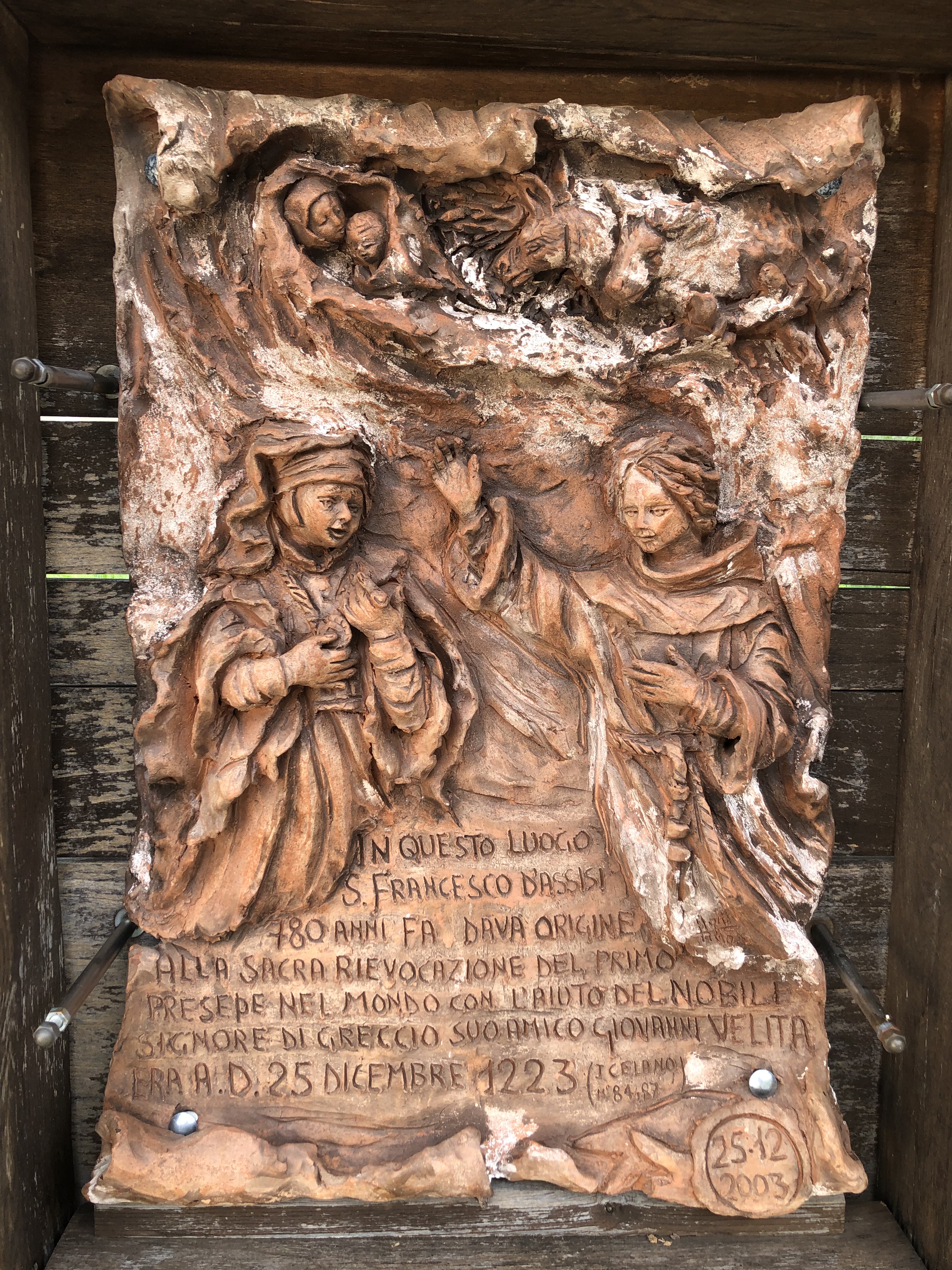
A few weeks before Christmas in the year 1223, St. Francis told one of his brothers that he wished to celebrate the holiday in Greccio, a hamlet about halfway between Assisi and Rome. He added something more: that he wanted to see with his own eyes the baby born in Bethlehem and the crude stable where he lay.

The brother went on ahead and arranged everything as the saint had asked in a little grotto just outside the town, a scene now familiar to us–figures of Mary and Joseph, the shepherds, the ox and the ass. The sight drew men and women from around Greccio and delighted Francis, who served as a deacon at Mass that Christmas night. The tradition of the Christmas manger scene was born.

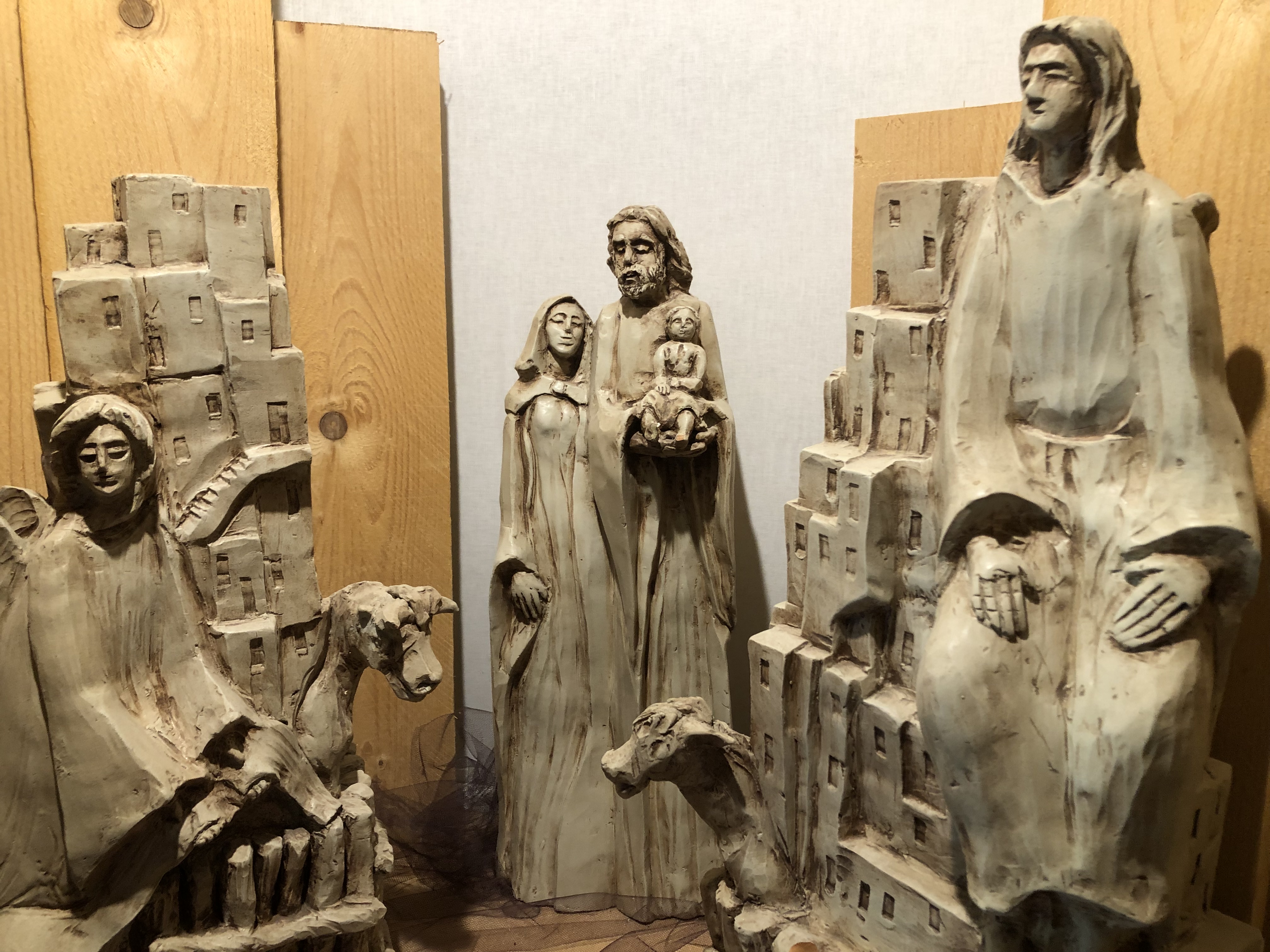
It’s a tradition that thrives all over the world, but especially in Italy. It’s also an example of what is known to theologians as “inculturation,” the way the Gospel enters into different cultures and finds ever-new expression in their traditions. The traditional Nativity scenes of Italy, especially Naples, often include dozens, even hundreds, of figures going about the tasks of daily life–shopkeepers, bakers, fruit vendors, beggars, musicians, servants, housewives, children, farmers, you name it. Dress and architecture in the scenes reflect the daily life of those who create them.

Continue reading “The Nativity scene at 800”

Memento mori

As I noted at the beginning of the month, November is a month dedicated to praying for the dead. It is also a time in which the readings begin to take on a somewhat apocalyptic flare. The theme of the end of things echoes with the changing seasons; at least in the northern hemisphere, this is the time when fall turns into winter.

Sedlec Ossuary, Kutna Hora, Czech Republic

It might seem macabre to dedicate a particular season to considering death, but it doesn’t have to be. In any case, not thinking about death will not prevent it from happening to each one of us. One reason to pray for the dead, as I wrote a few weeks ago, is to help them on their journey through purgatory. Another is to give us the proper attitude toward life. The things in this world are temporary; our relationship with God is eternal. We should plan accordingly.

Continue reading “Memento mori”