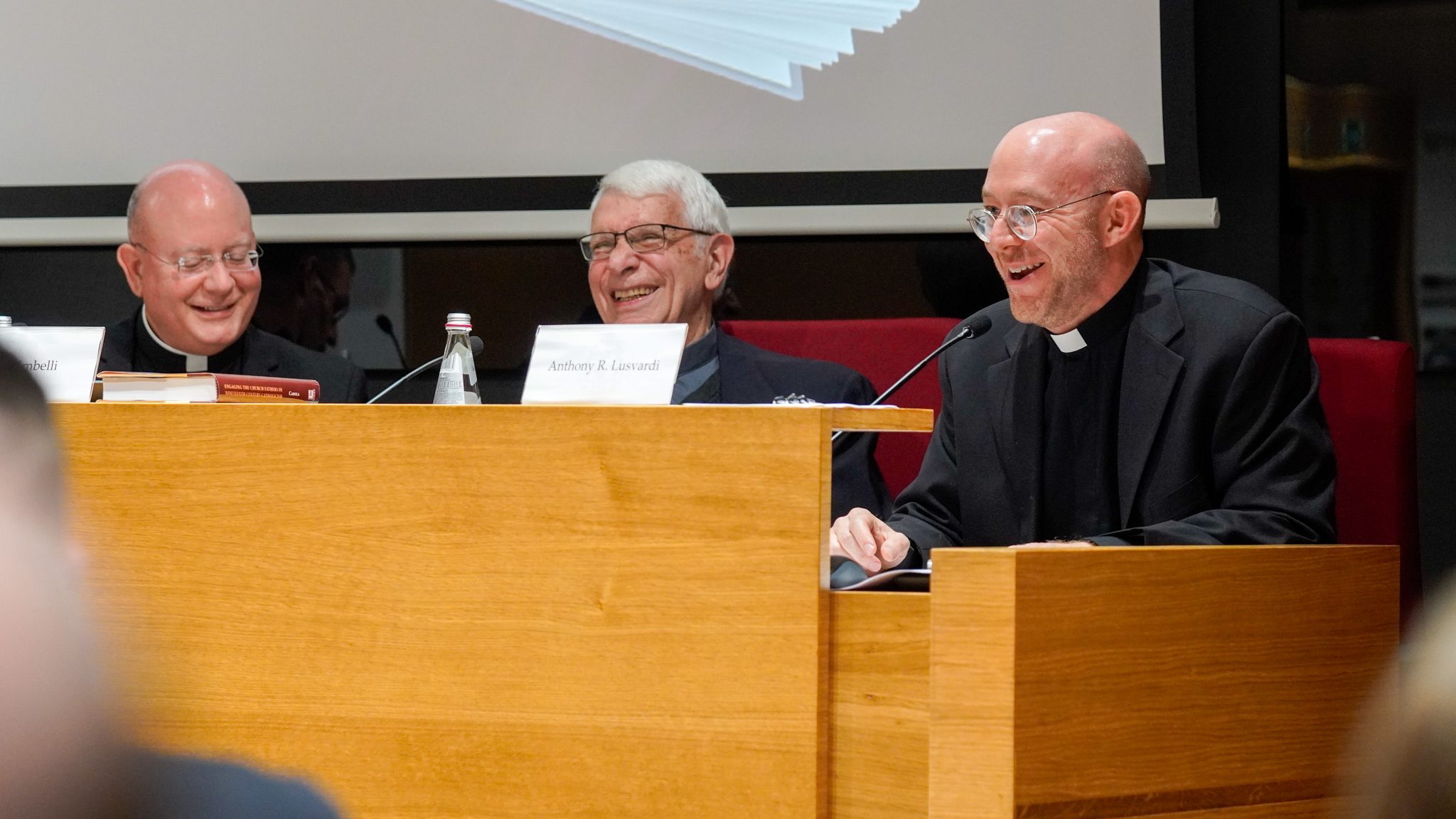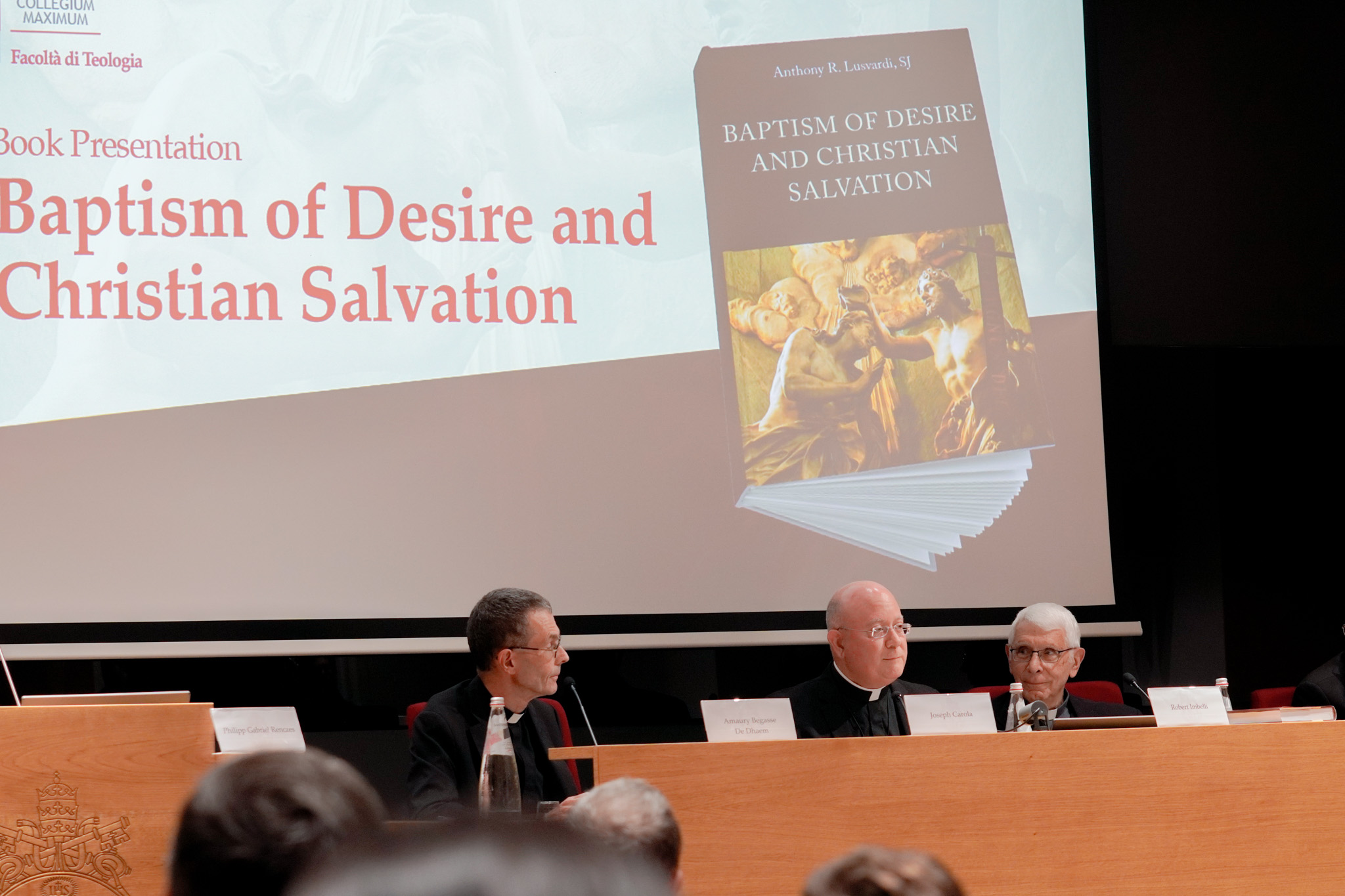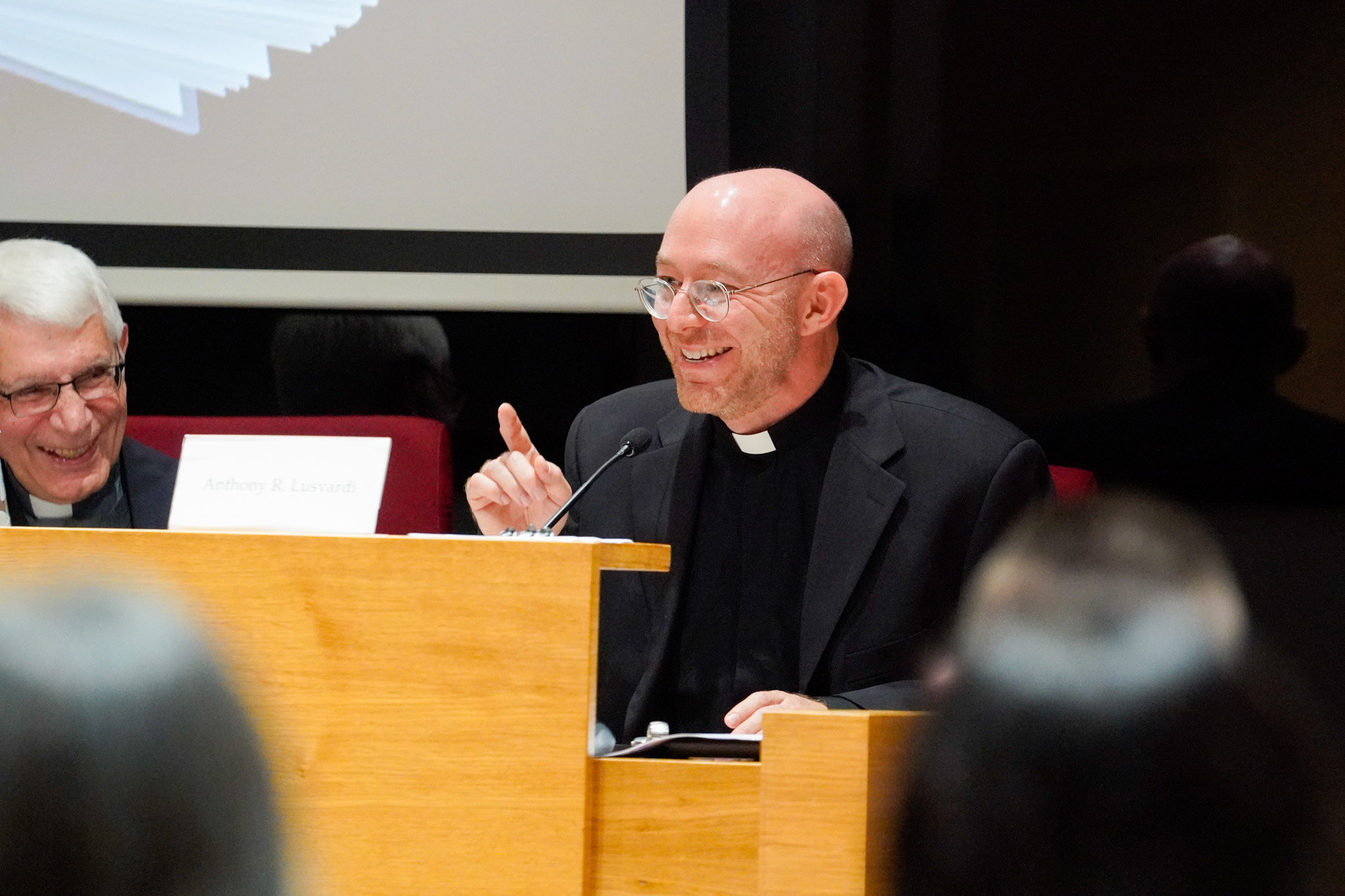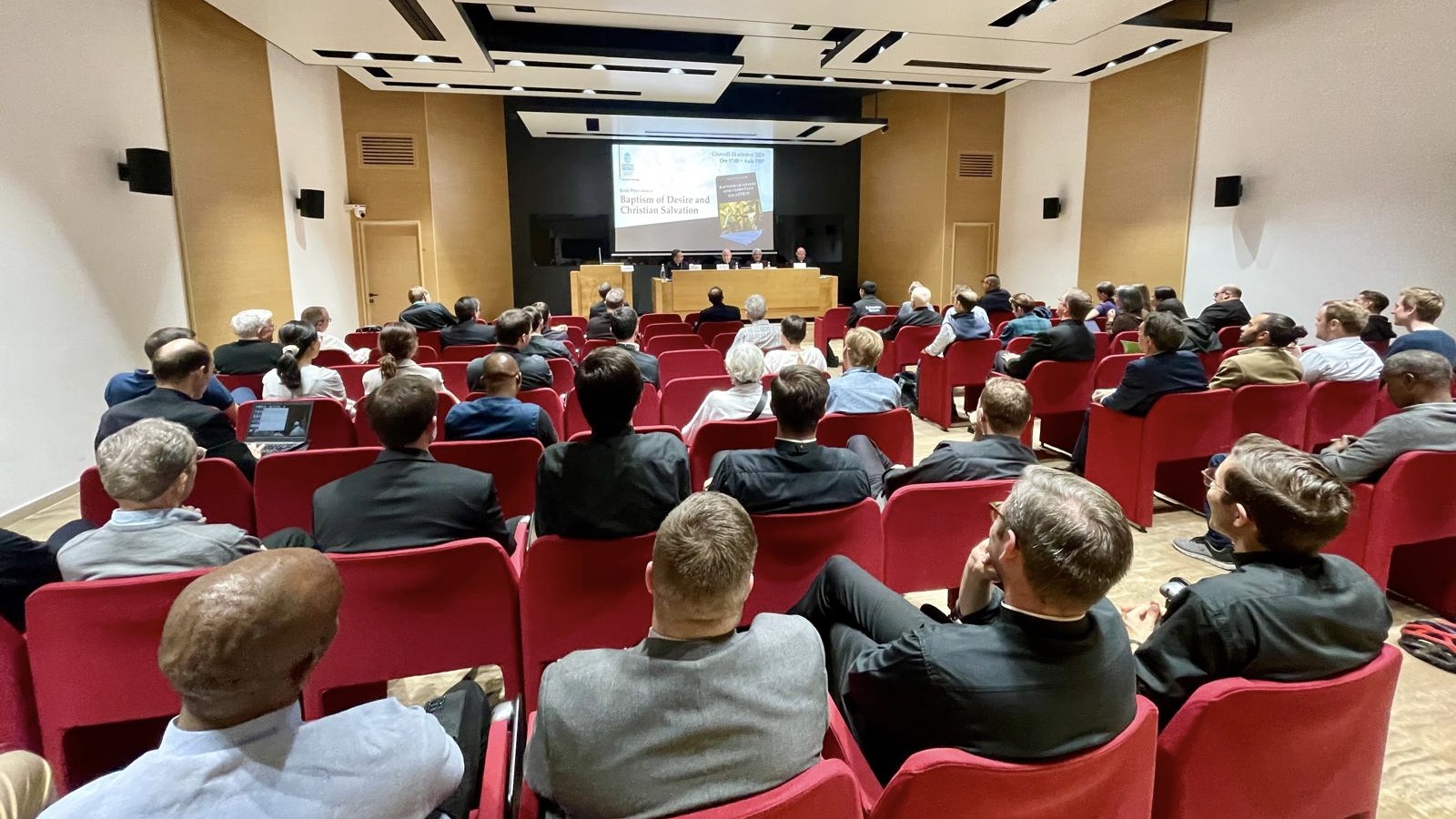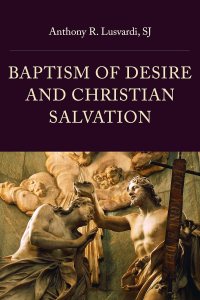
Andrea Grillo and Rachel Lu on Baptism of Desire and Christian Salvation

Sant’Anselmo, Rome

Earlier this month, after delivering ten copies of Baptism of Desire and Christian Salvation to Sant’Anselmo at Easter time, I walked up the Aventine Hill to pick up my diploma–the last formality involved in earning my doctorate. The last act, I suppose, of my formal education! It’s a walk I made many times before while a student. I haven’t been back to Sant’Anselmo for a while now, but am grateful for the studies in sacramental theology I did there.

When I received my copies of Baptism of Desire and Christian Salvation, I had one more reason to be grateful — the insightful words of endorsement on the back cover from my dissertation director Prof. Andrea Grillo, who read many draft versions of the tome and managed to remain in good humor throughout! Here’s his review:

Lusvardi offers a historical reconstruction of the ‘baptism of desire’ that traverses the entire arc of the Christian tradition, starting from the origins. A straightforward work, expressed in a language endowed with finesse, irony and acumen. Baptism of Desire and Christian Salvation is singularly effective in pointing out the fact that in the modern reception, a series of priorities is imposed on the issue that empty its meaning.

Andrea Grillo, Pontifical Atheneum of Saint Anselm, Rome

Also last week, I was delighted to see Rachel Lu’s review of the book at Word On Fire. Rachel’s review had a particular significance for me since, as she points out, I was there when she was baptized as an adult 19 years ago.

Granados endorsement

Just a friendly reminder that if you haven’t yet ordered your copy of Baptism of Desire and Christian Salvation, at a mere 20 cents/page, it remains a bargain. And each page is jam-packed with non-stop theological action.

You might think I’m biased, but you don’t have to take my word for it. When the book came out, I was thrilled to see that CUA Press had arranged a review and endorsement from Fr. José Granados. Attentive readers will recall that I mentioned Fr. Granados’s superb Introduction to Sacramental Theology here before. (It’s now available in Italian under the title Teologia dei sacramenti: Segni di Cristo nella carne.)

Here’s his verdict:

Offers a very accurate historical analysis of the doctrine of baptism of desire, starting with St. Ambrose and St. Augustine up to Vatican II. Lusvardi does not only give information about the different Fathers and theologians but delineates a clear leading thread that allows us to follow the development of the idea. The analyses are precise, the bibliography is abundant and well chosen, the documentation is excellent, the theological approach very sound.

José Granados, author of Introduction to Sacramental Theology: Signs of Christ in the Flesh

The bodily resurrection of Jesus

Galleria degli Arazzi (Gallery of Tapestries), Vatican Museum: The Resurrection, Raphael, 1519

As we near the end of the Easter season, I’ve been reading the latest book of Fr. Robert Imbelli, Christ Brings All Newness (Word On Fire Academic, 2023). It is a fine collection of essays on everything from Vatican II to Dante, all held together by the wonder and uniqueness of the Son of God’s entry into the world. The title comes from St. Irenaeus of Lyons: “Christ brought all newness in bringing himself.”

To give a taste of the book–and as we approach the Ascension–I thought I’d share some of Fr. Imbelli’s words on the Resurrection from the essay “Resurrection and Real Presence.” Insisting on the bodily resurrection of Jesus–and not some watered-down academic knock-off–Imbelli again demonstrates a truly sacramental sense of the body’s importance, which I mentioned in another post a few weeks ago.

“Resurrection faith stretches heart and mind to the breaking point, as they stagger under the unbearable lightness of being. Is it any wonder that we frequently retreat before the mystery, reducing it to more manageable perspectives? And so, certain scholars contend, ‘He is risen into the kerygma’–betraying thereby their inordinate appetite for ideas. No resurrection there, only a ghostly apparition. Or, some ecclesiastical functionaries insist, ‘He is risen into the institutional church”–displaying, by the very contention, a rather petrified imagination. That would merely exchange one tomb for another. Or, others of more liberationist bent cry, ‘He is risen as the people’–manifesting their often havoc-wreaking innocence. A provocative resuscitation, perhaps, but no true resurrection. But against all infringement of the mystery, the angel stands adamant: ‘He is risen; he is not here!'” (pp. 158-9)

Sacraments, incarnation, and the body

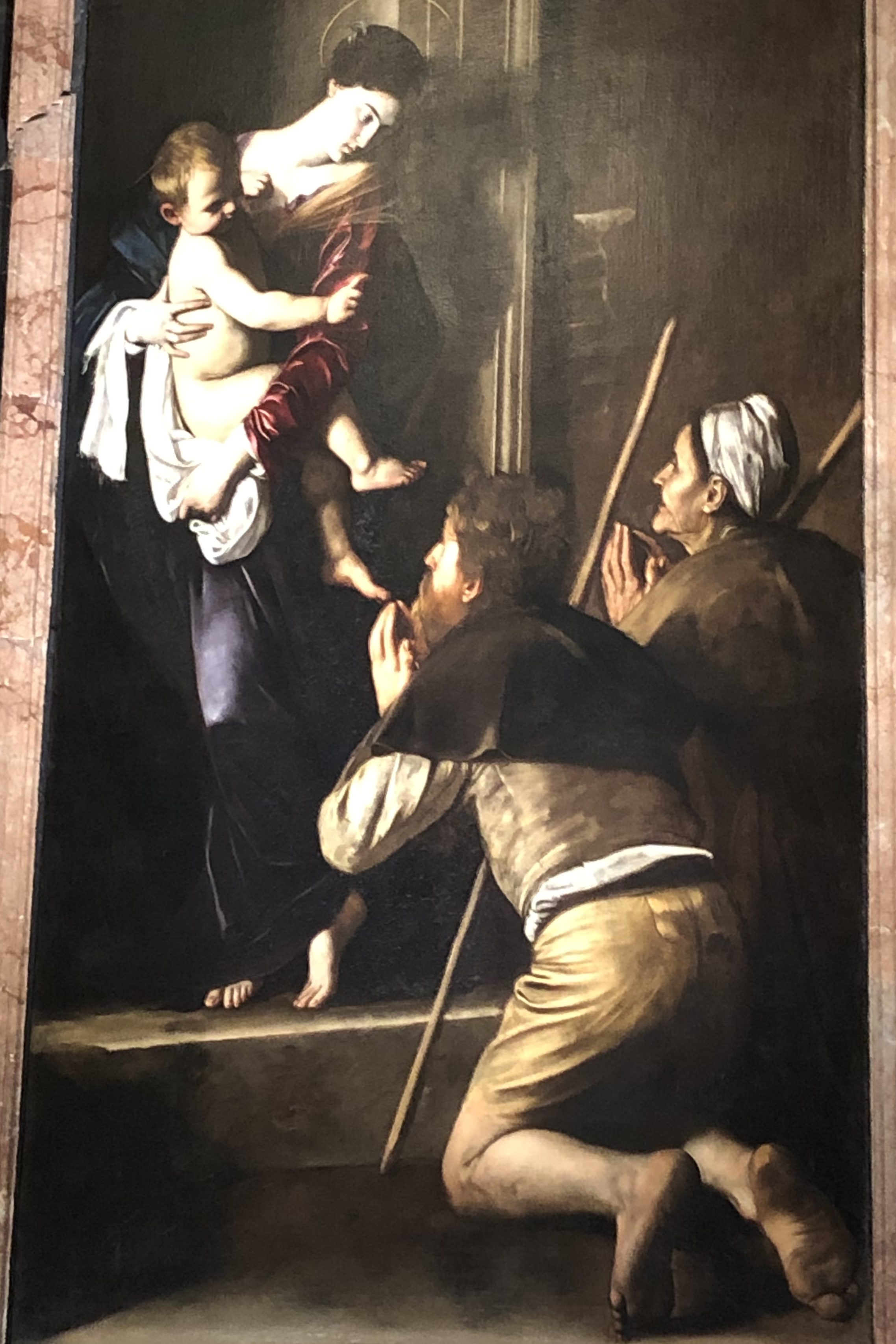
Madonna of the Pilgrims, (1604-6) Caravaggio, Church of Sant’Agostino, Rome

I’ve shared the work of theologian Fr. Robert Imbelli before. Here is another piece from him about a theme near to my heart, the “sacramental sense,” a phrase he takes from St. John Henry Newman.

Imbelli makes a point that has struck me before as well, that our society’s neglect of the transcendent is oddly connected to an unease with the body. We see this unease with our own bodies in everything from the explosion in the popularity of piercings and tattoos to the growth of eating disorders. Sex-changes are perhaps the most dramatic example of turning against one’s own flesh.

One of the sad marks of our secular age is a paradoxical double loss. Not only do we struggle to find access to the other dimension, that is, the spiritual, but we also seem impervious to the true sense of the material. Our sacramental sense has atrophied. Indeed, these two losses may be intricately connected.

Imbelli quotes philosopher Charles Taylor to argue that secular people today live lives of “excarnation,” disconnected from the communities and traditions that bore them. We live increasingly rootless lives. In contrast to this “excarnation,” Imbelli quotes Jesuit poet Gerard Manley Hopkins and points toward our Eucharistic faith. He hints at the way that this sacrament directs us toward a relationship with creation–and our own embodied part in it– that is rooted, first of all, in gratitude.

Read the rest of Imbelli’s piece at the Catholic Thing.

Baptism of Desire and Christian Salvation — now in print!

After a few delays, I am pleased to report that my book is now officially in print and copies have arrived for those who preordered. It seems to have been released on Good Friday no less.

If you’re still on the fence about whether it’s worth the read, I thought I’d share the very kind words of endorsement from Fr. Joseph Carola, SJ, my colleague at the Gregorian University and expert in both the Church Fathers and Nineteenth Century theology.

So take it from Fr. Carola:

Jesus instructed Nicodemus that, “unless one is born of water and the Spirit, he cannot enter the kingdom of God” (John 3:5).  Faithful to the Lord’s revelation, Christians have insisted for two millennia upon the necessity of baptism for salvation.  But already in the ancient Church, salvation’s rough edges, as Father Anthony Lusvardi creatively calls them, have challenged believers.  What is the fate of those who lived before Christ and therefore died without Christian baptism?  What happens to the catechumen who dies unexpectedly before being baptized?  Can unbaptized babies get to heaven?  Is there any hope for the salvation of non-Christians?  In his thoroughly historical and insightfully theological study of the baptism of desire, Father Lusvardi offers his readers a fresh perspective on this traditional notion often misunderstood and misapplied in contemporary theology and pastoral practice.  Providing a convincing response to the challenges that the hard cases present, Father Lusvardi especially appeals to the Catholic Church’s lex orandi in order to establish the Church’s lex credendi that simultaneously upholds the necessity of baptism, the need for evangelization, and the nuances of desire.  Historically informative, theologically rich, and occasionally even humorous, Baptism of Desire and Christian Salvation is a book not only for theologians, but perhaps even more so for pastors who labor on the rough edges of salvation.

Joseph Carola, S.J., S.T.D.

November 2, 2023

All Souls

The Pontifical Gregorian University, Rome

New journal!

It might seem that there’s nothing new under the sun in the world of theology, but that’s not the case. This spring, The New Ressourcement journal launched its first issue. The journal is sponsored by Word on Fire Academic, one of the many great ministries founded by Bishop Robert Barron. In fact, Bishop Barron has an article in the first issue. The editorial staff is an all-star lineup: Matthew Levering of Mundelein Seminary, Jonathan Ciraulo of St. Meinrad Seminary, and my own colleague at the Gregorian University, Aaron Pidel, S.J. The authors represented in the first issue can also all be fairly described as all stars.

Here’s a description of the journal from its website:

The New Ressourcement

 is a quarterly journal of theology and philosophy published by Word on Fire Academic. It serves the Church and the academy by publishing scholarly articles that demonstrate the depth and relevance of the entirety of the Catholic tradition.

This journal aims to sentire cum tota ecclesia, to think with the whole Church as it has ever reflected on the mystery of the Incarnate Christ, as seen in sources that are biblical, patristic, medieval, as well as modern. The journal draws inspiration from, and seeks to continue the work of, previous generations of ressourcement theologians. It shares with them a conviction that the renewal of theology and philosophy occurs by returning to sources that remain inexhaustible. This ressourcement is “new” because we trust that this patrimony is fertile enough to encounter contemporary questions confidently and to illuminate the challenges and opportunities that shape the present age.

https://newressourcement.wordonfire.org

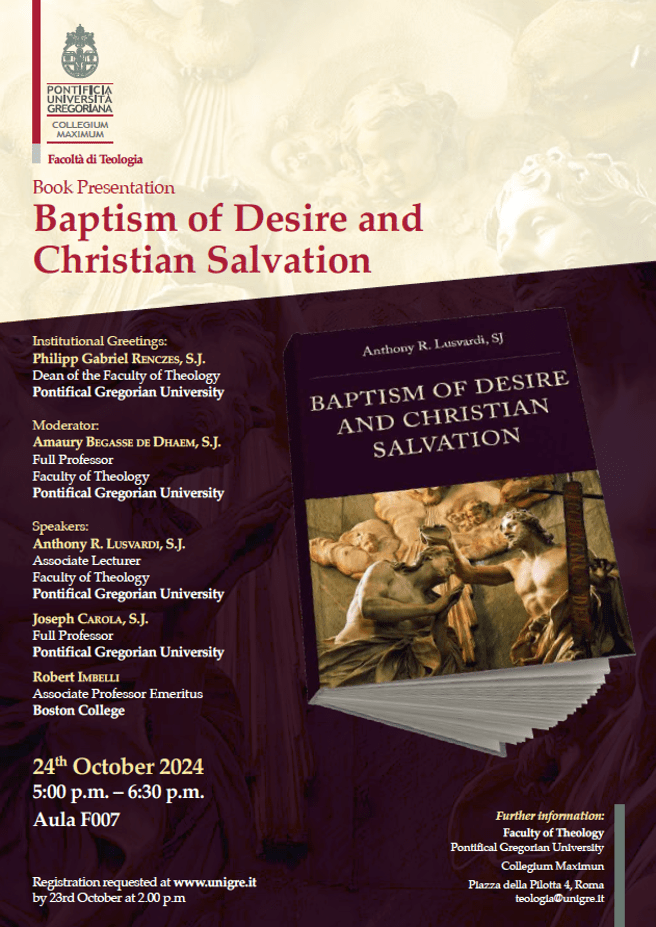
Baptism of Desire and Christian Salvation

My book Baptism of Desire and Christian Salvation is now available to order, though its shipping date will be a little later. Its official publication date was originally last Friday but now seems to have been bumped to March. I’ve been working on the topic of baptism of desire since my STL studies at Sant’Anselmo–a good six years ago–so it has been a long time coming. I think the result says some important things for Catholic theology and the evangelizing mission of the Church. So let me assure you, it’s worth the wait!

I’ll have more on the topic to say, of course, and I’ll share the reactions of others to the book so you don’t have to take my word for it. For now I’ll just share the official description from Catholic University of America Press. The book is available directly from CUA’s website as well as other online booksellers such as Amazon. This spring CUA is offering a 20% discount on new books with the promo code CT10. Make sure that your library gets a copy, too!

Baptism of Desire and Christian Salvation. Belief in the necessity of baptism for salvation is rooted in the New Testament and was forcefully affirmed by the Church Fathers, yet today this belief is treated with unease if not ignored altogether. Over the course of centuries, Catholic theology has wrestled with a doctrine—baptism of desire—that both preserves this fundamental principle and allows for salvation in hard cases, such as catechumens dying unexpectedly. Baptism of Desire and Christian Salvation traces this doctrine’s varied history, from its genesis in a fourth century funeral oration given by Ambrose of Milan to its uneasy position in the Anonymous Christianity of Karl Rahner. 

More than a history, however, this book raises questions about the nature of religious ritual and the sacraments, the mission of the Church, and the essence of salvation. Arguing that theologians of the past two centuries have tended to downplay the role of the sacraments when discussing salvation, Lusvardi suggests that baptism should remain our theological starting point. Engaging with the theological tradition and at times challenging the conventional wisdom, Baptism of Desire and Christian Salvation shows how such a sacramental approach can offer credible—and sometimes surprising—responses to questions related to the salvation of non-Christians, the fate of unbaptized infants, and the relevance of the Church’s mission today.

From John Paul II’s “Letter to Artists”

Every genuine artistic intuition goes beyond what the senses perceive and, reaching beneath reality’s surface, strives to interpret its hidden mystery. The intuition itself springs from the depths of the human soul, where the desire to give meaning to one’s own life is joined by the fleeting vision of beauty and of the mysterious unity of things. All artists experience the unbridgeable gap which lies between the work of their hands, however successful it may be, and the dazzling perfection of the beauty glimpsed in the ardour of the creative moment: what they manage to express in their painting, their sculpting, their creating is no more than a glimmer of the splendour which flared for a moment before the eyes of their spirit.

Believers find nothing strange in this: they know that they have had a momentary glimpse of the abyss of light which has its original wellspring in God. Is it in any way surprising that this leaves the spirit overwhelmed as it were, so that it can only stammer in reply? True artists above all are ready to acknowledge their limits and to make their own the words of the Apostle Paul, according to whom “God does not dwell in shrines made by human hands” so that “we ought not to think that the Deity is like gold or silver or stone, a representation by human art and imagination” (Acts 17:24, 29). If the intimate reality of things is always “beyond” the powers of human perception, how much more so is God in the depths of his unfathomable mystery!  […]

Beauty is a key to the mystery and a call to transcendence. It is an invitation to savour life and to dream of the future. That is why the beauty of created things can never fully satisfy. It stirs that hidden nostalgia for God which a lover of beauty like Saint Augustine could express in incomparable terms: “Late have I loved you, beauty so old and so new: late have I loved you!”

From Pope St. John Paul II, Letter to Artists (1999)

The Virtue of Penance

Last week, I mentioned the seminar I taught this past semester about the sacrament of marriage. I also taught a course about the sacrament of penance. (I learned to be careful when describing my course load to make clear that those were, in fact, two different courses and not a sly commentary on marriage!)

Jonah sarcophagus (ca. AD 300), Vatican Museums

The sacrament of penance has a fascinating history, and the way in which it has been practiced over the centuries has varied more than perhaps any other sacrament. A major theme of the class, however, was that the sacrament itself is not the only way that Christians practice penance. As Thomas Aquinas pointed out (in the Summa Theologiae III q. 85), penance is not only a sacrament but also a virtue. He didn’t come up with that particular insight himself, of course, but was summarizing the theological tradition before him.

Continue reading “The Virtue of Penance”

The Future of Christian Marriage

This week marks the end of the first semester at the Greg. One of the semester’s blessings has been the seminar I taught on the sacrament of marriage, which looked first at some classic theological texts on the subject and then attempted to grapple with the contemporary problems the Christian vision of marriage faces. No small task, and I learned much from the discussion. I’m grateful to my lively group of students.

To guide our discussion I assigned sociologist Mark Regnerus’s engaging and insightful book The Future of Christian Marriage (Oxford 2020). The book makes use of social surveys, Regnerus’s own extensive research on the subject, and 200 interviews conducted with young Christians in seven different countries. My students–who hailed from a total of eight different countries–found the book quite helpful for understanding the situation they themselves face. Having real-world data also improved our theological discussion, which, in today’s climate, can sometimes get bogged down in sloganeering.

At the root of Regnerus’s argument is the contention that attitudes toward marriage have changed from seeing it as a “foundation” to seeing it as a “capstone.” In other words, instead of a unit based on mutual exchange that helps a couple to weather life’s uncertainties, young people have increasingly come to see marriage as a capstone one acquires only after attaining personal, financial, and career success. This means that marriage is delayed, comes with more difficult-to-realize expectations of one’s spouse, and, for many, ultimately becomes unattainable. This is all part of the “atomization” of society as individuals become our primary social grouping at the expense of families.

Continue reading “The Future of Christian Marriage”