On the Annunciation

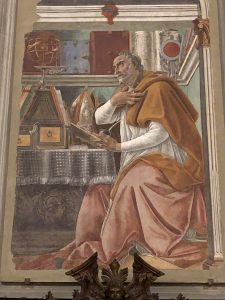
Detail from Botticelli’s Annunciation.

A beautiful piece for today’s feast from Fr. Robert Imbelli, a fine theologian and teacher, “Annunciations are Frequent, Incarnations are Rare.”

Here’s an excerpt:

You may understandably object that I project too much into a scant fifteen-minute encounter passed almost entirely in silence. I concede the complaint. Yet the Spirit radiates where he wills. And the new Eve leads a multitude of daughters (and sons) to compassionate being, which manifests itself in courteous demeanor and directness of gaze. Mary continues both to enchant and to challenge.

Indeed, let me insist: bodily demeanor and gaze. For in an incarnational spirituality the body assumes a dignity and importance that is unique. It is no rarefied “spiritual” assent that we celebrate on Mary’s feast: but a fully embodied “yes” to God’s call.

Read the whole article at The Catholic Thing.

The churches of Trastevere

There are a lot of churches in Rome. I’ve heard 900-something, but I’m not really sure. There are eight or nine chapels in the building I live in, but I might be forgetting some. Needless to say, it seems a little too late for a master plan to ensure efficiency.

Santa Maria in Trastevere

The closest Rome ever came to an efficient program of church construction was probably right at the beginning, with the tituli, which were really just the houses of prominent Christians where the faithful gathered to worship, sometimes in secret. Titulus refers to the name of the owner, usually written on a plaque by the door. These centers weren’t laid out in any logical plan, but depended on whoever had a big enough living room (well, courtyard) to accommodate the whole proto-parish. When Christianity came out into the open after the Edict of Milan, the city’s faithful erected church buildings on the site of the tituli, which often enough coincided with sites of martyrdom. A few of the station churches are also built on the site of an old diaconia, basically an early Christian charitable distribution center.

Continue reading “The churches of Trastevere”

Roman liturgy, Midwestern seasons

Outside San Clemente, Rome 2018.

Today’s station church, San Clemente, marks something of a milestone. San Clemente was where the station liturgy broke off two years ago in what was to become the longest fortnight in human history, “two weeks to flatten the curve.” In fact, in my experience of the station pilgrimage, the second Monday of Lent at San Clemente seems associated with portentous events. It was to San Clemente that I trudged through the slush in 2018, the last time that Rome got snow.

Continue reading “Roman liturgy, Midwestern seasons”

Soldier saints

San Giorgio in Velabro, Rome

I’ve noted before the prevalence of former soldiers among the saints of Rome, a fact especially evident in the first week of Rome’s station liturgy, when day two is celebrated at a church dedicated to St. George and St. Sebastian and day three at the site two other former soldiers, the brothers John and Paul, were martyred in 360.

The prominence of these soldier saints is especially striking while war rages in the Ukraine. Though the signs were all there ahead of time–this was not the first time Vladimir Putin invaded Ukraine–the attack and the resistance to it has seemed to jolt the West from a deep and dangerous torpor. A friend recently showed me a poll asking the people of various nations if they would be willing to fight for their country; less than half of Americans said yes–and that was high for the West. In his inaugural address, John F. Kennedy, pledged to the world, “Let every nation know, whether it wishes us well or ill, that we shall pay any price, bear any burden, meet any hardship, support any friend, oppose any foe, to assure the survival and the success of liberty.” Today, in the face of crisis, presidents compete to issue stimulus checks because, hey, free money. Something seems to have been lost.

Continue reading “Soldier saints”

Rising from the Ashes

Santa Sabina

Rising from the ashes is, I suppose, the theme of every Lent and Easter season, though it appears especially appropriate this year. On a personal note, this will be the first time since 2020 that I will be able to return to one of Rome’s great Lenten traditions, the station churches.

I managed to complete the full itinerary my second year here in Rome–and my first Lent as a priest–and wrote about the experience in a series of articles for America Magazine, the first of which gives some background on the tradition: A Jesuit’s Lenten pilgrimage through the station churches of Rome.

The following year, balancing other obligations, I hit about half the churches, and then in 2020, in the second week of Lent, Rome’s churches closed. It seemed as if Nero had gotten his way at last.

Continue reading “Rising from the Ashes”

Feast of the Chair of Peter

To celebrate today’s feast, I walked over to St. Peter’s Basilica this morning, especially keen to see the church decorated for the day–the candles lit on Bernini’s spectacular sculpture of the Cathedra Petri and the first pope’s statue decked out in his party regalia.

Cathedra Petri, Bernini

In the past I’ve always had class or other obligations or there were too many tourists or the world was closed for pandemic, so I’d never visited the basilica on this feast. Today, like Goldilocks but without the hair, I found everything just right. Just a smattering of visitors early in the morning, and as a bonus I was able to get to the altar of St. Leo the Great, which is in a part of the church that is sometimes blocked off. Leo is a favorite of mine because of his lapidary teaching that what was visible in Jesus when he walked the earth has passed over into the sacraments (Sermon 74).

Continue reading “Feast of the Chair of Peter”

Washington’s Birthday

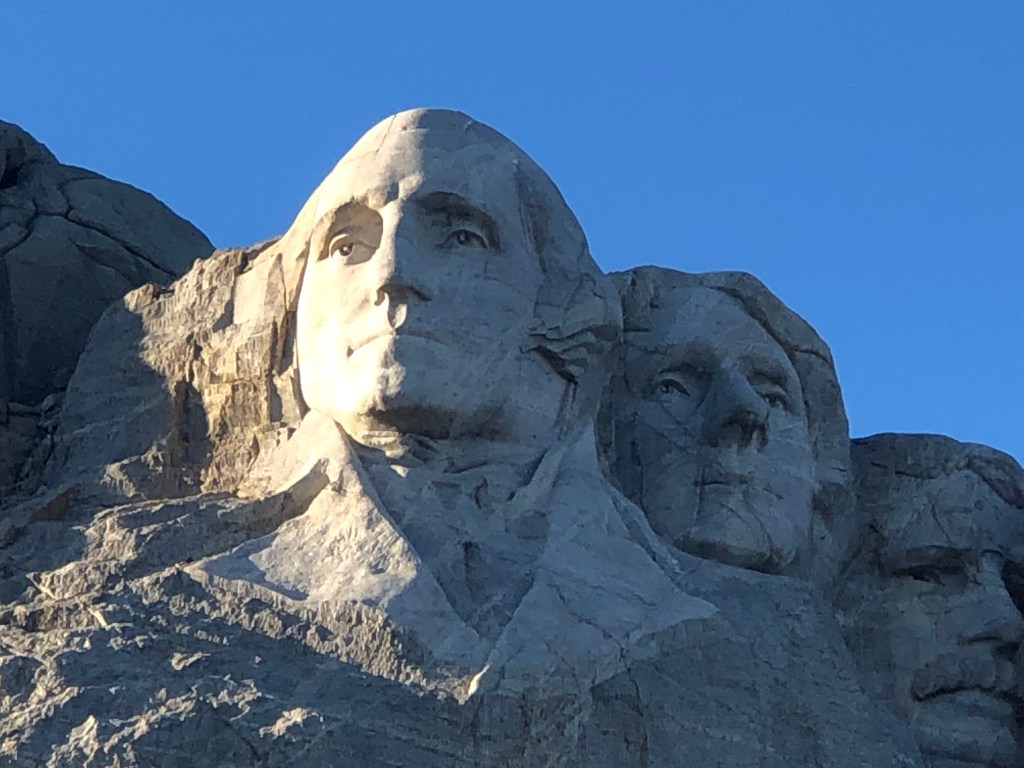
I paid a visit to chilly Mount Rushmore on my last trip to South Dakota and was stuck by the way the sunlight hit Washington’s face, casting it half in light and half in shadow. It occurred me how little I knew of our first president, whose birthday–with characteristic American efficiency–we combine with Lincoln’s to produce a three-day weekend.

Mount Rushmore

To remedy my lack of knowledge–and perhaps because Americana takes on added interest when you live abroad–I read a biography of our first president.1 And it stuck me just how fortunate those thirteen colonies were to have a man like George Washington as their leader.

Continue reading “Washington’s Birthday”

Augustine on desire…

St. Augustine, Sandro Botticelli, Ognissanti, Florence

“The entire life of a good Christian is in fact an exercise in holy desire. You do not yet see what you long for, but the very act of desiring prepares you, so that when he comes you may see and be utterly satisfied.

“Suppose you are going to fill some holder or container, and you know you will be given a large amount. Then you set about stretching your sack or wineskin or whatever it is. Why? Because you know the quantity you will have to put in it and your eyes tell you there is not enough room. By stretching it, therefore, you increase the capacity of the sack, and this is how God deals with us. Simply by making us wait he increases our desire, which in turn enlarges the capacity of our soul, making it able to receive what is to be given to us.

“So, my brethren, let us continue to desire, for we shall be filled…”

St. Augustine, Tractates on the first letter of John 4

from today’s Office of Readings, Friday of the 6th Week in Ordinary Time


For more on the doctrine of baptism of desire see my new book Baptism of Desire and Christian Salvation.

Like a bush in a lava waste…

Craters of the Moon National Monument

Today’s first reading from Jeremiah brought to mind the surreal landscape of Craters of the Moon National Monument in central Idaho, which I visited on a long road trip through the American West several years ago.  It’s a surreal landscape of lava flows, ash, and shards of rock so sharp they’ll slice through your shoes if you wander off the trail.  

Jeremiah’s image of a “barren bush [that] stands in a lava waste” to describe those who trust in men and not in the Lord brought Craters of the Moon to mind.  I remember rounding a cinder cone, descending onto a river of hard rock, and thinking I’d wandered into Mordor.

Continue reading “Like a bush in a lava waste…”

The Eagle

I’m back in Rome after a happy stay at St. Isaac Jogues in Rapid City, grateful for my time in America and all that I continue to learn at my adopted parish in particular.

One anecdote came back to me this morning, reading the Gospel about the call of Peter, an important passage for me in accepting my own call. Peter recognizes his own unworthiness–“Depart from me, Lord, for I am a sinful man”–but Jesus is undaunted and calls him anyway. And, of course, Peter’s subsequent story is filled with missteps, too, with the Lord again reaching out to save him and get him back on the right track. Yeah, I can identify.

At a confirmation in Rapid City a few years ago, one of my Lakota friends gave a talk that has stuck with me ever since about the eagle. Few objects are considered more sacred among Native Americans than eagle feathers, and few sights, I have to say, are more impressive than an eagle or a hawk soaring over the land.

But the point of this story was how the eagle teaches her young to fly–by carrying the little ones up into the winds and letting them go. At first they plunge, flailing and failing–until, from below, the eagle swoops down to catch them, save them, carry them aloft to try again. And that’s Jesus, my friend said, to a hushed congregation, with a conviction that could only come from knowing what it’s like to plunge and to soar.