Buildings that speak to us: Homily for the dedication of the Lateran Basilica

Homily for the Feast of the Dedication of the Lateran Basilica (2023).

From the cloister of St. John Lateran, Rome

The feast we celebrate today is particularly special for us in Rome. We celebrate the dedication of our cathedral. It is a magnificent building, and probably all of us have been there to appreciate the beauty of this splendid and ancient church.

The anniversaries of church dedications are important in the Church calendar because churches are the places where we gather to celebrate the Christian liturgy, the holy mysteries of salvation. Here in Rome, however, we live in an unusual situation because there are many beautiful and ancient churches–but when we enter them, often we find few of the faithful.

We should not be discouraged; instead we should remember the faithful who still speak to us through these monuments of their faith. The churches they built and left us are not mere buildings; they are their testimony. There is a message in these buildings that the saints of past times wanted to convey to us.

But more than a message, there is still a presence. When we celebrate the liturgy, we are not alone; we enter into the presence of the saints. They are with us. On November 1, we entered the season in which we remember the saints. Churches–from St. John Lateran to this little chapel–are more than museums where we learn from the past; they are places where we encounter the saints, where eternity becomes the present.

(Original: Italian)

Readings: Ez 47:1-2, 8-9, 12; 1 Cor 3:9c-11, 16-17; John 2:13-22

Gregorian University Chapel

November 9, 2023

From the cloister of St. John Lateran, Rome

Pope Leo: an ever-ancient, ever-new beginning for the Church

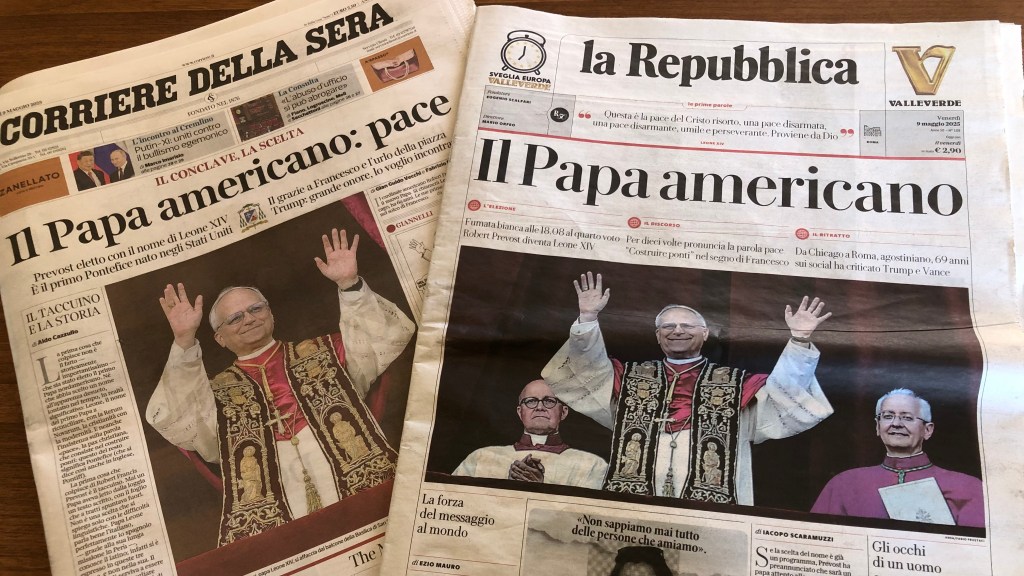
Just over a week ago I stood among the throng in St. Peter’s Square waiting for Pope Leo XIV’s Mass of installation. As the new pope emerged on the back of a white truck and made the rounds through the square, one of the priests who was with me to concelebrate whispered, “It still feels surreal.”

It still does.

The one iron-clad rule of papal elections, after all, used to be that the cardinals would never elect an American pope. And now we have a pope who grew up cheering for the Chicago White Sox. Going into the conclave, the Church seemed tired and divided. Yet Pope Leo has managed to evoke good will on all sides, and he hasn’t had to resort to any particular gimmicks to do so. Rome is elated.

What is perhaps most striking about our new Holy Father is the paradoxical way in which he seems both totally at ease in his new role–as if he’d been pope-ing for years already–and at the same time totally unassuming. One could imagine sitting next to him at a baseball game and him introducing himself as “Bob from Chicago.” At the same time, seeing him on the balcony of St. Peter’s Basilica or meeting world leaders in the robes of his office, one senses the quiet dignity of a successor of the Apostles.

A lot has already been written about Pope Leo on the basis of relatively scant pre-conclave writings and interviews. I was particularly impressed by the first homily he gave to the cardinals after his election. His brief address to the Synod of Bishops on evangelization more than a decade ago equally impressed me because he seemed to grasp one of the central problems facing the Church: the role of the media in communicating–and sometimes miscommunicating–our message. I remember an interview given by the late Cardinal Avery Dulles to Charlie Rose, in which the cardinal observed that the biggest problem faced by the Church was that most Catholics learn what they know about Catholicism not from the Church herself, but from the media. Leo XIV understands that dynamic–and he is alert to the equally challenging frontiers now being opened by artificial intelligence.

Continue reading “Pope Leo: an ever-ancient, ever-new beginning for the Church”

Build back baptistries! A trip to the Baptistry of San Giovanni in Fonte

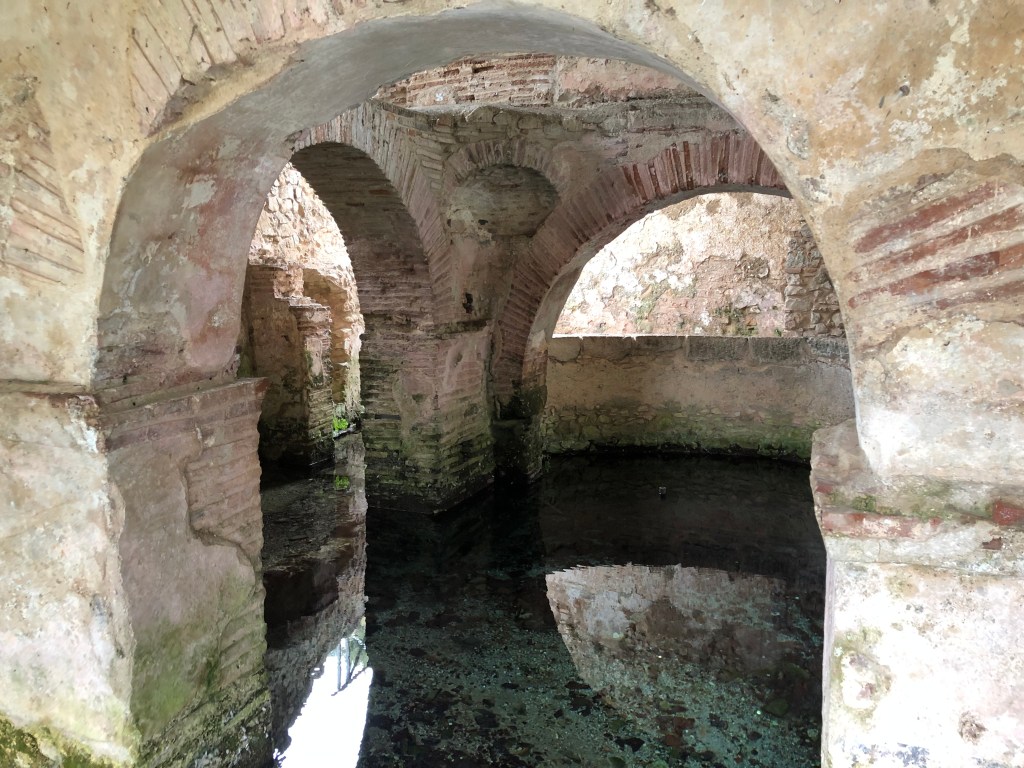
An unexpected discovery on my recent trip to Italy’s Cilento was the Baptistry of San Giovanni in Fonte, just outside of Padula. Also known as the Battistero Marcelliano, after Pope Marcellus, it dates from the fourth century, putting it among the oldest Christian structures in the world. A letter from Cassiodorus in AD 527 mentions a miracle occurring at the baptistry, its water level rising unexpectedly while a priest was pronouncing the prayer over the baptismal waters on the vigil of the feast of St. Cyprian.

Battistero di San Giovanni in Fonte, Paula, Italy

The structure itself sits on the site of a natural spring, so the baptismal font was a pool of “living” water. The baptistry was built on the ruins of an earlier pagan structure and underwent several renovations and expansions throughout history. Hints of a fresco, dating from the 11th century when the structure was converted into a chapel, remain on the wall. The remains of still earlier frescoes from the 6th and 7th centuries were removed and taken to a local museum.

Rising water levels caused the chapel to be abandoned in the 19th century, though the site of the remains and spring, down a winding country road, are quite a pleasant spot today.

This reminder of baptism from Christianity’s earliest days is worth reflecting on during the Easter season. I discuss some of the theological and practical consequences of the shift away from the patristic catechumenate and toward near-universal infant baptism in the Christian cultures of the Middle Ages in Baptism of Desire and Christian Salvation, but the subject is worth more reflection than what I’m able to give it there.

Reflecting on early Christian baptismal practices is important because we are moving into a new phase in Christian history that in some ways will more closely resemble the Church of the Fathers — in which Christianity was a minority — than medieval Christendom. Some of our sacramental practices, I am convinced, will have to shift to respond to this new reality. This may not be entirely a bad thing. When it comes to baptism, for example, too often the sacrament, celebrated in a minimalistic way, has become a mere formality with little connection new life in Christ.

Continue reading “Build back baptistries! A trip to the Baptistry of San Giovanni in Fonte”

Finding hope in Jerusalem, Babylon, and Sweden: homily for the thirtieth Sunday on Ordinary Time

Uppsala domkyrko

Homily for the 30th Sunday in Ordinary Time (B)

Today I’m going to talk about Jerusalem, Babylon, and Sweden—all of them, in different ways, places of hope.

We are probably used to hearing messages of hope in church, so we could easily miss just how remarkable our first reading from the prophet Jeremiah really is.  This particular message of hope, if placed in context, is as startling as stumbling upon a lush citrus grove in the Arabian desert.  To appreciate the passage, it helps to remember a bit about the tragic and cantankerous life of Jeremiah.  This is the prophet, after all, whose name gives us the literary term “jeremiad” to describe a long speech bitterly denuncing something or someone.  In fact, the book of Jeremiah contains plenty of jeremiads.  The prophet denounces the elite of Jerusalem for straying from the law revealed to them by Moses, for their petty idolatry and corruption, for their self-satisfaction and complacency.  Their cowardly refusal to return to the faith of their ancestors has left the Kingdom of Judah weak and vulnerable to its enemies, Jeremiah warns, as had many prophets before him.  What sets Jeremiah apart from these other prophets of gloom is that he tells Jerusalem’s rulers that they have ignored God’s message for too long, and now it’s too late.  A superpower has risen in the East—Babylon—and nothing Judah’s rulers do now will stop it.  It is better, Jeremiah warns, to surrender.

Jeremiah’s message—“you’ve been leading us in the wrong direction for a generation, and you can’t escape the consequences of your actions”—did not win him popularity.  Judah’s rulers hired a more optimistic prophet, Hananiah, who delivered a message more to their liking.  But a few pages before today’s first reading, Hananiah drops dead, a none-too-subtle sign that the Lord does not approve his message.  As the Babylonians close in and a brutal siege begins, Jeremiah tells the people of Jerusalem, you will be defeated, your city destroyed, and then you will be dragged off into exile.

Continue reading “Finding hope in Jerusalem, Babylon, and Sweden: homily for the thirtieth Sunday on Ordinary Time”