Heaven without God? Homily for the 21st Sunday of Ordinary Time

Luca Signorelli, The Last Judgment (1499-1504), Orvieto Cathedral

Homily for the twenty-first Sunday in Ordinary Time (C)

Attention: this homily contains spoilers.  A few years ago, Ted Danson and Kristen Bell stared in a comedy on NBC called “The Good Place.”  The premise was that Kristen Bell’s character, Eleanor Shellstrop, had died and in the afterlife ended up in the “Good Place.”  The only problem was that Eleanor was a shallow and selfish person.  There had apparently been a mix-up in the calculations—points were awarded for good actions and subtracted for bad ones—and she had been confused with a much better woman also named Eleanor who happened to die at exactly the same moment.  After not too long, Eleanor realizes that there had been an error and that she needs to hide her true identity to avoid being sent to the Bad Place, where she belongs.  Since she had spent her whole life being petty, mean, and vulgar, she has no idea how to act and keeps slipping up and almost blowing her cover.  

The show presents a picture of a very common understanding of heaven.  It is a pleasant place, a never-ending vacation, tailored to the preferences—dietary, decorating, recreational—of its inhabitants.  It is more or less religiously neutral; it’s a reward for good behavior, that’s it.  In fact, though there are angels in the show—including Michael, played by Ted Danson—God is not mentioned at all.  If you watch the show in light of Christian revelation—the way the Gospel talks about heaven—you figure out pretty quickly that the Good Place is most certainly not heaven.  Understanding where the show goes wrong can help us to understand a bit better what makes the Christian offer of heaven so unique and surprising, and it can also help us to understand Jesus’ admonitory words in the Gospel today.

Continue reading “Heaven without God? Homily for the 21st Sunday of Ordinary Time”
Mary’s Assumption: the ultimate celebration of the human body

Homily for the Assumption of the Blessed Virgin Mary (from 2021.)

Crowning of the Virgin, St. Martin’s Cathedral, Spišská Kapitula, Slovakia

Ounce per ounce, the largest bone in our body, the femur, is stronger than steel.  Laid out end to end, the blood vessels from an adult’s body could circle the globe four times.  Our brains contain 86 billion nerve cells, which are joined by 100 trillion connections.

Right now in your brains several million of those connections are lighting up asking, “What in the world is he talking about?  Nice factoids, padre, but what do they have to do with anything?”  The answer is that today’s feast, among the most solemn on the Church’s calendar, is a celebration of the human body.  

Today we celebrate the Assumption of the Blessed Virgin Mary, the dogma that at the end of her life Mary was taken up soul and body into heavenly glory.  This dogma is more than just an interesting factoid.  It is deeply relevant to each one of us because Christianity professes belief in the resurrection of the body.  St. Paul’s First Letter to the Corinthians talks about Christ’s resurrection as “the firstfruits” of a much larger harvest.  In a sense, Mary’s Assumption is also a guarantee that the fruits of the resurrection will be shared with the whole Church.  Mary, the first Christian believer, the first to receive the news of Jesus’ Incarnation, represents the Church in a way nobody else can.  

We human beings are both body and soul.  We are not souls trapped in a body; our bodies are part of who we are.  Angels are souls without bodies, but we are not angels.  If the resurrection were an entirely spiritual phenomenon, it wouldn’t be us rising from the dead.  This is why Jesus became incarnate, coming in the flesh.  It is why the Gospels insist so forcefully that, when Jesus rose from the dead, he had not become a ghost or a hologram but remained a man who ate food and whose flesh bore the wounds of his passion.  It is why the sacraments require material elements, and not just any material elements but specific elements connected to Jesus’ physical existence on earth.

Continue reading “Mary’s Assumption: the ultimate celebration of the human body”

“A must-read for anyone who wants to understand how salvation works in the Church’s tradition”

Baptism of Desire and Christian Salvation has now been out long enough to begin generating some discussion, and I’m grateful to have seen a number of new reviews and reactions over the past few months.

With Dr. Ralph Martin and Dr. Gavin D’Costa

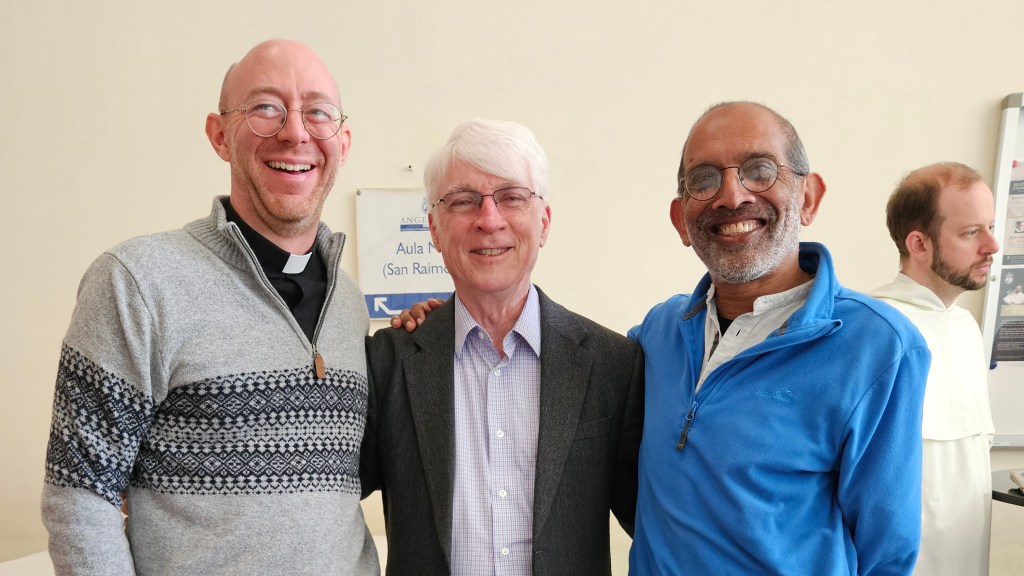
I was delighted to see Dr. Ralph Martin, one of the world’s top authorities on the new evangelization, mention the book in his latest update at Renewal Ministries. Dr. Martin mentions meeting up while he was visiting Rome. I had a charming and stimulating conversation with him and his wonderful wife Anne, as well as a number of equally enjoyable conversations with Dr. Gavin D’Costa, whom he also mentions, an expert on world religions who teaches at the Angelicum. We also discussed Dr. Martin’s book Will Many Be Saved?, which I cite in my work. I’m deeply honored that he considers Baptism of Desire and Christian Salvation “a very solid and brave work of scholarship that faithfully presents the doctrinal and moral implications of the Church’s–and Jesus’–insistence on baptism to be saved.”

I’m equally grateful to have stumbled upon the careful and detailed review and summary of the book by Fr. Richard Conlin at The Prodigal Catholic Blog. I’m especially glad that Fr. Conlin considers the book “a must-read for anyone who wants to understand how salvation works in the Church’s tradition–especially in ‘hard cases’ like the unbaptized, non-Christians, or infants” and that he highly recommends it “especially for priests, catechists, and anyone serious about the faith.” A scholarly book such as Baptism of Desire and Christian Salvation might seem intimidating, but I think this one is important for more than just an academic audience. My intention was always that it would be accessible not just to specialists but to anyone with a theological background. So it’s encouraging to read that Fr. Conlin found it “both theologically rich and remarkably readable–a rare combination.”

Those who read Italian might check out the insightful review in Ecclesia Orans by Prof. Paolo Trianni, who recognizes the theological approach as “innovative” because it seeks to overcome a “legalistic concept of the sacrament” present at times in scholasticism and neo-scholasticism.

Finally and somewhat unexpectedly, I was recently contacted by Brianne Edwards of Rapid City, who brought to my attention the remarkable story of baby Brian Thomas Gallagher, who died 43 minutes after his birth in 1982 and whose body was found to be apparently incorrupt in 2019. He happens to be interred at Black Hills National Cemetery. I discuss the possibility that infants can receive baptism of desire in the book, and Baby Brian’s case seems almost to have been designed to fit the argument I make. I’ll have more to say on the subject in the future…

In the meantime, remember that Baptism of Desire and Christian Salvation is available on Amazon, directly from Catholic University of America Press (20% discount with the code CT10),  and at other online booksellers.

Bargaining with God? Homily for the 17th Sunday of Ordinary Time

Homily for the seventeenth Sunday in Ordinary Time (C)

Guido Reni, Trinity of the Pilgrims (1625-6)

Readings: Gn 18:20-32; Col 2:12-14; Lk 11:1-13

A few weeks ago, some friends were talking about watching a movie.  They knew that it took a dark twist at the end, so they hit the stop button early to avoid the tragic finish.  That’s exactly what happens in today’s first reading.  The wickedness of Sodom and Gomorrah becomes too great for God to ignore, and he decides to destroy the cities.  Abraham questions him, as if bargaining him down.  If just ten innocent people remain, God will spare the cities.  But, as you probably know, if you read on, God does destroy the cities.  They did not contain even ten good men.  They were corrupt from top to bottom. 

Still, it’s not an accident that today’s reading stops where it does.  The premature ending focuses our attention on God’s reaction to human corruption.  He is not eager for destruction or motived by vindictiveness.  To use the terms of later Christian theology, we could say that the destruction of Sodom and Gomorrah is one of the many stories in the Book of Genesis that express the reality of Original Sin.  The Biblical message is clear: None of us is innocent.  Mankind is corrupt from top to bottom.  God’s reaction to Abraham—his desire to spare the innocent—shows that the destruction wrought by Original Sin is not what God wants.  Our sinfulness is self-destructive. 

If self-destruction were the end of the movie, we could understand turning it off early.  But God’s full response to human sinfulness, which unfolds in the New Testament, is not to strike a deal, to plea bargain, or to negotiate.  Nor is it to ignore our sinfulness or to excuse it.  It is not to declare a new paradigm in which there are no longer any moral absolutes and what was once sinful is now OK, if circumstances are right or you get your pastor’s permission.  No, God’s reaction is something else entirely.  As St. Paul tells the Colossians, God has removed sinfulness from our midst by “nailing it to the cross.”

Continue reading “Bargaining with God? Homily for the 17th Sunday of Ordinary Time”

A “monumental study… unmatched in what it positively contributes”

With a year approaching since Baptism of Desire and Christian Salvation‘s publication, I’m pleased to see reviews starting to appear. I just read a great one by Joseph Arias of Christendom College in the journal of liturgical theology Antiphon. Arias provides a summary and identifies “controversial” points where I challenge the received wisdom. I’m grateful to have such careful readers and can’t say I mind having the book described as “monumental” and “unmatched”!

Here’s just a sample:

“The author takes the reader on a profoundly illuminating historical and dogmatic theology journey from the apostolic age to our own, acting throughout as an immensely capable and careful guide, making sure we do not miss either major or minor attractions that can enhance the experience of trying to arrive at a deeper understanding of a profoundly significant (though sometimes underappreciated) teaching that is firmly rooted in the Catholic tradition…

… this volume is unmatched in what it positively contributes towards a better understanding of this area of theology.”

And more good news — it looks like the price of the book may have dropped on Amazon as well.

Also, following up on my previous post on the Ukrainian bishops’ statement about the war in their country last week, I have a new piece out on the subject in America. It is equally about what is dysfunctional in our own American political culture right now.

Taking the gold for Team Humanity: homily for the Assumption of the Blessed Virgin Mary

Homily for the Assumption

Raphael, Coronation of the Virgin, Vatican Museums

My brothers and sisters, I’m no angel.  Before you respond with too much glee, “Oh, Father, we know,” let me point out—you’re no angels, either.

Now, when people say, “He’s no angel,” usually what they’re saying doesn’t mean what they think it does.  Usually, if someone says, “He’s no angel,” they mean, “He’s not so nice.”  Maybe there are a few skeletons in his closet.

But not all the angels were good.  Lucifer and the demons are angels, and they have so many skeletons there’s no room for clothes in their closets.  Today’s great feast is dedicated to a woman who never sinned.  But today, the feast of the Assumption, we celebrate the fact that Mary is no angel.  She is a human being.  A woman.  One of us.

You see, because the real reason demons don’t have clothes in their closets is because they don’t have anything to wear them on.  Angels don’t have bodies.  But we do.  That’s the difference between angels and human beings.  Otherwise, we’re quite a bit alike.  We both have intelligence and free will—which is how the fallen angels sinned.  The big difference is the body.

Today we celebrate the fact that at the end of her life on earth, Mary’s body entered immediately into heavenly glory.

And, my friends, this is not some bit of religious trivia, but something very, very important for each one of us.  Because it means that to be saved, to enter into heavenly glory, we don’t have to give up being human.  We don’t have to become angels.  God wants to save us as human beings, which is why his plan for our salvation involved taking the flesh of Mary, a woman, to become a man, so that we, women and men, might be saved in our human bodies.

Continue reading “Taking the gold for Team Humanity: homily for the Assumption of the Blessed Virgin Mary”

Baptism of Desire and Christian Salvation — now in print!

After a few delays, I am pleased to report that my book is now officially in print and copies have arrived for those who preordered. It seems to have been released on Good Friday no less.

If you’re still on the fence about whether it’s worth the read, I thought I’d share the very kind words of endorsement from Fr. Joseph Carola, SJ, my colleague at the Gregorian University and expert in both the Church Fathers and Nineteenth Century theology.

So take it from Fr. Carola:

Jesus instructed Nicodemus that, “unless one is born of water and the Spirit, he cannot enter the kingdom of God” (John 3:5).  Faithful to the Lord’s revelation, Christians have insisted for two millennia upon the necessity of baptism for salvation.  But already in the ancient Church, salvation’s rough edges, as Father Anthony Lusvardi creatively calls them, have challenged believers.  What is the fate of those who lived before Christ and therefore died without Christian baptism?  What happens to the catechumen who dies unexpectedly before being baptized?  Can unbaptized babies get to heaven?  Is there any hope for the salvation of non-Christians?  In his thoroughly historical and insightfully theological study of the baptism of desire, Father Lusvardi offers his readers a fresh perspective on this traditional notion often misunderstood and misapplied in contemporary theology and pastoral practice.  Providing a convincing response to the challenges that the hard cases present, Father Lusvardi especially appeals to the Catholic Church’s lex orandi in order to establish the Church’s lex credendi that simultaneously upholds the necessity of baptism, the need for evangelization, and the nuances of desire.  Historically informative, theologically rich, and occasionally even humorous, Baptism of Desire and Christian Salvation is a book not only for theologians, but perhaps even more so for pastors who labor on the rough edges of salvation.

Joseph Carola, S.J., S.T.D.

November 2, 2023

All Souls

The Pontifical Gregorian University, Rome

Serpents, Cyrus, and salvation: homily for the fourth Sunday of Lent

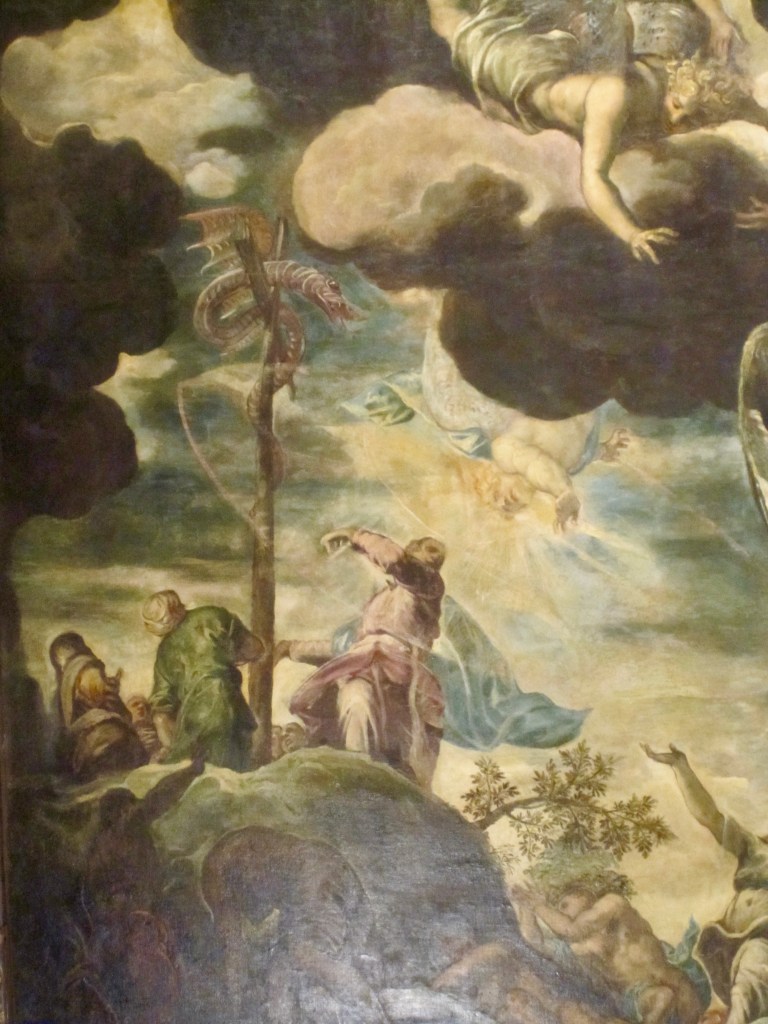
Miracle of the Bronze Serpent, Tintoretto (Scuola Grande di San Rocco, Venice, 1564-1587)

Homily for the 4th Sunday of Lent (B)

Today’s readings are a workout.  The serpent in the desert, God’s love and the refusal of many to accept it, faith and works, the prophets, Israel’s exile in Babylon, and King Cyrus, a Gentile who saves the day.  Getting through today’s readings means not just getting in your spiritual steps for the day—it’s more like earning a medal for the decathlon.

For a bit of mid-Lent spiritual exercise, the first image from today’s Gospel is a good place to start.  At first glance, it might seem a bit obscure.  What was Moses doing lifting up a serpent in the desert?  Jesus is referring to an incident during Israel’s wandering in the desert found in the Book of Numbers.  The Israelites, as seems to be their habit, complain against God and against Moses, saying “There is no food” and “We loathe this worthless food.”  The complaint does raise the question, which is it?  Is there no food or just food the Israelites don’t like?  There seems to be a bit of manipulative use of language in the Israelites’ rebelliousness, perhaps even a bit of self-delusion.  The phenomenon is not unique to the ancient world.  Today our political and social divisions are often made worse because we use exaggerated terms to describe our opponents and their intentions—or to mask uncomfortable facts we do not want to hear—and then we start to believe our own rhetoric.  The result is poisonous.  And, in fact, in the Book of Numbers, God punishes the people of Israel for their rebellion by sending fiery serpents to bite them.

Continue reading “Serpents, Cyrus, and salvation: homily for the fourth Sunday of Lent”

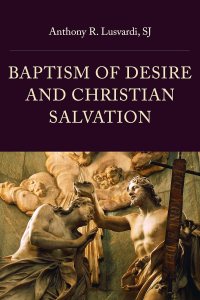
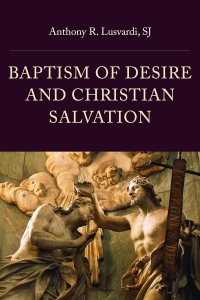
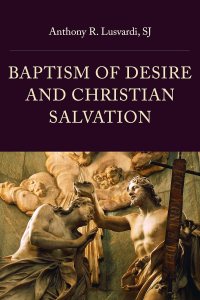
Baptism of Desire and Christian Salvation

My book Baptism of Desire and Christian Salvation is now available to order, though its shipping date will be a little later. Its official publication date was originally last Friday but now seems to have been bumped to March. I’ve been working on the topic of baptism of desire since my STL studies at Sant’Anselmo–a good six years ago–so it has been a long time coming. I think the result says some important things for Catholic theology and the evangelizing mission of the Church. So let me assure you, it’s worth the wait!

I’ll have more on the topic to say, of course, and I’ll share the reactions of others to the book so you don’t have to take my word for it. For now I’ll just share the official description from Catholic University of America Press. The book is available directly from CUA’s website as well as other online booksellers such as Amazon. This spring CUA is offering a 20% discount on new books with the promo code CT10. Make sure that your library gets a copy, too!

Baptism of Desire and Christian Salvation. Belief in the necessity of baptism for salvation is rooted in the New Testament and was forcefully affirmed by the Church Fathers, yet today this belief is treated with unease if not ignored altogether. Over the course of centuries, Catholic theology has wrestled with a doctrine—baptism of desire—that both preserves this fundamental principle and allows for salvation in hard cases, such as catechumens dying unexpectedly. Baptism of Desire and Christian Salvation traces this doctrine’s varied history, from its genesis in a fourth century funeral oration given by Ambrose of Milan to its uneasy position in the Anonymous Christianity of Karl Rahner. 

More than a history, however, this book raises questions about the nature of religious ritual and the sacraments, the mission of the Church, and the essence of salvation. Arguing that theologians of the past two centuries have tended to downplay the role of the sacraments when discussing salvation, Lusvardi suggests that baptism should remain our theological starting point. Engaging with the theological tradition and at times challenging the conventional wisdom, Baptism of Desire and Christian Salvation shows how such a sacramental approach can offer credible—and sometimes surprising—responses to questions related to the salvation of non-Christians, the fate of unbaptized infants, and the relevance of the Church’s mission today.

Mercy or Justice? Homily for the twenty-fifth Sunday of Ordinary Time

Homily for the 25th Sunday of Ordinary Time (A)

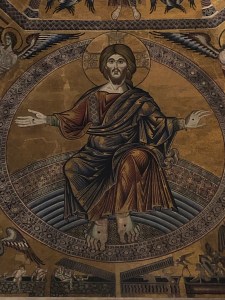
Florence Baptistry

Today’s Gospel raises a host of tricky questions—what is justice?  What is the relationship between divine justice and human justice?  Or between God’s justice and his mercy?  What does the apparently unfair situation described by Jesus in the Gospel—no doubt in violation of several labor laws—tell us about salvation?  Or conversion?  One thing, however, is clear: if I preach for eight hours, or five hours, or three hours, or twelve minutes, I’m going to get paid the same amount anyway.  So I’ll leave some of these questions unanswered.

It’s obvious that Jesus is not giving instruction for how to run a business, but is instead trying to teach us something about salvation.  He is also reinforcing what the prophet Isaiah says: “my thoughts are not your thoughts, nor are your ways my ways, says the Lord.  As high as the heavens are above the earth, so high are my ways above your ways and my thoughts above your thoughts.”  No matter how much advice we give the Lord, he has his own ideas about how to run the universe and he doesn’t always explain them to us.  And sometimes he does explain, but we hear only the parts we want to hear.  

In its original context, the earliest Christians probably understood today’s parable to be about the relationship between Jewish Christians and Gentile Christians, which was the big controversy in the first century.  Even though the Jewish people received divine revelation first, this did not mean that Gentiles who converted to Christianity were in any way less Christian.  Still, even then the passage’s broader meaning would have been apparent to everyone: conversion is possible, even for the worst sinner, even a deathbed conversion.  Thus, Isaiah says, “Let the scoundrel forsake his way, and the wicked his thoughts.”

Now it sounds very nice to say conversion is possible for even the worst sinners.  But Jesus’ parable forces us to confront the difficult question: is that really fair?  Or, to put it another way, what does this mean about the relationship between God’s mercy and his justice?  Do they contradict each other?  We know that God is both merciful and just, but sometimes it’s hard to understand how he can be both.  Is he 50% just, 50% merciful?  Is he just in the obvious cases, but merciful in the ones that are borderline, sort of willing to round up?  In fact, God is 100% merciful and 100% just, and there can be no contradiction between his mercy and his justice.  If we’re thinking about divine justice and divine mercy as contradictory, we’re thinking about them wrong.  

Continue reading “Mercy or Justice? Homily for the twenty-fifth Sunday of Ordinary Time”