What is wisdom? Homily for the twenty-third Sunday of Ordinary Time

Homily for the 23rd Sunday in Ordinary Time (C).

I’m back to my day job in Rome, so this week I’m posting a homily from 2016, given the day after my ordination to the diaconate.

Ordination to the diaconate 2016, St. Ignatius Church, Boston, MA

Today’s Gospel reading is perhaps the single most unfortunate passage in Scripture to have to preach about to a congregation consisting mostly of family members, so we’re going to work our way up to it by starting with the Old Testament.

The Old Testament reading is from the Book of Wisdom.  You’ll be happy to know that I took an entire course on the Biblical wisdom tradition and have prepared a brief 45-minute summary as an introduction to the homily.  We can skip all that, however, if you will consider for a moment the question of what it means to be wise.  

To understand what wisdom is, it can be helpful, first, to think about what it is not.  Wisdom is not the same thing as being clever; we probably know people who are clever manipulators, for example, but not really wise.  Wisdom is not the same as knowledge, as knowing lots of facts.  Teachers know that there’s a difference between a student who memorizes what he hears and then regurgitates it, and a student who actually thinks about what she’s learning.  Wisdom is not the same thing as being educated.  If you’ve been in school as long as I have, you realize that there are some very foolish people with PhDs.  And we all probably know people who didn’t receive much education who nonetheless we’d consider wise because they had a sense for people, a sense for what was right and wrong, a sense for what really matters in life. 

Continue reading “What is wisdom? Homily for the twenty-third Sunday of Ordinary Time”

Etiquette for heaven: homily for the twenty-second Sunday of Ordinary Time

Homily for the 22nd Sunday of Ordinary Time (C)

Years ago, one of my college friends—who remains among the best judges of character I know—gave me as a gift a book by Judith Martin, otherwise known as Miss Manners.  I said, “Miss Manners, huh?  Is this a hint?”  And she said, “Yes.”  

My friend has assured me that my social skills have improved over the past 20 years, but, more than that, the value of the book is that Judith Martin—who is an elegant, witty writer—explains the reason why we should care about manners.  We might think that manners are about things like what to do with all the extra forks at a fancy restaurant, but Miss Manners reminds her readers that the fundamental purpose behind all manners is to facilitate harmonious relationships with other people.  It doesn’t matter how fancy you are; if you make your guests or your hosts or your friends or your acquaintances feel uncomfortable, then you’re being rude.  

The best definition of justice is “right relationship.”  Manners are not the only thing that goes into right relationships, but they are one way of making interpersonal justice a little smoother. Fundamentally, having good manners means being considerate of other people.

Continue reading “Etiquette for heaven: homily for the twenty-second Sunday of Ordinary Time”

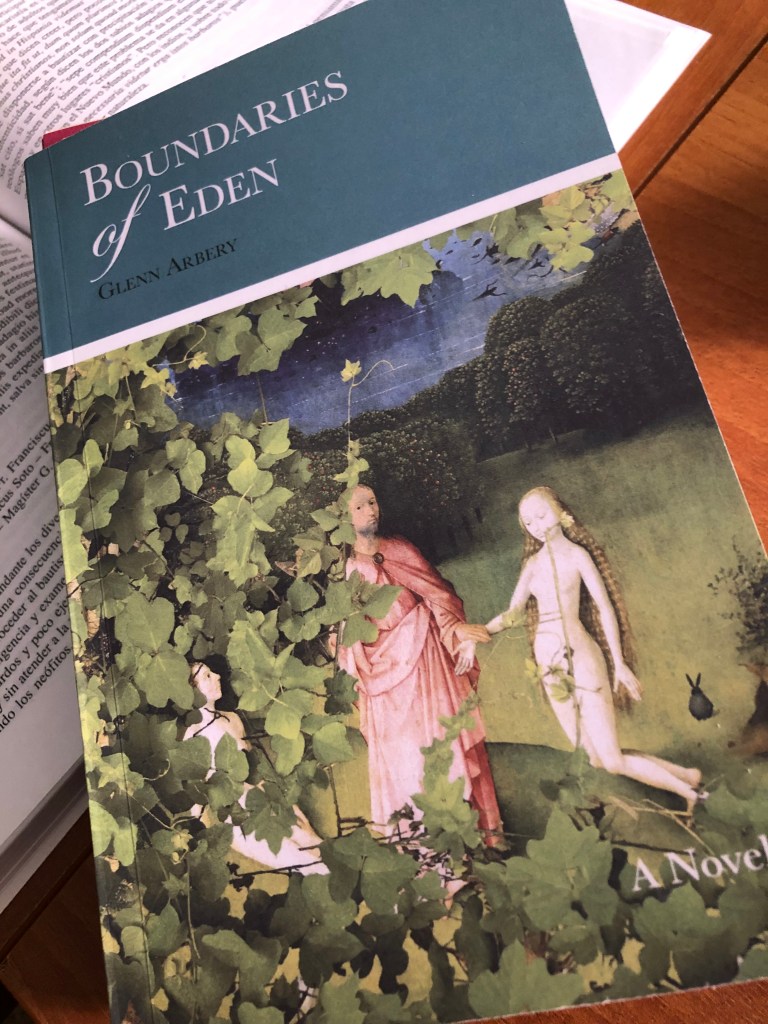
Boundaries of Eden

My recent pleasure reading has included Glenn Arbery’s Boundaries of Eden from Wiseblood Books. Always nice to discover another Catholic writer. Here’s a part I liked…

Why should there be providence with respect to Braxton Forrest, anyway? Hardest of all to imagine was that God Almighty, with the whole universe to look after, cared anything about the peccadilloes of a middle-aged literature professor. The apparent absurdity of it had to be balanced against the overwhelmingly convincing sense of an inner witness, an exacting (if often ignored) conscience, a kind of co-knowing whose ground lay deeper than his own conscious mind. So yes. Acceptance of providence brought him to see himself differently. It even brought him, if only occasionally, to the Gospels, where he did not encounter the sweet, naïve, androgynous new version of the fierce Old Testament God that he expected, but the Old Testament God incarnate, the fierce, severe, enigmatic otherness of a man whose absolute authority overflowed any apparent warrant for it….

Glenn Arbery, Boundaries of Eden

Leo the Great on the Passion

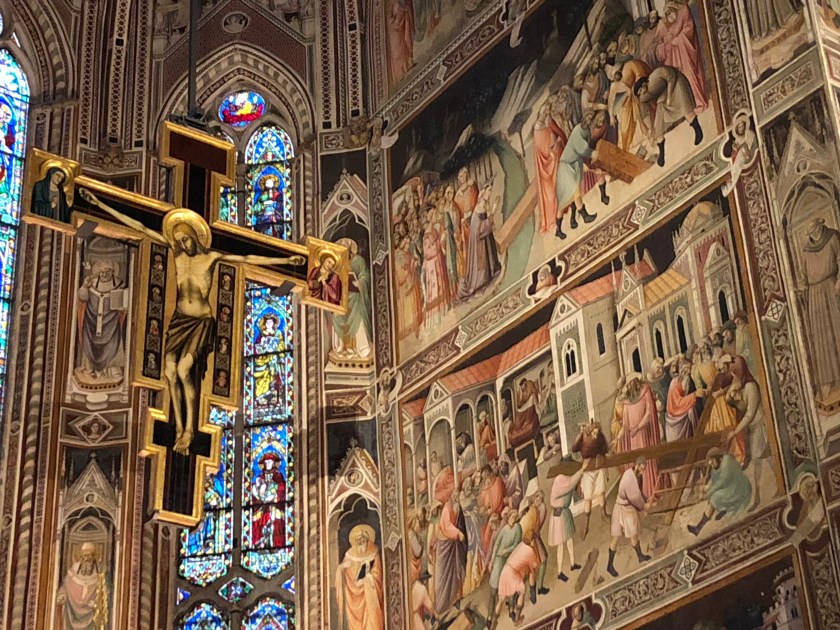
Santa Croce, Florence

“True reverence for the Lord’s passion means fixing the eyes of our heart on Jesus crucified and recognizing in him our own humanity.

“The earth–our earthly nature–should tremble at the suffering of its Redeemer…. No one, however weak, is denied a share in the victory of the cross. No one is beyond the help of the prayer of Christ. His prayer brought benefit to the multitude that raged against him. How much more does it bring to those who turn to him in repentance… Everything that he did or suffered was for our salvation: he wanted his body to share the goodness of its head.

“First of all, in taking our human nature while remaining God, so that the Word became man, he left no member of the human race, the unbeliever excepted, without a share in his mercy. Who does not share a common nature with Christ if he has welcomed Christ, who took our nature, and is reborn in the Spirit through whom Christ was conceived?

“Again, who cannot recognize in Christ his own infirmities? Who would not recognize that Christ’s eating and sleeping, his sadness and his shedding of tears of love are marks of the nature of a slave? …

“The body that lay lifeless in the tomb is ours. The body that rose again on the third day is ours. The body that ascended above all the heights of heaven to the right hand of the Father’s glory is ours. If then we walk in the way of his commandments, and are not ashamed to acknowledge the price he paid for our salvation in a lowly body, we too are to rise to share his glory.”

Leo the Great, Sermo 15

Office of Readings, Thursday, 4th Week of Lent

One Spirit, many gifts: Homily for the Second Sunday in Ordinary Time

Homily for the 2nd Sunday in Ordinary Time (C)

St. Isaac Jogues at sunrise.

This week I stopped at the store to purchase a box of wine.  Just in case there was another quarantine, I wanted to make sure I had enough on hand to celebrate Mass.  Also, like the miracle at Cana, I wanted enough left over for dinner.  Coming out of a box, however, I’m not sure that anyone would say, “You saved the best for last.”

There’s something a little bit lighter in today’s Gospel story.  Usually, Jesus’ miracles involve healing grave ailments—leprosy, paralysis, even death—but the miracle at Cana begins and ends at a party.  At most Jesus’ intervention saves the new bride and groom from a social embarrassment.  The miracle also seems a bit off script, not what Jesus had in mind.  It’s his mother, after all, who intercedes for the couple and then doesn’t take no for an answer.  When Protestants object to Catholics praying for Mary’s intercession, I point out that all we’re doing is repeating what happened at Cana.  Nobody knows what Jesus is capable of better than Mary.

Continue reading “One Spirit, many gifts: Homily for the Second Sunday in Ordinary Time”