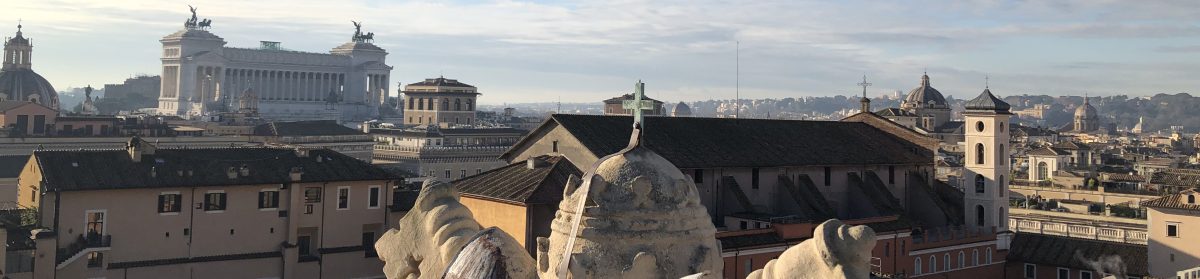
Look East! Homily for the Second Sunday of Advent

Homily for the Second Sunday of Advent (C)
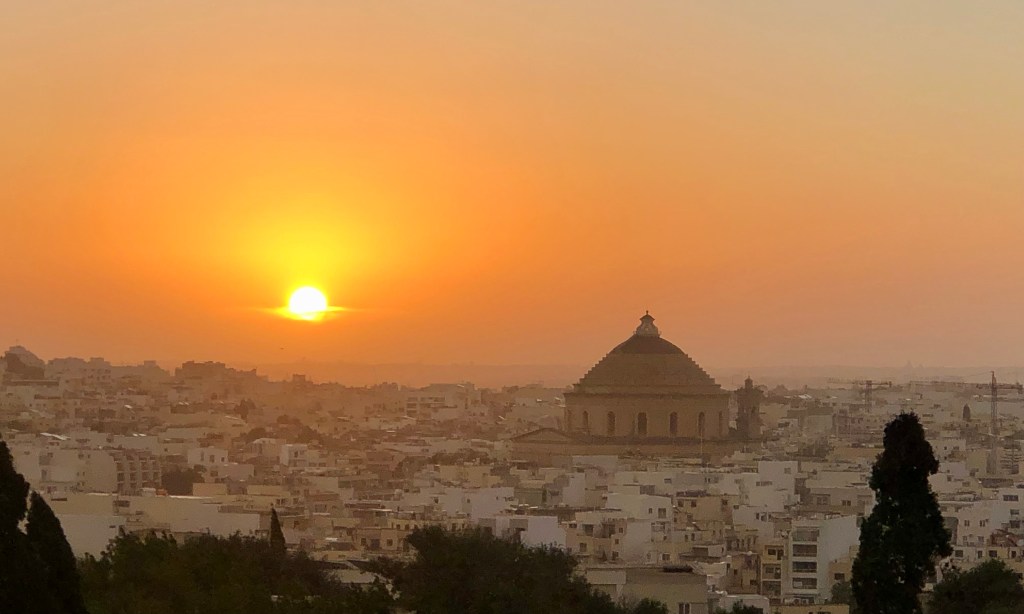
Dawn, Mosta, Malta

“Look to my coming,” Gandolf tells Aragorn in the second installment of the Lord of the Ringstrilogy, The Two Towers.  “At dawn on the fifth day, look east.”  Those familiar with the story, know that Gandolf’s words come at a particularly dramatic moment in the epic, when the last holdouts of Rohan—one of the two remaining kingdoms of men not to succumb to the forces of evil—have retreated to their mountain stronghold, Helms Deep, and the walls of the fortress have begun to crumble, its gates to give way, and its doors to crack under the onslaught of a massive army sent by the turncoat wizard Saruman, who, seduced by power, has joined the forces of darkness.  And as Aragorn, the king in exile, prepares for one final charge with what knights remain, he remembers the words of the faithful wizard Gandolf, who had left five days before to seek aid.  “At dawn on the fifth day, look east.”

We read a similar instruction in the Book of Baruch, directed to the holy city, “Up, Jerusalem! Stand upon the heights; look to the east.”  These words are echoed in the Advent hymn familiar to many of us, “People, Look East.”  There is something primordial in this call, in the instinct to look in hope to the east.  When I worked among the Lakota Sioux in South Dakota, I learned that in their traditional religion, east was the direction of prayer.  I found some Lakota Christians very insistent on a Christian tradition—which I did not know about—of burying the dead facing east.  The Christian tradition of prayer facing east goes back to the first centuries.  St. Ambrose talks about catechumens, after their baptism, turning from the west to the east as a sign of the new orientation of their lives.

Continue reading “Look East! Homily for the Second Sunday of Advent”
Finding hope in Jerusalem, Babylon, and Sweden: homily for the thirtieth Sunday on Ordinary Time

Uppsala domkyrko

Homily for the 30th Sunday in Ordinary Time (B)

Today I’m going to talk about Jerusalem, Babylon, and Sweden—all of them, in different ways, places of hope.

We are probably used to hearing messages of hope in church, so we could easily miss just how remarkable our first reading from the prophet Jeremiah really is.  This particular message of hope, if placed in context, is as startling as stumbling upon a lush citrus grove in the Arabian desert.  To appreciate the passage, it helps to remember a bit about the tragic and cantankerous life of Jeremiah.  This is the prophet, after all, whose name gives us the literary term “jeremiad” to describe a long speech bitterly denuncing something or someone.  In fact, the book of Jeremiah contains plenty of jeremiads.  The prophet denounces the elite of Jerusalem for straying from the law revealed to them by Moses, for their petty idolatry and corruption, for their self-satisfaction and complacency.  Their cowardly refusal to return to the faith of their ancestors has left the Kingdom of Judah weak and vulnerable to its enemies, Jeremiah warns, as had many prophets before him.  What sets Jeremiah apart from these other prophets of gloom is that he tells Jerusalem’s rulers that they have ignored God’s message for too long, and now it’s too late.  A superpower has risen in the East—Babylon—and nothing Judah’s rulers do now will stop it.  It is better, Jeremiah warns, to surrender.

Jeremiah’s message—“you’ve been leading us in the wrong direction for a generation, and you can’t escape the consequences of your actions”—did not win him popularity.  Judah’s rulers hired a more optimistic prophet, Hananiah, who delivered a message more to their liking.  But a few pages before today’s first reading, Hananiah drops dead, a none-too-subtle sign that the Lord does not approve his message.  As the Babylonians close in and a brutal siege begins, Jeremiah tells the people of Jerusalem, you will be defeated, your city destroyed, and then you will be dragged off into exile.

Continue reading “Finding hope in Jerusalem, Babylon, and Sweden: homily for the thirtieth Sunday on Ordinary Time”

Serpents, Cyrus, and salvation: homily for the fourth Sunday of Lent

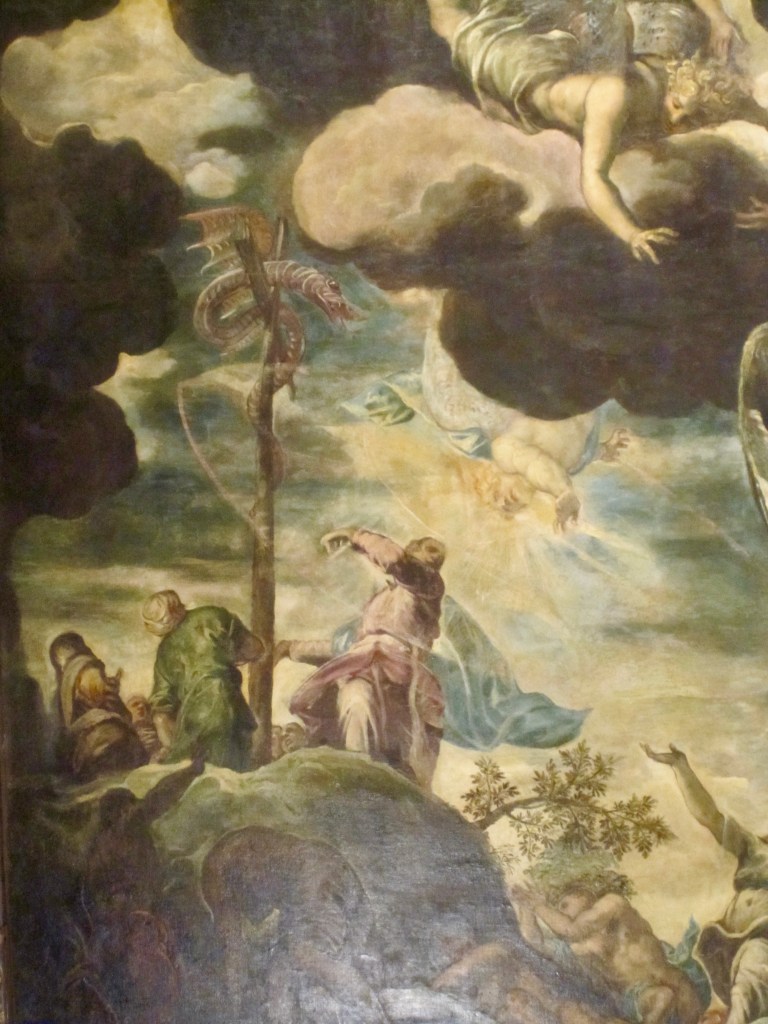
Miracle of the Bronze Serpent, Tintoretto (Scuola Grande di San Rocco, Venice, 1564-1587)

Homily for the 4th Sunday of Lent (B)

Today’s readings are a workout.  The serpent in the desert, God’s love and the refusal of many to accept it, faith and works, the prophets, Israel’s exile in Babylon, and King Cyrus, a Gentile who saves the day.  Getting through today’s readings means not just getting in your spiritual steps for the day—it’s more like earning a medal for the decathlon.

For a bit of mid-Lent spiritual exercise, the first image from today’s Gospel is a good place to start.  At first glance, it might seem a bit obscure.  What was Moses doing lifting up a serpent in the desert?  Jesus is referring to an incident during Israel’s wandering in the desert found in the Book of Numbers.  The Israelites, as seems to be their habit, complain against God and against Moses, saying “There is no food” and “We loathe this worthless food.”  The complaint does raise the question, which is it?  Is there no food or just food the Israelites don’t like?  There seems to be a bit of manipulative use of language in the Israelites’ rebelliousness, perhaps even a bit of self-delusion.  The phenomenon is not unique to the ancient world.  Today our political and social divisions are often made worse because we use exaggerated terms to describe our opponents and their intentions—or to mask uncomfortable facts we do not want to hear—and then we start to believe our own rhetoric.  The result is poisonous.  And, in fact, in the Book of Numbers, God punishes the people of Israel for their rebellion by sending fiery serpents to bite them.

Continue reading “Serpents, Cyrus, and salvation: homily for the fourth Sunday of Lent”

Like a bush in a lava waste…

Craters of the Moon National Monument

Today’s first reading from Jeremiah brought to mind the surreal landscape of Craters of the Moon National Monument in central Idaho, which I visited on a long road trip through the American West several years ago.  It’s a surreal landscape of lava flows, ash, and shards of rock so sharp they’ll slice through your shoes if you wander off the trail.  

Jeremiah’s image of a “barren bush [that] stands in a lava waste” to describe those who trust in men and not in the Lord brought Craters of the Moon to mind.  I remember rounding a cinder cone, descending onto a river of hard rock, and thinking I’d wandered into Mordor.

Continue reading “Like a bush in a lava waste…”

Truth and love in time of conflict: Homily for the Fourth Sunday in Ordinary Time

Homily for the fourth Sunday in Ordinary Time (C)

Today’s readings are not for the conflict-averse.  Today’s world is not for the conflict-averse, either.  Within our communities and families, we experience conflict over vaccines and politics.  Irresponsible political and media actors seem intent on increasing racial conflict.  In the Ukraine, armed conflict threatens.  But, as even the Bible demonstrates, the world has never been a conflict-free zone.

Conflict is a part of the human reality Jesus entered into.  Conflict is not always bad, either. Political conflicts between big states and small states produced the checks-and-balances of the American Constitution.  Theological conflict has led to doctrines that give us deeper insight into the nature of God.  We wouldn’t have a Creed if there hadn’t first been disagreements about the Trinity. The fact that sometimes we disagree doesn’t make us bad Christians.

Continue reading “Truth and love in time of conflict: Homily for the Fourth Sunday in Ordinary Time”