One is always discovering new artists in Rome, and earlier this year, thanks to a special exhibit at the Scuderie del Quirinale and the recommendation of a friend, I discovered Guercino (1591-1666). Born Giovanni Francesco Barbieri in Cento (Emilia-Romagna), he worked in Rome when baroque art was at its zenith.
Guercino, Gregory XV, ca. 1621
The exhibit was of particular interest to me because Guercino’s time in Rome corresponded to the period when the Jesuits were also at their zenith. The pope who proved to be Guercino’s great patron, Gregory XV (Alessandro Ludovisi), also favored the Society of Jesus, especially in its mission of spreading Catholicism around the globe.
The Jesuits have often been associated with the baroque because it was the artistic style in vogue around the time of our founding, so our great Roman churches, the Gesù and Sant’Ignazio — and all the other Jesuit churches around the world built to imitate them — are classic examples of baroque architecture.
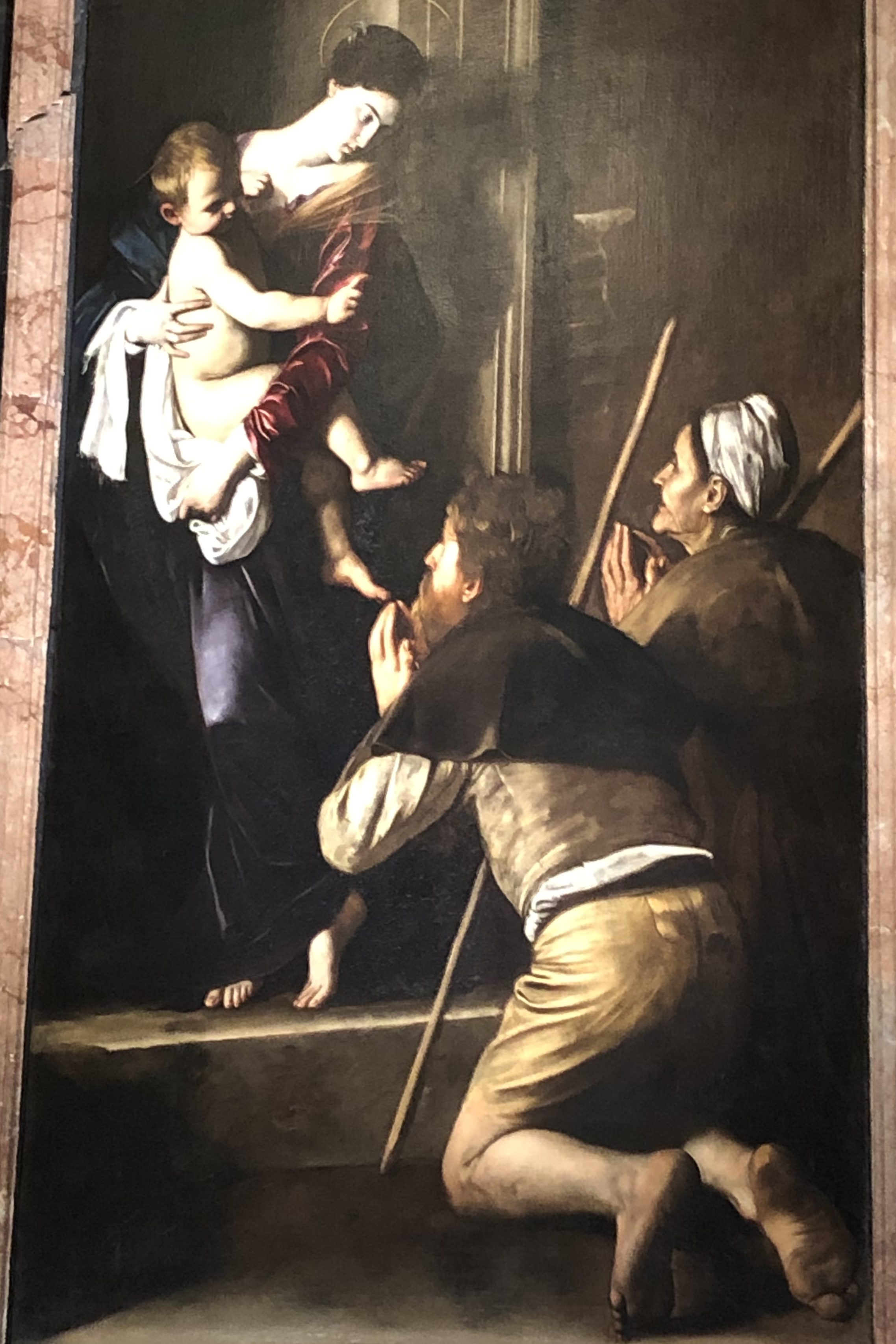
Madonna of the Pilgrims, (1604-6) Caravaggio, Church of Sant’Agostino, Rome
I’ve shared the work of theologian Fr. Robert Imbelli before. Here is another piece from him about a theme near to my heart, the “sacramental sense,” a phrase he takes from St. John Henry Newman.
Imbelli makes a point that has struck me before as well, that our society’s neglect of the transcendent is oddly connected to an unease with the body. We see this unease with our own bodies in everything from the explosion in the popularity of piercings and tattoos to the growth of eating disorders. Sex-changes are perhaps the most dramatic example of turning against one’s own flesh.
One of the sad marks of our secular age is a paradoxical double loss. Not only do we struggle to find access to the other dimension, that is, the spiritual, but we also seem impervious to the true sense of the material. Our sacramental sense has atrophied. Indeed, these two losses may be intricately connected.
Imbelli quotes philosopher Charles Taylor to argue that secular people today live lives of “excarnation,” disconnected from the communities and traditions that bore them. We live increasingly rootless lives. In contrast to this “excarnation,” Imbelli quotes Jesuit poet Gerard Manley Hopkins and points toward our Eucharistic faith. He hints at the way that this sacrament directs us toward a relationship with creation–and our own embodied part in it– that is rooted, first of all, in gratitude.
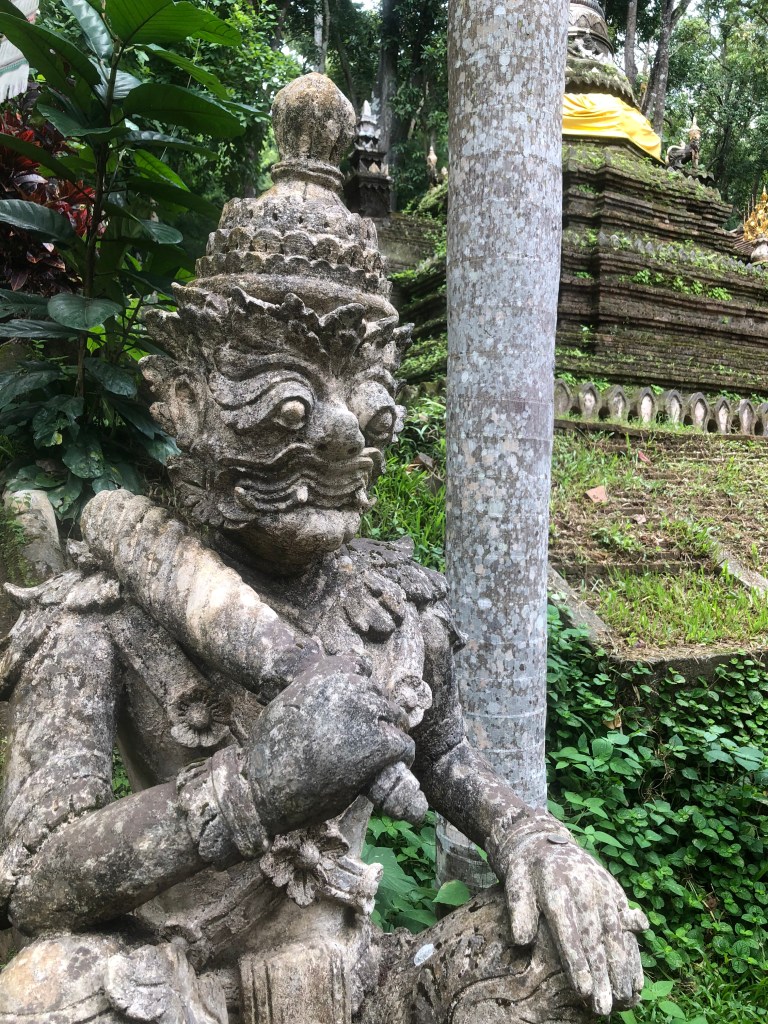
One of the highlights of my recent travels through Asia was visiting a number of quite impressive Buddhist temples and shrines. This was particularly the case in Thailand, though Chinese temples in Singapore, Taiwan, and Hong Kong were also filled with rich carvings, colorful statues, and piles of offerings including fruit, flowers, and burning incense. The warm red–the color of prosperity–of the Chinese temples reminded me of the red color with which the ancient Romans frescoed the inside of their homes. The desire for a warm hearth is written deeply in the human psyche.
Thian Hock Keng Temple, Singapore
A place of worship that makes an absorbing appeal to the senses is of course nothing new to me. I live in Rome, city of the baroque, where tales of religious ecstasy are told and retold in marble, mosaic, and fresco. The impulse of Christianity to express itself in art goes back to the Incarnation itself, to God revealing himself by entering into the world of the flesh, expressing his divinity in the matter of creation. We Catholics believe that he continues to communicate his grace to us through the sacraments. Artistic expressions using color, smell, and sound to amplify this divine work come naturally enough to a sacramental faith.
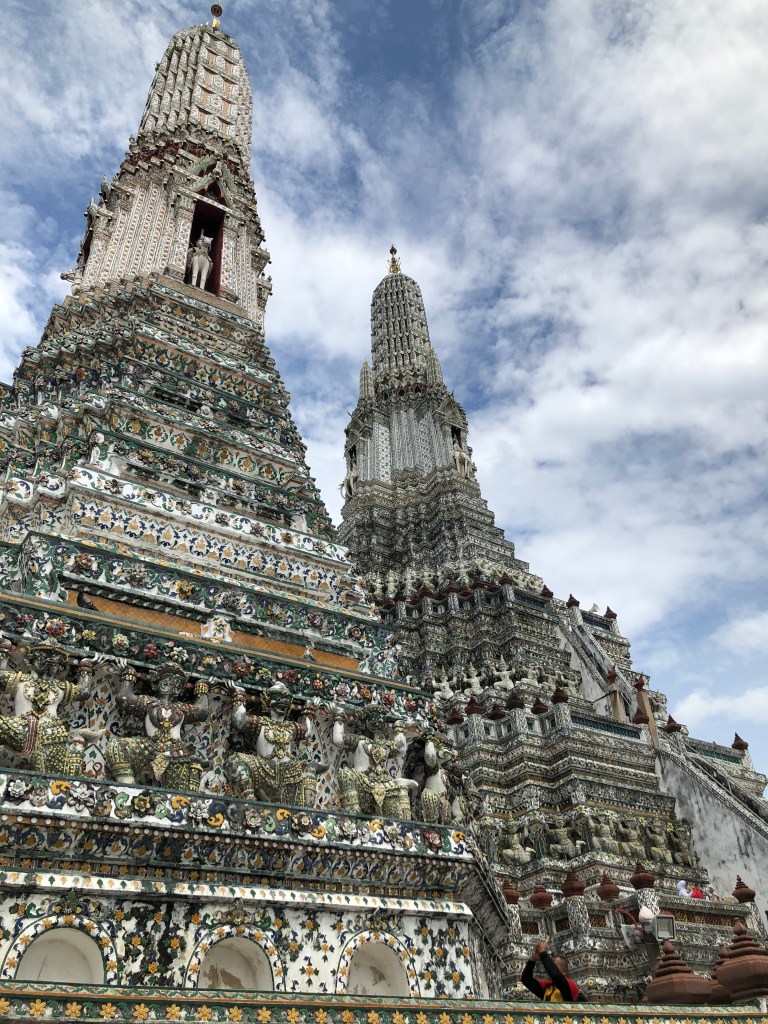
But what about Buddhism? Such expressions would seem to me, an outsider, to fit less naturally within Buddhist philosophy, with its distrust of all desire and negation of the world of pleasure and pain. Incarnation and Nirvana are two radically different beliefs. Yet how else to describe the gilded wats of Thailand, the cascades of angels and demons in glittering ceramic, than Buddhist baroque?
Wat Arun Ratchawaramahawihan, Bangkok
Of course, Thailand’s wats are not the architectural expression of pure Buddhist philosophy but a kind of non-culinary Asian fusion–Buddhism grafted into a still older mix of traditional folk beliefs, legends, and superstitions. How cogent such a mix is, I can’t evaluate. But there’s something human about that folk mix that I find more compelling than Buddhism in its purity, which I’ve always thought a little chilly.
My summer reading this year included Fr. José Granados’s excellent book Introduction to Sacramental Theology: Signs of Christ in the Flesh, which Catholic University of America Press has recently made available in English. (The Spanish original Tratado General de los Sacramentos came out in 2016.)
Like the Church Fathers, Granados emphasizes the rootedness of the sacraments in the Incarnation of Jesus. This means giving due importance–too often lacking in theology–to the human body, which is the locus for all of our relationships.
The sacraments tell us that the message of Jesus is always rooted in the concrete relations that we form in our flesh.
José Granados, Introduction to Sacramental Theology, xiv
The book’s preface eloquently identifies the fundamental desire to which the sacraments respond, our need for the presence of Jesus:
“We have his parables, we lack the sight of him; we have his commandments, we lack his voice; we have the strength of his commission, we lack the touch of his arms. Without the second, the first loses its foundations: doctrine that is clear but abstract; morality that is superior but utopian; mission that is great but irrelevant.” (xiii-xiv)
The sacraments provide what is missing.
This leads to surprising conclusions about the need for a sacramental basis for today’s evangelization. A fairly common error is to think that responding to the needs of the modern world means conforming to the modern world; really, it means offering what contemporary life lacks.
“In fact, the great evil that afflicts the postmodern subject is his isolation in the cell of subjectivity. What remains is a weak individual who moves to the tune of his most intense feeling, with no relations to sustain him and with no path to bring him to his destination. We will not cure this sickness by proposing that he encounter God in the depths of his soul. For his real problem is the lack of relational environments that would enable him to understand his true identity, which is always discovered and forged in an encounter and a communion.” (383)
You may understandably object that I project too much into a scant fifteen-minute encounter passed almost entirely in silence. I concede the complaint. Yet the Spirit radiates where he wills. And the new Eve leads a multitude of daughters (and sons) to compassionate being, which manifests itself in courteous demeanor and directness of gaze. Mary continues both to enchant and to challenge.
Indeed, let me insist: bodily demeanor and gaze. For in an incarnational spirituality the body assumes a dignity and importance that is unique. It is no rarefied “spiritual” assent that we celebrate on Mary’s feast: but a fully embodied “yes” to God’s call.





 Tony Lusvardi, S.J.