Heaven without God? Homily for the 21st Sunday of Ordinary Time

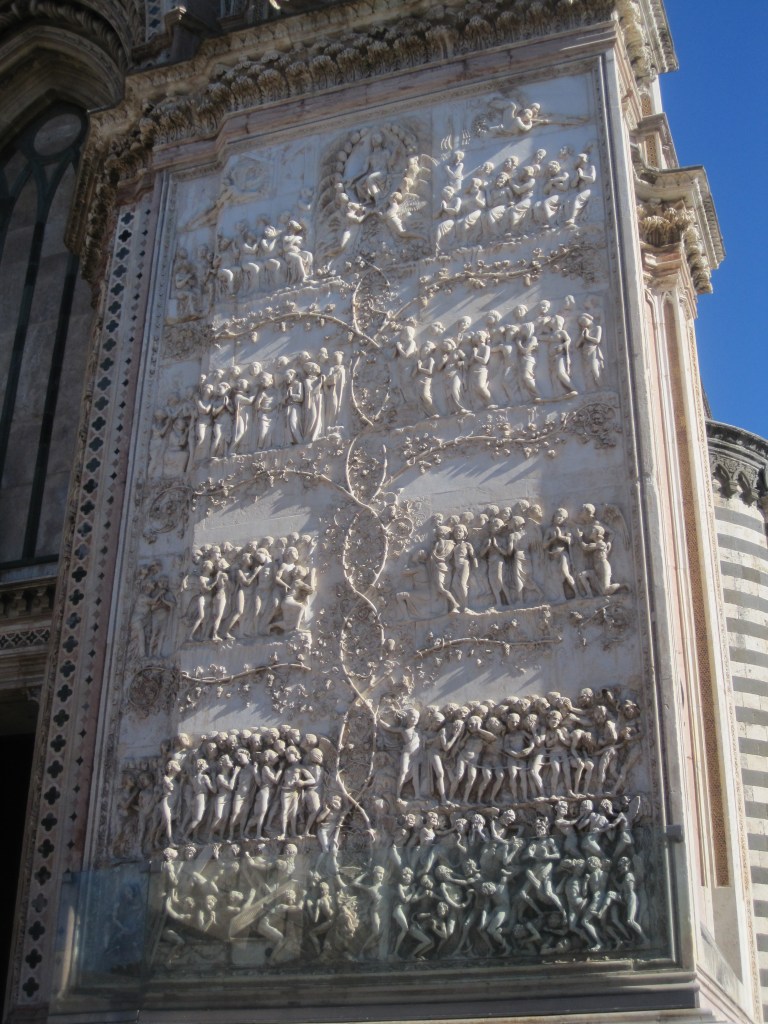
Luca Signorelli, The Last Judgment (1499-1504), Orvieto Cathedral

Homily for the twenty-first Sunday in Ordinary Time (C)

Attention: this homily contains spoilers.  A few years ago, Ted Danson and Kristen Bell stared in a comedy on NBC called “The Good Place.”  The premise was that Kristen Bell’s character, Eleanor Shellstrop, had died and in the afterlife ended up in the “Good Place.”  The only problem was that Eleanor was a shallow and selfish person.  There had apparently been a mix-up in the calculations—points were awarded for good actions and subtracted for bad ones—and she had been confused with a much better woman also named Eleanor who happened to die at exactly the same moment.  After not too long, Eleanor realizes that there had been an error and that she needs to hide her true identity to avoid being sent to the Bad Place, where she belongs.  Since she had spent her whole life being petty, mean, and vulgar, she has no idea how to act and keeps slipping up and almost blowing her cover.  

The show presents a picture of a very common understanding of heaven.  It is a pleasant place, a never-ending vacation, tailored to the preferences—dietary, decorating, recreational—of its inhabitants.  It is more or less religiously neutral; it’s a reward for good behavior, that’s it.  In fact, though there are angels in the show—including Michael, played by Ted Danson—God is not mentioned at all.  If you watch the show in light of Christian revelation—the way the Gospel talks about heaven—you figure out pretty quickly that the Good Place is most certainly not heaven.  Understanding where the show goes wrong can help us to understand a bit better what makes the Christian offer of heaven so unique and surprising, and it can also help us to understand Jesus’ admonitory words in the Gospel today.

Continue reading “Heaven without God? Homily for the 21st Sunday of Ordinary Time”
Mercy or Justice? Homily for the twenty-fifth Sunday of Ordinary Time

Homily for the 25th Sunday of Ordinary Time (A)

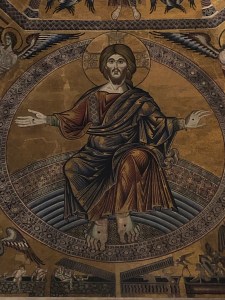
Florence Baptistry

Today’s Gospel raises a host of tricky questions—what is justice?  What is the relationship between divine justice and human justice?  Or between God’s justice and his mercy?  What does the apparently unfair situation described by Jesus in the Gospel—no doubt in violation of several labor laws—tell us about salvation?  Or conversion?  One thing, however, is clear: if I preach for eight hours, or five hours, or three hours, or twelve minutes, I’m going to get paid the same amount anyway.  So I’ll leave some of these questions unanswered.

It’s obvious that Jesus is not giving instruction for how to run a business, but is instead trying to teach us something about salvation.  He is also reinforcing what the prophet Isaiah says: “my thoughts are not your thoughts, nor are your ways my ways, says the Lord.  As high as the heavens are above the earth, so high are my ways above your ways and my thoughts above your thoughts.”  No matter how much advice we give the Lord, he has his own ideas about how to run the universe and he doesn’t always explain them to us.  And sometimes he does explain, but we hear only the parts we want to hear.  

In its original context, the earliest Christians probably understood today’s parable to be about the relationship between Jewish Christians and Gentile Christians, which was the big controversy in the first century.  Even though the Jewish people received divine revelation first, this did not mean that Gentiles who converted to Christianity were in any way less Christian.  Still, even then the passage’s broader meaning would have been apparent to everyone: conversion is possible, even for the worst sinner, even a deathbed conversion.  Thus, Isaiah says, “Let the scoundrel forsake his way, and the wicked his thoughts.”

Now it sounds very nice to say conversion is possible for even the worst sinners.  But Jesus’ parable forces us to confront the difficult question: is that really fair?  Or, to put it another way, what does this mean about the relationship between God’s mercy and his justice?  Do they contradict each other?  We know that God is both merciful and just, but sometimes it’s hard to understand how he can be both.  Is he 50% just, 50% merciful?  Is he just in the obvious cases, but merciful in the ones that are borderline, sort of willing to round up?  In fact, God is 100% merciful and 100% just, and there can be no contradiction between his mercy and his justice.  If we’re thinking about divine justice and divine mercy as contradictory, we’re thinking about them wrong.  

Continue reading “Mercy or Justice? Homily for the twenty-fifth Sunday of Ordinary Time”

Thomas Aquinas on eternal life

The end of the liturgical year coincides with a number of gems from the Office of Readings, including this conference from St. Thomas Aquinas, which I’d never taken note of before. It reinforces a number of things that I’ve noticed over the past several years researching the theme of baptism of desire. The first–that eternal life means union with God–is perhaps the most important and, today, the most neglected. Heaven, in others words, does not mean having more treats, but communion with God. It’s maybe uncomfortable to say in our age of “moralistic therapeutic Deism”, but those who don’t desire communion with God don’t really want what we mean by heaven. In the end, heaven has more to do with how we love than with where we are.

Here’s how Thomas puts it:

Final Judgment, Orvieto Cathedral

“The first point about eternal life is that man is united with God. For God himself is the reward and end of all our labors…

“Next it consists in perfect praise…

“It also consists in the complete satisfaction of desire, for there the blessed will be given more than they wanted or hoped for. The reason is that in this life no one can fulfill his longing, nor can any creature satisfy man’s desire. Only God satisfies, he infinitely exceeds all other pleasures. That is why man can rest in nothing but God. As Augustine says: You have made us for yourself, Lord, and our heart can find no rest until it rests in you

“…eternal life consists of the joyous community of all the blessed, a community of supreme delight, since everyone will share all that is good with all the blessed. Everyone will love everyone else as himself…”

St. Thomas Aquinas, Credo in Deum

Office of Readings

Saturday of the Thirty-third week in Ordinary Time