This Homily for Easter Sunday comes from 2019 and was given just a few days after the fire at Notre Dame Cathedral in Paris — thus the reference to the rose window at the end. Seems appropriate this year when Notre Dame has been reopened…
Occasionally the most erudite theologians overlook the most obvious things. This morning’s gospel contains a curious detail that has provoked a great deal of discussion among theologians: why do Mary of Magdala and John, the other disciple, not enter the tomb? Mary sees the stone removed from the tomb and returns to the apostles. John, running and perhaps a bit younger than Peter, arrives at the tomb first, but remains outside. Why? Biblical exegetes have explained this event symbolically–maybe John represents prophecy and Peter represents the institutional Church–but in my opinion the reason is simpler.
It’s a tomb. They were afraid.
Sometimes the simplest explanations are also the most profound. We know that Jesus is risen–maybe this announcement has become too familiar and gets taken for granted–but at that moment Mary, John and Peter did not have that advantage. We must imagine their psychological state that morning. Two days ago, they had seen the humiliation and killing of their Lord, teacher and friend at the hands of evil men. We must imagine the darkness of those days, when violence, lies and selfishness defeated the truth.
Last week I was pleased to take part in a conference organized by at the Gregorian University’s Faculty of History and Culture and the Institute of Liturgy at the University of Santa Croce entitled L’edificio di culto e gli artisti: A 25 anni dal primo Giubileo degli Artisti (2000-2025). The theme was church architecture and art over the past 25 years. The conference brought together an impressive group of international architects, artists, and theologians.
My own rather modest contribution was to extend the reflection I began in November’s issue of First Things on “Screens and Sacraments.” The talk seemed to produce a good deal of agreement that we need to be more discerning in how we allow technology to intrude on our sacred spaces.
Pulpit, Church of the Gesù, Rome
On a related note, I was also happy to read a quite generous response to my article from Kevin Martin of Raleigh, North Carolina in the January 2025 issue of First Things. He reports being “strong-armed against [his] better judgement into Zooming the liturgy during the first year of the pandemic,” but eventually abandoning the practice because it felt wrong for many of the reasons I discussed in my article. He wonders, however, if I do not concede too much by suggesting that it might be OK to continue to broadcast the Liturgy of the Word, while stopping at the Liturgy of the Eucharist.
It’s a thoughtful question. I’d begin by saying that I am by no means arguing that one must broadcast any form of worship, and I have no quarrel with the decision of Rev. Martin’s church to give up streaming altogether. At the same time, I’m not an absolutist when it comes to technology, and some of the goods that people claim from broadcast Masses are real. Sick parishioners in particular can be helped to pray by seeing images of the liturgy online and comforted by the sight of their home church and familiar faces. These might supplement pastoral outreach to the homebound, without replacing it. I’m a little more skeptical about the evangelical or formative value of e-liturgy, since I think its appeal is mainly to those who have already been sufficiently formed by real liturgy.
Ludovico Carracci, Presentation of Jesus in the Temple, 1613-1616
Homily for the Presentation of the Lord (C)
Simeon and Anna appear so briefly in the Gospel that we might almost miss them. They are a part of the story of the life of Jesus for just a few minutes, yet the few words that Luke writes about them reveal two remarkable lives. It is especially moving, I think, to reflect on those lives in this Jubilee year because in Simeon and Anna we feel the challenge of hope.
Neither Simeon nor Anna, it seems, lived an easy life. There is a tiredness in Simeon’s words after he takes the baby Jesus in his arms: “Now, Master, you may let your servant go in peace.” Simeon had received a special revelation that he would not see death before he had seen the Messiah, and his words hint that it might not have been easy to hang on until that moment. Perhaps you know of friends or relatives who have held on to life to see one special event—a wedding or a graduation or the birth of a child—and then let go soon after. I think of a dear friend whose grandfather passed away minutes after watching his ordination, and I think there is something of that letting go—with gratitude for one last precious gift—in Simeon’s words.
But Simeon, too, still has something to give in that moment. Today his words form part of the Church’s Night Prayer, and his prophecy to Mary would stay with her in the decades ahead. To the blessing he received, Simeon responded with a blessing.
There is something moving, too, about what just a glance of God’s glory means for Simeon. After all, he sees the Messiah only as a baby. He will never hear the Sermon on the Mount, see Jesus cure the sick or raise Lazarus; he will never receive the sacraments; and, though his words to Mary allude to the crucifixion, he himself will not be there. His eyes do see the salvation God has prepared in the sight of all the peoples—because salvation is Jesus Christ—but only just barely. And that’s enough. Jesus, before he can speak, before he can walk—but present—is enough. Simeon has lived his life in hope for the moment that we see in the Gospel, and yet that hope fulfilled is itself a promise of more to come. He is led from hope into hope, I suppose, much as our celebration of the Eucharist leads us to hope for the banquet promised us in heaven.
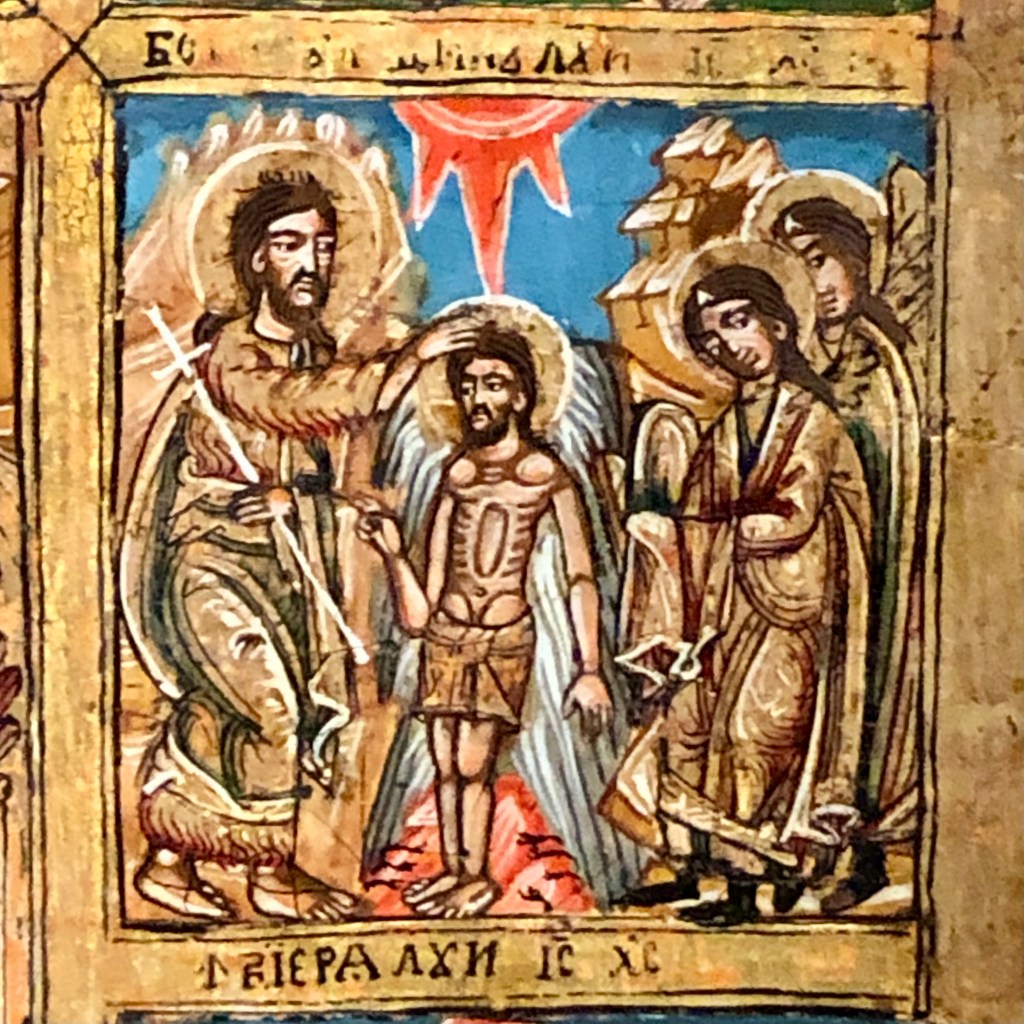
Baptism of the Lord from “Praznicar,” Romanian, 19th century
Today’s readings use some artful cinematography. Today we celebrate the Baptism of the Lord. Our readings give us scenes before baptism and immediately after baptism, but they cut away so that we don’t see the baptisms. This montage of before and after shots nonetheless serves to highlight the uniqueness of Christian baptism. Luke cuts from John the Baptist’s preaching to Jesus praying after his baptism. The Holy Spirit descends like a dove and a voice from heaven speaks to the Lord. The scene is obviously meant to show approval for Jesus’ baptism at the hands of John.
The scene chosen today from Acts of the Apostles is also meant to put the stamp of divine approval on baptism. To understand Peter’s words in the house of Cornelius, we need to remember the whole context of the chapter in which they occur, Acts 10. The scene unfolds in the earliest days of the Church when there was still doubt about who could belong to the Church: was the message of Jesus directed only to Jews or were all people called to Christianity? In Acts 10, the centurion Cornelius—a Roman, not a Jew—receives a vision that prompts him to call Peter to his house. At the same time, Peter receives a vision in which he’s told to eat all of the animals that Jewish dietary laws consider forbidden. The vision was not a marketing ploy for the pork and shellfish industry, but instead it ensured that Peter didn’t hesitate to go to a Gentile’s house when Cornelius’s servants came to find him. At Cornelius’s house Peter preached the message that we hear today. The word was sent to the Israelites, he says, but it was intended, as Isaiah prophesied in the first reading, “to bring forth justice to the nations,” in other words, to extend beyond Israel itself.
What we unfortunately don’t read today is what happens next. As if anyone missed the first several hints, the Holy Spirit descends on the people in Cornelius’s house, who begin to speak in tongues, and Peter says, “Can anyone forbid water for baptizing these people?” (Acts 10:47). God’s will is that baptism should be conferred on Gentiles as well as Jews and that all nations should enter the Church, even Roman centurions.
Now if you were a medieval theologian, who spent your days raising difficulties about sacramental theology, the story of Cornelius’s baptism might provoke another question: if the Holy Spirit had already descended on everyone in Cornelius’s household, why did they even need to be baptized? Isn’t getting the Holy Spirit the whole point of baptism? And once you’ve got the Holy Spirit, doesn’t the ceremony become redundant? If you remember from Matthew’s account of the baptism of Jesus, John the Baptist himself poses a similar question about the baptism of Jesus. “I need to be baptized by you,” he says. “Why do you come to me?” (Matt 3:4).
“Look to my coming,” Gandolf tells Aragorn in the second installment of the Lord of the Ringstrilogy, The Two Towers. “At dawn on the fifth day, look east.” Those familiar with the story, know that Gandolf’s words come at a particularly dramatic moment in the epic, when the last holdouts of Rohan—one of the two remaining kingdoms of men not to succumb to the forces of evil—have retreated to their mountain stronghold, Helms Deep, and the walls of the fortress have begun to crumble, its gates to give way, and its doors to crack under the onslaught of a massive army sent by the turncoat wizard Saruman, who, seduced by power, has joined the forces of darkness. And as Aragorn, the king in exile, prepares for one final charge with what knights remain, he remembers the words of the faithful wizard Gandolf, who had left five days before to seek aid. “At dawn on the fifth day, look east.”
We read a similar instruction in the Book of Baruch, directed to the holy city, “Up, Jerusalem! Stand upon the heights; look to the east.” These words are echoed in the Advent hymn familiar to many of us, “People, Look East.” There is something primordial in this call, in the instinct to look in hope to the east. When I worked among the Lakota Sioux in South Dakota, I learned that in their traditional religion, east was the direction of prayer. I found some Lakota Christians very insistent on a Christian tradition—which I did not know about—of burying the dead facing east. The Christian tradition of prayer facing east goes back to the first centuries. St. Ambrose talks about catechumens, after their baptism, turning from the west to the east as a sign of the new orientation of their lives.
One of the casualties of the smartphone revolution has been losing our ability to wait. Instead of waiting, we scroll. Losing the ability to wait may not seem a real loss, but I think it is. Scrolling and checking messages and adding new apps has not made me more productive. Instead, I’m more easily distracted and impatient. Inside our electronic cocoons, we miss the things that used to happen while we waited—people watching, striking up conversations, noticing the landscape from the window, wondering at it.
Today’s readings are about the art of waiting. But they warn us not to romanticize it. Times of waiting can be dangerous. Today’s Gospel identifies two dangers of waiting: anxiety and drowsiness.
The anxieties mentioned in the Gospel come from genuinely terrifying world events—“people will die of fright,” the Gospel warns—but also everyday anxieties that seem related to drowsiness. The context of today’s readings, of course, is the Lord’s second coming, when Jesus will return in awesome and awful judgment, remaking all reality. It may be that some of us are anxious about meeting Jesus because we’re afraid of that judgment. Paul warns the Thessalonians to conduct themselves to please God, as they have been taught. Advent is a time when the Church reminds us to examine our consciences, to make use of the sacrament of penance, to align our lives with Jesus’ teaching.
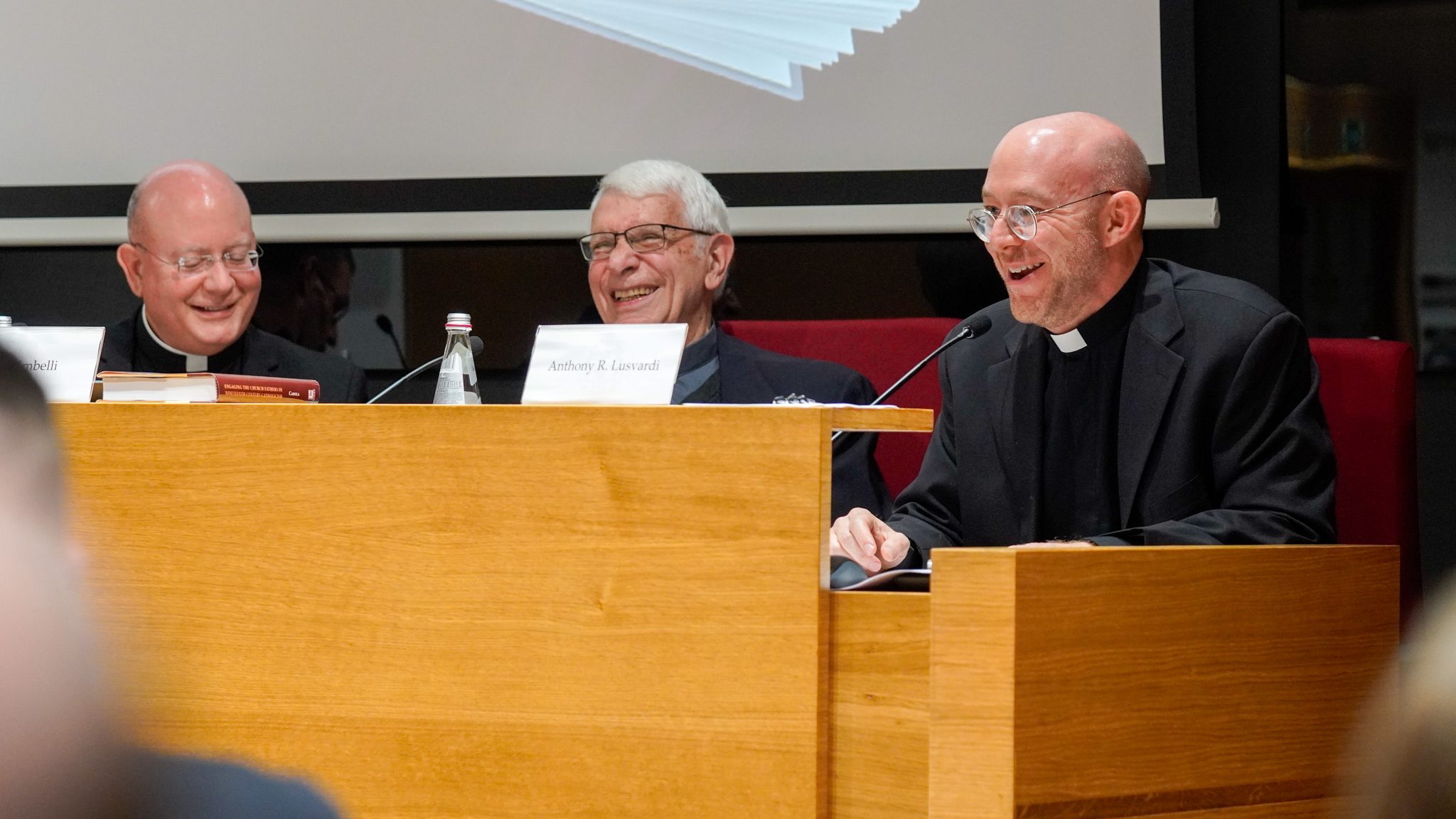
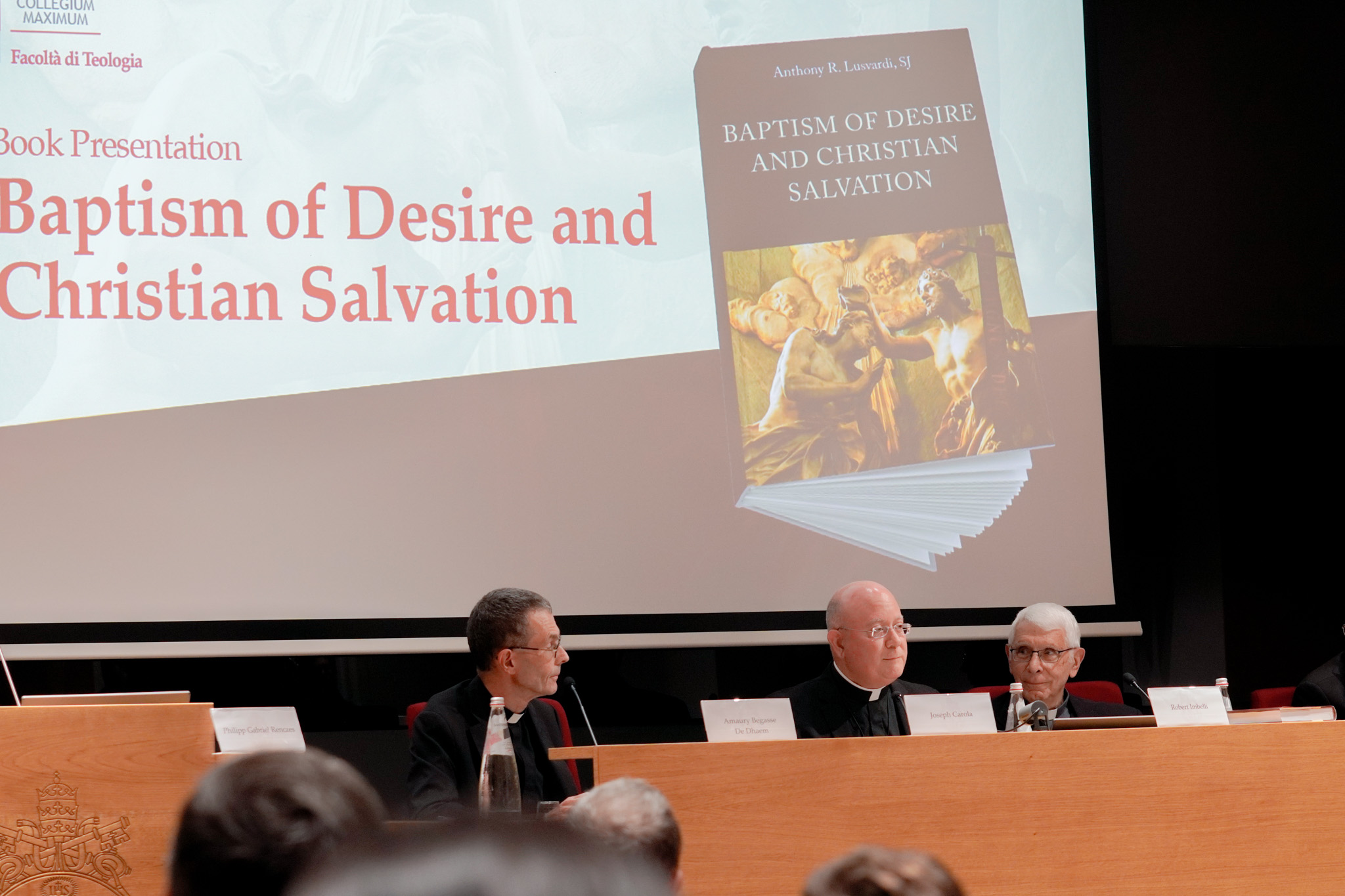
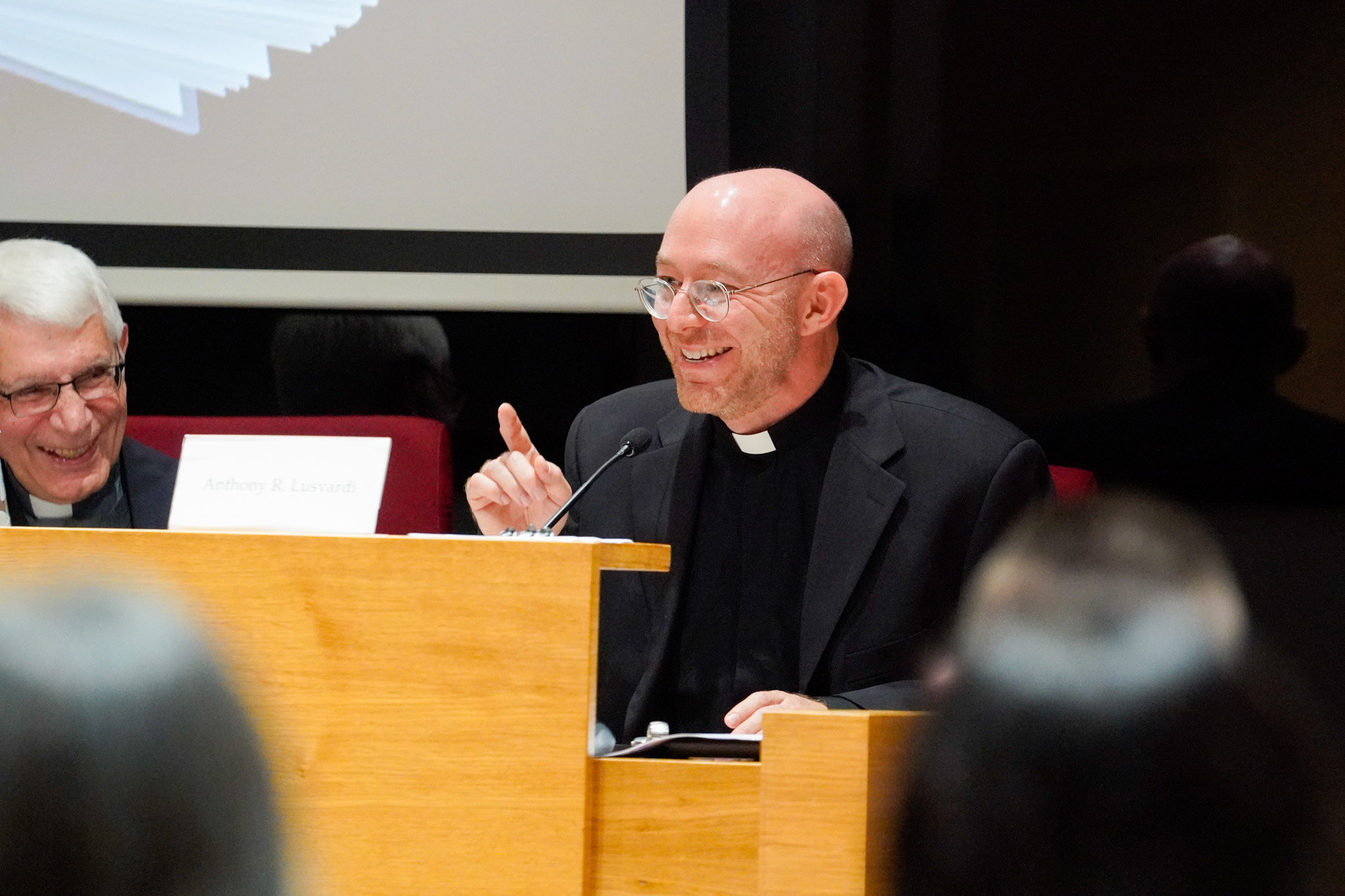
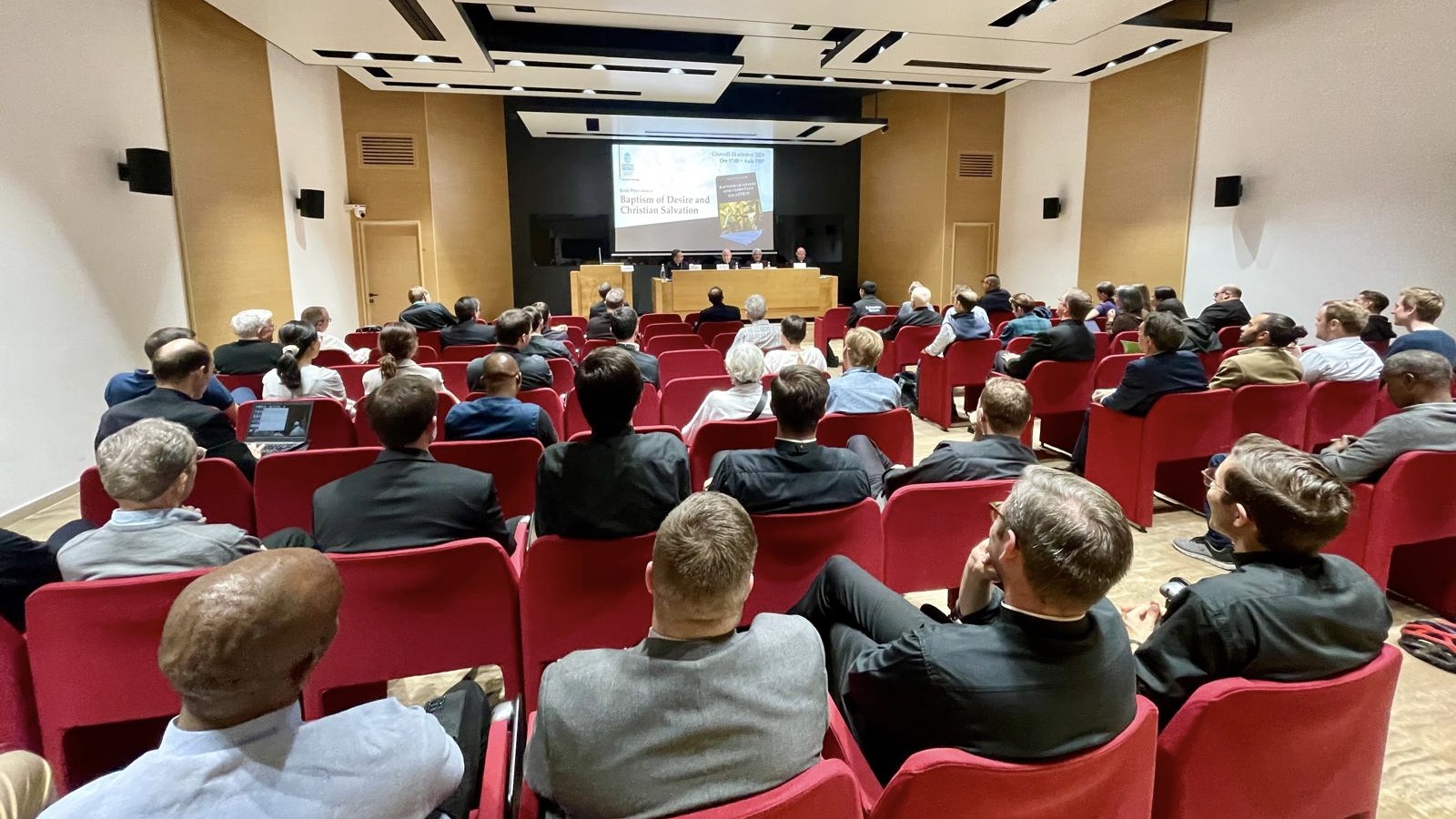
Baptism of Desire and Christian Salvation is now in orbit after an excellent turnout at the official book launch at the Gregorian last Thursday. More good news: the code CT10 still gives you a 20% discount if ordering the book directly from Catholic University of America Press. At the presentation of the book, Fr. Joseph Carola gave an overview of its content and shared some stories from personal experience to illustrate its pastoral relevance. Fr. Bob Imbelli drew on other contemporary thinkers, such as Khaled Anatolios, Charles Taylor, and William Cavanaugh to demonstrate its relevance. I hope to have video of the presentations up on the Baptism of Desire page soon.
Fr. Joseph Carola, S.J., Fr. Robert Imbelli, Fr. Anthony Lusvardi, S.J.
On another note, in this month’s First Things I return to an issue I raised a few years ago in an article in America magazine, the effects of technology on the liturgy. Here’s the new article: “Screens and Sacraments.” The original from 2020 is here.
And, finally, if you’re looking for some pre-election reading that isn’t about either Donald or Kamala, but instead about the way voting functions as a civic ritual, check out my latest at The Catholic Thing: “Rites (and Wrongs) of Democracy.“
Prophet Isaiah, Raphael (1511-2), Church of Sant’Agostino Rome
A mile or so from where I live in Rome is a street called Via dei Condotti; there you can find the stores of Armani, Tiffany’s, Gucci—the highest high-end designers. Sometimes I like to amuse myself by looking in the windows at the prices—a thousand dollars for a sweater, twelve hundred dollars for a necktie, twenty thousand dollars for a watch. Of course, many of the stores don’t list prices because if you have to ask, you can’t afford it. I’ve never gone inside any of these stores because they are usually guarded by a man with a shaved head, six inches taller than I am, with a black suit and a mouth that never smiles. In fact, I think they’ve had the facial muscles that allow you to smile surgically removed.
The owners of these stores would not be happy to read today’s Letter of St. James. James says: don’t favor a person with gold rings over a person in shabby clothes. Of course, sometimes shabby clothes are fashionable and expensive; having torn jeans means that you’re one of the cool kids. What’s in fashion always changes because it’s not based on anything real. A thousand dollar sweater won’t keep you any warmer than a thirty dollar sweater; a twenty thousand dollar Rollex tells the same time as my twenty dollar Timex. Fashions based on wealth, prestige, and the most up-to-date style are like the leaves that you see on the trees this September day; next month they’ll be a different color; a month after that, they’ll be gone.
Even though fashion and prestige aren’t based on anything true and lasting, they can be used to hurt people in some very real ways. I think of how hard it is for someone not to be one of the “cool kids” in middle school or high school. Adults are sometimes just as bad; I can remember from my time here on the reservation that sometimes people are looked down on for being “too Native”; other times they may be looked down on for “not being Native enough.” In either case, sometimes people can be treated quite unfairly.
Are there any Bears fans here? I have a question for you: if I reached into my wallet, how much money would I have to offer to get you to root for the Vikings? I know what you’re thinking: “You keep your wallet where it is, Father, because there ain’t enough money in the world to make me a Vikings fan.” Fair enough. I am a Notre Dame fan, and you could fill up the collection plate with hundred dollar bills, but you’d never get me to root for USC or Michigan.
Triumph of Faith over Idolatry, Jean-Baptistre Théodon, Church of the Gesù, Rome
In both cases, the reason why is loyalty. Each of today’s readings is about loyalty, though much more important types of loyalty than what we show our sports teams. When the first reading takes place, Joshua and the Israelites have spent their lifetime conquering the Promised Land after the death of Moses; here Joshua is an old man and he is putting a choice to the people. They’ve arrived, the land is theirs, and he tells them: Now you have to decide whom to serve. The God of our fathers Abraham and Moses got us here, and he has given us his law. Other nations have other gods, maybe with laws that aren’t so demanding. You are free to make a choice. You can serve whichever god you wish, Joshua says, but “as for me and my house, we will serve the Lord.”
And the people agree to serve the Lord. But if you continuing reading in the book of Joshua, you’ll see that Joshua asks the people a second time. Are you sure? Because if you agree to serve the Lord, then God will hold you to his law. You are free, but your choice is binding.
I recently read something in a book written by an American sociologist that struck me–and disturbed me. This sociologist is a very good scholar and has conducted studies in several different countries and written a number of topics. In one of these studies, as an aside, he mentioned that, in general, people care more about being normal than about being good. For the majority of people it is more important to feel normal than to be good.
Holy Stairs, Rome
This disturbing observation struck me because it seemed hard to deny. And the truth of this observation is evident on no other day more than on this one, Palm Sunday. The celebration begins with Jesus’ triumphal entry into Jerusalem. The people welcome him as a hero, as a king. They throw their cloaks before him and cheer him enthusiastically, “Hosanna!” And in the space of a week, the same crowd will shout with the same enthusiasm, “Crucify him!”
On no other day do we feel so acutely the fickleness of the crowd or the inconstancy of the human heart.







 Tony Lusvardi, S.J.