Look East! Homily for the Second Sunday of Advent

Homily for the Second Sunday of Advent (C)
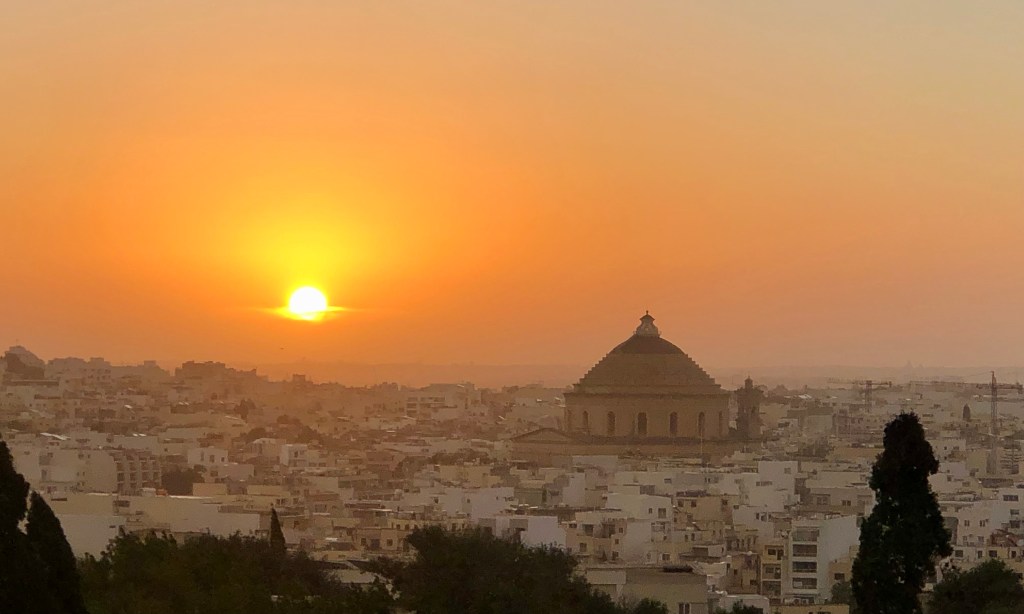
Dawn, Mosta, Malta

“Look to my coming,” Gandolf tells Aragorn in the second installment of the Lord of the Ringstrilogy, The Two Towers.  “At dawn on the fifth day, look east.”  Those familiar with the story, know that Gandolf’s words come at a particularly dramatic moment in the epic, when the last holdouts of Rohan—one of the two remaining kingdoms of men not to succumb to the forces of evil—have retreated to their mountain stronghold, Helms Deep, and the walls of the fortress have begun to crumble, its gates to give way, and its doors to crack under the onslaught of a massive army sent by the turncoat wizard Saruman, who, seduced by power, has joined the forces of darkness.  And as Aragorn, the king in exile, prepares for one final charge with what knights remain, he remembers the words of the faithful wizard Gandolf, who had left five days before to seek aid.  “At dawn on the fifth day, look east.”

We read a similar instruction in the Book of Baruch, directed to the holy city, “Up, Jerusalem! Stand upon the heights; look to the east.”  These words are echoed in the Advent hymn familiar to many of us, “People, Look East.”  There is something primordial in this call, in the instinct to look in hope to the east.  When I worked among the Lakota Sioux in South Dakota, I learned that in their traditional religion, east was the direction of prayer.  I found some Lakota Christians very insistent on a Christian tradition—which I did not know about—of burying the dead facing east.  The Christian tradition of prayer facing east goes back to the first centuries.  St. Ambrose talks about catechumens, after their baptism, turning from the west to the east as a sign of the new orientation of their lives.

Continue reading “Look East! Homily for the Second Sunday of Advent”

Finding hope in Jerusalem, Babylon, and Sweden: homily for the thirtieth Sunday on Ordinary Time

Uppsala domkyrko

Homily for the 30th Sunday in Ordinary Time (B)

Today I’m going to talk about Jerusalem, Babylon, and Sweden—all of them, in different ways, places of hope.

We are probably used to hearing messages of hope in church, so we could easily miss just how remarkable our first reading from the prophet Jeremiah really is.  This particular message of hope, if placed in context, is as startling as stumbling upon a lush citrus grove in the Arabian desert.  To appreciate the passage, it helps to remember a bit about the tragic and cantankerous life of Jeremiah.  This is the prophet, after all, whose name gives us the literary term “jeremiad” to describe a long speech bitterly denuncing something or someone.  In fact, the book of Jeremiah contains plenty of jeremiads.  The prophet denounces the elite of Jerusalem for straying from the law revealed to them by Moses, for their petty idolatry and corruption, for their self-satisfaction and complacency.  Their cowardly refusal to return to the faith of their ancestors has left the Kingdom of Judah weak and vulnerable to its enemies, Jeremiah warns, as had many prophets before him.  What sets Jeremiah apart from these other prophets of gloom is that he tells Jerusalem’s rulers that they have ignored God’s message for too long, and now it’s too late.  A superpower has risen in the East—Babylon—and nothing Judah’s rulers do now will stop it.  It is better, Jeremiah warns, to surrender.

Jeremiah’s message—“you’ve been leading us in the wrong direction for a generation, and you can’t escape the consequences of your actions”—did not win him popularity.  Judah’s rulers hired a more optimistic prophet, Hananiah, who delivered a message more to their liking.  But a few pages before today’s first reading, Hananiah drops dead, a none-too-subtle sign that the Lord does not approve his message.  As the Babylonians close in and a brutal siege begins, Jeremiah tells the people of Jerusalem, you will be defeated, your city destroyed, and then you will be dragged off into exile.

Continue reading “Finding hope in Jerusalem, Babylon, and Sweden: homily for the thirtieth Sunday on Ordinary Time”

Hope vs. optimism: homily for the twenty-third Sunday of Ordinary Time

Homily for the 23rd Sunday of Ordinary Time (A)

Prophet Ezekiel, Sistine Chapel

Of all the Old Testament prophets, the one whose writings most resemble a hallucination caused by LSD is probably Ezekiel.  There’s a psychedelic temple; four-faced creatures that are part man, part lion, part eagle, part ox; apocalyptic battles; a bit of cannibalism; an army of dry bones that rattle back to life; and a few scenes that are definitely rated R.  If you’re seeking entertainment, cancel your HBO subscription this month and just read the book of Ezekiel.

Now please don’t go home and tell people, “Father preached this morning about LSD.  He was a Jesuit—you know how they are.”  In order to appreciate this marvelous book of the Bible, I want to draw a contrast between hallucination, optimism, and the central theme of the book of Ezekiel—hope. 

Ezekiel lived through what might be considered the most hopeless moment in the history of the Jewish people.  The corruption of the Israelite monarchy had so weakened and divided Israelite society that the nation was easy prey first for the brutal Assyrian empire, which utterly destroyed ten of the twelve tribes of Israel, and then a few decades later for the even more ruthless Babylonians.  Ezekiel was a priest, who along with the other educated members of Israelite society was carted off into forced exile in Babylon.  It would have appeared to any observer at the time that Israel’s story was over.  They had been favored by God; they had been given the Promised Land and a covenant, and they blew it.  They broke the covenant, lost their land, and had only slavery and extinction to look forward to.   

And at this moment in history, in exile in the heart of enemy territory, in Babylon itself, Ezekiel started receiving visions.  Ezekiel’s visions were wild but not hallucinations.  They pointed toward a better future but it would be difficult to call Ezekiel—or any of the Hebrew prophets—an optimist. Ezekiel’s vision was something else entirely—it was a vision of hope.  What’s the difference, you ask.

Continue reading “Hope vs. optimism: homily for the twenty-third Sunday of Ordinary Time”