Baby Brian’s story and baptism of desire

Those of you who have been following this blog know that over the summer I was put in touch with a group of people dedicated to telling the story of baby Brian Gallagher, an infant who died shortly after his birth but whose body was discovered to be apparently incorrupt 37 years after his burial. Because Brian was not baptized before he died, the story raised the question of the eternal destiny of babies who die before baptism and my work on baptism of desire.

That story has started to get attention in several Catholic media outlets, and last week I had the chance to talk about baptism of desire on Real Presence Radio; you can listen to the interview here .

Hats off also to Dr. Kody Cooper for his opinion piece about baptism of desire and infants on the Word on Fire site. The author comes to similar conclusions to my own, arguing that baptism of desire is the best theological doctrine with which to consider this tough case, even citing Cardinal Cajetan who I discuss in my book . Baptism of desire seems to me a superior approach to what the author calls the “post-conciliar view,” which means hoping that the babies will be saved while remaining agnostic about the means. This approach, it seems to me, has two serious flaws. It seems to invite hope in a kind of divine Plan B which turns out to be more effective than those means revealed to us by Jesus. Revelation, then, seems not so revealing. At the same time, precisely because whatever those means happen to be can’t be found in revelation, such hope remains necessarily vague and not particularly well-grounded.

Baptism of desire, on the other hand, identifies our grounds for hope in the Church’s sacramental practice — the practice of a sacrament instituted by Jesus Christ and declared by him to be necessary for salvation (John 3:5). I posted a brief description of my position on the question here a few weeks ago.

Continue reading “Baby Brian’s story and baptism of desire”

Infants and baptism of desire: one theologian’s perspective

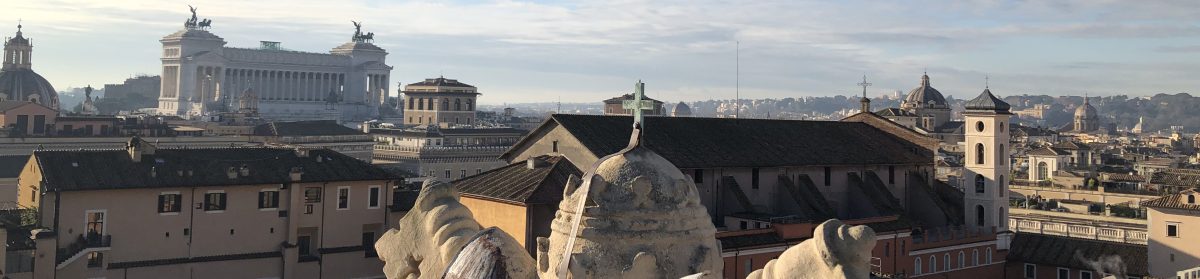
Spisska Kapitula, Slovakia

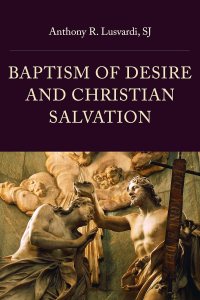
As I mentioned earlier, over the summer God’s providence brought me into contact with a group of people dedicated to sharing the story of Baby Brian Gallagher. The circumstances of Baby Brian’s short life raise the question of babies who die before baptism and baptism of desire, and the group asked me to write up a one page summary of the argument I present in my book Baptism of Desire and Christian Salvation. Of course, for the full story–and much else besides–buy the book! What I wrote is not intended as a full pastoral response to those who have lost a child too soon, but a very brief sketch of the theological issues involved.

Theologians have a precise mission within the Church. Our task is not to “create” the truth, but to use the tools of reason and study to understand better what God has revealed to us. When it comes to salvation, theologians don’t “decide” what the Church believes; we merely try to express with greater clarity what we find in Christian revelation. 

Good theologians, then, must be humble and cautious in what they claim. Historically, theologians have found the question of what happens to babies who die before baptism particularly difficult. We know that baptism is necessary for salvation (John 3:5) because baptism is the unique way Jesus has revealed for us to participate in his death and resurrection (Romans 6:3-5). At the same time, the doctrine of baptism of desire has found strong support among theologians and in the Church’s official teaching. Baptism of desire does not deny the necessity of baptism or create an alternative to the sacrament. Instead, the doctrine means that those who desire the sacrament but are prevented by circumstances beyond their control from receiving it can still obtain baptism’s effect—rebirth to eternal life. 

Historically, most—but not all—theologians have had trouble seeing how baptism of desire could apply in the case of infants who are too young to formulate a desire of their own. After a decade studying baptism of desire, however, I believe that these theologians have tended to leave out a decisive piece of evidence: our practice of the sacrament of baptism. The key theological principle that has been neglected up until now is known as lex orandi—lex credendi, which means “the law of prayer is the law of belief.” In other words, the way we celebrate the sacraments is itself a guide to what is true. In this case, the Church’s firmly-established practice invites us to look more deeply into how to understand the desire for baptism in regard to infants.

Continue reading “Infants and baptism of desire: one theologian’s perspective”

Summer articles

The October start of the Roman academic year means that I am wrapping up my time in the States before heading home (and back to work!) next week. Nonetheless, I haven’t been idle over the course of the summer. In addition to seminars and retreats, I published a couple of articles which might be of interest.

First Things asked me to weigh in on the questions surrounding transsexuals and the sacrament of baptism: Can Transsexuals Be Baptized?

America magazine also published a long-planned article on baptism of desire, in which I distinguish the implications for evangelization of my position from those of two other people I admire but (partially) disagree with: Is there salvation outside baptism? A better way of looking at a difficult question.

The relationship between salvation and evangelization, however, is only one of the difficult questions my book addresses. I also suggest a new approach to the question of unbaptized infants and children dying in utero. This summer, I was contacted by some folks involved in ministry to Catholic parents who have lost children either through miscarriage or in early infancy. I found a quite enthusiastic reception for my work among those who are involved in this kind of grief ministry, and, a week ago, a group of the faithful put up a statement online in support of the position that I advance in my book: that baptism of desire can, in some cases, apply to the children of Christian parents. You can find this statement in support of the development of doctrine I outline here and sign if you wish: A Statement of Hope regarding Salvation through Baptism of Desire for Infants.

The statement also mentions the case of baby Brian Gallagher, whose grave I visited at Black Hills National Cemetery. On the outskirts of the cemetery I snapped a photo of a quintessentially American scene: a giant flag waving from a piece of heavy machinery with the Western landscape in the background. What else is there to say but, God bless the USA!

“A must-read for anyone who wants to understand how salvation works in the Church’s tradition”

Baptism of Desire and Christian Salvation has now been out long enough to begin generating some discussion, and I’m grateful to have seen a number of new reviews and reactions over the past few months.

With Dr. Ralph Martin and Dr. Gavin D’Costa

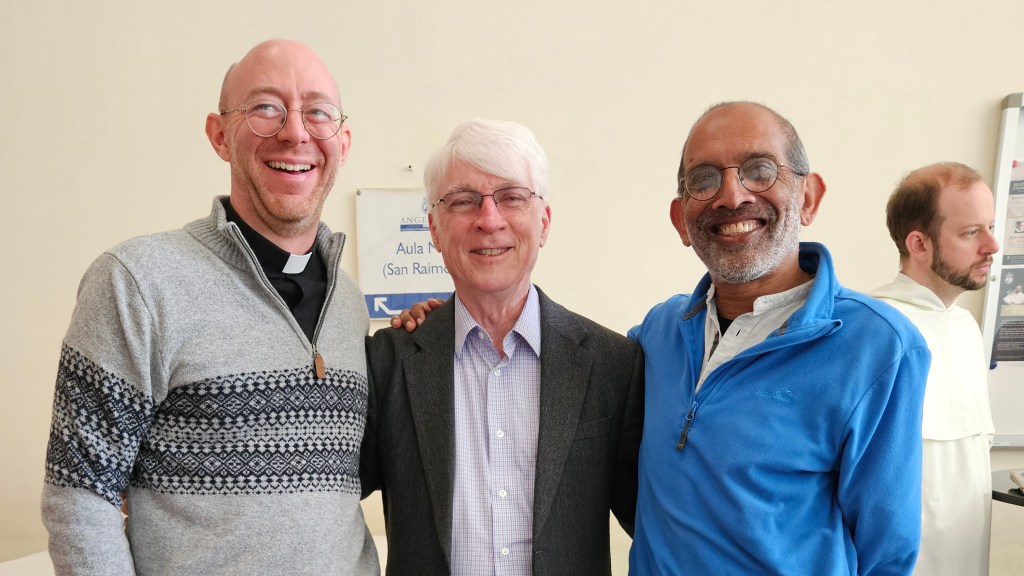
I was delighted to see Dr. Ralph Martin, one of the world’s top authorities on the new evangelization, mention the book in his latest update at Renewal Ministries. Dr. Martin mentions meeting up while he was visiting Rome. I had a charming and stimulating conversation with him and his wonderful wife Anne, as well as a number of equally enjoyable conversations with Dr. Gavin D’Costa, whom he also mentions, an expert on world religions who teaches at the Angelicum. We also discussed Dr. Martin’s book Will Many Be Saved?, which I cite in my work. I’m deeply honored that he considers Baptism of Desire and Christian Salvation “a very solid and brave work of scholarship that faithfully presents the doctrinal and moral implications of the Church’s–and Jesus’–insistence on baptism to be saved.”

I’m equally grateful to have stumbled upon the careful and detailed review and summary of the book by Fr. Richard Conlin at The Prodigal Catholic Blog. I’m especially glad that Fr. Conlin considers the book “a must-read for anyone who wants to understand how salvation works in the Church’s tradition–especially in ‘hard cases’ like the unbaptized, non-Christians, or infants” and that he highly recommends it “especially for priests, catechists, and anyone serious about the faith.” A scholarly book such as Baptism of Desire and Christian Salvation might seem intimidating, but I think this one is important for more than just an academic audience. My intention was always that it would be accessible not just to specialists but to anyone with a theological background. So it’s encouraging to read that Fr. Conlin found it “both theologically rich and remarkably readable–a rare combination.”

Those who read Italian might check out the insightful review in Ecclesia Orans by Prof. Paolo Trianni, who recognizes the theological approach as “innovative” because it seeks to overcome a “legalistic concept of the sacrament” present at times in scholasticism and neo-scholasticism.

Finally and somewhat unexpectedly, I was recently contacted by Brianne Edwards of Rapid City, who brought to my attention the remarkable story of baby Brian Thomas Gallagher, who died 43 minutes after his birth in 1982 and whose body was found to be apparently incorrupt in 2019. He happens to be interred at Black Hills National Cemetery. I discuss the possibility that infants can receive baptism of desire in the book, and Baby Brian’s case seems almost to have been designed to fit the argument I make. I’ll have more to say on the subject in the future…

In the meantime, remember that Baptism of Desire and Christian Salvation is available on Amazon, directly from Catholic University of America Press (20% discount with the code CT10),  and at other online booksellers.

Build back baptistries! A trip to the Baptistry of San Giovanni in Fonte

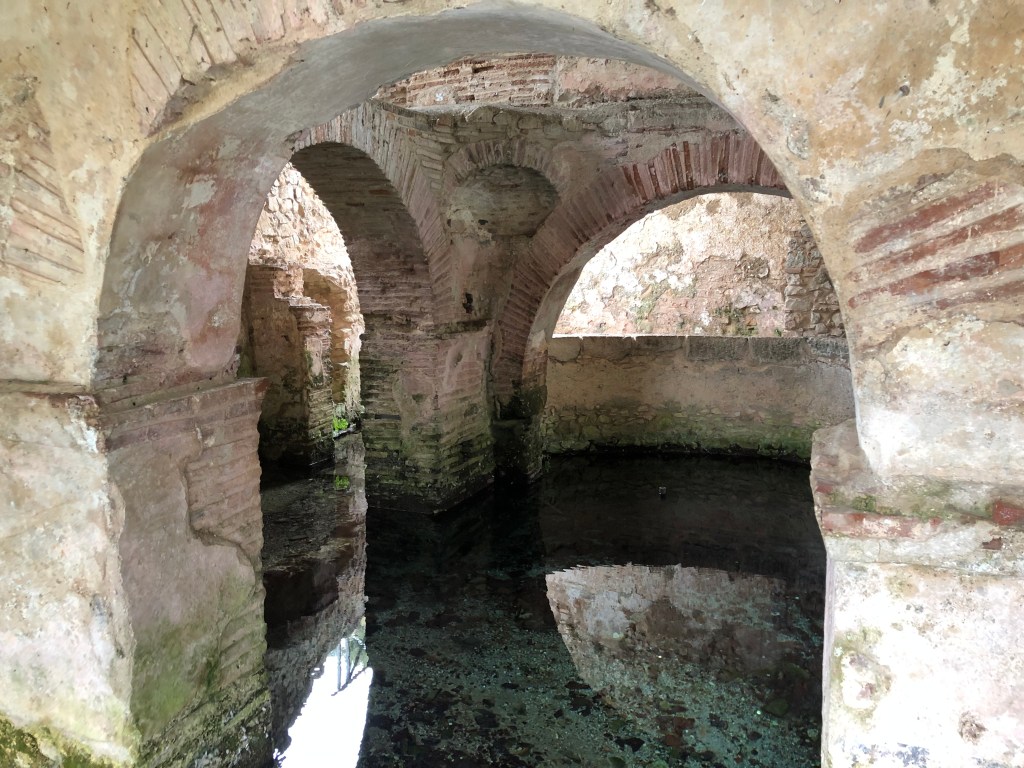
An unexpected discovery on my recent trip to Italy’s Cilento was the Baptistry of San Giovanni in Fonte, just outside of Padula. Also known as the Battistero Marcelliano, after Pope Marcellus, it dates from the fourth century, putting it among the oldest Christian structures in the world. A letter from Cassiodorus in AD 527 mentions a miracle occurring at the baptistry, its water level rising unexpectedly while a priest was pronouncing the prayer over the baptismal waters on the vigil of the feast of St. Cyprian.

Battistero di San Giovanni in Fonte, Paula, Italy

The structure itself sits on the site of a natural spring, so the baptismal font was a pool of “living” water. The baptistry was built on the ruins of an earlier pagan structure and underwent several renovations and expansions throughout history. Hints of a fresco, dating from the 11th century when the structure was converted into a chapel, remain on the wall. The remains of still earlier frescoes from the 6th and 7th centuries were removed and taken to a local museum.

Rising water levels caused the chapel to be abandoned in the 19th century, though the site of the remains and spring, down a winding country road, are quite a pleasant spot today.

This reminder of baptism from Christianity’s earliest days is worth reflecting on during the Easter season. I discuss some of the theological and practical consequences of the shift away from the patristic catechumenate and toward near-universal infant baptism in the Christian cultures of the Middle Ages in Baptism of Desire and Christian Salvation, but the subject is worth more reflection than what I’m able to give it there.

Reflecting on early Christian baptismal practices is important because we are moving into a new phase in Christian history that in some ways will more closely resemble the Church of the Fathers — in which Christianity was a minority — than medieval Christendom. Some of our sacramental practices, I am convinced, will have to shift to respond to this new reality. This may not be entirely a bad thing. When it comes to baptism, for example, too often the sacrament, celebrated in a minimalistic way, has become a mere formality with little connection new life in Christ.

Continue reading “Build back baptistries! A trip to the Baptistry of San Giovanni in Fonte”

A “monumental study… unmatched in what it positively contributes”

With a year approaching since Baptism of Desire and Christian Salvation‘s publication, I’m pleased to see reviews starting to appear. I just read a great one by Joseph Arias of Christendom College in the journal of liturgical theology Antiphon. Arias provides a summary and identifies “controversial” points where I challenge the received wisdom. I’m grateful to have such careful readers and can’t say I mind having the book described as “monumental” and “unmatched”!

Here’s just a sample:

“The author takes the reader on a profoundly illuminating historical and dogmatic theology journey from the apostolic age to our own, acting throughout as an immensely capable and careful guide, making sure we do not miss either major or minor attractions that can enhance the experience of trying to arrive at a deeper understanding of a profoundly significant (though sometimes underappreciated) teaching that is firmly rooted in the Catholic tradition…

… this volume is unmatched in what it positively contributes towards a better understanding of this area of theology.”

And more good news — it looks like the price of the book may have dropped on Amazon as well.

Also, following up on my previous post on the Ukrainian bishops’ statement about the war in their country last week, I have a new piece out on the subject in America. It is equally about what is dysfunctional in our own American political culture right now.

Baptism of desire and Christian Salvation: reviews and interview

A friend sent me this picture, which looks like a recipe for beating the midwinter blues if ever there was one. I’m pleased that a number of reviews of Baptism of Desire and Christian Salvation have started to appear. And, though I haven’t seen them all–sometimes it takes a while for parcels and periodicals to arrive in Rome–it is humbling to see some really topnotch scholars engaging with my work. As far as I know, reviews have recently appeared in Antiphon, the Nouvelle Revue Théologique (in French), Hekima Review, Ephemerides Liturgicae (in Italian), and on João Vila-Chã’s page (in Portuguese). More news is collected here.

And in case you missed it in November, consider checking out my discussion of the book with Dr. Larry Chapp on his podcast Gaudiumetspes22.com. It was really an enjoyable interview, also available on YouTube:

Launched: book, articles, interview

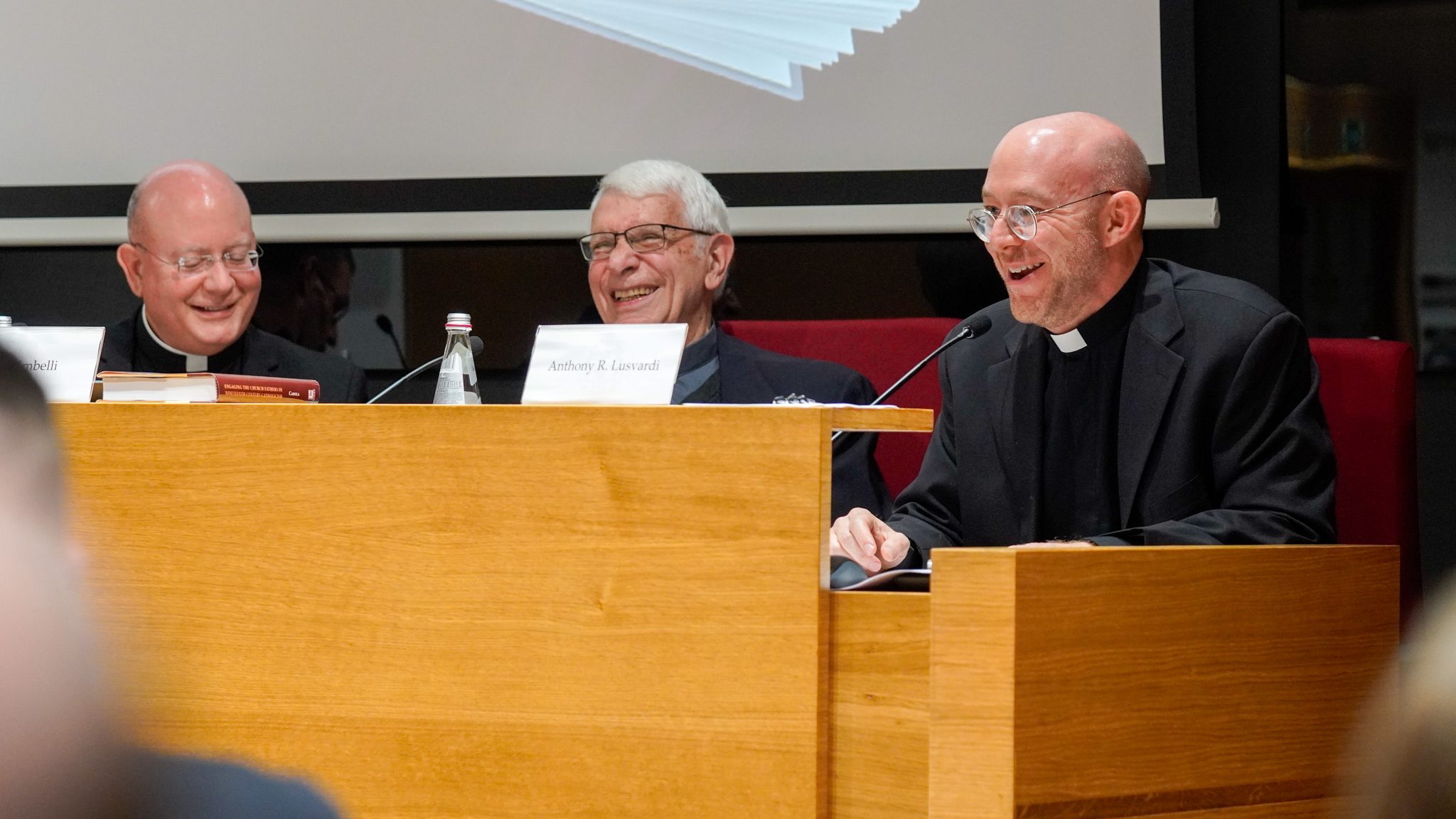
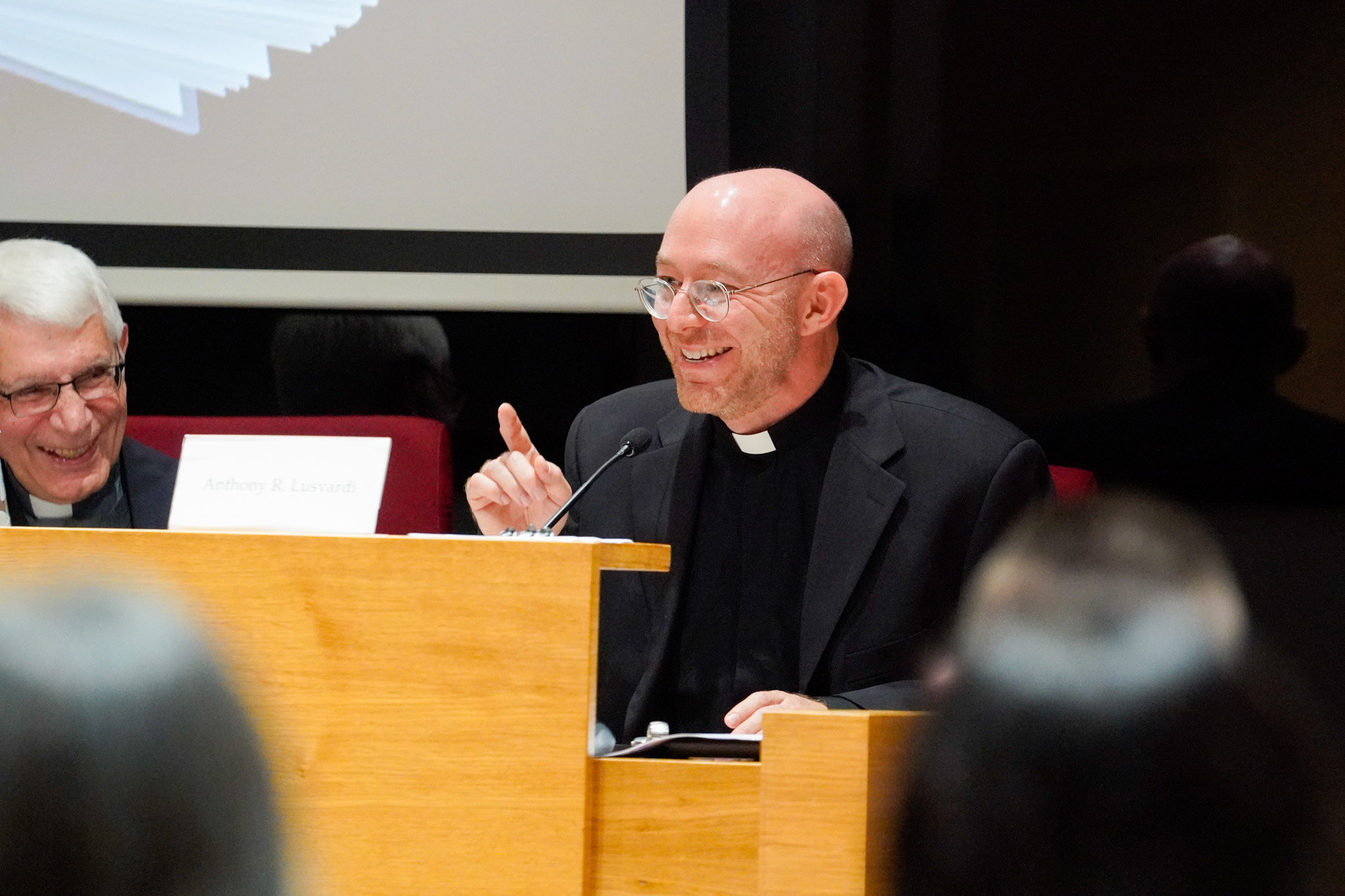
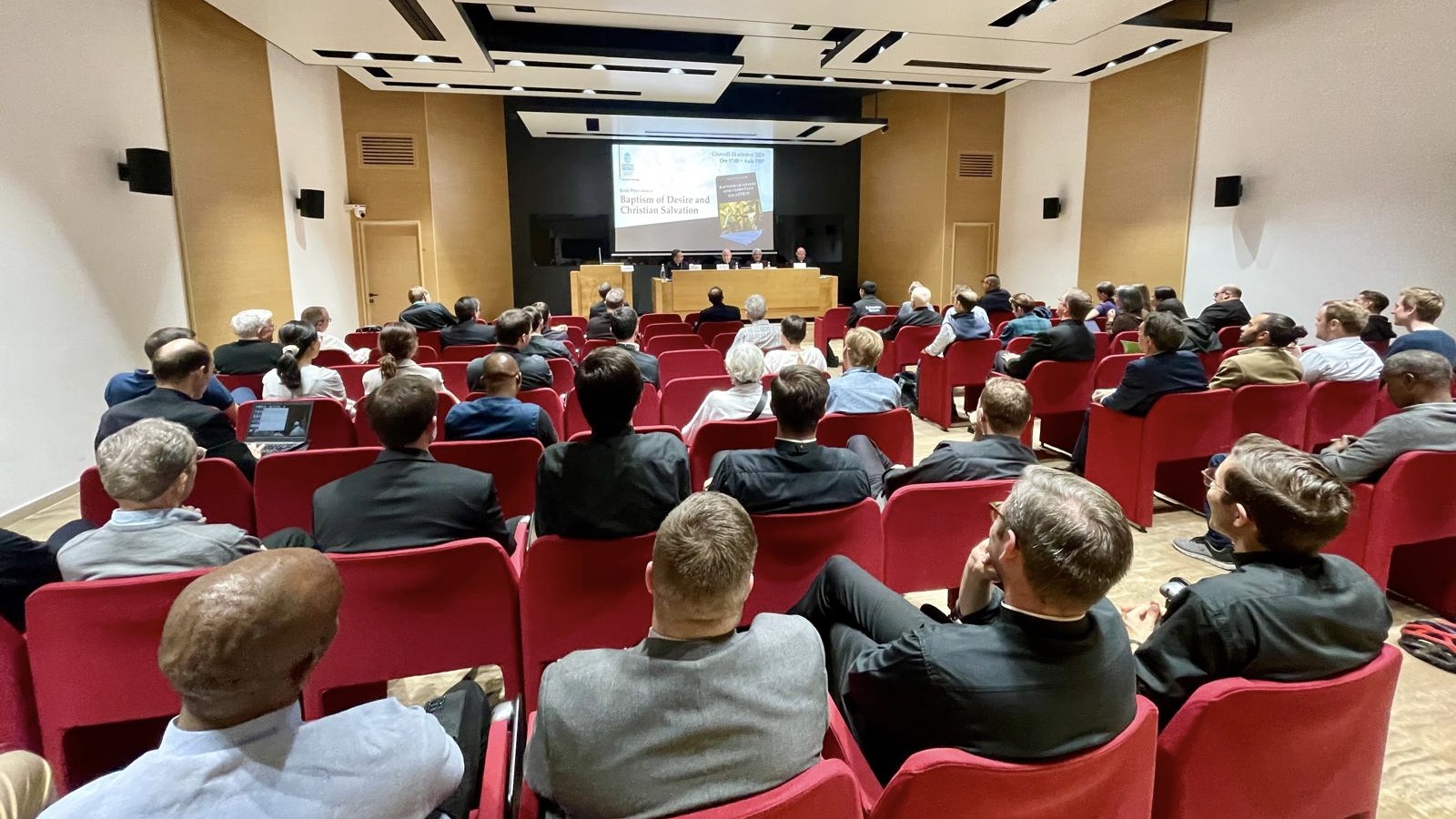
Baptism of Desire and Christian Salvation is now in orbit after an excellent turnout at the official book launch at the Gregorian last Thursday. More good news: the code CT10 still gives you a 20% discount if ordering the book directly from Catholic University of America Press. At the presentation of the book, Fr. Joseph Carola gave an overview of its content and shared some stories from personal experience to illustrate its pastoral relevance. Fr. Bob Imbelli drew on other contemporary thinkers, such as Khaled Anatolios, Charles Taylor, and William Cavanaugh to demonstrate its relevance. I hope to have video of the presentations up on the Baptism of Desire page soon.

Fr. Joseph Carola, S.J., Fr. Robert Imbelli, Fr. Anthony Lusvardi, S.J.

Just a week before, I was also pleased to talk about the book with my old friend Sean Salai at Catholic World Report. Read the interview here: Defending the necessity of baptism: An interview with Fr. Anthony Lusvardi, S.J.

On another note, in this month’s First Things I return to an issue I raised a few years ago in an article in America magazine, the effects of technology on the liturgy. Here’s the new article: “Screens and Sacraments.” The original from 2020 is here.

And, finally, if you’re looking for some pre-election reading that isn’t about either Donald or Kamala, but instead about the way voting functions as a civic ritual, check out my latest at The Catholic Thing: “Rites (and Wrongs) of Democracy.

Book launch, podcasts, and other news

I am pleased to see Baptism of Desire and Christian Salvation in the news. Ralph Martin mentioned the book in his recent video Are All Religions a Path to God? As Dr. Martin points out, the research and arguments the book offers are highly relevant to some of the most difficult theological questions the Church faces today. As I’ve said before, perhaps the most urgent question the book raises has to do with whether we should still understand salvation to be at the heart of the Church’s mission. (Spoiler alert: Yes.)

With Dr. George Ceremuga at St. Isaac Jogues this summer.

I was also delighted to have a thoroughly enjoyable conversation a few weeks ago with Dr. George Ceremuga, friend and parishioner at St. Isaac Jogues parish in South Dakota, for the inaugural episode of his new Lead With Love podcast. We talked about Baptism of Desire and Christian Salvation as well as Dr. George’s new book My 50 Day Pentecost in the Holy Land, in which he recounts some of the encounters and insights he had on an amazing journey through the Holy Land last year. UPDATE: the podcast is now out here. I’m collecting info and reviews about baptism of desire here.

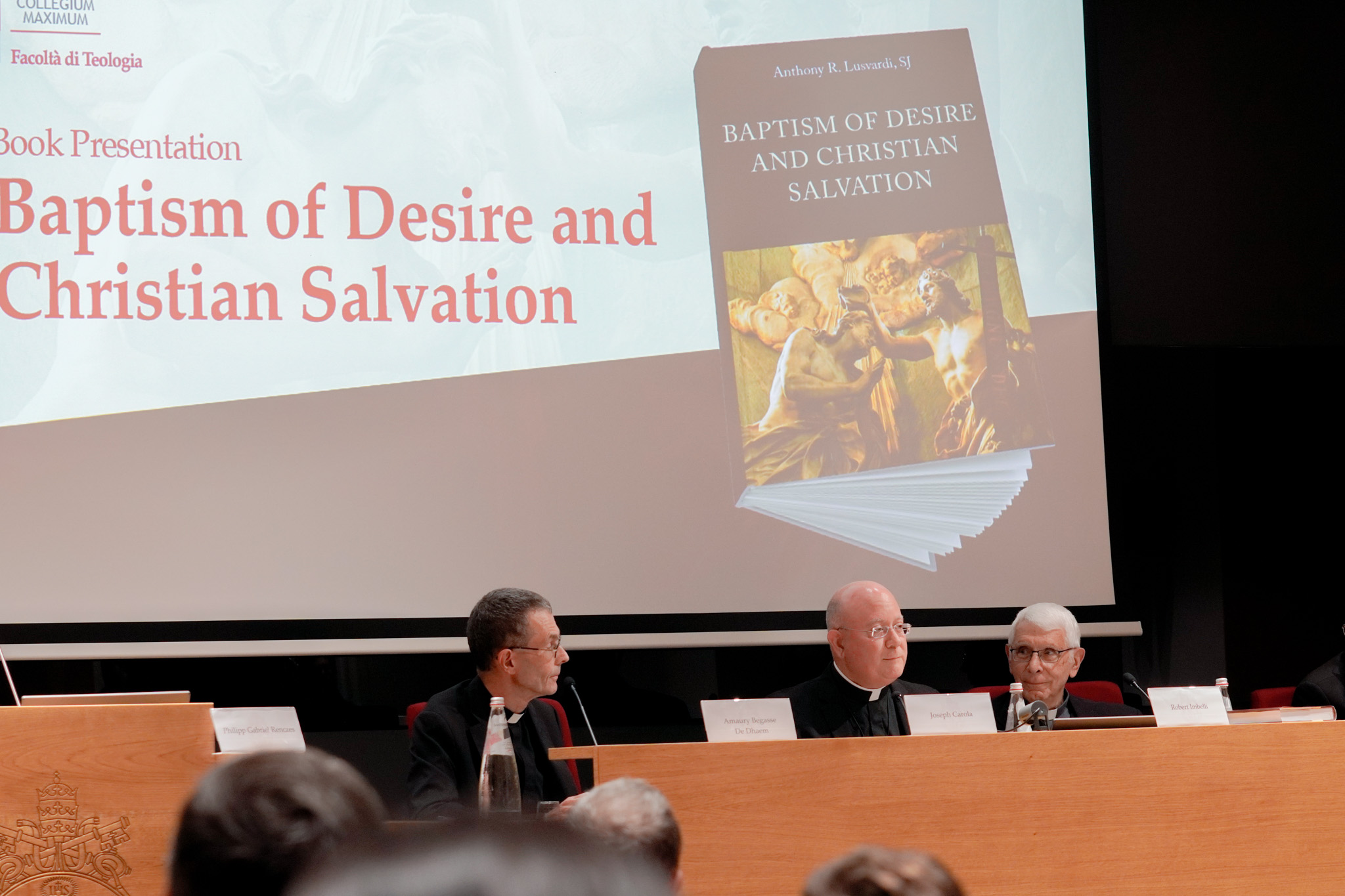
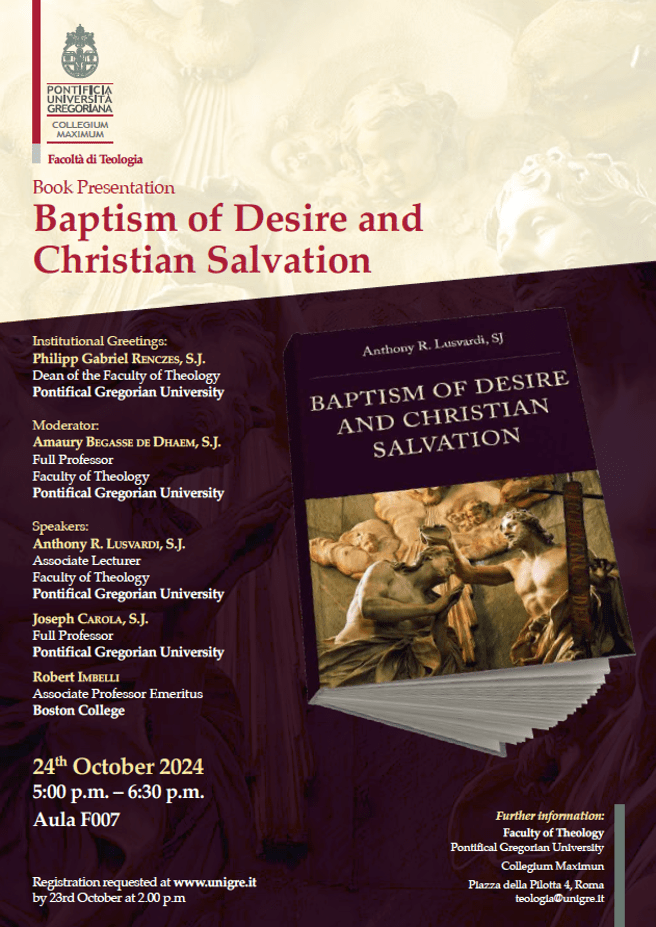
And finally, as you can see from the flyer at the top of this post, I’m pleased to announce that we will have a book launch for Baptism of Desire and Christian Salvation later this month at the Gregorian University. If you are in Rome, please come on Thursday October 24 to hear Fr. Robert Imbelli (coming all the way from New York!) and Fr. Joseph Carola discuss the book’s significance. The event will take place at 5:00 PM in room F007 of the Frascara Building at the Gregorian University. I’ll try to get the talks posted here, too, since it promises to be an interesting discussion.

And for something just a little bit different, you might want to check out the November issue of First Things. Just saying.

Andrea Grillo and Rachel Lu on Baptism of Desire and Christian Salvation

Sant’Anselmo, Rome

Earlier this month, after delivering ten copies of Baptism of Desire and Christian Salvation to Sant’Anselmo at Easter time, I walked up the Aventine Hill to pick up my diploma–the last formality involved in earning my doctorate. The last act, I suppose, of my formal education! It’s a walk I made many times before while a student. I haven’t been back to Sant’Anselmo for a while now, but am grateful for the studies in sacramental theology I did there.

When I received my copies of Baptism of Desire and Christian Salvation, I had one more reason to be grateful — the insightful words of endorsement on the back cover from my dissertation director Prof. Andrea Grillo, who read many draft versions of the tome and managed to remain in good humor throughout! Here’s his review:

Lusvardi offers a historical reconstruction of the ‘baptism of desire’ that traverses the entire arc of the Christian tradition, starting from the origins. A straightforward work, expressed in a language endowed with finesse, irony and acumen. Baptism of Desire and Christian Salvation is singularly effective in pointing out the fact that in the modern reception, a series of priorities is imposed on the issue that empty its meaning.

Andrea Grillo, Pontifical Atheneum of Saint Anselm, Rome

Also last week, I was delighted to see Rachel Lu’s review of the book at Word On Fire. Rachel’s review had a particular significance for me since, as she points out, I was there when she was baptized as an adult 19 years ago.