As an American abroad, I’ll readily confess to a bit of nostalgia come Thanksgiving time. As a national rite, the holiday is sublime in its simplicity: turkey, family, eating–and an implicit spirituality as unobtrusive and essential as bedrock. I do celebrate here in Rome with other expats, but the Italian interpretation of cranberry sauce, stuffing, and pumpkin pie, while sometimes whimsical and frequently tasty, is never quite the same. Thanksgiving is quintessentially American, expressing what is best about our country–and perhaps also something of what we seem to be losing.
November 2 is All Souls Day on which we remember and pray for the dead. For Catholics, November is traditionally a month dedicated to praying for the dead, a practice that goes back to the earliest days of the Church and, indeed, even to pre-Christian times. This pair of days, All Saints and All Souls, is a reminder of the profound solidarity that exists between all Christ’s faithful, on whichever side of the grave we currently find ourselves. Our lives and our journeys continue to intertwine with those who have come and gone before us.
Santa Maria del Purgatorio, Monopoli, Italy
The first reason we pray for the dead, of course, is to help those in the final process of purification we call purgatory. Since heaven means existing in a state of perfection and most of us still aren’t perfect when we die, purgatory is the time we need to reach that perfect way of being we long for.
This doesn’t mean that purgatory is a second chance, as if this earthly life were a video game in which you get five or six lives to move up levels. No, the choices we make in this life are decisive. Our free will really matters. Purgatory is the completion of what we start on earth.
Sant’Agnese in Agone, the church in the center of Piazza Navona, is more beautiful than usual these days because it is hosting a special exhibit of three El Greco paintings. The largest and most impressive of these is the “Baptism of Christ,” a favorite theme of mine and something I think the Church would do well to reflect on more deeply–especially in these days of deep division and various lobbies jockeying for influence.
Sant’Agnese in Agone, Piazza Navona, Rome
At his baptism, the identity of Jesus is revealed by the Father: “This is my beloved Son, with whom I am well pleased.” As John the Baptist well knew, Jesus had no need of baptism; the event was for our benefit. The Lord’s baptism reveals what happens in our baptism: we become the children of God by adoption; we come to share in the Sonship of Jesus. The Father’s words come to apply to us. We become the beloved sons and daughters of God.
The reason I think this event is so important is because, for Christians, our status as God’s sons and daughters must become and remain our most fundamental identity. When some other form of identity becomes primary–our national identity, our identification with a particular political party or ideology, even our natural family–we go badly astray. This, it seems to me, is the most serious problem with contemporary LGBT ideology. The problem is certainly not with the people themselves, nor even so much with any particular sexual desires per se–living our sexuality with integrity has always been challenging, in different ways, for all Christians. The problem is when those sexual desires become ideology and ideology becomes identity, when one particular aspect of one’s personal make-up–one’s sexuality–becomes the dominant characteristic in one’s self-definition, the one ring to rule them all.
One of the highlights of my recent travels through Asia was visiting a number of quite impressive Buddhist temples and shrines. This was particularly the case in Thailand, though Chinese temples in Singapore, Taiwan, and Hong Kong were also filled with rich carvings, colorful statues, and piles of offerings including fruit, flowers, and burning incense. The warm red–the color of prosperity–of the Chinese temples reminded me of the red color with which the ancient Romans frescoed the inside of their homes. The desire for a warm hearth is written deeply in the human psyche.
Thian Hock Keng Temple, Singapore
A place of worship that makes an absorbing appeal to the senses is of course nothing new to me. I live in Rome, city of the baroque, where tales of religious ecstasy are told and retold in marble, mosaic, and fresco. The impulse of Christianity to express itself in art goes back to the Incarnation itself, to God revealing himself by entering into the world of the flesh, expressing his divinity in the matter of creation. We Catholics believe that he continues to communicate his grace to us through the sacraments. Artistic expressions using color, smell, and sound to amplify this divine work come naturally enough to a sacramental faith.
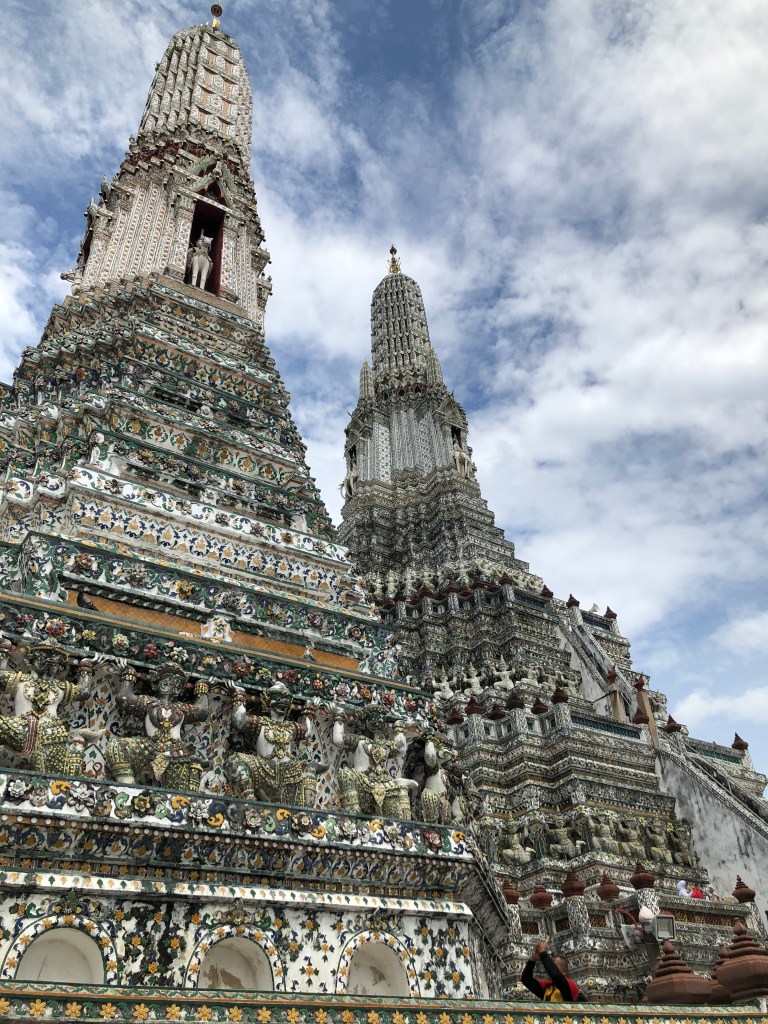
But what about Buddhism? Such expressions would seem to me, an outsider, to fit less naturally within Buddhist philosophy, with its distrust of all desire and negation of the world of pleasure and pain. Incarnation and Nirvana are two radically different beliefs. Yet how else to describe the gilded wats of Thailand, the cascades of angels and demons in glittering ceramic, than Buddhist baroque?
Wat Arun Ratchawaramahawihan, Bangkok
Of course, Thailand’s wats are not the architectural expression of pure Buddhist philosophy but a kind of non-culinary Asian fusion–Buddhism grafted into a still older mix of traditional folk beliefs, legends, and superstitions. How cogent such a mix is, I can’t evaluate. But there’s something human about that folk mix that I find more compelling than Buddhism in its purity, which I’ve always thought a little chilly.
Those at daily Mass this week get to enjoy the special treat of hearing the book of Jonah. The book is such a good tale–who doesn’t love a giant sea monster? or a cantankerous prophet?–that I imagine the story originally told dramatically aloud. I think we’re meant to laugh at Jonah, the Mr. Bean of prophets.
Of course, there is a serious message to the book that goes beyond whale innards and the prophet’s pouty attachment to his gourd plant. Jonah reveals the sweeping reach of God’s mercy, extending even to the most wicked of cities–Nineveh, grrr—when those within it seek conversion. Students in my classes are probably sick of hearing it, but one way to get under my skin is to claim that the grumpy “God of the Old Testament” has been replaced by the groovy “God of the New Testament.” There’s only one God. He’s infinitely merciful and revealed in both the Old and New Testaments. And the book of Jonah proves it.
In case you missed it, an essay of mine appeared recently in issue 19 of The Lamp, a relatively new Catholic magazine full of interesting and thoughtful writing (if I do say so myself).
“Public apologies for historical wrongs have multiplied in recent years… Yet we do not seem to have become a more reconciled and understanding society.”
This particular essay, “Confessing Other People’s Sins,” is among the most important things I’ve written. The essay draws on a lot — my experiences in South Dakota, as a confessor, and studying theology.
After a couple of months in Western Australia and half a year Down Under, I am still amazed by the diversity of this island continent’s landscapes. This includes unparalleled bio-diversity–all the birds and marsupials and one-of-a-kind wonders, like the platypus, that look like something out of a Dr. Seuss book–as well as the geological curiosities.
The Twelve Apostles, Victoria, Australia
On this, the driest of Earth’s continents, I’ve been especially fascinated by water. Most of Australia’s population (almost 90%) live within 30 miles of the coast, and some of the country’s greatest wonders–the Great Barrier Reef, for example–lie underwater. My own fascination with water comes in part from its sacramental usage. Water is the one physical element necessary for baptism and, thus, entry into Christianity.
Today is unofficially known as “Spy Wednesday” on the Church calendar because the Gospel reading recounts the story of Judas’s betrayal. I spent this Lent doing the 30-day Spiritual Exercises of St. Ignatius Loyola, and, for me, the most moving part of the retreat was contemplating the Lord’s Passion, in which, through the liturgy, we participate during Holy Week.
There is much to say about the retreat and much to say about Holy Week–but having been away for over a month, I also have a fair bit of catching up to do. So for now, I’ll share just one thought.
Until we reach Easter Sunday, this week is incredibly dark. Judas is present at the Last Supper and his impending betrayal colors everything else. Even before the Lord’s arrest, Jesus suffers because of his disciple’s mendacity. Peter’s courage and good intentions fail. The physical torture–scourging, beating, the nails, exposure and slow suffocation on the cross–is inhuman, enough to turn one’s stomach just thinking about it. And then, the cravenness of Pilate, the calculated cruelty of Jerusalem’s religious leaders, the callous and fickle crowd. What is most sobering of all is the realization that there is some of Judas and Pilate and Peter in each one of us. The Lord suffers for our sins.
In the West today, pessimism is warranted. Suicide, crime, and drug use are up; birthrates are down. In America, woke excess has undermined much of the progress made toward racial reconciliation over the course of the last century. The decline in religious practice has eroded those values that transcend political conflict and material consumption; we’re losing the shared cultural language with which we could talk to one another about matters touching on the common good. In the absence of a common cultural narrative and shared values, tribal loyalties have filled the void, becoming our false gods.
I don’t think it disloyal to admit that the Church has not adequately responded to the West’s malaise. Faced with Covid, we closed shop. Rome these days sometimes seems to be swimming in nostalgia for the 1960s. No doubt it was more pleasant to be a young cleric in the heady days of Vatican Council II–at least, before the seminaries emptied–but those are not our days.
Half a century ago, perhaps, Catholics in the West could still see their societies as Christian, though ones that were rapidly changing. So it seemed reasonable enough to hope that with a bit of updating around the edges, a little accommodation to the Zeitgeist, we might experience a new flourishing of Christian life. That didn’t happen, and it is no longer reasonable to expect that it will. We need a new response to today’s reality.
A recent article by Sydney’s Archbishop Anthony Fisher The West: Post- or Pre-Christian? provides a helpful, nuanced diagnosis of where we are.
Yesterday’s reading from the Office, the last of the liturgical year, is also one of the best, St. Augustine at his most eloquent. Like this time of year in the liturgy itself, it’s as much about beginning as it is about ending. It captures that joyful hope that so characterizes the Advent season and which I think is much in need these days — that flicker of unfailing light to guide us through the winter darkness.
Santa Croce in Gerusalemme, Rome
There’s nothing saccharine in Augustine — Rome was crumbling as he wrote, and his honesty about his own failings and man’s sinfulness is unflinching — but that’s what makes his alleluia really count. Despite his own weakness and wrongheadedness, he knew God’s pursuit was unfailing. And he knew — something I feel acutely today given the state of the Church and the world — that there is still so much work before us…
“Let us sing alleluia here on earth, while we still live in anxiety, so that we may sing it one day in heaven in full security… Even here amidst trials and temptations let us, let all men, sing alleluia. God is faithful, says holy Scripture, and he will not allow you to be tried beyond your strength. So let us sing alleluia, even here on earth. Man is still a debtor, but God is faithful…
“O the happiness of the heavenly alleluia, sung in security, in fear of no adversity! We shall have no enemies in heaven, we shall never lose a friend. God’s praises are sung both there and here, but here they are sung in anxiety, there, in security; here they are sung by those destined to die, there, by those destined to live forever; here they are sung in hope, there, in hope’s fulfillment; here they are sung by wayfarers, there, by those living in their own country.
“So, then, my brothers, let us sing now, not in order to enjoy a life of leisure, but in order to lighten our labors. You should sing as wayfarers do — sing, but continue your journey. Do not be lazy, but sing to make your journey more enjoyable. Sing, but keep going…”







 Tony Lusvardi, S.J.