A Thousand Pounds: A review

The Homiletic & Pastoral Review has graciously published my review of Bri Edwards’s moving book,  A Thousand Pounds: Finding the Strength to Live and Love Under the Weight of Unbearable Loss, which I am reproducing below. (It was Bri who first brought the story of Baby Brian to my attention this past summer.) Check out the other great reviews and articles on the HPR site — and pick up a copy of Bri’s book!

A Thousand Pounds: Finding the Strength to Live and Love Under the Weight of Unbearable Loss is a profound and beautiful book, as hope-giving as it is heart-breaking.  In it, Brianne Edwards, a Catholic mother of six from South Dakota’s Black Hills, tells the story of the death of her son Lachlan to sudden infant death syndrome and the long process of learning to live anew after that loss.

The first part of the book is simply an account of Lachlan’s death.  It is a hard read, told with a directness that gives the reader access to what for most of us is an unimaginable experience.  For those involved in pastoral ministry such an opportunity to walk alongside Brianne and her family through the days of grief and confusion is invaluable.  Alongside Brianne’s own grief we see numerous other people—relatives and friends, a few priests, funeral directors, co-workers and near strangers—come in and out of the picture, often unsure how to react, some helpful and others not.  The author writes with sympathy and understanding even of those who do not quite manage to be helpful, but it is immensely valuable to see and reflect upon the different ways of being present to those experiencing such excruciating loss.

Continue reading “A Thousand Pounds: A review”

Baby Brian’s story and baptism of desire

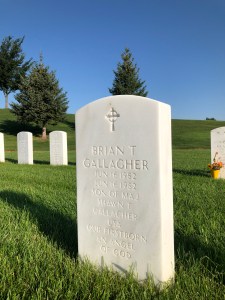
Those of you who have been following this blog know that over the summer I was put in touch with a group of people dedicated to telling the story of baby Brian Gallagher, an infant who died shortly after his birth but whose body was discovered to be apparently incorrupt 37 years after his burial. Because Brian was not baptized before he died, the story raised the question of the eternal destiny of babies who die before baptism and my work on baptism of desire.

That story has started to get attention in several Catholic media outlets, and last week I had the chance to talk about baptism of desire on Real Presence Radio; you can listen to the interview here .

Hats off also to Dr. Kody Cooper for his opinion piece about baptism of desire and infants on the Word on Fire site. The author comes to similar conclusions to my own, arguing that baptism of desire is the best theological doctrine with which to consider this tough case, even citing Cardinal Cajetan who I discuss in my book . Baptism of desire seems to me a superior approach to what the author calls the “post-conciliar view,” which means hoping that the babies will be saved while remaining agnostic about the means. This approach, it seems to me, has two serious flaws. It seems to invite hope in a kind of divine Plan B which turns out to be more effective than those means revealed to us by Jesus. Revelation, then, seems not so revealing. At the same time, precisely because whatever those means happen to be can’t be found in revelation, such hope remains necessarily vague and not particularly well-grounded.

Baptism of desire, on the other hand, identifies our grounds for hope in the Church’s sacramental practice — the practice of a sacrament instituted by Jesus Christ and declared by him to be necessary for salvation (John 3:5). I posted a brief description of my position on the question here a few weeks ago.

Continue reading “Baby Brian’s story and baptism of desire”

Summer articles

The October start of the Roman academic year means that I am wrapping up my time in the States before heading home (and back to work!) next week. Nonetheless, I haven’t been idle over the course of the summer. In addition to seminars and retreats, I published a couple of articles which might be of interest.

First Things asked me to weigh in on the questions surrounding transsexuals and the sacrament of baptism: Can Transsexuals Be Baptized?

America magazine also published a long-planned article on baptism of desire, in which I distinguish the implications for evangelization of my position from those of two other people I admire but (partially) disagree with: Is there salvation outside baptism? A better way of looking at a difficult question.

The relationship between salvation and evangelization, however, is only one of the difficult questions my book addresses. I also suggest a new approach to the question of unbaptized infants and children dying in utero. This summer, I was contacted by some folks involved in ministry to Catholic parents who have lost children either through miscarriage or in early infancy. I found a quite enthusiastic reception for my work among those who are involved in this kind of grief ministry, and, a week ago, a group of the faithful put up a statement online in support of the position that I advance in my book: that baptism of desire can, in some cases, apply to the children of Christian parents. You can find this statement in support of the development of doctrine I outline here and sign if you wish: A Statement of Hope regarding Salvation through Baptism of Desire for Infants.

The statement also mentions the case of baby Brian Gallagher, whose grave I visited at Black Hills National Cemetery. On the outskirts of the cemetery I snapped a photo of a quintessentially American scene: a giant flag waving from a piece of heavy machinery with the Western landscape in the background. What else is there to say but, God bless the USA!

Celebrating St. Kateri in South Dakota

July 14 is an important day for Native American Catholics: the feast day of St. Kateri Tekakwitha (1656-1680). St. Kateri’s life was characterized by courage and fidelity in the face of great suffering. She lost her parents to a smallpox epidemic as a girl, and the disease left her scarred for life and with damaged eyesight. At twenty, she converted to Catholicism and, as happens to many converts, suffered hostility for doing so. But she lived an exemplary life as a Christian, dedicating herself to caring for the sick and elderly, prayer, and devotion to the Eucharist.

In 2012, Kateri Tekakwitha, the “Lily of the Mohawks,” became the first canonized saint to hail from one of the Native tribes of North America. Her canonization by Pope Benedict XVI coincided with my time working on the Rosebud Indian Reservation in South Dakota, a deeply formative experience in my own life as a Jesuit. I knew many Lakota Catholics who had spent years praying for Kateri’s canonization, and it was a joy to be with them when the day finally came. I remember very well the beautiful Mass we celebrated in St. Charles Borromeo Church on St. Francis Mission — and the feast that followed.

St. Charles Church was recently the subject of a news segment produced by South Dakota Public Broadcasting. It is a remarkably beautiful church–recognizable on the plains for its distinctive purple color. First-time visitors stepping inside often remark on how they never expected to find such a treasure on the prairie. Its combination of Lakota art with traditional church architecture is, in my opinion, a terrific example of successful inculturation.

I was delighted when I watched the SDPB segment to see it narrated by Deacon Ben Black Bear, an expert in Lakota language and culture and a man of deep faith and spiritual insight with whom I had the honor of working on Rosebud.

If you’re looking for a way to celebrate the memorial of this great and humble saint, spend a couple of minutes watching Deacon Ben describe St. Charles Borromeo Church here:

And if you’re anywhere between Murdo, South Dakota and Valentine, Nebraska, take a detour to check out this gem of a church in person!


If you haven’t already done so, consider subscribing to this blog:

Pope Leo: an ever-ancient, ever-new beginning for the Church

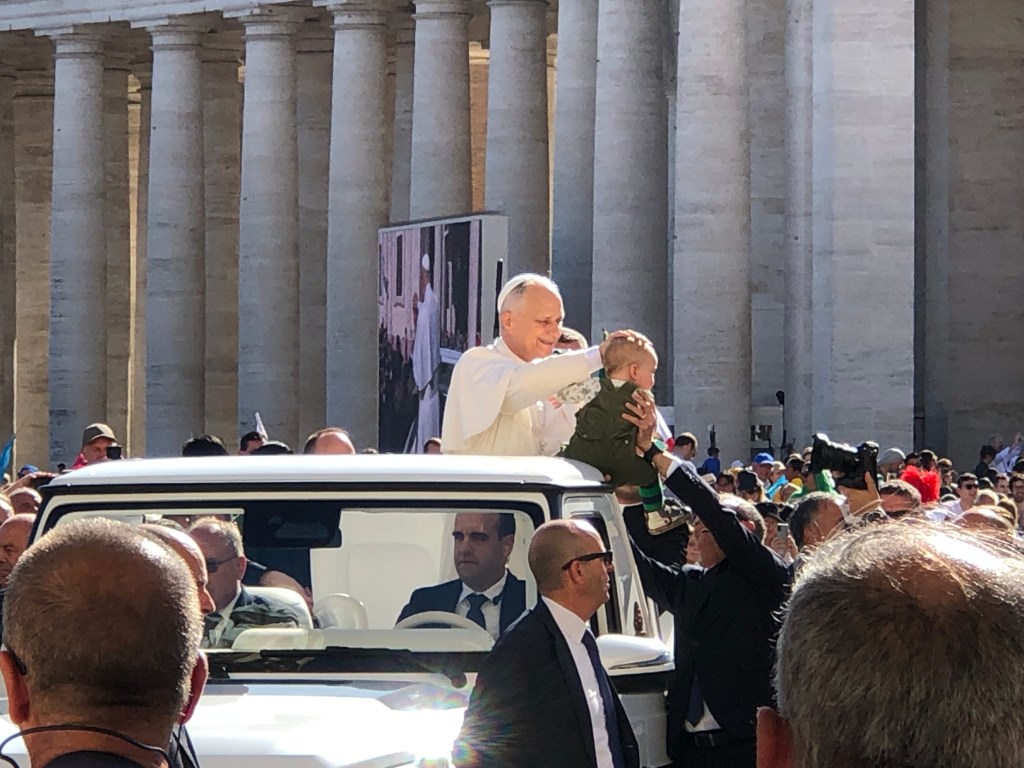
Just over a week ago I stood among the throng in St. Peter’s Square waiting for Pope Leo XIV’s Mass of installation. As the new pope emerged on the back of a white truck and made the rounds through the square, one of the priests who was with me to concelebrate whispered, “It still feels surreal.”

It still does.

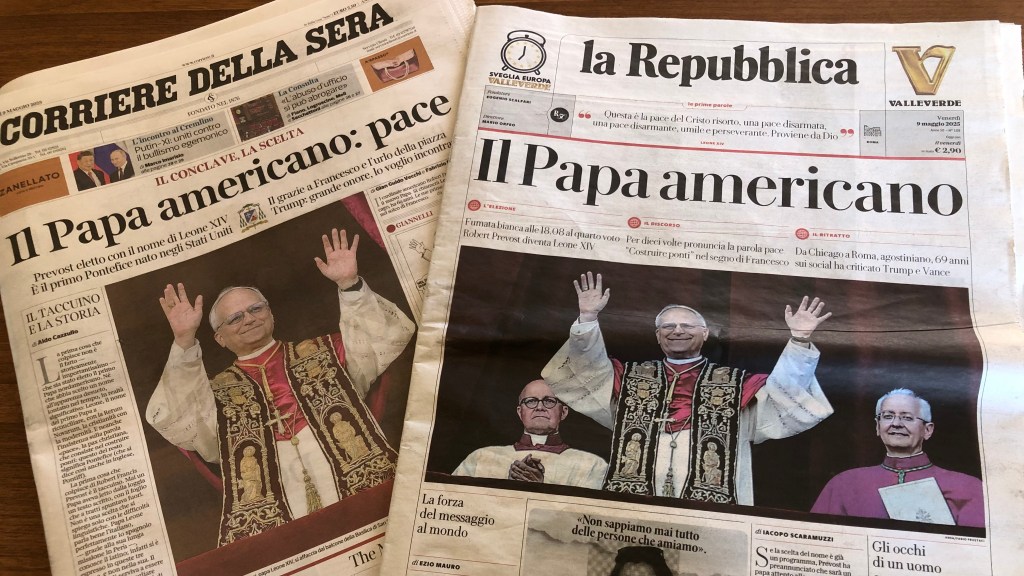
The one iron-clad rule of papal elections, after all, used to be that the cardinals would never elect an American pope. And now we have a pope who grew up cheering for the Chicago White Sox. Going into the conclave, the Church seemed tired and divided. Yet Pope Leo has managed to evoke good will on all sides, and he hasn’t had to resort to any particular gimmicks to do so. Rome is elated.

What is perhaps most striking about our new Holy Father is the paradoxical way in which he seems both totally at ease in his new role–as if he’d been pope-ing for years already–and at the same time totally unassuming. One could imagine sitting next to him at a baseball game and him introducing himself as “Bob from Chicago.” At the same time, seeing him on the balcony of St. Peter’s Basilica or meeting world leaders in the robes of his office, one senses the quiet dignity of a successor of the Apostles.

A lot has already been written about Pope Leo on the basis of relatively scant pre-conclave writings and interviews. I was particularly impressed by the first homily he gave to the cardinals after his election. His brief address to the Synod of Bishops on evangelization more than a decade ago equally impressed me because he seemed to grasp one of the central problems facing the Church: the role of the media in communicating–and sometimes miscommunicating–our message. I remember an interview given by the late Cardinal Avery Dulles to Charlie Rose, in which the cardinal observed that the biggest problem faced by the Church was that most Catholics learn what they know about Catholicism not from the Church herself, but from the media. Leo XIV understands that dynamic–and he is alert to the equally challenging frontiers now being opened by artificial intelligence.

Continue reading “Pope Leo: an ever-ancient, ever-new beginning for the Church”

Build back baptistries! A trip to the Baptistry of San Giovanni in Fonte

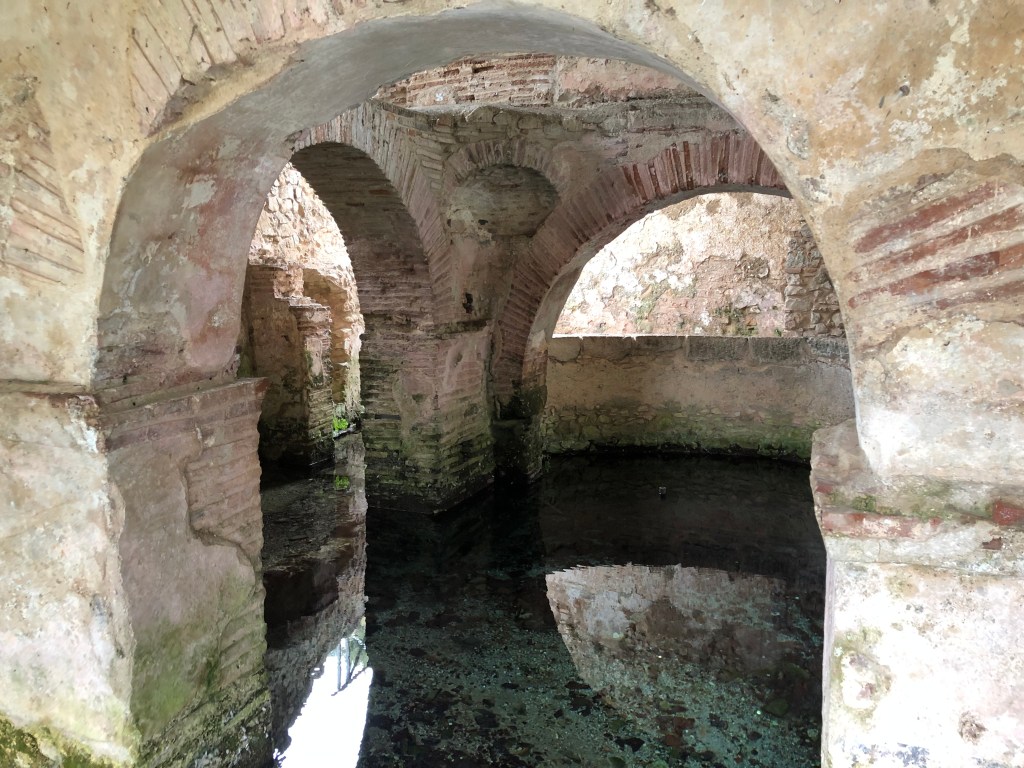
An unexpected discovery on my recent trip to Italy’s Cilento was the Baptistry of San Giovanni in Fonte, just outside of Padula. Also known as the Battistero Marcelliano, after Pope Marcellus, it dates from the fourth century, putting it among the oldest Christian structures in the world. A letter from Cassiodorus in AD 527 mentions a miracle occurring at the baptistry, its water level rising unexpectedly while a priest was pronouncing the prayer over the baptismal waters on the vigil of the feast of St. Cyprian.

Battistero di San Giovanni in Fonte, Paula, Italy

The structure itself sits on the site of a natural spring, so the baptismal font was a pool of “living” water. The baptistry was built on the ruins of an earlier pagan structure and underwent several renovations and expansions throughout history. Hints of a fresco, dating from the 11th century when the structure was converted into a chapel, remain on the wall. The remains of still earlier frescoes from the 6th and 7th centuries were removed and taken to a local museum.

Rising water levels caused the chapel to be abandoned in the 19th century, though the site of the remains and spring, down a winding country road, are quite a pleasant spot today.

This reminder of baptism from Christianity’s earliest days is worth reflecting on during the Easter season. I discuss some of the theological and practical consequences of the shift away from the patristic catechumenate and toward near-universal infant baptism in the Christian cultures of the Middle Ages in Baptism of Desire and Christian Salvation, but the subject is worth more reflection than what I’m able to give it there.

Reflecting on early Christian baptismal practices is important because we are moving into a new phase in Christian history that in some ways will more closely resemble the Church of the Fathers — in which Christianity was a minority — than medieval Christendom. Some of our sacramental practices, I am convinced, will have to shift to respond to this new reality. This may not be entirely a bad thing. When it comes to baptism, for example, too often the sacrament, celebrated in a minimalistic way, has become a mere formality with little connection new life in Christ.

Continue reading “Build back baptistries! A trip to the Baptistry of San Giovanni in Fonte”

Susanna and the wicked judges

Monday of the fifth week of Lent brings one of the Bible’s great courtroom dramas — the story of Susanna and the elders from the Book of Daniel. It’s one of the longest readings in the lectionary, but one that deserves to be read with relish. An innocent woman does what is right even at the cost of her life. Two powerful and corrupt men, overthrown by lust, suppress their consciences, and compound debauchery with vindictiveness. And a lone idealistic voice, indignant at the injustice of the crowd, speaks out — and the old goats are snared in the net they’ve woven.

Susanna and the Elders, Guercino, 1617

There’s something refreshing about the story. It’s not hard to tell the bad guys from the good gal, and for once justice is throughly vindicated. A few weeks ago in my post about Guercino, I mentioned the baroque era’s love of drama (one might be excused for saying “melodrama”). I was happy to see Guercino take up the story of Susanna. Quite a lot could be said about tale — the Lord hears the cry of the innocent even when everyone else seems deaf — but it is, first of all, a great yarn. As we look forward to Holy Week, Susanna’s travail is a reminder that, even if it doesn’t always happen quickly — or even in this life — justice will ultimately prevail.

Susanna and the Elders, Guercino, 1617

The Church of Sant’Agnese in Agone

Sant’Agnese in Agone, Rome

This week’s liturgical calendar includes two prominent–and very different– Roman martyrs. The first, St. Sebastian, a third century soldier originally from Milan, was sentenced to death after converting to Christianity. Tied to a column, he was shot through with arrows but miraculously survived and was nursed back to health by a Roman matron named Irene. He went right back to preaching and, after warning the Emperor Diocletian to repent–a gutsy move if there ever was one–was beaten to death and thrown into Rome’s sewers.

No less courageous, St. Agnes sought to dedicate her life entirely to God while very young. This meant refusing the advances of several powerful suitors, who were enraged by the rejection. Agnes’s pagan father sided with the suitors. She was humiliated, even dragged naked through the streets of Rome, burnt at the stake and when that failed–as with the first attempt to kill St. Sebastian–eventually beheaded.

The courage of such martyrs–one a solider, the other a mere girl, barely a teenager–is fundamental, I think, to appreciating the full significance of Christian faith in eternal life. At least some of the ennui that one can perceive in the Church over the past several decades perhaps comes from deemphasizing the witness of the martyrs just when we need it most.

Continue reading “The Church of Sant’Agnese in Agone”

Post-election thoughts from Rome

Augustus Caesar in the robes of supreme pontiff, Palazzo Massimo, Rome

As a follow up to my piece at The Catholic Thing on elections as civic rituals, America magazine asked me to reflect on how the US Presidential election looked from Rome. So here are my thoughts from an election morning walk to the Mausoleum of Caesar Augustus: Caesars, presidents and apostles: Viewing the presidential election from Rome. I was happy to see some pieces of our election rituals restored this time around; President Biden’s invitation of President-elect Trump to the White House was a gracious moment, more important as a symbol than because of anything said between the two men.

With the election now behind us, I also thought it worth sharing what for me was one of the more interesting–even edifying–reflections to come out of campaign. When he converted to Catholicism, Vice-President-elect JD Vance penned a thoughtful account of what led him to the faith in The Lamp (where yours truly has also published). Regardless of what you think of his politics, it is refreshing to read about a public figure’s faith journey, both personal and intellectual. I was particularly interested to read about the role René Girard’s work played in Vance’s conversion. From 2020, “How I joined the resistance” is worth a read.


Those who weren’t able to be at the book launch of Baptism of Desire and Christian Salvation last month might be interested to read Jonathan Liedl’s account of the event–with a tie-in to one of Rome’s most unique Jesuit relics–in The Catholic Spirit: What a severed arm can tell us about evangelization. A reminder that the discount code CT10 gives 20% off on new releases when purchasing directly from the CUA Press website. The book is also available on Amazon and seems to be in stock again. In Italy, it might be faster to order through IBS or La Feltrinelli. The Libreria Sole across from the Gregorian University was also supposed to order copies. I hope to have a video of the talks from the book launch up on the Baptism of Desire page soon.

Launched: book, articles, interview

Baptism of Desire and Christian Salvation is now in orbit after an excellent turnout at the official book launch at the Gregorian last Thursday. More good news: the code CT10 still gives you a 20% discount if ordering the book directly from Catholic University of America Press. At the presentation of the book, Fr. Joseph Carola gave an overview of its content and shared some stories from personal experience to illustrate its pastoral relevance. Fr. Bob Imbelli drew on other contemporary thinkers, such as Khaled Anatolios, Charles Taylor, and William Cavanaugh to demonstrate its relevance. I hope to have video of the presentations up on the Baptism of Desire page soon.

Fr. Joseph Carola, S.J., Fr. Robert Imbelli, Fr. Anthony Lusvardi, S.J.

Just a week before, I was also pleased to talk about the book with my old friend Sean Salai at Catholic World Report. Read the interview here: Defending the necessity of baptism: An interview with Fr. Anthony Lusvardi, S.J.

On another note, in this month’s First Things I return to an issue I raised a few years ago in an article in America magazine, the effects of technology on the liturgy. Here’s the new article: “Screens and Sacraments.” The original from 2020 is here.

And, finally, if you’re looking for some pre-election reading that isn’t about either Donald or Kamala, but instead about the way voting functions as a civic ritual, check out my latest at The Catholic Thing: “Rites (and Wrongs) of Democracy.