Weight-lifting for the Assumption: homily for Mary’s Assumption

Homily for the Solemnity of the Assumption of the Blessed Virgin Mary

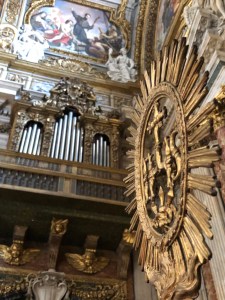
Santa Maria in Trastevere, Rome

If you are looking for an appropriate way to observe today’s Solemnity of the Assumption of the Blessed Virgin Mary, may I suggest weight-lifting.

Today’s feast is a celebration of strength.  The strength we celebrate today is more than that shown by Olympic weightlifters—though it includes a little of that—more than the moral strength of a figure like Rosa Parks—though it includes that too—more than the geo-political strength projected by a squadron of B-21 bombers—though that’s not absent either.  Add to all of these the strength of a cosmic force—like the gravity of the sun or the moon tugging at the tides—and you get an idea of the strength we’re dealing with. 

Continue reading “Weight-lifting for the Assumption: homily for Mary’s Assumption”

Not peace, but division: homily for the twentieth Sunday of Ordinary Time

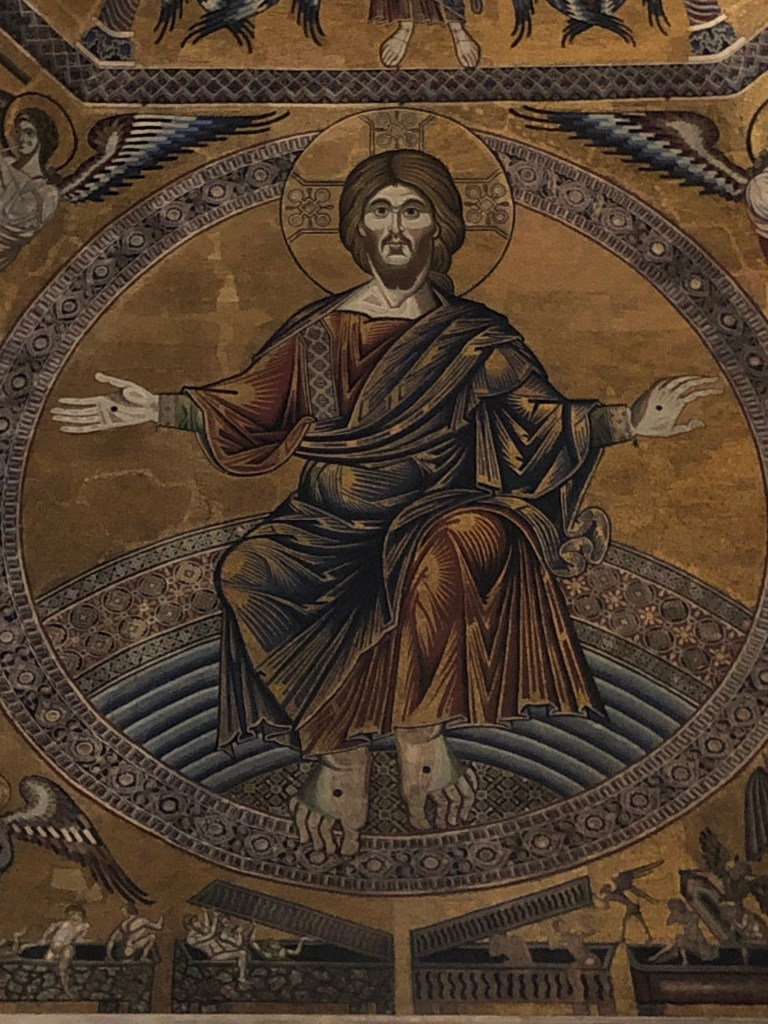
Baptistry, Florence

Homily for the 20th Sunday in Ordinary Time (C)

Politicians frequently claim to be uniters, not dividers.  If you wanted proof, therefore, that Jesus was not a politician, look no further than today’s Gospel: “Do you think that I have come to establish peace on the earth?  No, I tell you, but rather division.”

Political promises of unity, of course, come cheaply; sometimes they simply mean, “If you disagree with me, I’ll accuse you of being a divider.”  In today’s Gospel reading, however, Jesus makes a move never recommended by any political consultant: he preemptively accuses himself of bringing division.  Other than the desire to put centuries of future homilists in a very awkward position, why would Jesus do this?

Continue reading “Not peace, but division: homily for the twentieth Sunday of Ordinary Time”

Baptism, before and after: homily for the 17th Sunday of Ordinary Time

Homily for the seventeenth Sunday of Ordinary Time (C)

Today’s three readings can be read as something like before and after photos.  Not, however, photos advertising a particular diet, plastic surgery, or hair cream.  The middle reading, St. Paul’s letter to the Colossians, mentions one of my favorite subjects, baptism.  The first reading and the Gospel give us the before and after of baptism.  

But before we get into the evidence of baptism’s effects in these before and after readings, take a look again at how St. Paul describes the first sacrament in Colossians: “You were buried with him in baptism, in which you were also raised with him through faith in the power of God, who raised him from the dead.”  Baptism means both death and life.  It means participating in the Paschal Mystery of Jesus, dying with him in order to rise with him.  You may already have heard me say that I think we lose something if we only think about baptism in terms of babies and don’t remember the way that the sacrament was celebrated in the early Church.  Then baptismal fonts were below floor-level and deep enough for adults being baptized to step down into and be fully immersed.  

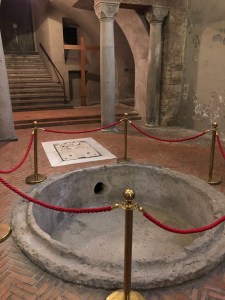
Ancient Christian baptistry, Naples

Baptisms, in other words, were really dramatic events.  In Colossians, Paul uses dramatic language—the bond of our guilt, he says, is obliterated and nailed to the cross.  In Rapid City, we know the dramatic effects of water.  After a dry and scorching week, we remember that water brings life.  But we also know that in 1972 this city was destroyed by flood—in fact, this church was built here after the original St. Isaac Jogues was washed away.  The Bible uses two very different sets of images to talk about baptism: the water represent both the tomb, because it means being buried with Jesus, and the womb, because baptism is a second birth.  

Continue reading “Baptism, before and after: homily for the 17th Sunday of Ordinary Time”

Abraham’s promises: homily for the sixteenth Sunday in Ordinary Time

Homily for the sixteenth Sunday in Ordinary Time (C)

This morning, I want to talk about Abraham.  For many of us, perhaps, Abraham is like one of those distant relatives your grandmother mentions occasionally but you’re never quite sure how you’re related.  Fortunately, it’s easy to see how Abraham fits into the family tree.  He’s at the top—Abraham is the patriarch, the father of the Jewish people and also, according to the New Testament, the father of us all in faith.

Caravaggio, Sacrifice of Isaac, Uffizi Gallery, Florence

We find Abraham’s story in the book of Genesis.  He lives in that period in history after the fall, when the sin of Adam has left humanity existentially disoriented.  It’s the era of Cain and Abel, the Tower of Babel, Noah and the Flood—man is lost, and every turn he makes only worsens his desolation.  When I was in the Peace Corps, I was once heating a bucket of water with an electric coil, which was, shall we say, not up to OSHA standards.  And without noticing that the plastic safety handle around the coil had melted, I picked it up and gave myself a shock.  And in the moments after the shock, everything was fuzzy, and I couldn’t quite tell what had happened or what I was doing—so I picked it up and shocked myself again.  And that’s kind of what original sin did to mankind.

Continue reading “Abraham’s promises: homily for the sixteenth Sunday in Ordinary Time”

Pentecost Homily

The feast of Pentecost holds a special place in my heart because I presided at my first Mass on Pentecost Sunday. This year is the fifth anniversary of my ordination, so, for kicks, I dug up my homily from that Mass and thought I’d repost it here. A lot has happened since that day, yet in some ways it still feels like yesterday…

Pentecost Sunday 2017, Marquette University chapel

I’ll begin with homework.  Today’s first reading from Acts 2 tells the story of Pentecost, but it’s just the beginning of the story of Pentecost.  So on your i-Phones on the drive home, pull up Acts of the Apostles and read all of chapter 2.  (Unless you’re driving.)  

Now, since in my 22 years of formal education I have noted that occasionally students don’t do their homework, I will go ahead and tell you what happens in Acts 2.  The part we heard this morning takes place after Jesus had risen from the dead, appeared to his disciples for 40 days, and then ascended into heaven.  One thing I don’t think we realize when we talk about Easter is how disoriented the disciples were even after Jesus rose from the dead.  The Resurrection doesn’t immediately bring understanding to the disciples.  If you read all of John 20, the chapter from which today’s Gospel is taken (extra credit), you’ll note that even after the Resurrection there’s still disbelief, confusion, and fear.  Mary Magdalene meets Jesus but mistakes him for a gardener.  Then, when she realizes who it is, she won’t let go of him—to the point that Jesus has to tell her, “Stop holding on to me.”  After the horror of the crucifixion, we can understand why the disciples would be fearful and why Mary Magdalene wouldn’t want to let Jesus go.  But Jesus says he has to go to do something necessary for the disciples.  He promises that when he has ascended to the Father, he, with the Father, will send the Holy Spirit to the disciples.  

Continue reading “Pentecost Homily”

Truth and love in time of conflict: Homily for the Fourth Sunday in Ordinary Time

Homily for the fourth Sunday in Ordinary Time (C)

Today’s readings are not for the conflict-averse.  Today’s world is not for the conflict-averse, either.  Within our communities and families, we experience conflict over vaccines and politics.  Irresponsible political and media actors seem intent on increasing racial conflict.  In the Ukraine, armed conflict threatens.  But, as even the Bible demonstrates, the world has never been a conflict-free zone.

Conflict is a part of the human reality Jesus entered into.  Conflict is not always bad, either. Political conflicts between big states and small states produced the checks-and-balances of the American Constitution.  Theological conflict has led to doctrines that give us deeper insight into the nature of God.  We wouldn’t have a Creed if there hadn’t first been disagreements about the Trinity. The fact that sometimes we disagree doesn’t make us bad Christians.

Continue reading “Truth and love in time of conflict: Homily for the Fourth Sunday in Ordinary Time”

One Body, many witnesses: Homily for the Third Sunday in Ordinary Time

Homily for the 3rd Sunday of Ordinary Time (C)

In today’s second reading, St. Paul warns us of autoimmune disease.  An autoimmune disease, as you may know, is when the body attacks itself, one of its own parts.  It’s a self-destructive disease.  Last week we heard Paul tell the Corinthians, who had been squabbling over who had the better gifts, that all these different gifts come from one Spirit.  One Spirit, many gifts. 

Today Paul continues the same theme with the analogy of the body.  The Church is like a body, with different parts—eyes and ears and limbs and so on—and if jealousy between these parts enters in and the eye stops seeing because it wants to hear, and the legs stop walking because they want to see, and the lungs stop breathing because they want to walk, then pretty soon instead of a body you have a corpse.  It is one of the most important metaphors in the Bible, and this morning I’d like to focus on two implications of this metaphor.  The first is that bodies share common goods.  And the second is that the Body of Christ is meant to be alive.  

Continue reading “One Body, many witnesses: Homily for the Third Sunday in Ordinary Time”

One Spirit, many gifts: Homily for the Second Sunday in Ordinary Time

Homily for the 2nd Sunday in Ordinary Time (C)

St. Isaac Jogues at sunrise.

This week I stopped at the store to purchase a box of wine.  Just in case there was another quarantine, I wanted to make sure I had enough on hand to celebrate Mass.  Also, like the miracle at Cana, I wanted enough left over for dinner.  Coming out of a box, however, I’m not sure that anyone would say, “You saved the best for last.”

There’s something a little bit lighter in today’s Gospel story.  Usually, Jesus’ miracles involve healing grave ailments—leprosy, paralysis, even death—but the miracle at Cana begins and ends at a party.  At most Jesus’ intervention saves the new bride and groom from a social embarrassment.  The miracle also seems a bit off script, not what Jesus had in mind.  It’s his mother, after all, who intercedes for the couple and then doesn’t take no for an answer.  When Protestants object to Catholics praying for Mary’s intercession, I point out that all we’re doing is repeating what happened at Cana.  Nobody knows what Jesus is capable of better than Mary.

Continue reading “One Spirit, many gifts: Homily for the Second Sunday in Ordinary Time”

Baptism by fire: Homily for the Baptism of the Lord

Homily for the Baptism of the Lord (C)

“One mightier than I is coming… He will baptize you with the Holy Spirit and fire.”  Put aside for a moment everything you think you know about baptism, and imagine you are hearing John the Baptist’s words for the first time.  You’ve seen John calling sinners to repent, warning of punishments to come if they don’t, and then dunking them in the Jordan River as a sign of conversion.  And now he says a mightier one is coming, who will use fire instead of water.  Is it a promise or a warning?

Continue reading “Baptism by fire: Homily for the Baptism of the Lord”