Christ made visible in his martyrs: Homily for the 7th Sunday of Easter

I’m pleased and honored that the Homiletic and Pastoral Review asked me to provide homilies for the Sundays of June this year. You can find the full text of all the month’s homilies here. (Regular readers might note that the homilies may not be as fleshed out as usual since they are meant to be adapted.) Be sure to visit the HPR site and check out the other articles, reviews, and fine catechetical materials they provide. Below, to give you a taste, is a homily for the Seventh Sunday of Easter (for those places where the Ascension is celebrated on its proper Thursday).


Homily for the Seventh Sunday of Easter (C).

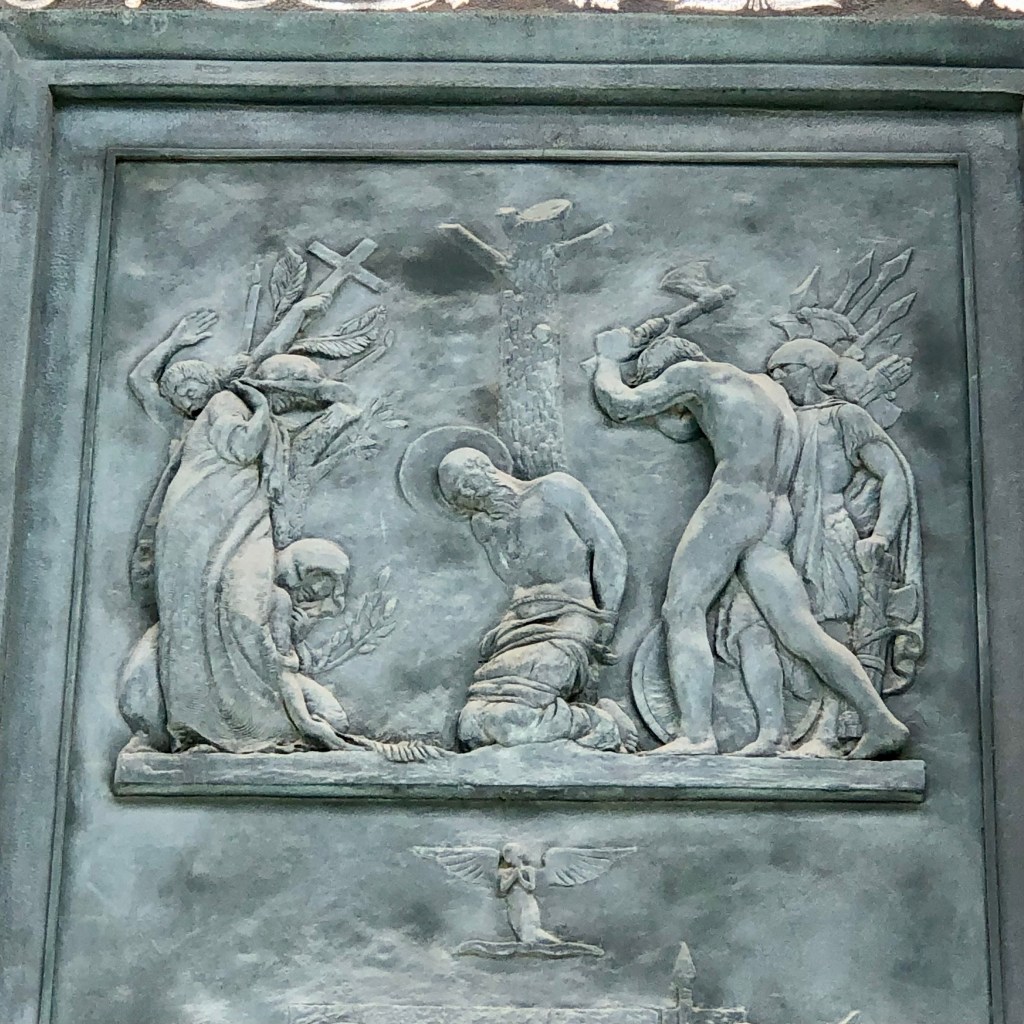
Chapel of St. Stephen, Certosa di San Lorenzo, Padula, Italy

Nowhere is Jesus Christ more visible than in his martyrs.  In the Gospel of John, Jesus, who makes the Father visible to the world, prays that his disciples may be in him and he in them.  In today’s first reading, we see God become dramatically visible in the life of one of those disciples, the deacon Stephen.

First, however, Stephen gazes on God.  He sees Jesus standing at the right hand of his Father in the heavens.  This vision is made possible by the action of the Holy Spirit, already present in Stephen’s life.  In the first part of the chapter from which today’s reading is taken, Stephen delivers a sermon which is both learned and fiery, retelling the story of Israel from a Christian point of view and leveling a hard judgement against the men of Jerusalem who crucified Jesus.

Continue reading “Christ made visible in his martyrs: Homily for the 7th Sunday of Easter”

What to do when you don’t have a pope? Preach Jesus Christ

Homily for Wednesday of the Third Week of Easter.

Brothers and sisters, papam non habemus. We do not have a pope. Not yet.

We live in uncertain and, often, disturbing times. I’m not talking only about the sede vacante in the Church of Rome. The last few years–the last few decades, really–have been a difficult time for the Catholic Church. The Church sometimes seems confused and divided from within, and opposed by powerful forces from without. And today we also live with all the uncertainty of a papal election.

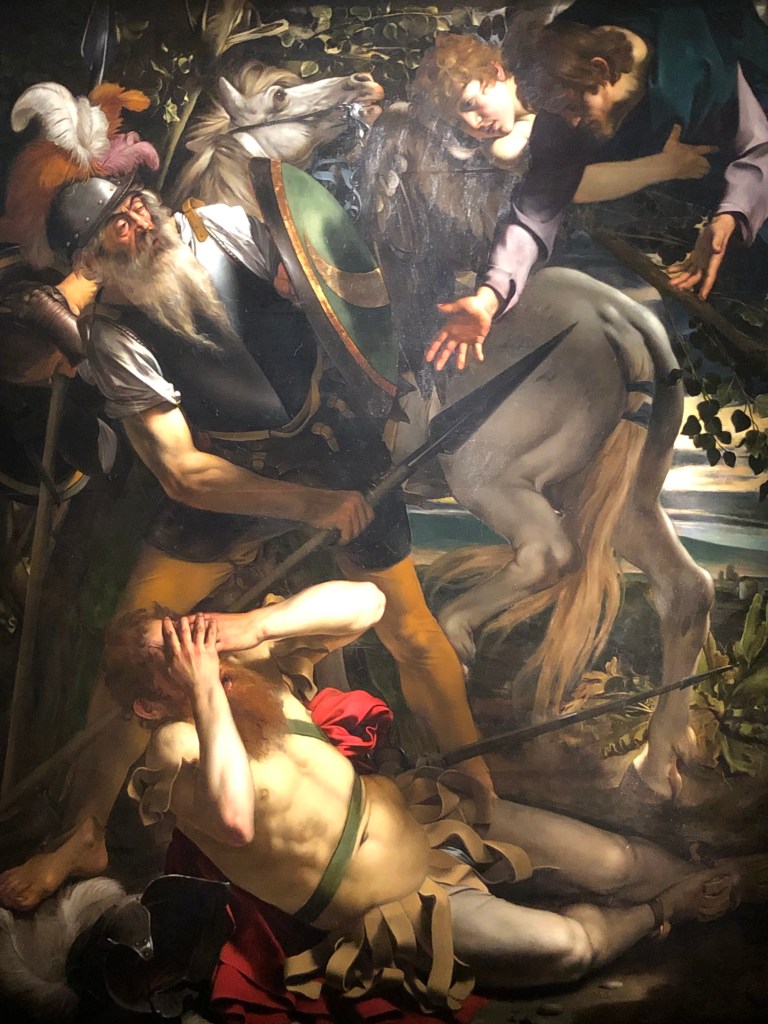
In this uncertain moment, today’s first reading reminds us of a simple but profound lesson: things have been worse. Much worse. Here we see the Church at its very beginning, tiny and persecuted. Stephen, one of the first deacons, has just been killed. The faithful are scattered. Those who persecute the Church are full of zeal, backed by the age’s political powers in all their strength. It seems like a catastrophic moment for the nascent Church, but it becomes a moment of triumph, a moment of growth. The dispersion of the faithful–even if caused by persecution–becomes the condition for the spread of the Word. Soon, we know, even the great persecutor, Saul, will convert and become the greatest missionary in the history of the Church.

Caravaggio, The Conversion of St. Paul, 1600-1

What I most want to emphasize today is the response of the disciples, who transformed this apparent catastrophe into a moment of growth: They continued to preach Jesus. Without panic, without discouragement. They returned and remained steadfast in the most fundamental mission of the Christian: to bear witness to the life, death and resurrection of Jesus Christ.

Today’s Gospel reading also calls us back to the heart of our Catholic faith: “I am the bread of life,” says Jesus. There is no action more important for the Catholic than to encounter the Lord in the Eucharist, in his true body and in his true blood.

Brothers and sisters, despite our anxieties and our doubts, despite the moments of uncertainty that alternate with moments of glory in the life of the Church, this message remains our rock. If we continue to proclaim it, we cannot go wrong. In a few days we will have a new pope, but our mission will not change. Times change. Popes change. Jesus Christ does not change.

Jesus Christ is the bread of life. Jesus Christ is Lord.

Readings: Acts 8:1b-8; John 6:35-40

(Original: Italian)

May 7, 2025

Gregorian University Chapel, Rome


Those interested can see my interview on the CBS Evening News with Maurice Dubois here.

Entering the tomb: a homily for Easter

This Homily for Easter Sunday comes from 2019 and was given just a few days after the fire at Notre Dame Cathedral in Paris — thus the reference to the rose window at the end. Seems appropriate this year when Notre Dame has been reopened…

Occasionally the most erudite theologians overlook the most obvious things. This morning’s gospel contains a curious detail that has provoked a great deal of discussion among theologians: why do Mary of Magdala and John, the other disciple, not enter the tomb? Mary sees the stone removed from the tomb and returns to the apostles. John, running and perhaps a bit younger than Peter, arrives at the tomb first, but remains outside. Why? Biblical exegetes have explained this event symbolically–maybe John represents prophecy and Peter represents the institutional Church–but in my opinion the reason is simpler.

It’s a tomb. They were afraid.

Sometimes the simplest explanations are also the most profound. We know that Jesus is risen–maybe this announcement has become too familiar and gets taken for granted–but at that moment Mary, John and Peter did not have that advantage. We must imagine their psychological state that morning. Two days ago, they had seen the humiliation and killing of their Lord, teacher and friend at the hands of evil men. We must imagine the darkness of those days, when violence, lies and selfishness defeated the truth.

Continue reading “Entering the tomb: a homily for Easter”

The Anointing at Bethany and Holy Week’s unsettling beginning

Going through some old files, I came across this homily for the Monday of Holy Week, written, in my younger and more vulnerable years, when I was a novice in St. Paul, Minnesota.

St. Mary Magdalene penitent, Guercino 1622

During the Third Week of the Spiritual Exercises, St. Ignatius asks us to contemplate the suffering and death of Our Lord.  This week, Holy Week, the Church, liturgically, asks us to do the same.  The Third Week is one of the times in the Exercises when we ask for strange graces—shame, sorrow, confusion.  

The Church’s liturgy also evokes these troubling graces, and it does so by, among other things, confronting us with today’s passage from John, the Anointing at Bethany.  The shock this passage should provoke in us is perhaps diminished by its familiarity, but if we really deeply consider what is happening here, then we should be confused.  We should be confused because part of us is tempted to side with Judas.  

Three hundred days wages!  Put in contemporary terms this must amount to something like $30,000, $40,000, $50,000—enough for college scholarships for one or several years, or private high school scholarships for several students; in some Third World countries that much money could build a school.  And instead it is being spent on a jar of ointment.  An expensive perfume.  An ostentatious toiletry.  

Continue reading “The Anointing at Bethany and Holy Week’s unsettling beginning”

Seeing truly, judging clearly: homily for the eighth Sunday of Ordinary Time

Homily for the 8th Sunday of Ordinary Time (C)

St. Luke, 13th century, Old St. Peter’s, Rome

I have to admit that the opening of today’s first reading, “When a sieve is shaken, the husks appear; so do one’s faults when one speaks,” is not the most encouraging thing to read when one has to give a homily.  Both the words of Sirach and Jesus’ sayings in the Gospel of Luke deal with what is inside a person and what becomes visible to others, what we see and what we don’t.  The first reading is a warning about putting too much faith in outward appearances.  Someone might have all the right credentials, but little wisdom; someone might repeat all the fashionable phrases, but say nothing of substance.

The test that Sirach proposes to separate the trustworthy from the slick shyster is tribulation.  “As the test of what the potter molds is in the furnace, so in tribulation is the test of the just.”  It is easy to follow Jesus when he tells us what we want to hear, less so when we might lose friends because of what he says.  Fidelity doesn’t mean much when it comes without a cost.  Imagine marriage vows modified to promise faithfulness “in good times but not bad, in health but not sickness, wherever I find my bliss.”  It’s only when the going gets tough that faith, hope, and love show their worth.

Jesus adds another criterion for distinguishing the enduring truth from the well-dressed lie: you shall know the tree by its fruit.  You may have heard people say, “It’s really what’s inside that counts.”  Jesus pours a bit of cold water on such sentimentalism.  If what’s inside produces thorns, then it can’t really be all that good.  Again and again in different ways Jesus calls for the unity of what is inside with what is outside, opposing any division between interior and exterior religion—challenging us to confess his name with both our words and our deeds.

Jesus again and again challenges us to purity of heart, which means purity all the way through—in our thoughts and in our words, in what we do, and what we chose not to do.  In the Beatitudes, Jesus promises that the pure in heart will see God.  Sight, interestingly, is also at the center of today’s Gospel reading.  The blind lead the blind into a pit, and we notice the splinter in our brother’s eye but not the beam in our own.  But that image showing the absurdity of hypocrisy also comes with an instruction and a promise: “Remove the wooden beam… then you will see clearly.”  

Continue reading “Seeing truly, judging clearly: homily for the eighth Sunday of Ordinary Time”

Simeon and Anna, prophets of hope: homily for the Presentation of the Lord

Ludovico Carracci, Presentation of Jesus in the Temple, 1613-1616

Homily for the Presentation of the Lord (C)

Simeon and Anna appear so briefly in the Gospel that we might almost miss them.  They are a part of the story of the life of Jesus for just a few minutes, yet the few words that Luke writes about them reveal two remarkable lives.  It is especially moving, I think, to reflect on those lives in this Jubilee year because in Simeon and Anna we feel the challenge of hope.

Neither Simeon nor Anna, it seems, lived an easy life.  There is a tiredness in Simeon’s words after he takes the baby Jesus in his arms: “Now, Master, you may let your servant go in peace.”  Simeon had received a special revelation that he would not see death before he had seen the Messiah, and his words hint that it might not have been easy to hang on until that moment.  Perhaps you know of friends or relatives who have held on to life to see one special event—a wedding or a graduation or the birth of a child—and then let go soon after.  I think of a dear friend whose grandfather passed away minutes after watching his ordination, and I think there is something of that letting go—with gratitude for one last precious gift—in Simeon’s words.

But Simeon, too, still has something to give in that moment.  Today his words form part of the Church’s Night Prayer, and his prophecy to Mary would stay with her in the decades ahead.  To the blessing he received, Simeon responded with a blessing.

There is something moving, too, about what just a glance of God’s glory means for Simeon.  After all, he sees the Messiah only as a baby.  He will never hear the Sermon on the Mount, see Jesus cure the sick or raise Lazarus; he will never receive the sacraments; and, though his words to Mary allude to the crucifixion, he himself will not be there.  His eyes do see the salvation God has prepared in the sight of all the peoples—because salvation is Jesus Christ—but only just barely.  And that’s enough.  Jesus, before he can speak, before he can walk—but present—is enough.  Simeon has lived his life in hope for the moment that we see in the Gospel, and yet that hope fulfilled is itself a promise of more to come.  He is led from hope into hope, I suppose, much as our celebration of the Eucharist leads us to hope for the banquet promised us in heaven.

Continue reading “Simeon and Anna, prophets of hope: homily for the Presentation of the Lord”

The uniqueness of Christian Baptism: homily for the Baptism of the Lord

Homily for the Baptism of the Lord (C)

Baptism of the Lord from “Praznicar,” Romanian, 19th century

Today’s readings use some artful cinematography.  Today we celebrate the Baptism of the Lord.  Our readings give us scenes before baptism and immediately after baptism, but they cut away so that we don’t see the baptisms.  This montage of before and after shots nonetheless serves to highlight the uniqueness of Christian baptism.  Luke cuts from John the Baptist’s preaching to Jesus praying after his baptism.  The Holy Spirit descends like a dove and a voice from heaven speaks to the Lord.  The scene is obviously meant to show approval for Jesus’ baptism at the hands of John.

The scene chosen today from Acts of the Apostles is also meant to put the stamp of divine approval on baptism.  To understand Peter’s words in the house of Cornelius, we need to remember the whole context of the chapter in which they occur, Acts 10.  The scene unfolds in the earliest days of the Church when there was still doubt about who could belong to the Church: was the message of Jesus directed only to Jews or were all people called to Christianity?  In Acts 10, the centurion Cornelius—a Roman, not a Jew—receives a vision that prompts him to call Peter to his house.  At the same time, Peter receives a vision in which he’s told to eat all of the animals that Jewish dietary laws consider forbidden.  The vision was not a marketing ploy for the pork and shellfish industry, but instead it ensured that Peter didn’t hesitate to go to a Gentile’s house when Cornelius’s servants came to find him.  At Cornelius’s house Peter preached the message that we hear today.  The word was sent to the Israelites, he says, but it was intended, as Isaiah prophesied in the first reading, “to bring forth justice to the nations,” in other words, to extend beyond Israel itself. 

What we unfortunately don’t read today is what happens next.  As if anyone missed the first several hints, the Holy Spirit descends on the people in Cornelius’s house, who begin to speak in tongues, and Peter says, “Can anyone forbid water for baptizing these people?” (Acts 10:47).  God’s will is that baptism should be conferred on Gentiles as well as Jews and that all nations should enter the Church, even Roman centurions.

Now if you were a medieval theologian, who spent your days raising difficulties about sacramental theology, the story of Cornelius’s baptism might provoke another question: if the Holy Spirit had already descended on everyone in Cornelius’s household, why did they even need to be baptized?  Isn’t getting the Holy Spirit the whole point of baptism?  And once you’ve got the Holy Spirit, doesn’t the ceremony become redundant?  If you remember from Matthew’s account of the baptism of Jesus, John the Baptist himself poses a similar question about the baptism of Jesus.  “I need to be baptized by you,” he says.  “Why do you come to me?” (Matt 3:4).

Continue reading “The uniqueness of Christian Baptism: homily for the Baptism of the Lord”

Look East! Homily for the Second Sunday of Advent

Homily for the Second Sunday of Advent (C)

Dawn, Mosta, Malta

“Look to my coming,” Gandolf tells Aragorn in the second installment of the Lord of the Ringstrilogy, The Two Towers.  “At dawn on the fifth day, look east.”  Those familiar with the story, know that Gandolf’s words come at a particularly dramatic moment in the epic, when the last holdouts of Rohan—one of the two remaining kingdoms of men not to succumb to the forces of evil—have retreated to their mountain stronghold, Helms Deep, and the walls of the fortress have begun to crumble, its gates to give way, and its doors to crack under the onslaught of a massive army sent by the turncoat wizard Saruman, who, seduced by power, has joined the forces of darkness.  And as Aragorn, the king in exile, prepares for one final charge with what knights remain, he remembers the words of the faithful wizard Gandolf, who had left five days before to seek aid.  “At dawn on the fifth day, look east.”

We read a similar instruction in the Book of Baruch, directed to the holy city, “Up, Jerusalem! Stand upon the heights; look to the east.”  These words are echoed in the Advent hymn familiar to many of us, “People, Look East.”  There is something primordial in this call, in the instinct to look in hope to the east.  When I worked among the Lakota Sioux in South Dakota, I learned that in their traditional religion, east was the direction of prayer.  I found some Lakota Christians very insistent on a Christian tradition—which I did not know about—of burying the dead facing east.  The Christian tradition of prayer facing east goes back to the first centuries.  St. Ambrose talks about catechumens, after their baptism, turning from the west to the east as a sign of the new orientation of their lives.

Continue reading “Look East! Homily for the Second Sunday of Advent”

The Art of Waiting: Homily for the First Sunday of Advent

Basilica di Santa Maria Assunta, Torcello, Venice

Homily for the First Sunday of Advent (C)

One of the casualties of the smartphone revolution has been losing our ability to wait.  Instead of waiting, we scroll.  Losing the ability to wait may not seem a real loss, but I think it is.  Scrolling and checking messages and adding new apps has not made me more productive.  Instead, I’m more easily distracted and impatient.  Inside our electronic cocoons, we miss the things that used to happen while we waited—people watching, striking up conversations, noticing the landscape from the window, wondering at it.

Today’s readings are about the art of waiting.  But they warn us not to romanticize it.  Times of waiting can be dangerous.  Today’s Gospel identifies two dangers of waiting: anxiety and drowsiness.

The anxieties mentioned in the Gospel come from genuinely terrifying world events—“people will die of fright,” the Gospel warns—but also everyday anxieties that seem related to drowsiness.  The context of today’s readings, of course, is the Lord’s second coming, when Jesus will return in awesome and awful judgment, remaking all reality.  It may be that some of us are anxious about meeting Jesus because we’re afraid of that judgment.  Paul warns the Thessalonians to conduct themselves to please God, as they have been taught.  Advent is a time when the Church reminds us to examine our consciences, to make use of the sacrament of penance, to align our lives with Jesus’ teaching.  

Continue reading “The Art of Waiting: Homily for the First Sunday of Advent”

Finding hope in Jerusalem, Babylon, and Sweden: homily for the thirtieth Sunday on Ordinary Time

Uppsala domkyrko

Homily for the 30th Sunday in Ordinary Time (B)

Today I’m going to talk about Jerusalem, Babylon, and Sweden—all of them, in different ways, places of hope.

We are probably used to hearing messages of hope in church, so we could easily miss just how remarkable our first reading from the prophet Jeremiah really is.  This particular message of hope, if placed in context, is as startling as stumbling upon a lush citrus grove in the Arabian desert.  To appreciate the passage, it helps to remember a bit about the tragic and cantankerous life of Jeremiah.  This is the prophet, after all, whose name gives us the literary term “jeremiad” to describe a long speech bitterly denuncing something or someone.  In fact, the book of Jeremiah contains plenty of jeremiads.  The prophet denounces the elite of Jerusalem for straying from the law revealed to them by Moses, for their petty idolatry and corruption, for their self-satisfaction and complacency.  Their cowardly refusal to return to the faith of their ancestors has left the Kingdom of Judah weak and vulnerable to its enemies, Jeremiah warns, as had many prophets before him.  What sets Jeremiah apart from these other prophets of gloom is that he tells Jerusalem’s rulers that they have ignored God’s message for too long, and now it’s too late.  A superpower has risen in the East—Babylon—and nothing Judah’s rulers do now will stop it.  It is better, Jeremiah warns, to surrender.

Jeremiah’s message—“you’ve been leading us in the wrong direction for a generation, and you can’t escape the consequences of your actions”—did not win him popularity.  Judah’s rulers hired a more optimistic prophet, Hananiah, who delivered a message more to their liking.  But a few pages before today’s first reading, Hananiah drops dead, a none-too-subtle sign that the Lord does not approve his message.  As the Babylonians close in and a brutal siege begins, Jeremiah tells the people of Jerusalem, you will be defeated, your city destroyed, and then you will be dragged off into exile.

Continue reading “Finding hope in Jerusalem, Babylon, and Sweden: homily for the thirtieth Sunday on Ordinary Time”