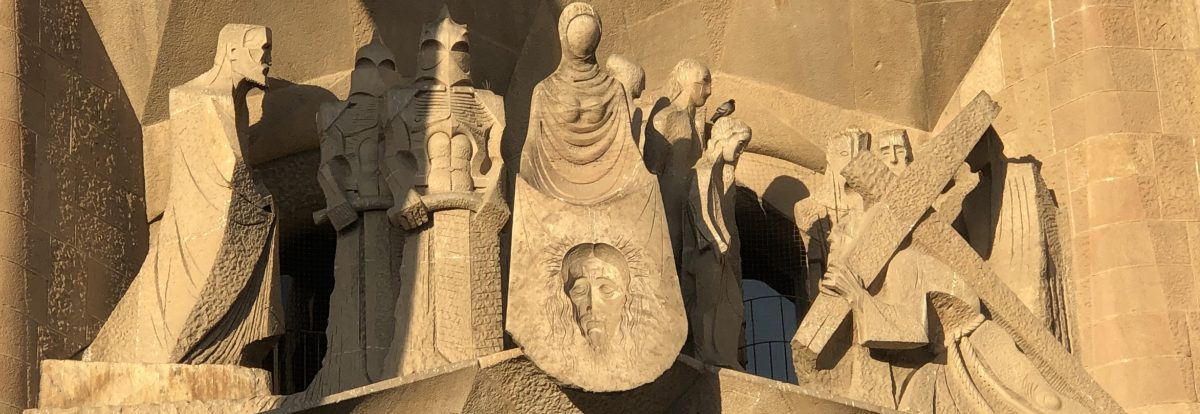
The Immaculate Conception: God’s own Advent preparation

Homily for the Immaculate Conception (2019. Note, that year, the Solemnity fell on a Sunday.)

On the first Sunday of Advent, I cleaned my room. I must admit, it needed it—there were coffee stains on the desk; the trash can was overflowing; I found forgotten lists of things not to forget. But Advent is the beginning of a new liturgical year, the season when we prepare for Christmas, and it seemed right to start with a clean room. In the coming weeks, there will be many other things to prepare: food, gifts, decorations, travel.

Column of the Immaculate Conception, Rome

This is the second Sunday of Advent, and normally the readings highlight the figure of St. John the Baptist, who speaks of another kind of preparation, another kind of cleaning—in fact, a much deeper cleaning than coffee stains. John the Baptist warns of the need for inner cleansing, moral and spiritual conversion. And this too is part of the preparation for Christmas. As a confessor, I have to do a little advertising for my profession, strangely absent from all the Black Friday advertising we received last month. But I must say that our special offer—the forgiveness of sins, eternal life—is truly the best deal in the world.

However, this year is a bit special, because this second Sunday of Advent is December 8, the Solemnity of the Immaculate Conception of Mary, the Mother of Jesus. This coincidence of dates is interesting because the Immaculate Conception is also a feast of preparation. But not the preparation we do during this season. The preparation that God has done for us.

Continue reading “The Immaculate Conception: God’s own Advent preparation”

Capernaum’s centurion: a man of faith and hope

Homily for Monday of the first week of Advent (2019).

The figure we encounter today in the Gospel, the centurion of Capernaum, helps us to prepare. We use his adapted words to prepare for communion: “Lord, I am not worthy that you should enter under my roof, but only say the word and my soul shall be healed.” And today, at the beginning of Advent, the season when we prepare for the coming of the Lord, the centurion appears in the readings.

A season of preparation is a season of faith and hope—and I think the centurion of Capernaum appears today because he is a figure of faith and hope.

Both of these virtues exist in imperfect situations. We need hope because of something we lack in the present; we need faith because there is something doubtful about the situation in which we find ourselves.

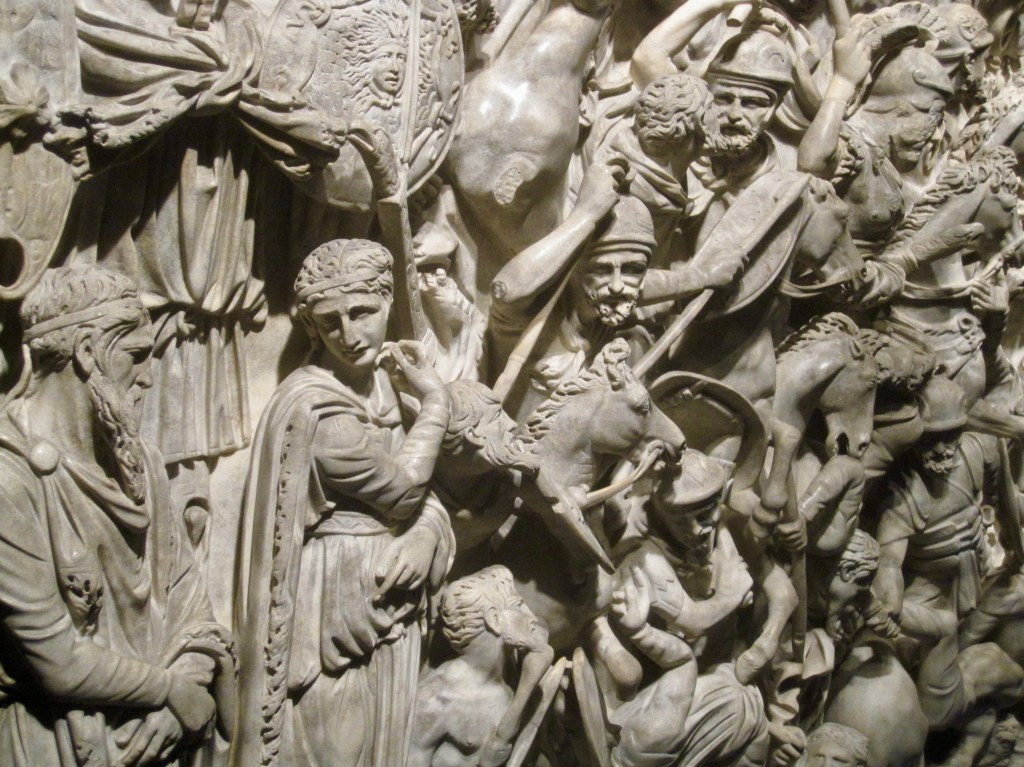
Roman Sarcophagus, Palazzo Massimo, Rome

The centurion comes to Jesus asking for help. And his words—“I am not worthy that you should enter under my roof”—are poignant because in them we hear the unvarnished truth. We can easily imagine that the centurion, an officer in the imperial army, has seen terrible things and perhaps–even if only out of duty–has had to do terrible things as well. His sense of unworthiness, however, does not prevent him from turning to the Lord.

Continue reading “Capernaum’s centurion: a man of faith and hope”

How much does heaven cost?

Homily for Monday of the 34th week of Ordinary Time (Year 1, 2019 – original Italian).

Church of the Holy Spirit, Žehra, Slovakia

How much does it cost to enter the Kingdom of Heaven?

Perhaps a lot. In the Gospels, the rich never seem to have enough. If we arrive at the gates of paradise with suitcases full of banknotes, it seems that won’t be enough. In eternity, they probably won’t accept credit cards, either.

Perhaps it costs very little. The widow offers just two cents. But if we have listened to the readings from the Old Testament in recent days—the sufferings of the Israelites under pagan rulers and in exile—we know that the price of fidelity can be very high. Martyrs pay with their blood.

Perhaps it is free. God does not need money. He created the world. What would he buy? Still, Jesus praises the widow for making an offering.

So, how much does it cost to enter the Kingdom of Heaven? The answer is everything. No more and no less.

Offering everything to the Lord means that no aspect of our lives is outside the Lord’s presence. Not just certain moments of worship–but also our financial, family, social, political, and professional decisions must be made with God at the center. The young Jews in the first reading from the book of Daniel put fidelity to divine law at the center of their lives, even in the service of the king of Babylon. We owe God nothing less than everything.

But nothing more, either. That is, God does not expect from us something we do not have, something we are not. If we are not the richest, God does not care. If we are not the strongest, God does not care. If we are not the most intelligent or the most beautiful or the most famous, God absolutely does not care. God does not want these things from us. He wants what we have–or, rather, he wants what we are. He wants an offering of ourselves.

This is, in fact, the offering that God makes to us in the sacrament we are about to celebrate. Physically, the Eucharist is not very big. But it is certainly not little. It is God’s gift of himself.

And that is everything.

(Original: Italian)

Readings: Daniel 1:1-6, 8-20; Lk 21:1-4

Church of the Gesù, Rome

November 2019


I was happy to be invited back to the pages of First Things last week to discuss celebrities, scandal, and the sacrament of confirmation. Check out the article: Sacraments of Initiation or Affirmation?

Apocalypse when? Homily for the 33rd Sunday in Ordinary Time

Homily for the 33rd Sunday in Ordinary Time (C). November 2019.

Reflecting on this Sunday’s readings, I turned to that great source of theological wisdom, Amazon Video. In November, at the end of the liturgical year, the liturgy speaks of the Apocalypse. Well, I discovered that there are also many films on this theme. I found earthquakes, hurricanes, volcanoes–even alien invasions. And lots and lots of zombies.

The name of one film–at a discounted price–was “Apocalypse 2012.” This film provoked the question: has the Apocalypse already happened? Was I distracted and didn’t notice? As I thought about it, I remember hearing in 1999, “The end is near. At midnight, our computers will no longer work, there will be a total collapse of civilization. Buy canned food.”

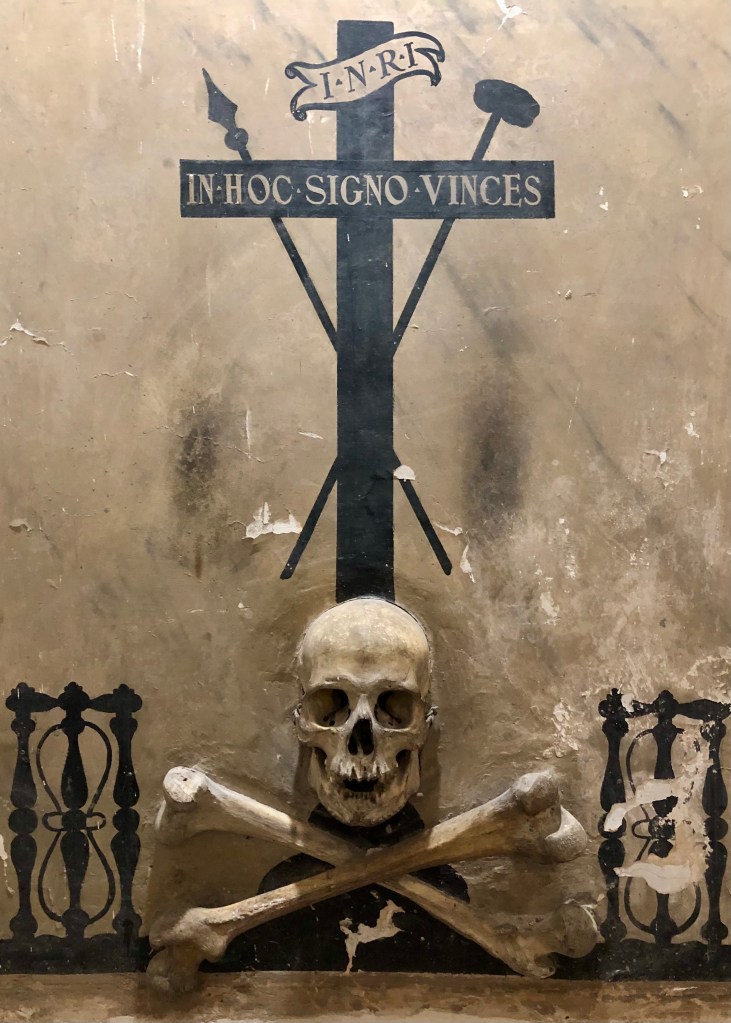
From the Church of Santa Maria dell’Orazione e Morte, Rome

Then in 2012, I did an interview for an American Catholic radio program, and they asked me about the Mayan calendar. It was about to end on December 21, 2012, they said, and asked, “Is it true that the world will end? Should we buy canned food?”

Even today, when we talk about the environment—an important issue—there is often an apocalyptic element. And this element, in my opinion, probably does not help us deal with this complex problem in a sober manner.

Perhaps you are now thinking, “But, Father, are you saying that there will be no Apocalypse?” Absolutely not. The Apocalypse is a recurring theme in Jesus’ preaching, and since time of the apostles, the Church has never ceased to proclaim the urgency of being prepared for this event. There have been many false prophets who have proclaimed “the time is near,” but that does not mean we should not be prepared. Even if the Mayan astrologers were wrong about the date, our life is short.

However, with these recent examples of false prophecies, I would like to point out that in today’s culture, the idea of the Apocalypse continues to exist but has become secularized. Earthquakes, hurricanes, aliens, computers, astrologers, pollution, zombies—in all this apocalyptic talk, the one thing missing is the most important thing: Jesus Christ.

Continue reading “Apocalypse when? Homily for the 33rd Sunday in Ordinary Time”

Buildings that speak to us: Homily for the dedication of the Lateran Basilica

Homily for the Feast of the Dedication of the Lateran Basilica (2023).

From the cloister of St. John Lateran, Rome

The feast we celebrate today is particularly special for us in Rome. We celebrate the dedication of our cathedral. It is a magnificent building, and probably all of us have been there to appreciate the beauty of this splendid and ancient church.

The anniversaries of church dedications are important in the Church calendar because churches are the places where we gather to celebrate the Christian liturgy, the holy mysteries of salvation. Here in Rome, however, we live in an unusual situation because there are many beautiful and ancient churches–but when we enter them, often we find few of the faithful.

We should not be discouraged; instead we should remember the faithful who still speak to us through these monuments of their faith. The churches they built and left us are not mere buildings; they are their testimony. There is a message in these buildings that the saints of past times wanted to convey to us.

But more than a message, there is still a presence. When we celebrate the liturgy, we are not alone; we enter into the presence of the saints. They are with us. On November 1, we entered the season in which we remember the saints. Churches–from St. John Lateran to this little chapel–are more than museums where we learn from the past; they are places where we encounter the saints, where eternity becomes the present.

(Original: Italian)

Readings: Ez 47:1-2, 8-9, 12; 1 Cor 3:9c-11, 16-17; John 2:13-22

Gregorian University Chapel

November 9, 2023

From the cloister of St. John Lateran, Rome

Do we still desire holiness? Homily for the Feast of All Saints and Blesseds of the Society of Jesus

November 5 is a special feast day on the Jesuit liturgical calendar–the Feast of All Saints and Blesseds of the Society of Jesus, a kind of All Saints Day for Jesuits. Five years ago, in 2020, at the height of the pandemic, I celebrated Mass in our formation community in Rome on that day. The homily, translated into English, is below.

We need saints.

Today more than ever, I feel this need. In these days of isolation, loneliness, anxiety, and disillusionment, we need companions. We need to know that we are not alone—even in the dark nights when we cannot sleep. And when we are confused, afraid, full of doubts, we need companions who have experienced confusion, opposition, doubt, sin and penance, and yet have come to peace.

Today we celebrate the great consolation that we have such companions. As Jesuits, we celebrate the fact that among all the saints recognized by the Church, there are many who made the same choice we have made, who prayed as we pray–who have, we might say, eaten with us in the refectory. As Moses says of the word of God, these companions are not across the sea but are near to us. In the long winter we are experiencing, we need only open our mouths in prayer, and these companions will be present at our side.

Church of St. Ignatius (ceiling), Rome

Today we remember not only the great names—Robert Bellarmine, who cheers us on in our studies, and Francis Xavier, who reminds us that our studies are only a means to spread the Gospel. Among these heavenly friends, there are many less famous ones, perhaps even some companions we have known in this life who are now in the Father’s house.

Every year when we reach the second half of Ordinary Time and volume four of the breviary, I find the holy card of Bob Araujo, a Jesuit who taught me in Chicago and greatly encouraged me in my studies and advised me during some doubtful moments of my formation. Bob suffered quite a bit in his life, first, from opposition in his career and, then, from a slow and painful cancer. He died in October 2015. When he died, the words of St. Paul came to mind: “I have fought the good fight; I have finished the race; I have kept the faith.” When he died, another companion said to me, “He’ll get right in.” Now I talk to Bob from time to time, and I ask him, “What do you think? How am I doing? Do you have any advice for me?” I imagine you also have such companions.

But when we talk about saints and Jesuit saints, I must admit that there is also something that disturbs me, just as there is something that disturbs us in the Gospel passage chosen for this feast: “Whoever loves his life loses it, and whoever hates his life in this world will preserve it for eternal life.”

Continue reading “Do we still desire holiness? Homily for the Feast of All Saints and Blesseds of the Society of Jesus”

Why pray? Homily for the 29th Sunday in Ordinary Time

Homily for the 29th Sunday in Ordinary Time (C). Translation of a homily, originally given in Italian in October 2019.

Why pray? Because the other team’s fans are praying, and we don’t want to give them any advantage? Because God seems a little indecisive, and maybe he needs our good advice? Because to get what we want, it helps to have powerful friends?

Ecstasy of St. Teresa, Gian Lorenzo Bernini, 1652

Unless we walked into church this morning by mistake, each of us believes that prayer is important in some way. In fact, we may feel that it is necessary. Maybe we can’t explain it, but we need prayer. Maybe we’ve learned from experience, maybe from hard experience, how necessary prayer is.

Continue reading “Why pray? Homily for the 29th Sunday in Ordinary Time”

Remember to say “Thank you”: Homily for the 28th Sunday of Ordinary Time

Homily for the twenty-eighth Sunday of Ordinary Time (C).

One of the lessons I remember being drilled into me as a child was the importance of saying “thank you.”  As with so many of the lessons we learn in childhood, I may not have appreciated its importance at the time, but now I’m grateful for it.  The next time I see my mom and dad, I’ll have to remember to thank them.

Today’s readings are all about remembering—and forgetting—to give thanks.  The attention that Sacred Scripture dedicates to the theme suggests that we are dealing with something much deeper than polite social convention.  Gratitude does make for more pleasant social interactions, but it is also necessary for us to see the world truthfully.  And it is something we easily forget.

Certosa di San Martino, Naples

Today’s Gospel passage, in fact, hints that perhaps we are more inclined to forget to give thanks than to remember.  Ten lepers were cleansed, Jesus points out, but only one returned to thank him.  Busyness can distract us from gratitude—we need to move on to the next thing, we don’t have time.  When we get what we want, often our tendency, instead of saying thank you, is to try to get more.  This is part of what theologians call “concupiscence,” the habit of selfishness burned into human nature by original sin.  Today we can add a sense of entitlement to concupiscence.  We like to speak of our rights—and politicians like to promise more rights—but while the rights we claim for ourselves multiply exponentially, our sense of responsibility never quite seems to keep pace.  We forget that we would have no rights whatsoever if these hadn’t been granted to us by our Creator.  To this forgetfulness we can add advertising that pushes us to buy more, to watch more, to scroll more, to consume more, and not to waste time remembering where we came from.  My parents did well to drill saying “thank you” into me because there are so many other voices saying, “Don’t worry—just give me your credit card.”

The loss of a sense of gratitude makes a truly Christian life impossible.  It’s no accident that the word that describes the central action in the life of the Church—“Eucharist”—comes from the Greek word for thanksgiving.  In some ways, this might seem surprising because in the celebration of the Eucharist, God’s action, and not ours, is central.  It is Jesus who gives himself to us; it is his power that transforms bread and wine into his Body and Blood, his living presence among us.  What we do in this sacrament we do only because he gave us the instructions.  The initiative is always God’s.  The same can be said of all of creation.  Everything that is is an unmerited gift.

Continue reading “Remember to say “Thank you”: Homily for the 28th Sunday of Ordinary Time”

Caveat emptor! Investing in the Kingdom of Heaven: Homily for the 25th Sunday of Ordinary Time

Homily for the twenty-fifth Sunday of Ordinary Time (C).

Detail of the statue of St. Matthew (St. John Lateran)

In 1920, Charles Ponzi devised a scheme to buy international postal coupons in Europe and sell them for a profit in the United States.  So many people invested in Ponzi’s plan that he couldn’t keep up with demand, so he used the money from new investors to pay off old investors, which worked as long as there were more new investors.  And, then, when there weren’t, the whole scheme went kaput.  For a while, Mr. Ponzi made a lot of money using a financial trick without actually producing anything real.  Today similar scams are known as “Ponzi schemes.”  

The parable of the dishonest steward, which Jesus tells in the Gospel, is rather like a first century Ponzi scheme.  The steward, learning that he is about to be fired, retires debts to his master at a steep discount.  Doing so doesn’t cost him anything but comes at his master’s expense.  His master’s debtors will now owe him for their savings, so he’ll have many grateful new friends when he becomes unemployed.  What is surprising about the parable is that the master does not condemn his conniving steward but seems to think his trick is rather clever.  

The explanation Jesus gives of the parable also surprises us because you’d expect the Lord to condemn obvious fraudulent behavior.  But, instead, Jesus uses the story to make a different—very ironic—point.  Jesus’ point is that people—like the steward—put so much cleverness and effort into making money that when it comes to what really matters—their relationship with God—they’re rather careless.  So, he says, “Go ahead, make friends with dishonest wealth.  Invest in the Ponzi scheme.  Then, when it fails, and you see how clever you really were, maybe, then, you’ll start thinking about your eternal dwelling.”  After all, if the steward had worked half as hard for his master as he did to save his own skin, he wouldn’t have been fired to begin with.

Continue reading “Caveat emptor! Investing in the Kingdom of Heaven: Homily for the 25th Sunday of Ordinary Time”

Humility is our glory: homily for the 22nd Sunday in Ordinary Time

Homily for the twenty-second Sunday in Ordinary Time (C).

Filippo Lippi, Madonna of Humility, 1420

Humility is the virtue that stands out both in today’s Gospel reading and in Sirach’s advice to “conduct your affairs with humility” and to “humble yourself the more, the greater you are.”  I’ve been thinking about humility a lot this summer because I’ve been thinking about my grandfathers.  One passed away in June, the other fourteen years ago, and “humble” is one of the first words that comes to mind when I think of either of them—perhaps in both cases because my grandfathers were the quiet ones, and my grandmothers were the talkers!  One grandfather was a baker, the other lived his whole life in the same small town in Minnesota.  I think of them both as great men not because they sought attention or prestige, but because they didn’t.  Because they dedicated themselves to others, to their families and to their communities, without making a fuss about it, and left the lives of many better as a result.  In the homely etiquette lesson Jesus offers in the Gospel—take the lower place instead of elbowing your way to the head of the table—he points to one way in which a humble act can leave one better off in the long run.

Continue reading “Humility is our glory: homily for the 22nd Sunday in Ordinary Time”