Book launch, podcasts, and other news

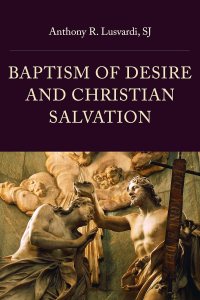
I am pleased to see Baptism of Desire and Christian Salvation in the news. Ralph Martin mentioned the book in his recent video Are All Religions a Path to God? As Dr. Martin points out, the research and arguments the book offers are highly relevant to some of the most difficult theological questions the Church faces today. As I’ve said before, perhaps the most urgent question the book raises has to do with whether we should still understand salvation to be at the heart of the Church’s mission. (Spoiler alert: Yes.)

With Dr. George Ceremuga at St. Isaac Jogues this summer.

I was also delighted to have a thoroughly enjoyable conversation a few weeks ago with Dr. George Ceremuga, friend and parishioner at St. Isaac Jogues parish in South Dakota, for the inaugural episode of his new Lead With Love podcast. We talked about Baptism of Desire and Christian Salvation as well as Dr. George’s new book My 50 Day Pentecost in the Holy Land, in which he recounts some of the encounters and insights he had on an amazing journey through the Holy Land last year. UPDATE: the podcast is now out here. I’m collecting info and reviews about baptism of desire here.

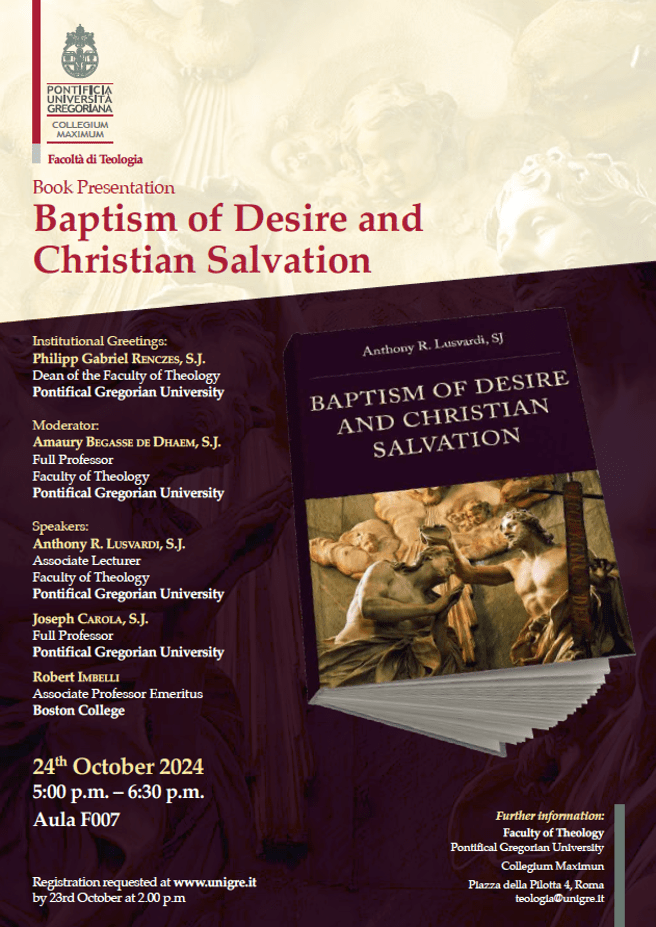
And finally, as you can see from the flyer at the top of this post, I’m pleased to announce that we will have a book launch for Baptism of Desire and Christian Salvation later this month at the Gregorian University. If you are in Rome, please come on Thursday October 24 to hear Fr. Robert Imbelli (coming all the way from New York!) and Fr. Joseph Carola discuss the book’s significance. The event will take place at 5:00 PM in room F007 of the Frascara Building at the Gregorian University. I’ll try to get the talks posted here, too, since it promises to be an interesting discussion.

And for something just a little bit different, you might want to check out the November issue of First Things. Just saying.


Homily for the Feast of St. Ignatius

The feast of St. Ignatius was back in July, of course, but I thought the reflections on discernment in my homily might be helpful in any season. Last year, I was asked for some thoughts on the process of communal discernment used by the Synod on Synodality. These reflections build on those observations.

Inigo the Pilgrim (2017), Church of St. Ignatius, Norwood, South Australia

You might have had the experience of the warning light on your dashboard coming on while you’re driving, signaling that you are low on gas, near the minimum.  Here in South Dakota especially–where outside of the city gas stations can be few and far between–you don’t want to fall below that minimum.  You might end up out in the cold or in this merciless heat—both dangerous circumstances—and in need of a good Samaritan to rescue you.

If you keep your tank filled, however, and don’t fall below the minimum, you can drive wherever you like.  You just plug the destination into the GPS and go.

The warning light and the GPS are both helpful, but they serve different functions—the warning light tells us not to drop below the minimum and the GPS gives us directions.  The readings for today’s feast of St. Ignatius, I think, point to a way of living the Christian faith that goes beyond the minimum.

If we think about the commandments, they are very useful for giving us the minimal rules of the road necessary to avoid an accident or a breakdown by the roadside. Because of this function, most of the commandments are written in a negative form—“Thou shall not…”  Even those that aren’t prohibitions—“Keep holy the Sabbath” and “Honor thy father and mother”—set a minimum of necessary behaviors.  Sunday Mass is the minimum necessary worship if we are to do justice to God, and fulfilling our family duties is the minimum necessary social obligation if we’re to maintain a functional social harmony.

But just doing the minimum isn’t enough to live a fulfilling life or to live a life of discipleship.  If I put on my to-do list for tomorrow, “Don’t kill anyone, don’t commit adultery, don’t steal,” I’ll end up rather bored.  The minimum tells us what to avoid, but not much of what to do.

Continue reading “Homily for the Feast of St. Ignatius”

Summer roundup

Chocolate Hills, Bohol, Philippines

As you could probably tell from last week’s post, I’m back in Rome getting ready for the start of the new academic year next month. It was a full and eventful summer more than a restful one. It started out with my first trip to the Philippines for a meeting of the Jungmann Society, the international association of Jesuit liturgists, where I gave a talk on daily Mass in Jesuit communities. It was encouraging to meet many young Jesuits interested in the liturgy, especially those from Asia. Some new initiatives are coming out of the meeting as well. The initiative I am most excited about is an eight-day retreat for Jesuits I am preparing for next summer: “Praying the Liturgy,” which will be offered June 29 – July 7, 2025 at the Jesuit Retreat Center in Parma, OH. It is open to all Jesuits.

I also spent some quality time at St. Isaac Jogues in Rapid City and back at home in Minnesota, connecting with friends. For the first time, I led a retreat at the gorgeous new retreat center Cloisters on the Platte outside of Omaha, and attended a really excellent conference in Mundelein, IL on the divergent theologies of Karl Rahner and Joseph Ratzinger organized by Prof. Matthew Levering and the Greg’s own Fr. Aaron Pidel, SJ. Some theological all-stars there. A book will be coming out at a later date with papers from the conference, including my own contribution on the two theologians and the liturgy, arguing that Ratzinger continues the project of the Liturgical Movement while Rahner’s attitude toward the liturgy is an extension of pre-Vatican II scholasticism.

I’m also happy to have had a handful of new publications over the summer, including a pair of articles in America. One is about the sin of presumption, scientism, and Michael Jordan’s shoes, the other a broader perspective on the ‘Last Supper’ controversy at the Paris Olympics. Check ’em out if you haven’t already.

Also, if you didn’t get a chance, you might enjoy my article “Getting Back in the Baptizing Business” in The Catholic Thing which explains why I think my book on baptism of desire is important.

And speaking of Baptism of Desire and Christian Salvation, I was pleased to be able to bring my summer to a close by giving several talks on the book in Sweden. I had an enjoyable discussion with the participants of the Hörge seminariet at the Newman Institute in Uppsala and was deeply encouraged by the large and energetic group of young adults at Sankta Eugenia in Stockholm. It is great to see the book both resonating with people and provoking discussion.

More on Baptism of Desire and Christian Salvation will be coming soon, including an official “book launch” here in Rome…

Stockholm, Sweden

St. Matthew according to Caravaggio: a spiritual masterpiece

The Inspiration of St. Matthew, Caravaggio

One of the most remarkable places in this remarkable city of art is the Contarelli Chapel in the Church of San Luigi dei Francesi, home to the St. Matthew trilogy of Michelangelo Merisi da Caravaggio. Three paintings–The Conversion, The Inspiration, and The Martyrdom of St. Matthew–tell the story of the life of the saint, from his improbable calling to his death. The paintings are full of artistic drama, reflecting the artist’s own spiritual struggles and his attempt to find his place among Italy’s artistic greats.

Contarelli Chapel, San Luigi dei Francesi, Rome

The paintings date from early in Caravaggio’s career (1599-1600), when he was at the apex of his success in Rome. Only a few years after painting the St. Matthew trilogy, however, Caravaggio’s artistic career was sabotaged by his own unruly passions–he was forced to flee Rome after murdering a man in a brawl. As I’ve argued before, the fact that Caravaggio sinned so spectacularly does not negate a deep thirst for God or his spiritual and sacramental sense. In fact, as so often happens, awareness of his sin may have heightened the need the artist felt for redemption. In one of his later works, which he painted while in exile for his crime, David holds the head of Goliath–who bears Caravaggio’s own anguished face.

David with the Head of Goliath, Caravaggio, Borghese Gallery, Rome

Conversion also drives the “plot” of Caravaggio’s St. Matthew cycle. The first of the paintings, The Call of Matthew, depicts the moment when Jesus walks into Matthew’s customs post where the tax collector sits among cronies, coins spread over the table in front of him. Light shines in from a window just over the Lord’s head and hits Matthew straight on as Jesus raises his hand and points an unrelenting finger, as if to say, “You.” The tax collector’s own finger rises to his chest and his eyes widen, as if to respond, “Who? Me?” Or perhaps he is trying to distract the Lord’s gaze by pointing to the ne’er-do-well next to him, whose eyes are still fixed on the coins. In either case, the painting captures all the passion and confusion of the call to conversion–the unrelenting gaze of God, the instinctual avoidance and doubt of the sinner who is called. Does Matthew think himself unworthy? Shy away from relinquishing the wealth he knows? Hesitate when truth itself dissolves the shadows of ambiguity he has woven around himself? Probably, all of the above.

Continue reading “St. Matthew according to Caravaggio: a spiritual masterpiece”

Faithfully unfashionable: homily for the twenty-third Sunday in Ordinary Time

Homily for the 23rd Sunday of Ordinary Time (B)

Prophet Isaiah, Raphael (1511-2), Church of Sant’Agostino Rome

A mile or so from where I live in Rome is a street called Via dei Condotti; there you can find the stores of Armani, Tiffany’s, Gucci—the highest high-end designers.  Sometimes I like to amuse myself by looking in the windows at the prices—a thousand dollars for a sweater, twelve hundred dollars for a necktie, twenty thousand dollars for a watch.  Of course, many of the stores don’t list prices because if you have to ask, you can’t afford it.  I’ve never gone inside any of these stores because they are usually guarded by a man with a shaved head, six inches taller than I am, with a black suit and a mouth that never smiles.  In fact, I think they’ve had the facial muscles that allow you to smile surgically removed.  

The owners of these stores would not be happy to read today’s Letter of St. James.  James says: don’t favor a person with gold rings over a person in shabby clothes.  Of course, sometimes shabby clothes are fashionable and expensive; having torn jeans means that you’re one of the cool kids.  What’s in fashion always changes because it’s not based on anything real.  A thousand dollar sweater won’t keep you any warmer than a thirty dollar sweater; a twenty thousand dollar Rollex tells the same time as my twenty dollar Timex.  Fashions based on wealth, prestige, and the most up-to-date style are like the leaves that you see on the trees this September day; next month they’ll be a different color; a month after that, they’ll be gone.

Even though fashion and prestige aren’t based on anything true and lasting, they can be used to hurt people in some very real ways.  I think of how hard it is for someone not to be one of the “cool kids” in middle school or high school.  Adults are sometimes just as bad; I can remember from my time here on the reservation that sometimes people are looked down on for being “too Native”; other times they may be looked down on for “not being Native enough.”  In either case, sometimes people can be treated quite unfairly.  

Continue reading “Faithfully unfashionable: homily for the twenty-third Sunday in Ordinary Time”

Law and communion: homily for the twenty-second Sunday in Ordinary Time

Homily for the 22nd Sunday in Ordinary Time (B)

If you could pick eight of the Ten Commandments to follow and drop two, which would they be?  What if you could keep six as commandments and downgrade four to recommendations?  Perhaps you’re thinking, “I probably only need about five or so, but I know a lot of people who could use a few more, maybe 12 or 15 for them.”  The Pharisees in the Gospel seem to have adopted this last strategy, and perhaps because of their bad example sometimes the very idea of law gets a bad rap.  Didn’t Jesus teach grace rather than law, mercy instead of rules?  Didn’t Jesus say, “All you need is love, love is all you need”?  

Actually, that was the Beatles.  Jesus said in the Sermon on the Mount:  “Do not think that I have come to abolish the law or the prophets.  I have come not to abolish but to fulfill.  Amen, I say to you, until heaven and earth pass away, not the smallest letter or the smallest part of a letter will pass from the law.”

Basilica de Santo Nino, Cebu City, Philippines

Now it is true that, as in today’s Gospel reading, Jesus harshly criticizes a certain way of using the law as self-serving and hypocritical.  So to be disciples of Jesus we need to think carefully about the role the law plays in salvation history and in our own lives of faith.  

Today’s first reading from Deuteronomy makes clear that the law of Israel is God’s gift.  It makes equally clear that no one but God may add to or subtract from what he commands.  No matter how much we find the commandments hard to follow, no matter how old they are, no matter if we think we could attract crowds of new people to our Church by loosening the loopholes, only God can modify the law of God.  

Continue reading “Law and communion: homily for the twenty-second Sunday in Ordinary Time”

Sacraments of loyalty, marriage and Eucharist: homily for the twenty-first Sunday in Ordinary Time

Homily for the 21st Sunday in Ordinary Time (B)

Are there any Bears fans here?  I have a question for you: if I reached into my wallet, how much money would I have to offer to get you to root for the Vikings?  I know what you’re thinking: “You keep your wallet where it is, Father, because there ain’t enough money in the world to make me a Vikings fan.” Fair enough.  I am a Notre Dame fan, and you could fill up the collection plate with hundred dollar bills, but you’d never get me to root for USC or Michigan. 

Triumph of Faith over Idolatry, Jean-Baptistre Théodon, Church of the Gesù, Rome

In both cases, the reason why is loyalty.  Each of today’s readings is about loyalty, though much more important types of loyalty than what we show our sports teams.  When the first reading takes place, Joshua and the Israelites have spent their lifetime conquering the Promised Land after the death of Moses; here Joshua is an old man and he is putting a choice to the people.  They’ve arrived, the land is theirs, and he tells them: Now you have to decide whom to serve.  The God of our fathers Abraham and Moses got us here, and he has given us his law.  Other nations have other gods, maybe with laws that aren’t so demanding.  You are free to make a choice.  You can serve whichever god you wish, Joshua says, but “as for me and my house, we will serve the Lord.”  

And the people agree to serve the Lord.  But if you continuing reading in the book of Joshua, you’ll see that Joshua asks the people a second time.  Are you sure?  Because if you agree to serve the Lord, then God will hold you to his law.  You are free, but your choice is binding.  

Continue reading “Sacraments of loyalty, marriage and Eucharist: homily for the twenty-first Sunday in Ordinary Time”

Choose life, South Dakota: homily for the twentieth Sunday in Ordinary Time

Homily for the 20th Sunday in Ordinary Time (B)

If there is one theme consistently present throughout the whole Bible, from the first chapter of Genesis to today’s Gospel, it is that God desires to give us life.  When he reveals the commandments to Moses on Mount Sinai, he tells the people of Israel, “I have set before you life and death, the blessing and the curse.  Choose life, then, that you and your descendants may live” (Dt 30:19).  Today the Eucharist too is presented as life-giving: “The bread that I will give is my flesh for the life of the world” (Jn 6:51). 

It is fitting that today’s readings would highlight God’s desire to give us life, because, as I mentioned last week, the bishops of South Dakota have asked us to speak these two Sundays about a particularly urgent social issue: a measure, Amendment G, has been placed on the ballot this November, which would add the right to abortion without significant limits to the South Dakota constitution.  As I pointed out last week, Christianity is not a political program, and Catholics can disagree about most political issues while still remaining faithful to the principles of our faith.  Amendment G, however, is impossible to reconcile with the fundamental principle that it is always wrong to deliberately kill an innocent human being.

This principle is something that both conservatives and liberals should be able to embrace.  Conservatives emphasize the government’s duty to protect and not usurp individual rights, and without the right to life no other rights are possible.  Even a libertarian “live and let live” philosophy only works if you let the other live.  Take away the right to life and you have neither conservative government nor a free people, but the oppression of the weak.  

Continue reading “Choose life, South Dakota: homily for the twentieth Sunday in Ordinary Time”

Taking the gold for Team Humanity: homily for the Assumption of the Blessed Virgin Mary

Homily for the Assumption

Raphael, Coronation of the Virgin, Vatican Museums

My brothers and sisters, I’m no angel.  Before you respond with too much glee, “Oh, Father, we know,” let me point out—you’re no angels, either.

Now, when people say, “He’s no angel,” usually what they’re saying doesn’t mean what they think it does.  Usually, if someone says, “He’s no angel,” they mean, “He’s not so nice.”  Maybe there are a few skeletons in his closet.

But not all the angels were good.  Lucifer and the demons are angels, and they have so many skeletons there’s no room for clothes in their closets.  Today’s great feast is dedicated to a woman who never sinned.  But today, the feast of the Assumption, we celebrate the fact that Mary is no angel.  She is a human being.  A woman.  One of us.

You see, because the real reason demons don’t have clothes in their closets is because they don’t have anything to wear them on.  Angels don’t have bodies.  But we do.  That’s the difference between angels and human beings.  Otherwise, we’re quite a bit alike.  We both have intelligence and free will—which is how the fallen angels sinned.  The big difference is the body.

Today we celebrate the fact that at the end of her life on earth, Mary’s body entered immediately into heavenly glory.

And, my friends, this is not some bit of religious trivia, but something very, very important for each one of us.  Because it means that to be saved, to enter into heavenly glory, we don’t have to give up being human.  We don’t have to become angels.  God wants to save us as human beings, which is why his plan for our salvation involved taking the flesh of Mary, a woman, to become a man, so that we, women and men, might be saved in our human bodies.

Continue reading “Taking the gold for Team Humanity: homily for the Assumption of the Blessed Virgin Mary”