Popular piety and tradition in Sardinia

I was fortunate this year to have spent Holy Week and Easter in Maracalagonis, Sardinia, a small town about a 20 minute drive from the center of Cagliari. It was a good break from the classroom and a wonderful taste of parish life.

Chiesa della Santa Vergine degli Angeli, Maracalagonis, Sardinia

The religious atmosphere I experienced was both warm and traditional. Masses were full; I heard confessions all week long; I met deeply committed Catholic families. I was especially impressed by the enthusiasm for traditional popular devotions. Teams of parishioners take responsibility for organizing different devotions throughout the year. Of particular note during Holy Week were the su Scravamentu, in which the nails are removed from the Lord’s hands and feet and he is taken down from the Cross after the Good Friday liturgy, and the many processions through the town streets–Stations of the Cross, Palm Sunday, Holy Thursday, the Sorrows of Mary on Good Friday, and then the S’Incontru on Easter morning.

Continue reading “Popular piety and tradition in Sardinia”

Sacraments, incarnation, and the body

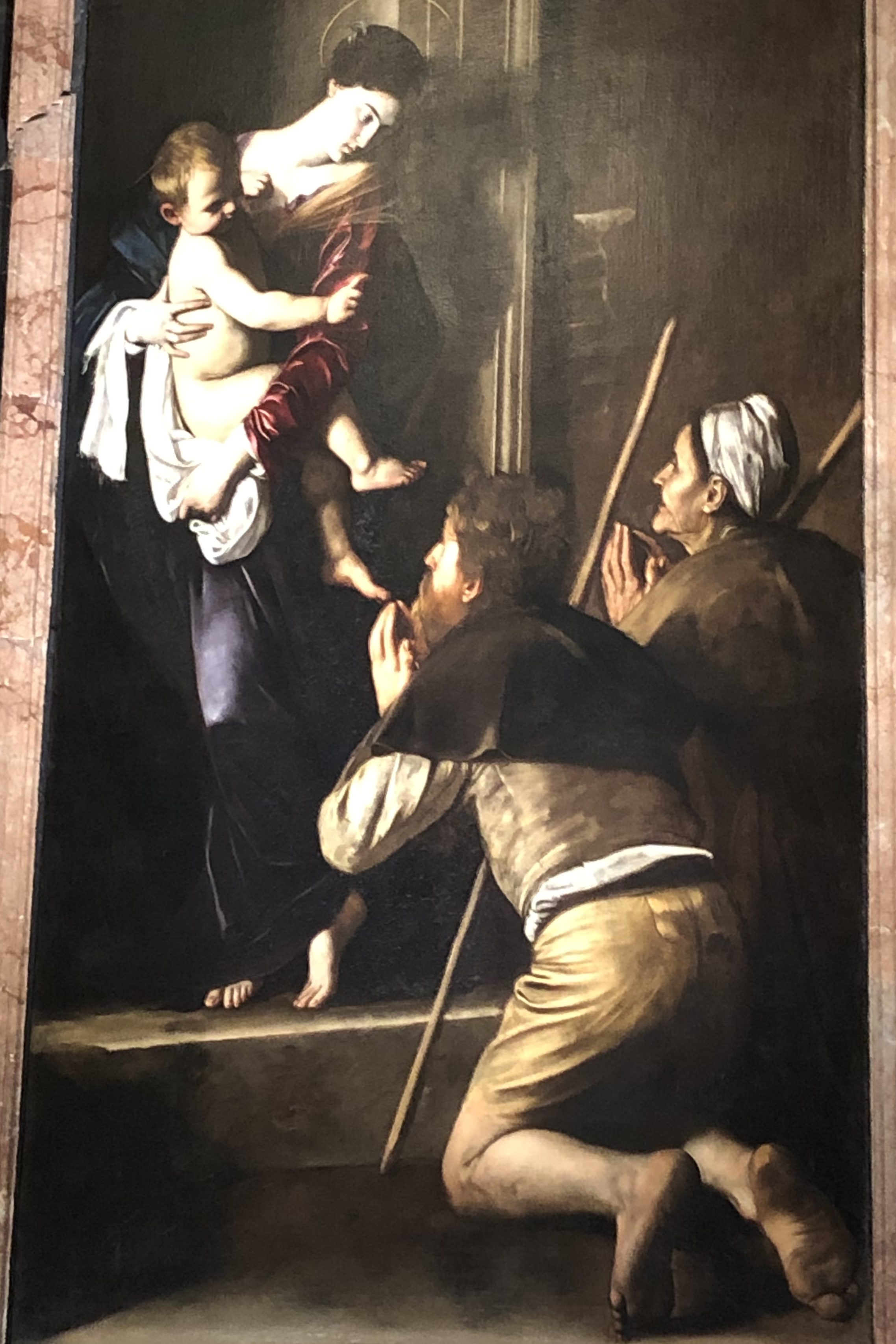
Madonna of the Pilgrims, (1604-6) Caravaggio, Church of Sant’Agostino, Rome

I’ve shared the work of theologian Fr. Robert Imbelli before. Here is another piece from him about a theme near to my heart, the “sacramental sense,” a phrase he takes from St. John Henry Newman.

Imbelli makes a point that has struck me before as well, that our society’s neglect of the transcendent is oddly connected to an unease with the body. We see this unease with our own bodies in everything from the explosion in the popularity of piercings and tattoos to the growth of eating disorders. Sex-changes are perhaps the most dramatic example of turning against one’s own flesh.

One of the sad marks of our secular age is a paradoxical double loss. Not only do we struggle to find access to the other dimension, that is, the spiritual, but we also seem impervious to the true sense of the material. Our sacramental sense has atrophied. Indeed, these two losses may be intricately connected.

Imbelli quotes philosopher Charles Taylor to argue that secular people today live lives of “excarnation,” disconnected from the communities and traditions that bore them. We live increasingly rootless lives. In contrast to this “excarnation,” Imbelli quotes Jesuit poet Gerard Manley Hopkins and points toward our Eucharistic faith. He hints at the way that this sacrament directs us toward a relationship with creation–and our own embodied part in it– that is rooted, first of all, in gratitude.

Read the rest of Imbelli’s piece at the Catholic Thing.

Romano Guardini on the liturgy

In preparation for I talk I gave last week to a group of seminary rectors from Africa and Asia, I read Romano Guardini’s short but profound book Liturgy and Liturgical Formation.

Guardini was one of the twentieth century’s sharpest and most balanced theological minds, and his writings on the liturgy are particularly valuable. He understands the irreducibility of liturgy and liturgical symbols and has absorbed the way the Fathers experienced liturgy, best exemplified by the line from Pope St. Leo the Great’s Ascension homily: “What was visible in the Lord has passed over into the mysteries.”

Chapel of San Basilio, Maracalagonis, Sardinia

Here are a few gems from Liturgy and Liturgical Formation:

“Liturgy does not deal with knowledge but with reality. There is knowledge of the liturgical action, which precedes it and could be called liturgical knowledge. And there is knowledge within it; the liturgical event allows an insight into itself. To speak of this today is not easy because it has escaped our religious consciousness at large. The liturgy itself is not merely knowledge but a full reality, which embraces much more than knowledge alone: a doing, an order, and the being of itself.” (13)

Continue reading “Romano Guardini on the liturgy”

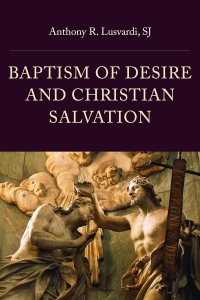
Baptism of Desire and Christian Salvation — now in print!

After a few delays, I am pleased to report that my book is now officially in print and copies have arrived for those who preordered. It seems to have been released on Good Friday no less.

If you’re still on the fence about whether it’s worth the read, I thought I’d share the very kind words of endorsement from Fr. Joseph Carola, SJ, my colleague at the Gregorian University and expert in both the Church Fathers and Nineteenth Century theology.

So take it from Fr. Carola:

Jesus instructed Nicodemus that, “unless one is born of water and the Spirit, he cannot enter the kingdom of God” (John 3:5).  Faithful to the Lord’s revelation, Christians have insisted for two millennia upon the necessity of baptism for salvation.  But already in the ancient Church, salvation’s rough edges, as Father Anthony Lusvardi creatively calls them, have challenged believers.  What is the fate of those who lived before Christ and therefore died without Christian baptism?  What happens to the catechumen who dies unexpectedly before being baptized?  Can unbaptized babies get to heaven?  Is there any hope for the salvation of non-Christians?  In his thoroughly historical and insightfully theological study of the baptism of desire, Father Lusvardi offers his readers a fresh perspective on this traditional notion often misunderstood and misapplied in contemporary theology and pastoral practice.  Providing a convincing response to the challenges that the hard cases present, Father Lusvardi especially appeals to the Catholic Church’s lex orandi in order to establish the Church’s lex credendi that simultaneously upholds the necessity of baptism, the need for evangelization, and the nuances of desire.  Historically informative, theologically rich, and occasionally even humorous, Baptism of Desire and Christian Salvation is a book not only for theologians, but perhaps even more so for pastors who labor on the rough edges of salvation.

Joseph Carola, S.J., S.T.D.

November 2, 2023

All Souls

The Pontifical Gregorian University, Rome