Baptism and Christian identity

El Greco, The Baptism of Christ

Sant’Agnese in Agone, the church in the center of Piazza Navona, is more beautiful than usual these days because it is hosting a special exhibit of three El Greco paintings. The largest and most impressive of these is the “Baptism of Christ,” a favorite theme of mine and something I think the Church would do well to reflect on more deeply–especially in these days of deep division and various lobbies jockeying for influence.

Sant’Agnese in Agone, Piazza Navona, Rome

At his baptism, the identity of Jesus is revealed by the Father: “This is my beloved Son, with whom I am well pleased.” As John the Baptist well knew, Jesus had no need of baptism; the event was for our benefit. The Lord’s baptism reveals what happens in our baptism: we become the children of God by adoption; we come to share in the Sonship of Jesus. The Father’s words come to apply to us. We become the beloved sons and daughters of God.

The reason I think this event is so important is because, for Christians, our status as God’s sons and daughters must become and remain our most fundamental identity. When some other form of identity becomes primary–our national identity, our identification with a particular political party or ideology, even our natural family–we go badly astray. This, it seems to me, is the most serious problem with contemporary LGBT ideology. The problem is certainly not with the people themselves, nor even so much with any particular sexual desires per se–living our sexuality with integrity has always been challenging, in different ways, for all Christians. The problem is when those sexual desires become ideology and ideology becomes identity, when one particular aspect of one’s personal make-up–one’s sexuality–becomes the dominant characteristic in one’s self-definition, the one ring to rule them all.

Continue reading “Baptism and Christian identity”
Gargoyles, east and west

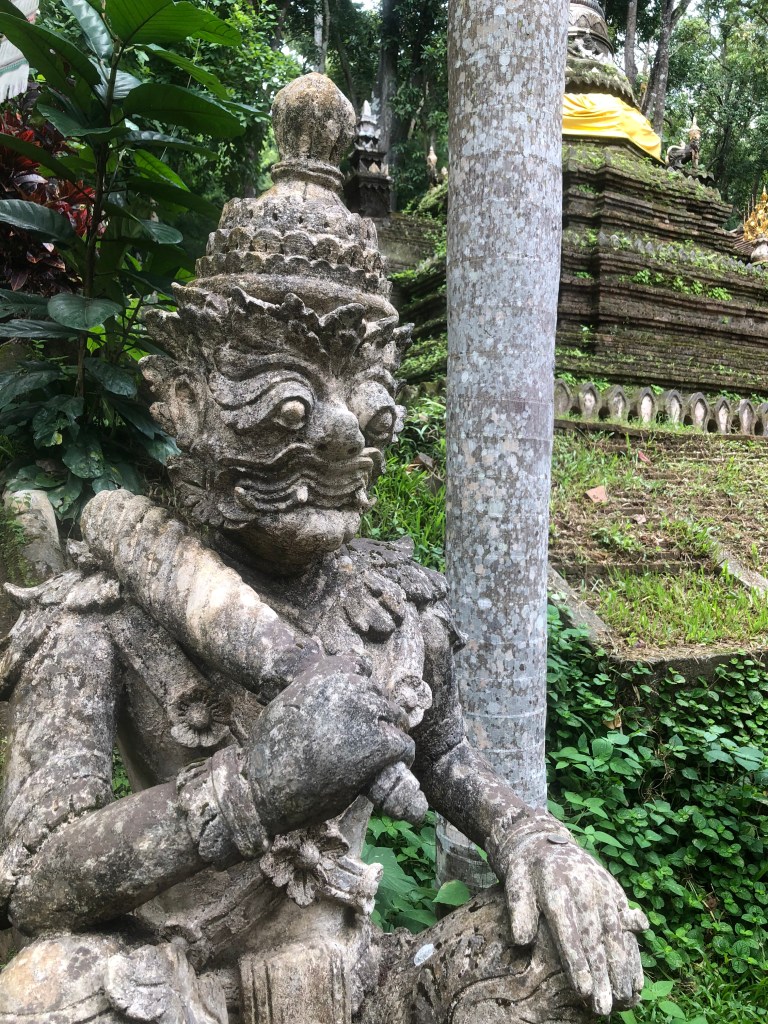
Wat Pha Lat, Chiangmai, Thailand

One of the highlights of my recent travels through Asia was visiting a number of quite impressive Buddhist temples and shrines. This was particularly the case in Thailand, though Chinese temples in Singapore, Taiwan, and Hong Kong were also filled with rich carvings, colorful statues, and piles of offerings including fruit, flowers, and burning incense. The warm red–the color of prosperity–of the Chinese temples reminded me of the red color with which the ancient Romans frescoed the inside of their homes. The desire for a warm hearth is written deeply in the human psyche.

Thian Hock Keng Temple, Singapore

A place of worship that makes an absorbing appeal to the senses is of course nothing new to me. I live in Rome, city of the baroque, where tales of religious ecstasy are told and retold in marble, mosaic, and fresco. The impulse of Christianity to express itself in art goes back to the Incarnation itself, to God revealing himself by entering into the world of the flesh, expressing his divinity in the matter of creation. We Catholics believe that he continues to communicate his grace to us through the sacraments. Artistic expressions using color, smell, and sound to amplify this divine work come naturally enough to a sacramental faith.

But what about Buddhism? Such expressions would seem to me, an outsider, to fit less naturally within Buddhist philosophy, with its distrust of all desire and negation of the world of pleasure and pain. Incarnation and Nirvana are two radically different beliefs. Yet how else to describe the gilded wats of Thailand, the cascades of angels and demons in glittering ceramic, than Buddhist baroque?

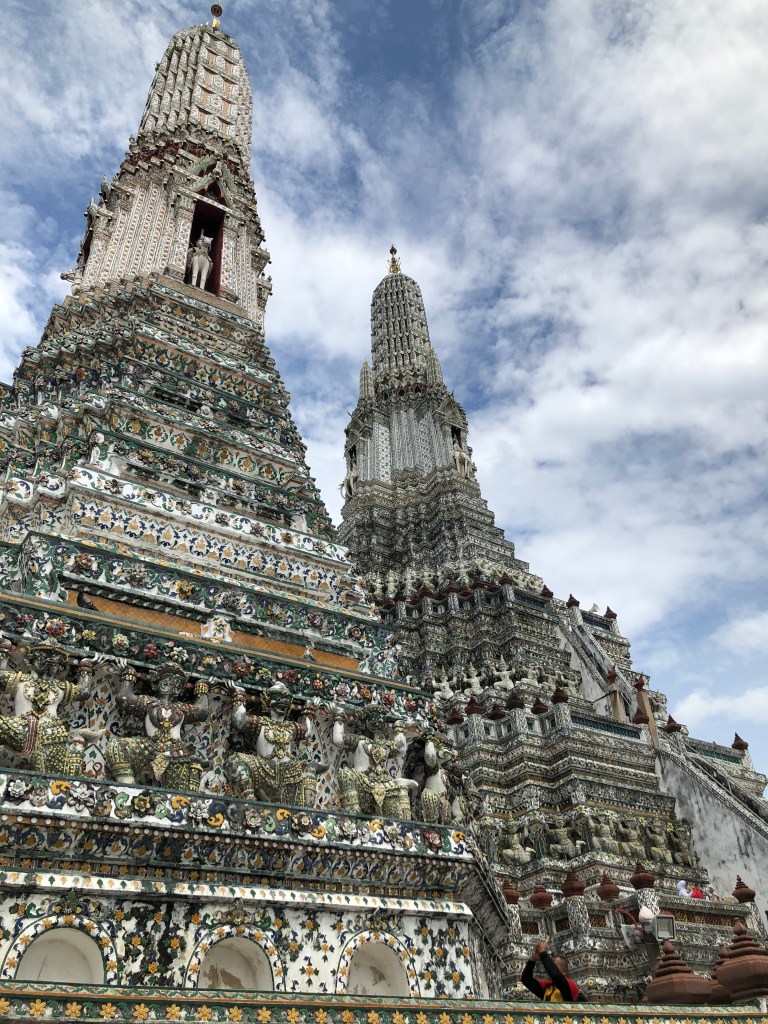
Wat Arun Ratchawaramahawihan, Bangkok

Of course, Thailand’s wats are not the architectural expression of pure Buddhist philosophy but a kind of non-culinary Asian fusion–Buddhism grafted into a still older mix of traditional folk beliefs, legends, and superstitions. How cogent such a mix is, I can’t evaluate. But there’s something human about that folk mix that I find more compelling than Buddhism in its purity, which I’ve always thought a little chilly.

Continue reading “Gargoyles, east and west”

Jonah, the most bumbling prophet

Jonah sarcophagus (ca. AD 300), Vatican Museums

Those at daily Mass this week get to enjoy the special treat of hearing the book of Jonah. The book is such a good tale–who doesn’t love a giant sea monster? or a cantankerous prophet?–that I imagine the story originally told dramatically aloud. I think we’re meant to laugh at Jonah, the Mr. Bean of prophets.

Of course, there is a serious message to the book that goes beyond whale innards and the prophet’s pouty attachment to his gourd plant. Jonah reveals the sweeping reach of God’s mercy, extending even to the most wicked of cities–Nineveh, grrr—when those within it seek conversion. Students in my classes are probably sick of hearing it, but one way to get under my skin is to claim that the grumpy “God of the Old Testament” has been replaced by the groovy “God of the New Testament.” There’s only one God. He’s infinitely merciful and revealed in both the Old and New Testaments. And the book of Jonah proves it.

Continue reading “Jonah, the most bumbling prophet”

Confessing other people’s sins

Old St. Anges Church, Parmelee, South Dakota

In case you missed it, an essay of mine appeared recently in issue 19 of The Lamp, a relatively new Catholic magazine full of interesting and thoughtful writing (if I do say so myself).

“Public apologies for historical wrongs have multiplied in recent years… Yet we do not seem to have become a more reconciled and understanding society.”

This particular essay, “Confessing Other People’s Sins,” is among the most important things I’ve written. The essay draws on a lot — my experiences in South Dakota, as a confessor, and studying theology.