Homily for the Transfiguration of the Lord (A)
At the end of today’s Gospel reading, Jesus tells Peter, James, and John to keep a secret. A Jesuit friend once wisely observed, “Most people can keep secrets. It’s the people they tell who can’t.”
This is just one of a number of times throughout his public ministry when Jesus asks his disciples not to tell people about the miracles they’ve seen. Since Jesus is constantly urging us to spread the Good News, this seems strange. Why would Jesus not want stories of his miracles to spread?
I suspect that Jesus does not want these miracles to distract from his mission. The miracles that we read about in the Gospels that stick with us and we love so much—the healing of the paralytic, the wedding at Cana, the healing of the man born blind, the raising of Lazarus—show Jesus’ compassion and his power, but they are nothing compared to the transformation that Jesus works through the cross. When, for example, Jesus raises Lazarus from the dead, Lazarus will die again. But when Jesus rises after being crucified, he opens for us a new life, a new way of being, that will never end.
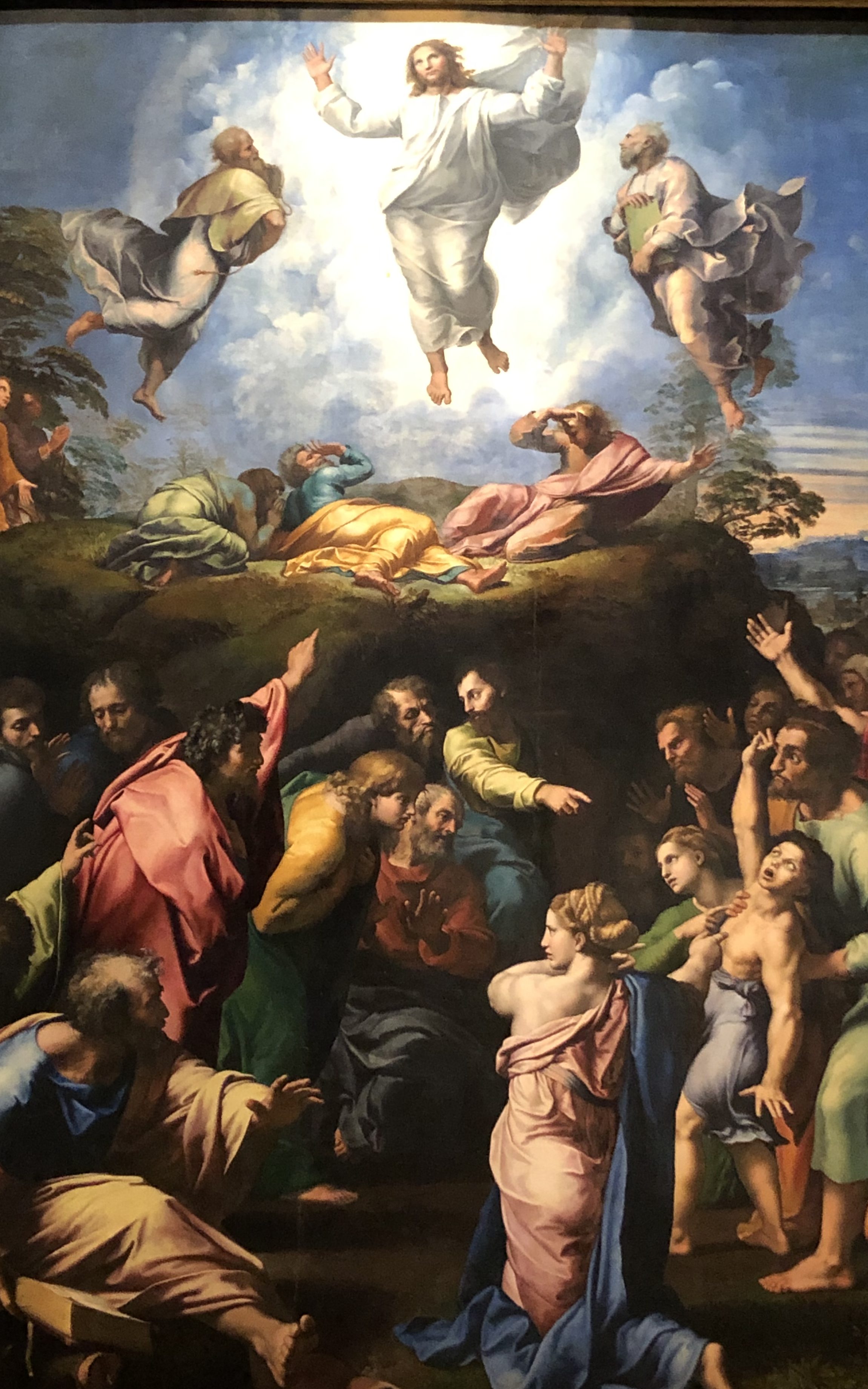
The miracles that Jesus performs before his death and resurrection—and I’d include today’s feast, the Transfiguration as one—are like the previews they show in movie theaters before the feature film. Jesus doesn’t want us to get so excited by the pictures of popcorn and soft drinks that we run out to the concession stand and forget about the movie. This is not to say that we should fast forward through first part of the Gospel. But we can’t stop halfway through; we can never be followers of Christ if we stop before the cross.
What, then, is the purpose of the event that we’re celebrating today, the Transfiguration? The Transfiguration happens in the middle of a long section in the middle of the Gospel in which Jesus has been teaching about discipleship. His teachings are challenging—you must be willing to give up everything, even family, to follow me; love God with your whole heart; love your enemies; live chastely; stay faithful in persecution; take up your cross and follow me. He also knows what’s coming, his arrest and torture, and the humiliating death that will send even Peter scurrying for cover. And so, in the midst of the difficult pilgrimage of this earthly life, God allows Peter, James, and John, to glimpse Jesus’ glory. Through their apostolic witness, passed on through the Scriptures, he allows us a glimpse at that glory too.
In the middle of the difficulties of discipleship, the Transfiguration gives us a glimpse at the big picture, at God’s plan for salvation and human history. We see that God has been working throughout the Old Testament, in the law and the prophets, through Moses and Elijah, to prepare the way for Jesus. The description of Jesus’ radiant face and clothing are also meant to point us forward in history toward the apocalypse. Today’s first reading, from the prophet Daniel, is a vision of the end time, when earthly life as we know it will come to an end, to be replaced by a new—and infinitely better—heaven and earth.
God gives the apostles the gift of the vision of the Transfiguration, which they pass on through the Church, because the difficulties of our life in this world can sometimes cause us to lose sight of the bigger picture. At this point in the Gospel the disciples still don’t realize just how awful the crucifixion is going to be; Jesus knows, and so he allows them this vision, as a way of building up their faith before the darkness of the Passion. You may have heard me repeat before the advice of St. Ignatius that when we have spiritual high points, when God gives us gifts, moments when we feel especially close to him, we need to store up those moments in our memories so that they can help us and others get through the dark times when we face our own cross.
It’s probably easy for us to understand how we can be knocked off track by dark moments—grief, frustration, disappointment, our own sins—and how a glimpse of the light of God’s glory can help us remember the big picture and get back on track. What is maybe harder to understand is how good things—for example, the miracles of Jesus—could become a distraction, so it’s worth spending just a little more time on this question. Again, I think the issue is losing sight of the big picture. There’s a saying “losing the forest for the trees.” Here in South Dakota it might be better to say losing the prairie for the grass. That’s actually a better metaphor for what I’m talking about: setting our sights too low, focusing on purely earthly concerns and losing sight of the sky, the heavens, above.
We must remember that we have a supernatural destiny. Our lives have a purpose and that purpose is to share the life of God forever. We usually call that state of unity—or communion—with God “heaven”. What it means is that the goal of our lives is for each one of us to shine like Jesus does in the Transfiguration. If we lose sight of this ultimate goal, even our religion can become worldly. We can become obsessed with questions of prestige or turf even within our parishes or schools. Or we can start to think of the sacraments and prayer as primarily ways to get what we want in this life. Usually the things we want are good—health for ourselves or friends, a more peaceful and just world, even that we become better people, that we behave better. These are all good things and we should pray for them. They are the sort of things Jesus brought about through the miracles and healings of his earthly ministry. But they are not the final goal of his earthly ministry. As important and beautiful as these earthly goods are, they are just side benefits to the real goal of the communion with God that endures for eternity. And some of these benefits will only occur when we learn to let go of this life and start living for eternity.
The point I’m trying to make is fairly subtle, so I’ll put it slightly differently and then give you a concrete example from my own life. Today you’ll sometimes hear people speak in favor of religion in terms of the positive effects it has for health, well-being, or morality. And these arguments are true as far as they go, but all of these things are appetizers, not the main course. Even morality. You’ll sometimes hear it said that the really important thing about religion—any religion—is to be a good person. Now I’m certainly not going to stand up here and tell you to be a bad person. But if being a good person in this life were the ultimate goal, we would need better rulebooks, not sacraments. An ethical life is no substitute for a relationship with God. Because no matter how good we are we will never achieve communion with God on our own.
Some of you might remember from the overly-generous biographical note that Fr. Ed wrote about me in the bulletin a few weeks ago, that before I became a Jesuit I served two years in the Peace Corps in Kazakhstan. It was a great experience involving all the sorts of things I love—travel, adventure, meeting people of different backgrounds, challenges every day, and helping people, contributing in a small way to understanding between different people, different nations. I was doing good things. But something was missing, something deep inside that it took me a few years to figure out. I was not living a bad life; I was living a good life, but it was still a this-wordly good life. It was a life a good secular humanist could live. And our destiny is higher than that. I was so focused on watering the grass that I did not notice the sky over the prairie. And eventually I realized that nothing on this earth, no matter how good or how noble, can substitute for God. I know eventually you want to eat breakfast this morning, so I won’t narrate every part of my story since then, but I can tell you how it ends. It ends right there on that altar.
Readings: Dn 7:9-10, 13-14; 2 Pt 1:16-19; Mt 17:1-9
St. Isaac Jogues Catholic Church
Rapid City, South Dakota
2017

 Tony Lusvardi, S.J.