Authority and truth in the Church: homily for the twenty-first Sunday of Ordinary Time

Homily for the 21st Sunday in Ordinary Time (A)

St. Peter’s Basilica, Rome

How do you feel about authority?  I wish I had a little more?  I wish those with it would loosen up a bit?  I wish they’d clamp down?  When you hear the word authority do you feel defensive or safe?

Even if you don’t like the word, even if you like to think of yourself as a freethinker, you still rely on authority.  Almost everything we believe, we’ve come to believe on the authority of others.  Many of today’s political and social controversies come down to authority—can we trust the media?  The experts?  Universities?  Business?  Government?  The Church?

Yes, authority is important for the Church because the Church is a human institution.  Instituted by God, guided by God, but made up of men and women like you and me.  And each of us depends upon authority.  Any complex human undertaking—even rowing a boat in unison—requires some degree of authority if the boat is to go anywhere.  Learning requires trusting authority as well.  If you saw the eclipse last Monday, you probably relied on the authority of the news media, who relied on the calculations of scientists, relying on the observations of centuries of scientists and mathematicians before them.  Or maybe you really are a freethinker, and figured it all out yourself with binoculars and a calculator.  

Today’s readings put the spotlight on religious authority.  In the first reading, one official in the palace of the king of Israel, Shebna, is condemned and replaced by another, Eliakim.  Just before the part we read this morning, Isaiah explains that Shebna is being fired for looking after his own personal interests instead of the people’s.  Specifically, he seems to have used public funds to construct an elaborate tomb for himself.  Eliakim, on the other hand, cares for the people of Jerusalem like a father.  

We can observe a few of things from this story of petty corruption.  First, authority is different than power.  Power can be seized, but authority is given from above and those with authority are answerable to their higher-ups.  In this case, Shebna answers to God when he misuses his authority.  Second, the religious authority spoken of in this reading is given for the good of others.  The type of authority that comes from God is service; Eliakim is given the symbols of authority, robe and sash, because he will serve.  And finally, office-holders come and office-holders go.  Some are better than others.  God remains the same.

Continue reading “Authority and truth in the Church: homily for the twenty-first Sunday of Ordinary Time”
When God puts us to the test: homily for the twentieth Sunday of Ordinary Time

Homily for the 20th Sunday in Ordinary Time (A)

Jesus is the Son of God, the savior of the world, the Prince of Peace, King of kings, and Lord of lords. He would also have been a public relations firm’s nightmare.  He is constantly saying things that are unpopular and confusing, offending all the important people, alienating even his own relatives, not taking the advice of his inner circle, and in today’s Gospel he gets caught on the record making ethnically insensitive comments.  No wonder Fr. Ed left town for this Sunday’s readings!

Today’s Gospel raises two difficult issues I’d like to touch on this morning.  The first is the way Jesus gives this woman such a hard time, as if he doesn’t want to help her.  Why?  The second issue is the role ethnicity plays in today’s readings; the woman speaking to Jesus is a Canaanite—a Gentile, not a Jew.  This issue is perhaps especially important given how much talk of racism has been in the news recently.  

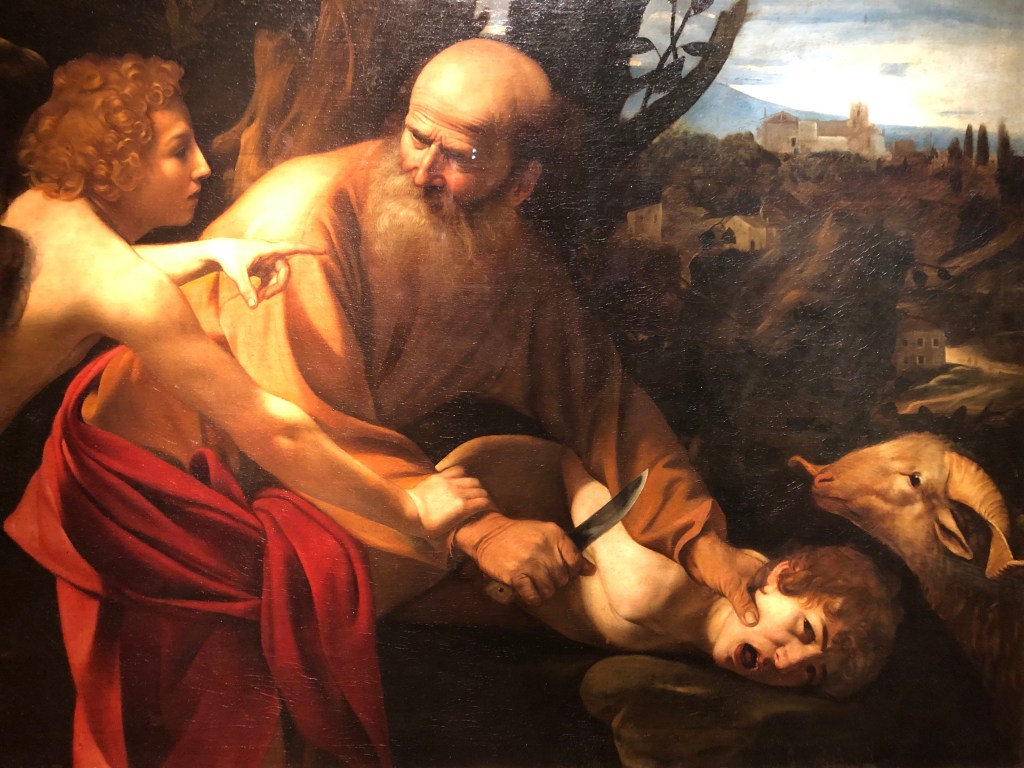
Sacrifice of Isaac, Caravaggio (1603), Uffizi Gallery, Florence

But first, why does Jesus give this woman such a hard time?  She comes to him obviously in distress because of a suffering child, the sort of situation we’ve seen Jesus handle with great compassion before, and first he gives her the silent treatment.  Then it gets worse.  Then he tells her, “We don’t serve your kind here.”  If you cringed a little bit when you heard Jesus’ words this morning, you were hearing them correctly:  “It is not right to take the food of the children and throw it to the dogs.”  Does Jesus have an evil twin?

Continue reading “When God puts us to the test: homily for the twentieth Sunday of Ordinary Time”

Anguish for those who leave: homily for the 19th Sunday of Ordinary Time

Homily for the 19th Sunday in Ordinary Time (A)

In today’s second reading from the letter to the Romans, St. Paul expresses a heartfelt anguish that I am certain many of us here share.  I would wager that there’s not a person in this church who does not have a son or daughter, a brother or sister, perhaps a parent, someone dear to us who has left the Catholic faith.  In Romans, Paul speaks of his people, his Jewish brothers and sisters, the majority of whom have not followed Christ, with painful passion, his heart full of “great sorrow and constant anguish.”  He goes so far as to say, “I could wish that I myself were accursed and separated from Christ for the sake of my brothers.”  So even though it’s not a cheerful topic, the problem of loved ones who have left the faith is one we can’t avoid, one most of us know firsthand.  I do too. 

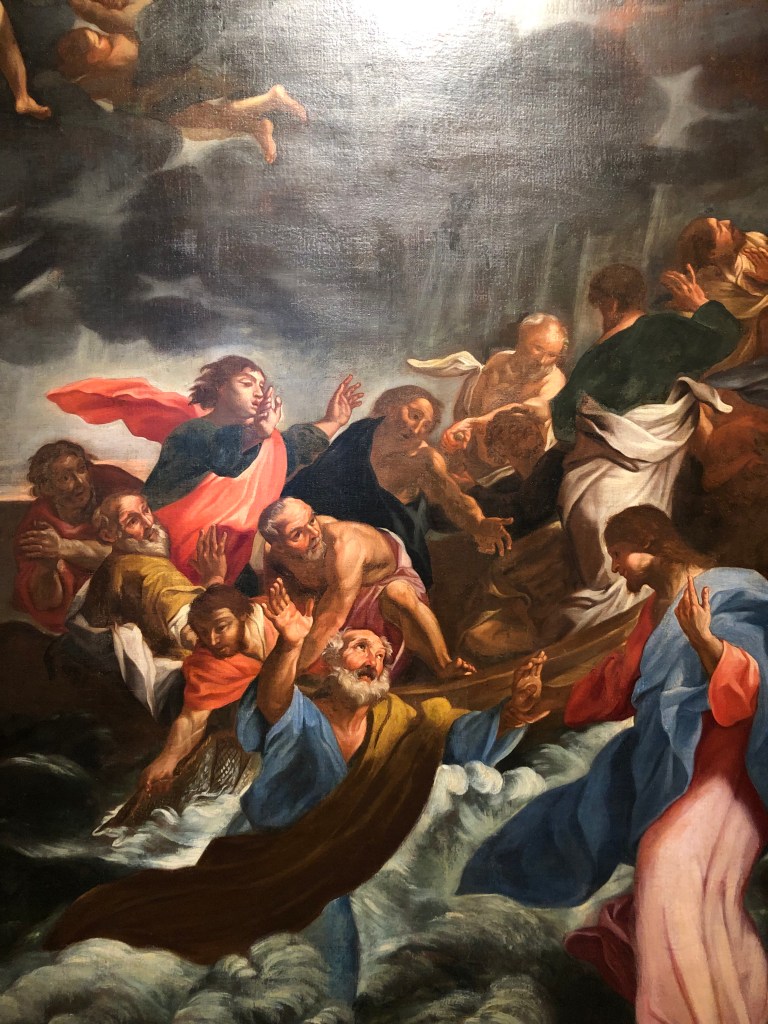
St. Peter Walking Upon the Water, circle of Giacinto Brandi (1600s), New Norcia, Australia

First, a caution.  Some time ago, I agreed to give a friend a ride to the dentist.  He was having major work done and was going to be given some powerful anesthesia and wasn’t allowed to drive.  I didn’t know where the office was, but I thought, “No problem, he’ll give me directions.”  The problem was he had to take one of the pills the dentist prescribed before the appointment, so when I got there to pick him up he was already floating in blissful never-never land.  We got into the car and I asked him where to go, and he said, “I don’t care.  You can take me wherever you want.  You can take me to a bar.”  Eventually, we got to the dentist.  But the point is he didn’t feel any pain because he’d taken a happy pill.  Now I will be honest:  I’m not going to give you a happy pill.  There are theological happy pills out there and plenty of priests and theologians who will give them to you.  The problem is, they aren’t true.  If they were true, Paul wouldn’t feel anguish and sorrow.

Continue reading “Anguish for those who leave: homily for the 19th Sunday of Ordinary Time”

The Transfiguration and previews for the main event: homily for the Feast of the Transfiguration

Homily for the Transfiguration of the Lord (A)

At the end of today’s Gospel reading, Jesus tells Peter, James, and John to keep a secret.  A Jesuit friend once wisely observed, “Most people can keep secrets.  It’s the people they tell who can’t.”

This is just one of a number of times throughout his public ministry when Jesus asks his disciples not to tell people about the miracles they’ve seen.  Since Jesus is constantly urging us to spread the Good News, this seems strange.  Why would Jesus not want stories of his miracles to spread?  

I suspect that Jesus does not want these miracles to distract from his mission.  The miracles that we read about in the Gospels that stick with us and we love so much—the healing of the paralytic, the wedding at Cana, the healing of the man born blind, the raising of Lazarus—show Jesus’ compassion and his power, but they are nothing compared to the transformation that Jesus works through the cross.  When, for example, Jesus raises Lazarus from the dead, Lazarus will die again.  But when Jesus rises after being crucified, he opens for us a new life, a new way of being, that will never end.  

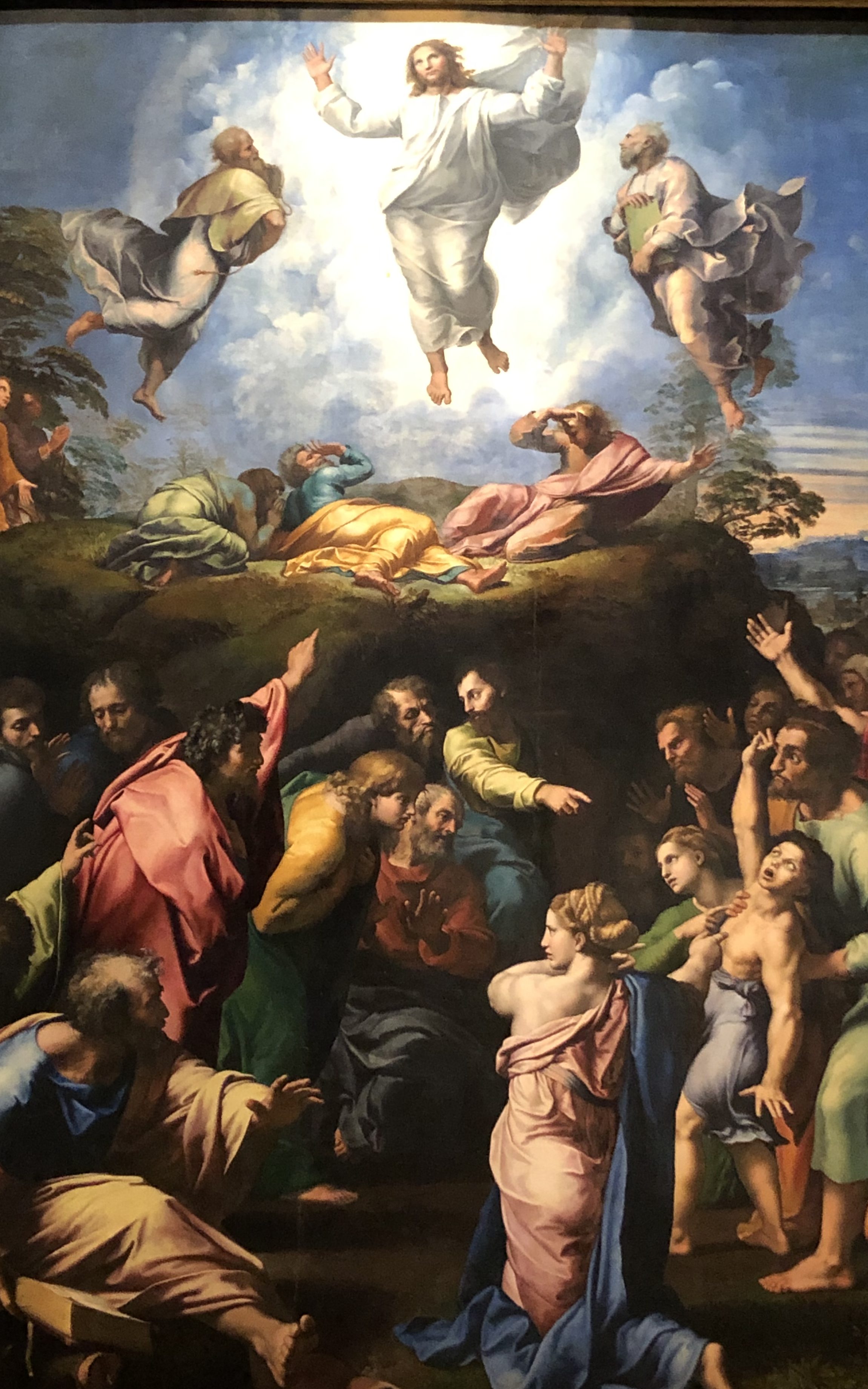
The Transfiguration, Raphael (1520), Vatican Museums

The miracles that Jesus performs before his death and resurrection—and I’d include today’s feast, the Transfiguration as one—are like the previews they show in movie theaters before the feature film.  Jesus doesn’t want us to get so excited by the pictures of popcorn and soft drinks that we run out to the concession stand and forget about the movie.  This is not to say that we should fast forward through first part of the Gospel.  But we can’t stop halfway through; we can never be followers of Christ if we stop before the cross.  

Continue reading “The Transfiguration and previews for the main event: homily for the Feast of the Transfiguration”