Do we still desire holiness? Homily for the Feast of All Saints and Blesseds of the Society of Jesus

November 5 is a special feast day on the Jesuit liturgical calendar–the Feast of All Saints and Blesseds of the Society of Jesus, a kind of All Saints Day for Jesuits. Five years ago, in 2020, at the height of the pandemic, I celebrated Mass in our formation community in Rome on that day. The homily, translated into English, is below.

We need saints.

Today more than ever, I feel this need. In these days of isolation, loneliness, anxiety, and disillusionment, we need companions. We need to know that we are not alone—even in the dark nights when we cannot sleep. And when we are confused, afraid, full of doubts, we need companions who have experienced confusion, opposition, doubt, sin and penance, and yet have come to peace.

Today we celebrate the great consolation that we have such companions. As Jesuits, we celebrate the fact that among all the saints recognized by the Church, there are many who made the same choice we have made, who prayed as we pray–who have, we might say, eaten with us in the refectory. As Moses says of the word of God, these companions are not across the sea but are near to us. In the long winter we are experiencing, we need only open our mouths in prayer, and these companions will be present at our side.

Church of St. Ignatius (ceiling), Rome

Today we remember not only the great names—Robert Bellarmine, who cheers us on in our studies, and Francis Xavier, who reminds us that our studies are only a means to spread the Gospel. Among these heavenly friends, there are many less famous ones, perhaps even some companions we have known in this life who are now in the Father’s house.

Every year when we reach the second half of Ordinary Time and volume four of the breviary, I find the holy card of Bob Araujo, a Jesuit who taught me in Chicago and greatly encouraged me in my studies and advised me during some doubtful moments of my formation. Bob suffered quite a bit in his life, first, from opposition in his career and, then, from a slow and painful cancer. He died in October 2015. When he died, the words of St. Paul came to mind: “I have fought the good fight; I have finished the race; I have kept the faith.” When he died, another companion said to me, “He’ll get right in.” Now I talk to Bob from time to time, and I ask him, “What do you think? How am I doing? Do you have any advice for me?” I imagine you also have such companions.

But when we talk about saints and Jesuit saints, I must admit that there is also something that disturbs me, just as there is something that disturbs us in the Gospel passage chosen for this feast: “Whoever loves his life loses it, and whoever hates his life in this world will preserve it for eternal life.”

Continue reading “Do we still desire holiness? Homily for the Feast of All Saints and Blesseds of the Society of Jesus”

The Holy Name of Jesus – and the Society that bears it

In the liturgical calendar of the Society of Jesus, January 3 is the Solemnity of the Holy Name of Jesus, our titular feast. Toward the end of his life, the great American Jesuit theologian Avery Dulles gave a lecture entitled “The Ignatian Charism at the Dawn of the Twenty-First Century,” which I think is as relevant today as it was nearly two decades ago. Dulles’s gift as a theologian was to clarify complex issues and get at the heart of the matter. The talk can be found in the collection of Dulles’s McGinley Lectures given at Fordham, Church and Society. Here are the final three paragraphs in which Dulles reflects on the Jesuit charism today:

“The Society can be abreast of the times if it adheres to its original purpose and ideals. The term Jesuit is often misunderstood. Not to mention enemies for whom Jesuit is a term of opprobrium, friends of the Society sometimes identify the term with independence of thought and corporate pride, both of which Saint Ignatius deplored. Others reduce the Jesuit trademark to a matter of educational techniques, such as the personal care of students, concern for the whole person, rigor in thought, and eloquence of expression. These qualities are estimable and have a basis in the teaching of Saint Ignatius. But they omit any consideration of the fact that the Society of Jesus is an order of vowed religious in the Catholic Church. They are bound by special allegiance to the pope, the bishop of Rome. And above all, it needs to be mentioned that the Society of Jesus is primarily about a person: Jesus, the Redeemer of the world. If the Society were to lose its special devotion to the Lord (which, I firmly trust, will never happen) it would indeed be obsolete. It would be like salt that had lost its savor.

“The greatest need of the Society of Jesus, I believe, is to be able to project a clearer vision of its purpose. Its members are engaged in such diverse activities that its unity is obscured. In this respect the recent popes have rendered great assistance. Paul VI helpfully reminded Jesuits that they are are religious order, not a secular institute; that they are a priestly order, not a lay association; that they are apostolic, not monastic, and that they are bound to obedience to the pope, not wholly self-directed.

“Pope John Paul II, in directing the Jesuits to engage in the new evangelization, identified a focus that perfectly matches the founding idea of the Society. Ignatius was adamant in insisting that it be named for Jesus, its true head. The Spiritual Exercises are centered on the Gospels. Evangelization is exactly what the first Jesuits did as they conducted missions in the towns of Italy. They lived lives of evangelical poverty. Evangelization was the sum and substance of what Saint Francis Xavier accomplished in his arduous missionary journeys. And evangelization is at the heart of all Jesuit apostolates in teaching, in research, in spirituality, and in the social apostolate. Evangelization, moreover, is what the world most sorely needs today. The figure of Jesus Christ in the Gospels has not lost its attraction. Who should be better qualified to present that figure today than members of the Society that bears his name?”

Avery Cardinal Dulles, S.J.

November 29, 2006

Homily for the Feast of St. Ignatius

The feast of St. Ignatius was back in July, of course, but I thought the reflections on discernment in my homily might be helpful in any season. Last year, I was asked for some thoughts on the process of communal discernment used by the Synod on Synodality. These reflections build on those observations.

Inigo the Pilgrim (2017), Church of St. Ignatius, Norwood, South Australia

You might have had the experience of the warning light on your dashboard coming on while you’re driving, signaling that you are low on gas, near the minimum.  Here in South Dakota especially–where outside of the city gas stations can be few and far between–you don’t want to fall below that minimum.  You might end up out in the cold or in this merciless heat—both dangerous circumstances—and in need of a good Samaritan to rescue you.

If you keep your tank filled, however, and don’t fall below the minimum, you can drive wherever you like.  You just plug the destination into the GPS and go.

The warning light and the GPS are both helpful, but they serve different functions—the warning light tells us not to drop below the minimum and the GPS gives us directions.  The readings for today’s feast of St. Ignatius, I think, point to a way of living the Christian faith that goes beyond the minimum.

If we think about the commandments, they are very useful for giving us the minimal rules of the road necessary to avoid an accident or a breakdown by the roadside. Because of this function, most of the commandments are written in a negative form—“Thou shall not…”  Even those that aren’t prohibitions—“Keep holy the Sabbath” and “Honor thy father and mother”—set a minimum of necessary behaviors.  Sunday Mass is the minimum necessary worship if we are to do justice to God, and fulfilling our family duties is the minimum necessary social obligation if we’re to maintain a functional social harmony.

But just doing the minimum isn’t enough to live a fulfilling life or to live a life of discipleship.  If I put on my to-do list for tomorrow, “Don’t kill anyone, don’t commit adultery, don’t steal,” I’ll end up rather bored.  The minimum tells us what to avoid, but not much of what to do.

Continue reading “Homily for the Feast of St. Ignatius”

Popular piety and tradition in Sardinia

I was fortunate this year to have spent Holy Week and Easter in Maracalagonis, Sardinia, a small town about a 20 minute drive from the center of Cagliari. It was a good break from the classroom and a wonderful taste of parish life.

Chiesa della Santa Vergine degli Angeli, Maracalagonis, Sardinia

The religious atmosphere I experienced was both warm and traditional. Masses were full; I heard confessions all week long; I met deeply committed Catholic families. I was especially impressed by the enthusiasm for traditional popular devotions. Teams of parishioners take responsibility for organizing different devotions throughout the year. Of particular note during Holy Week were the su Scravamentu, in which the nails are removed from the Lord’s hands and feet and he is taken down from the Cross after the Good Friday liturgy, and the many processions through the town streets–Stations of the Cross, Palm Sunday, Holy Thursday, the Sorrows of Mary on Good Friday, and then the S’Incontru on Easter morning.

Continue reading “Popular piety and tradition in Sardinia”

Praying for confusion

Church of St. Ignatius, Rome

One of the more puzzling turns of phrase in the Spiritual Exercises comes early in the First Week when St. Ignatius directs the person making the Exercises to ask God for “shame and confusion” for one’s sins (48). Shame I get; we ought to feel ashamed for our sins. If we say someone has no sense of shame, it means his conscience isn’t working. But confusion?

Confusion seems to cut against the whole thrust of the Spiritual Exercises and, indeed, Ignatian discernment in general. Isn’t the whole point of doing the Exercises to see the world more clearly, to cut through the illusions thrown up by the Evil Spirit in order to make good decisions and then stick to those decisions with confidence? Confusion is what we feel when we’re lost.

Continue reading “Praying for confusion”

The Nativity scene at 800

Santuario Francescano del Presepe, Greccio

A few weeks before Christmas in the year 1223, St. Francis told one of his brothers that he wished to celebrate the holiday in Greccio, a hamlet about halfway between Assisi and Rome. He added something more: that he wanted to see with his own eyes the baby born in Bethlehem and the crude stable where he lay.

The brother went on ahead and arranged everything as the saint had asked in a little grotto just outside the town, a scene now familiar to us–figures of Mary and Joseph, the shepherds, the ox and the ass. The sight drew men and women from around Greccio and delighted Francis, who served as a deacon at Mass that Christmas night. The tradition of the Christmas manger scene was born.

It’s a tradition that thrives all over the world, but especially in Italy. It’s also an example of what is known to theologians as “inculturation,” the way the Gospel enters into different cultures and finds ever-new expression in their traditions. The traditional Nativity scenes of Italy, especially Naples, often include dozens, even hundreds, of figures going about the tasks of daily life–shopkeepers, bakers, fruit vendors, beggars, musicians, servants, housewives, children, farmers, you name it. Dress and architecture in the scenes reflect the daily life of those who create them.

Continue reading “The Nativity scene at 800”

Gargoyles, east and west

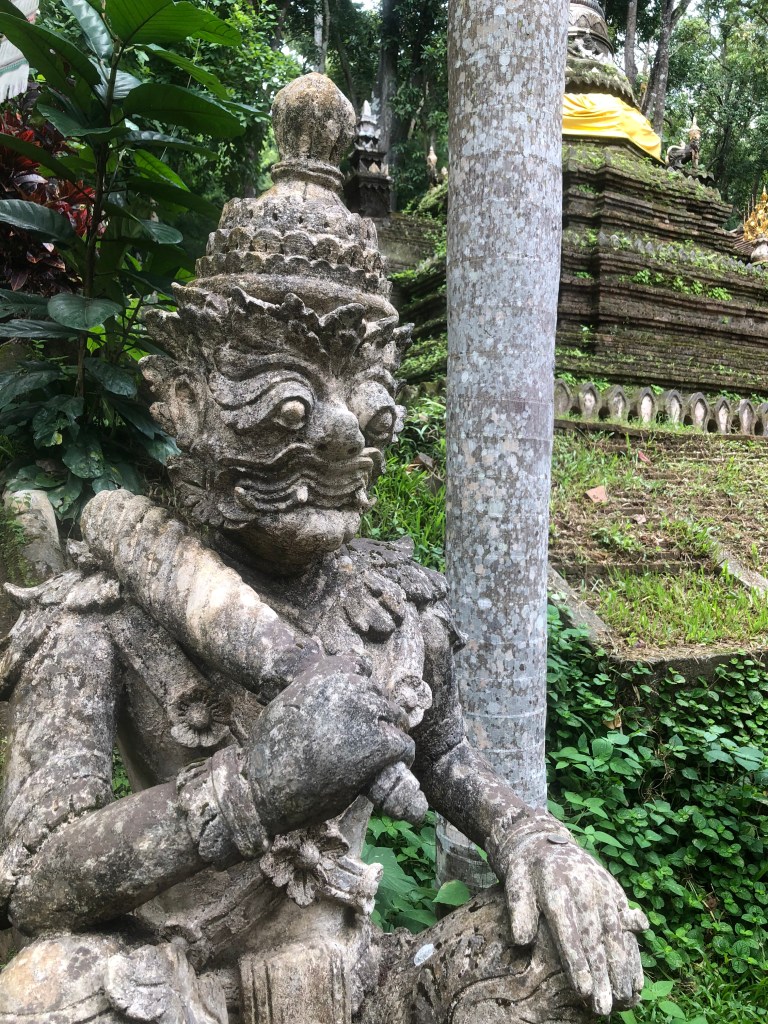
Wat Pha Lat, Chiangmai, Thailand

One of the highlights of my recent travels through Asia was visiting a number of quite impressive Buddhist temples and shrines. This was particularly the case in Thailand, though Chinese temples in Singapore, Taiwan, and Hong Kong were also filled with rich carvings, colorful statues, and piles of offerings including fruit, flowers, and burning incense. The warm red–the color of prosperity–of the Chinese temples reminded me of the red color with which the ancient Romans frescoed the inside of their homes. The desire for a warm hearth is written deeply in the human psyche.

Thian Hock Keng Temple, Singapore

A place of worship that makes an absorbing appeal to the senses is of course nothing new to me. I live in Rome, city of the baroque, where tales of religious ecstasy are told and retold in marble, mosaic, and fresco. The impulse of Christianity to express itself in art goes back to the Incarnation itself, to God revealing himself by entering into the world of the flesh, expressing his divinity in the matter of creation. We Catholics believe that he continues to communicate his grace to us through the sacraments. Artistic expressions using color, smell, and sound to amplify this divine work come naturally enough to a sacramental faith.

But what about Buddhism? Such expressions would seem to me, an outsider, to fit less naturally within Buddhist philosophy, with its distrust of all desire and negation of the world of pleasure and pain. Incarnation and Nirvana are two radically different beliefs. Yet how else to describe the gilded wats of Thailand, the cascades of angels and demons in glittering ceramic, than Buddhist baroque?

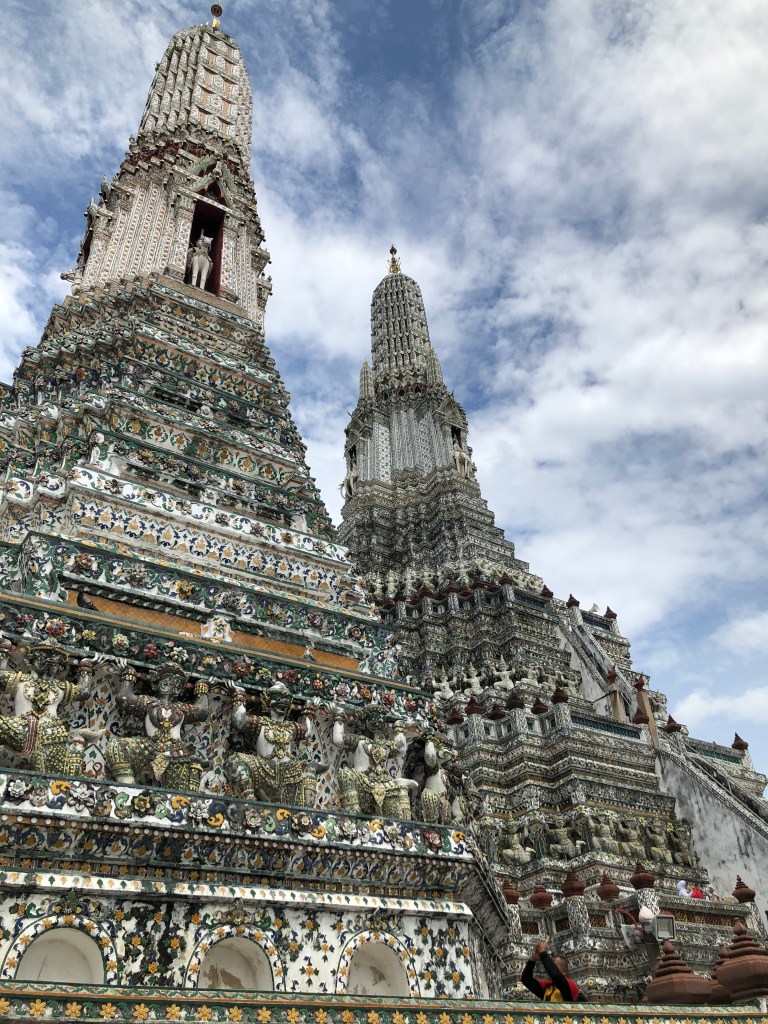
Wat Arun Ratchawaramahawihan, Bangkok

Of course, Thailand’s wats are not the architectural expression of pure Buddhist philosophy but a kind of non-culinary Asian fusion–Buddhism grafted into a still older mix of traditional folk beliefs, legends, and superstitions. How cogent such a mix is, I can’t evaluate. But there’s something human about that folk mix that I find more compelling than Buddhism in its purity, which I’ve always thought a little chilly.

Continue reading “Gargoyles, east and west”

The Spiritual Exercises in South Australia

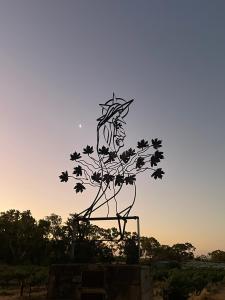
Our Lady of the Vines, Sevenhill, Australia

It is hard to know what to say to those who ask about one’s experience of the 30-day Spiritual Exercises of St. Ignatius Loyola. The experience is profound, intense, and deeply personal. It is also experience, not knowledge or information that can be transferred to another. To be sure, the retreat does have objective content–the life of Christ, God’s creation of the world, the moral law. It is not just a process for personal growth; it is an encounter with the Son of God who revealed himself in first century Palestine, who we know through the accounts that his followers handed on to the Church. Fundamentally, the content of the retreat is simply Christianity, nothing more and nothing less.

That said, the experience of encountering that content varies from person to person. We can either look at Jesus from a distance or approach him, talk to him, get to know him. The Spiritual Exercises are a way of getting to know him–spending time with God with other distractions removed, recognizing God’s work in our lives up to this point, discovering his hopes for us. Like meeting your future spouse or holding a newborn child for the first time, you can describe what happened, but the experience itself can never be fully captured in words. Spending thirty days getting to know Jesus more deeply in prayer is a similarly ineffable experience.

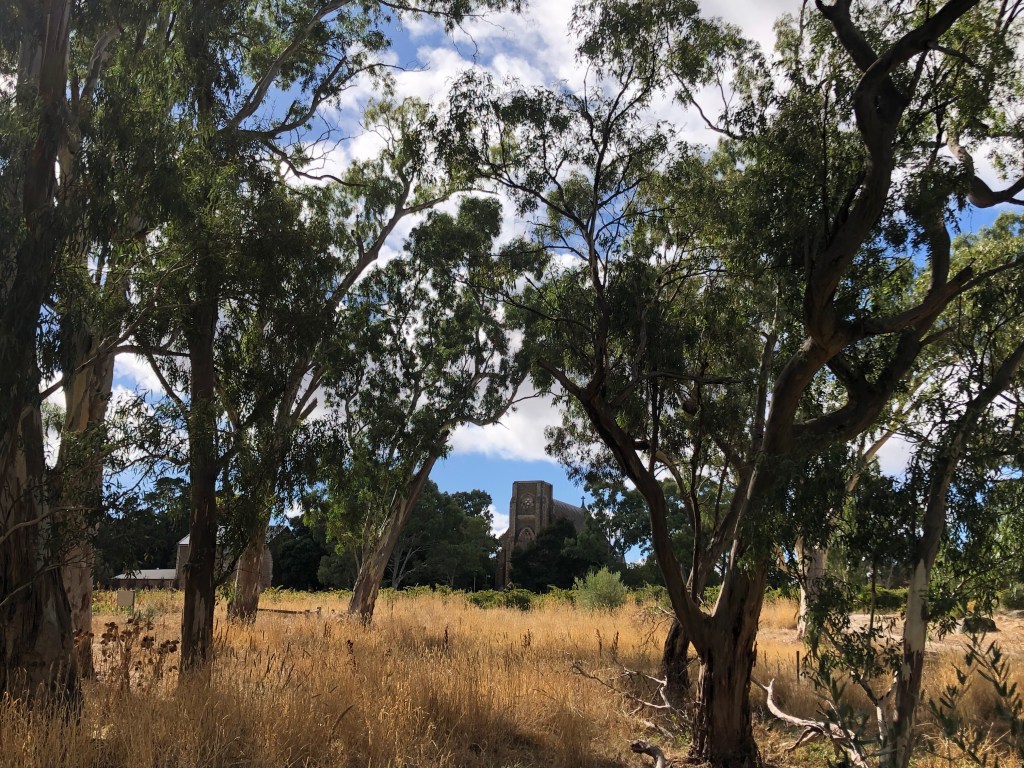
St. Aloysius Church, Sevenhill

Of course, some aspects of the retreat can be more easily shared, and I thought I’d start with one that might seem secondary but isn’t–the location. Christianity is an embodied, incarnational religion that acknowledges the influence of where we are on who we are. During the Spiritual Exercises St. Ignatius frequently invites us to begin by imagining the places where Jesus lived, “the synagogues, villages, and towns” where he preached or the hills and valleys between Nazareth and Bethlehem. Even on an interior journey, location matters.

Continue reading “The Spiritual Exercises in South Australia”

First principle for Lent… and for life

Tomb of St. Ignatius, Church of the Gesù, Rome

Ash Wednesday is once again upon us. This year my Lent will be mostly taken up with doing, for the second time in my life, the 30-day Spiritual Exercises of St. Ignatius Loyola. So I’ll be off-line and in silence until Holy Week.

As a consideration for the beginning of Lent, then, I thought I’d offer the principle St. Ignatius places at the beginning of the Spiritual Exercises, what he calls the “First Principle and Foundation”. It’s his way of expressing the truth of the First Commandment: nothing else is as important as right relationship with God, and we should never allow anything else to take God’s place. The value of all the other goods we encounter in this life is entirely relative to whether they help us grow closer to God. In fact, if anything damages or gets in the way of our relationship with God, it is no longer good.

That’s all straightforward enough in theory, but Ignatius gives the consideration a specificity that bites. Giving concreteness to this principle is where the hard work of putting our lives in the right order begins. And that, I suppose, is what Lent is about–giving God his rightful place at the center of our lives.

Here is how Ignatius puts it, and the words I’ll leave you with until Easter… In the meantime, please pray for me as I make my retreat!

FIRST PRINCIPLE AND FOUNDATION

Man is created to praise, reverence, and serve God our Lord, and by this means to save his soul. 

The other things on the face of the earth are created for man to help him in attaining the end for which he is created.  

Hence, man is to make use of them in as far as they help him in the attainment of his end, and he must rid himself of them in as far as they prove a hindrance to him.

Therefore, we must make ourselves indifferent to all created things, as far as we are allowed free choice and are not under any prohibition. Consequently, as far as we are concerned, we should not prefer health to sickness, riches to poverty, honor to dishonor, a long life to a short life. The same holds for all other things.

Our one desire and choice should be what is more conducive to the end for which we are created.